The Invention of Paris: A History in Footsteps
by Eric Hazan
On This Page
Description
The Invention of Paris is a tour through the streets and history of the French capital under the guidance of radical Parisian author and publisher Eric Hazan. Hazan reveals a city whose squares echo with the riots, rebellions and revolutions of the nineteenth and twentieth centuries. Combining the raconteur's ear for a story with a historian's command of the facts, he introduces an incomparable cast of characters: the literati, the philosophers and the artists—Balzac, Baudelaire, Blanqui, show more Flaubert, Hugo, Maney, and Proust, of course; but also Doisneau, Nerval and Rousseau. It is a Paris dyed a deep red in its convictions. It is haunted and vitalized by the history of the barricades, which Hazan retells in rich detail. The Invention of Paris opens a window on the forgotten byways of the capital's vibrant and bloody past, revealing the city in striking new colors. show lessTags
Recommendations






























Member Reviews
Hazan takes the reader on a tour of Paris across time and space, blending psychogeography and history with great panache. I have a longstanding fondness for Paris and its revolutionary upheavals, so found this fascinating. Hazan’s narrative is dense with references and quotations, which reignited my interest in 19th century French literature. (I still haven’t read any Proust and hardly any Balzac, etc.) The book is structured in three parts, the first and longest a geographical tour of Paris Old and New. It doesn’t matter whether you’re familiar enough with the city to follow this on a map, Hazan carries you along with a very evocative account of the roads, structures, and people that have made Paris over the centuries.
This is show more followed by section titled ‘Red Paris’ with a narrower focus on the revolution of 1848 that established the second republic. I wasn’t very familiar with the events of 1848 in Paris specifically, having mainly read about them in a wider context (Hobsbawm’s [b:The Age of Revolution: 1789-1848|550840|The Age of Revolution 1789-1848|Eric Hobsbawm|https://images.gr-assets.com/books/1401886118s/550840.jpg|538083] and Gildea’s [b:Children of the Revolution: The French, 1799-1914|3390601|Children of the Revolution The French, 1799-1914|Robert Gildea|https://images.gr-assets.com/books/1347671569s/3390601.jpg|3430468]). This section was therefore the highlight for me, as it demonstrated how the brutal suppression of a worker uprising prefigured the Commune two decades later. Hazan also links it with the 1851 coup d’etat and sees 1848 as the point of schism between the bourgeoisie and proletariat, who had managed a sometimes uneasy solidarity since 1789. Hazan skillfully conveys that the revolutionary ferment in Paris during the 19th century is literally inscribed in its streets, whose layout and names have changed as empire, monarchy, and republic succeeded one another. This is of course part of why Paris is so interesting. The tone here is sympathetic, which I approve of.
In the third section of the book, the artists, writers, and in particular photographers of the city become the focus, as their works cannot be separated from the locales and times in which they lived. In particular, the discussion of Baudelaire and Manet reminded me of how much contextual information and nuance we miss today when reading or looking at 19th century artworks. Ridiculous as the comparison might seem, there is a similarity with internet memes. These rely on often quite obscure and detailed references to arouse an amused response. The turnover of images might be much faster these days, but it’s telling that Manet evoked vehement emotional responses with pictures that seem entirely innocuous today. Moreover, the political symbols now used on the internet owe something to Dada and the Surrealist photography of early 20th century Paris.
As with Hazan’s [b:A People's History of the French Revolution|20177066|A People's History of the French Revolution|Eric Hazan|https://images.gr-assets.com/books/1410801093s/20177066.jpg|28031932], I found the frequent quotations and references gave the narrative an appealing texture and depth. Nonetheless, Hazan’s own words are equally striking and pull everything together well. I especially liked this comment near the end:
Hazan’s love for Paris and deep familiarity with it suffuse the whole book. After reading it, I feel as though I’ve walked the Parisian streets with him, peering back through the centuries to glimpse odd and sometimes hilarious details as well as tragedy, misery, and the sublime. show less
This is show more followed by section titled ‘Red Paris’ with a narrower focus on the revolution of 1848 that established the second republic. I wasn’t very familiar with the events of 1848 in Paris specifically, having mainly read about them in a wider context (Hobsbawm’s [b:The Age of Revolution: 1789-1848|550840|The Age of Revolution 1789-1848|Eric Hobsbawm|https://images.gr-assets.com/books/1401886118s/550840.jpg|538083] and Gildea’s [b:Children of the Revolution: The French, 1799-1914|3390601|Children of the Revolution The French, 1799-1914|Robert Gildea|https://images.gr-assets.com/books/1347671569s/3390601.jpg|3430468]). This section was therefore the highlight for me, as it demonstrated how the brutal suppression of a worker uprising prefigured the Commune two decades later. Hazan also links it with the 1851 coup d’etat and sees 1848 as the point of schism between the bourgeoisie and proletariat, who had managed a sometimes uneasy solidarity since 1789. Hazan skillfully conveys that the revolutionary ferment in Paris during the 19th century is literally inscribed in its streets, whose layout and names have changed as empire, monarchy, and republic succeeded one another. This is of course part of why Paris is so interesting. The tone here is sympathetic, which I approve of.
In the third section of the book, the artists, writers, and in particular photographers of the city become the focus, as their works cannot be separated from the locales and times in which they lived. In particular, the discussion of Baudelaire and Manet reminded me of how much contextual information and nuance we miss today when reading or looking at 19th century artworks. Ridiculous as the comparison might seem, there is a similarity with internet memes. These rely on often quite obscure and detailed references to arouse an amused response. The turnover of images might be much faster these days, but it’s telling that Manet evoked vehement emotional responses with pictures that seem entirely innocuous today. Moreover, the political symbols now used on the internet owe something to Dada and the Surrealist photography of early 20th century Paris.
As with Hazan’s [b:A People's History of the French Revolution|20177066|A People's History of the French Revolution|Eric Hazan|https://images.gr-assets.com/books/1410801093s/20177066.jpg|28031932], I found the frequent quotations and references gave the narrative an appealing texture and depth. Nonetheless, Hazan’s own words are equally striking and pull everything together well. I especially liked this comment near the end:
If it is true, as Michelet put it, that each epoch dreams the following one, it is even more clear that each epoch lives in nostalgia for its predecessor, above all in a period when this sentiment, promoted like washing powder, fits marvellously into an ideological scaffolding, the strategy of ‘ends’ - of history, of the book, of art, of utopias. Turbulent Paris is on this list of programmatic ‘ends’, which does not prevent the necessary measures being taken to conjure away those spectres that some people fear, not without reason, will return to haunt their streets.
Hazan’s love for Paris and deep familiarity with it suffuse the whole book. After reading it, I feel as though I’ve walked the Parisian streets with him, peering back through the centuries to glimpse odd and sometimes hilarious details as well as tragedy, misery, and the sublime. show less
This book is not for everyone, but for those interested in revolutionary history or the way that social forces shape, and are shaped by, urban geography, this is wonderful. Hazan’s rich and detailed knowledge of the history of Paris gives the reader a deep understanding of how a city develops, how each neighbourhood keeps (or doesn’t keep) its unique character and social context. Hazan describes, for example, the impact of diverse factors such as street lighting, the royal promenade, the need for railways to find a level access to the city (I always wondered why the Gare du Nord and the Gare de l'Est were so close), and sales tax policy.
The book is in three main parts that are not linked to each other except by reference to the show more same regions. It seems to be a collection of essays by Hazan on different themes relating to Paris. The longest section describes each arrondissment, and the next situates the nineteenth century revolutions in specific parts of Paris. The third reflects on the literary and visual heritage of the city. Each has a different appeal, although I found the first two of greatest interest.
Especially rich is Hazan’s frequent quotation of the descriptions by social and literary figures of the melieu in which they lived and worked. They add imagery and a sense of the atmosphere (very dark and dirty in most of the city until the twentieth century) that will certainly colour my own appreciation of Paris when I next visit or read about the city.
This isn’t a tourist guide, although it provides a street-by-street view of many neighbourhoods that would illuminate many walks through the city. Reading it, I found many sections were much easier to follow with Google maps handy, so I could search for the street references. Even better, I could go into Street View, and look at the intersections or lanes that he describes.
Hazan writes from the perspective of a social revolutionary, so his acidic comments on the bourgeoisie of the nineteenth century or the governments of the most recent decades are strong and entertaining. (He refuses to call the Centre Pompidou by its name, preferring to call it the Centre Beaubourg after the neighbourhood that was flattened to build it.) If you are sympathetic to his point of view, this will add an entertaining quirkiness to his text – otherwise, it will likely come across as opinionated and irritating. Tant pis, as the French say. I spent many pleasurable evenings reading through the book and thinking about the city. show less
The book is in three main parts that are not linked to each other except by reference to the show more same regions. It seems to be a collection of essays by Hazan on different themes relating to Paris. The longest section describes each arrondissment, and the next situates the nineteenth century revolutions in specific parts of Paris. The third reflects on the literary and visual heritage of the city. Each has a different appeal, although I found the first two of greatest interest.
Especially rich is Hazan’s frequent quotation of the descriptions by social and literary figures of the melieu in which they lived and worked. They add imagery and a sense of the atmosphere (very dark and dirty in most of the city until the twentieth century) that will certainly colour my own appreciation of Paris when I next visit or read about the city.
This isn’t a tourist guide, although it provides a street-by-street view of many neighbourhoods that would illuminate many walks through the city. Reading it, I found many sections were much easier to follow with Google maps handy, so I could search for the street references. Even better, I could go into Street View, and look at the intersections or lanes that he describes.
Hazan writes from the perspective of a social revolutionary, so his acidic comments on the bourgeoisie of the nineteenth century or the governments of the most recent decades are strong and entertaining. (He refuses to call the Centre Pompidou by its name, preferring to call it the Centre Beaubourg after the neighbourhood that was flattened to build it.) If you are sympathetic to his point of view, this will add an entertaining quirkiness to his text – otherwise, it will likely come across as opinionated and irritating. Tant pis, as the French say. I spent many pleasurable evenings reading through the book and thinking about the city. show less
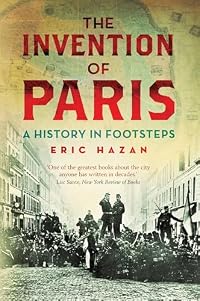
"The Invention of Paris is one of the greatest books about the city anyone has written in decades, towering over a crowded field, passionate and lyrical and sweeping and immediate." - Luc Sante, New York Review of Books Dec. 23, 2010
Knap werk, vooral door de belezenheid van de auteur; het boek is doorspekt met citaten uit vooral 19de eeuwse Franse klassiekers. In die zin brengt Hazan Parijs zeker tot leven, als een stad waar voortdurend en soms radicaal, niets ontziend aan getimmerd is. Naar mijn smaak ligt er net iets teveel melancholie naar het vroegere Parijs in, maar welk Parijs dan?, dat van de revoluties, dat van voor Haussmann, of dat van de jaren 50 van de twintigste eeuw (jeugdjaren van de auteur)? Ook als introductie tot de Franse hoofdstad is dit werk niet geschikt: het vergt teveel voorkennis, gaat soms heel selectief om met het materiaal, en bevat weinig of geen kaartjes. Ik zag te laat dat dit oorspronkelijk in het Frans was gepubliceerd; nu heb ik show more het met de Engelse vertaling gedaan. show less
Ratings
Members
- Recently Added By
Author Information

26+ Works 913 Members
Eric Hazan is the founder of the publisher La Fabrique and the author of several books, including the highly acclaimed The Invention of Paris. He lives in Paris.
Some Editions
Awards and Honors
Common Knowledge
- Canonical title
- The Invention of Paris: A History in Footsteps
- Important places
- Paris, France
- Important events
- Paris Commune
Classifications
Statistics
- Members
- 259
- Popularity
- 124,653
- Reviews
- 4
- Rating
- (4.00)
- Languages
- 6 — Dutch, English, French, German, Italian, Portuguese (Portugal)
- Media
- Paper, Ebook
- ISBNs
- 13
- ASINs
- 3