On This Page
Description
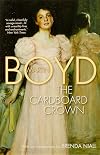
This remarkable novel, first published to a chorus of acclaim in 1952, is one of the lost classics of Australian literature. Martin Boyd is a deeply humane novelist, a writer of family sagas without peer. Set in Australia and England in the late nineteenth and early twentieth century, The Cardboard Crown presents an unforgettable portrait of an upper middle-class family who love both countries but are not quite at home in either. At the centre of this scintillating and immensely readable show more novel is Alice Verso, whose unexpected marriage to Austin Langton not only brings financial stability to the Langtons but founds an Anglo-Australian dynasty. But when her grandson finds her diaries and begins to uncover her story he chances on an intricate web of deception and reveals the complex fate of his family over three generations. show lessTags
Recommendations















Member Reviews
Stumbles a bit at the start, but the conceit--our narrator is convinced to tell the story of his family as mediated by his grandmother's diaries--is a very nice one, and once we get into the family story, the awkward flaws fall away. Then you're left with Evelyn Waugh (Brideshead style), or the early volumes of Powell's 'Dance to the Music of Time,' only in Australia.
"Austin understood much better le plaisir aristocratique which consists not as his guest had imagined in rudeness to someone whom it is safe to snub, but in a confidence so complete in one's own values that one affirms them clearly, indifferent to the fact that they are incompatible with the ideas of a bourgeois society, and the pleasure consists in seeing the bewilderment show more of a conventional mind, when faced with an idea too generous, or a taste too eclectic or even an honesty too obvious for its comprehension." show less
"Austin understood much better le plaisir aristocratique which consists not as his guest had imagined in rudeness to someone whom it is safe to snub, but in a confidence so complete in one's own values that one affirms them clearly, indifferent to the fact that they are incompatible with the ideas of a bourgeois society, and the pleasure consists in seeing the bewilderment show more of a conventional mind, when faced with an idea too generous, or a taste too eclectic or even an honesty too obvious for its comprehension." show less
This is the story of Alice Verso told through her grandson's discovery of her diary. From its pages half written in French he is able to uncover generations of intricate and complicated relationships. Alice marries into the Langton family and brings the clan financial stability. But, despite this Alice discovers her husband is having an affair with a childhood friend named Hetty. Told across three generations and bouncing between Australia and England everything about this story was strange. As a reader, I couldn't stay engaged with the story or the characters. There wasn't a single person I connected with or cared about. It was the kind of story I often lost place with - meaning, when I put it down I couldn't remember the last thing I show more read. show less
From the supremely talented Boyd family. The first in the Langton Quartet I read these books in high school and am revisiting them nearly 40 years later. The first is the story of Alice, grandmother to the fictional author and tells of her family's peripatetic lives. It is also an interesting look at early Melbourne. Loved the books in 1980, loved this now and will go on to read the rest in the series.
Ratings
Members
- Recently Added By
Author Information

23 Works 582 Members
Martin Boyd's major novels take Australia and Europe as settings to record the bihemispheric lives of those who until after World War II considered themselves Anglo-Australians, rather than just plain Australians, and spent more time at home in England than in their birthplace. Boyd started publishing in 1925, his first four novels appearing under show more pseudonyms. Six additional novels, published under his own name in the 1930s and in 1940, enjoyed modest success, but it was not until 1946, with the publication of Lucinda Brayford, that Boyd received international attention. A substantial work, Lucinda Brayford records the mundane life of the title character, who grows up in Melbourne as an aristocratic Anglo-Australian, then moves to London, where she is just a colonial. Although the book can be read as a social history that goes beyond World War II, its heroine also embodies Boyd's idea of the aristocratic principle. Through clinging to this concept, Lucinda, in spite of a ruined marriage and other defeats, manages to attain a kind of victory, in part spiritual and in part personal. Boyd's greatest achievement is the Langton Quartet, which appeared between 1952 and 1962: The Cardboard Crown (1952), A Difficult Young Man (1955), Outbreak of Love (1957), and When Blackbirds Sing (1962). Returning to the same autobiographical material that served so well in Lucinda Brayford, Boyd traces 80 years in the history of the Langtons, a thinly disguised version of his own Anglo-Australian family. The novels offer memorable characters and a strong evocation of time and place; they show the gradual disintegration of the Langtons as they forsake their aristocratic ideals for those of a modern bourgeois society. The Langton Quartet received attention in Australia and abroad, but even that soon faded. When Boyd died in genteel poverty in Italy, he and his work were largely forgotten. By then Australians shunned the prefix Anglo, striving instead in their fiction to establish a national identity separate from Great Britain. In recent years, however, there has been a revival of interest in Lucinda Brayford and the Langton Quartet, with international paperback editions appearing. Because of his archaic social attitudes and literary style, Boyd is not a fashionable novelist by modern standards. Yet he does accurately record an important part of the colonial experience. Boyd died in 1972. (Bowker Author Biography) show less
Series

Belongs to Publisher Series
Common Knowledge
- Original publication date
- 1952
- People/Characters
- Guy Langton
- First words
- 'When we have passed a certain age, the soul of the child that we were, and the souls of the dead from whom we spring, come and bestow upon us in handfuls their treasures and their calamities.'
Classifications
Statistics
- Members
- 122
- Popularity
- 268,360
- Reviews
- 4
- Rating
- (3.92)
- Languages
- English
- Media
- Paper, Ebook
- ISBNs
- 14
- ASINs
- 6