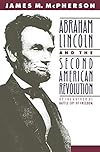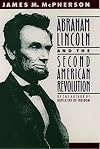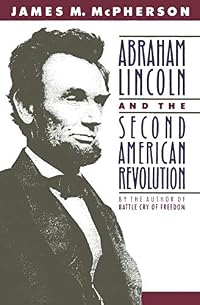
Abraham Lincoln and the Second American Revolution
by James M. McPherson
On This Page
Description
The main argument of this collection of essays is that Abraham Lincoln was the main catalyst of the American Civil War, a revolution with consequences as dramatic and far-reaching as the French Revolution. The author offers unusual perspectives on Lincoln's involvement in the war.Tags
Recommendations












Member Reviews
James McPherson (Battle Cry of Freedom) is the preeminent Civil War author and scholar of our time. The Princeton University professor provides fresh insight into A. Lincoln in these seven essays.
McPherson demonstrates conclusively that the Civil War was indeed the Second American Revolution - it abolished slavery and smashed the political, economic, and social status quo. Before the War, southerners dominated American politics - after the war it was decades before a son of the south could be elected President. The absence of the south from the national legislature during the war allowed the passage of the great progressive and modernizing legislation; the Homestead Act, enabled a continental railroad, and land-grant colleges. After show more the war, blacks made great (if far from complete) progress in education, politics, and economics.
Unfortunately, the reactionary forces led a counter-revolution that attempted to turn back the massive changes in society with much success. That counter-revolution eventually yielded to a Second Reconstruction in the mid-20th century.
McPherson repeatedly returns to Lincoln's political evolution as the War changed from a limited war for limited ends to a total war for revolutionary ends. In the end Lincoln insisted on unconditional surrender.
I particularly enjoyed the essays entitled 'How Lincoln Won the War with Metaphors', which contrasts the communication abilities of Lincoln and Jefferson Davis, and 'The Hedgehog and the Foxes', in which McPherson favors us with a description of Lincoln as the single-minded hedgehog outlasting the multifarious foxes such as Horace Greeley and William Seward.
My only small quibble is that similar points are made using the same quotes in multiple essays (perhaps unavoidable in a collection of previously published essays), but the quotes are so evocative of Lincoln's thinking that the repetition is not only forgiven, but enjoyed.
Highly recommended for anyone interested in US history, Lincoln, or the Civil War era. show less
McPherson demonstrates conclusively that the Civil War was indeed the Second American Revolution - it abolished slavery and smashed the political, economic, and social status quo. Before the War, southerners dominated American politics - after the war it was decades before a son of the south could be elected President. The absence of the south from the national legislature during the war allowed the passage of the great progressive and modernizing legislation; the Homestead Act, enabled a continental railroad, and land-grant colleges. After show more the war, blacks made great (if far from complete) progress in education, politics, and economics.
Unfortunately, the reactionary forces led a counter-revolution that attempted to turn back the massive changes in society with much success. That counter-revolution eventually yielded to a Second Reconstruction in the mid-20th century.
McPherson repeatedly returns to Lincoln's political evolution as the War changed from a limited war for limited ends to a total war for revolutionary ends. In the end Lincoln insisted on unconditional surrender.
I particularly enjoyed the essays entitled 'How Lincoln Won the War with Metaphors', which contrasts the communication abilities of Lincoln and Jefferson Davis, and 'The Hedgehog and the Foxes', in which McPherson favors us with a description of Lincoln as the single-minded hedgehog outlasting the multifarious foxes such as Horace Greeley and William Seward.
My only small quibble is that similar points are made using the same quotes in multiple essays (perhaps unavoidable in a collection of previously published essays), but the quotes are so evocative of Lincoln's thinking that the repetition is not only forgiven, but enjoyed.
Highly recommended for anyone interested in US history, Lincoln, or the Civil War era. show less
Interesting legal analysis of the insurgency, which technically was nothing but a rather large riot. Lincoln never, ever referred to "the Confederacy," and for good reason, too!
2378 Abraham Lincoln and the Second American Revolution, by James M. McPherson (read 14 Apr 1991) This is a book of seven essays. They are somewhat repetitious, but make good points about Lincoln and the meaning of the Civil War.
Ratings
Members
- Recently Added By
Lists

Lincoln
7 works; 4 members
Best Biographies of U.S. Presidents
61 works; 6 members

Tagged Civil War
16 works; 4 members

Biographies of American Presidents
39 works; 4 members
Author Information

67+ Works 16,497 Members
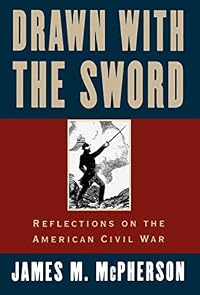
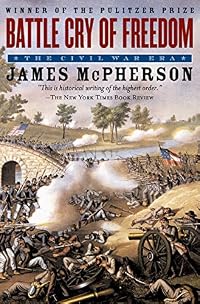
James M. McPherson is the author of Battle Cry of Freedom: The Civil War Era, which won a Pulitzer Prize in history, and For Cause and Comrades: Why Men Fought in the Civil War, a Lincoln Prize winner. He is the George Henry Davis Professor of American History at Princeton University in New Jersey, where he also lives. His newest book, entitled show more Abraham Lincoln, celebrates the 200th anniversary of Lincoln's birth with a short, but detailed look at this president's life. (Bowker Author Biography) James M. McPherson, McPherson was born in 1936 and received a Ph.D. from Johns Hopkins University in 1963. He began teaching at Princeton University in the mid 1960's and is the author of several articles, reviews and essays on the Civil War, specifically focusing on the role of slaves in their own liberation and the activities of the abolitionists. His earliest work, "The Struggle for Equality," studied the activities of the Abolitionist movement following the Emancipation Proclamation. "Battle Cry of Freedom" won the Pulitzer Prize for History in 1989. "Drawn With the Sword" (1996) is a collection of essays, with one entitled "The War that Never Goes Away," that is introduced by a passage from Abraham Lincoln's second inaugural address on March 4, 1865 from which its title came: "Fondly do we hope - and fervently do we pray - that this mighty scourge of war may speedily pass away. Yet, if God wills that it continue, until all the wealth piled by the bond-man's two hundred and fifty years of unrequited toil shall be sunk, and until every drop of blood drawn with the lash, shall be paid by another drawn with the sword, as was said three thousand years ago, so still it must be said, 'the judgments of the Lord, are true and righteous altogether.'" "From Limited to Total War: 1861-1865" shows the depth of the political and social transformation brought about during the Civil War. It told how the human cost of the Civil War exceeded that of any country during World War I and explains the background to Lincoln's announcement of the Emancipation Proclamation, in 1862. The book also recounts the exploits of the Fifty-fourth Massachusetts Volunteer Infantry, one of the first black regiments organized in the Civil War, and their attack on Fort Wagner in July 1863. It pays tribute to Robert Gould Shaw, the white commanding officer of the regiment, who died in the attack and was buried in a mass grave with many of his men. Professor McPherson's writings are not just about the middle decades of the nineteenth century but are also about the last decades of the twentieth century. The political turmoil prior to the Civil War, the violence of the war, Lincoln's legacy and the impeachment of Andrew Johnson shed some light on contemporary events. (Bowker Author Biography) show less
Awards and Honors
Notable Lists
Common Knowledge
- Canonical title
- Abraham Lincoln and the Second American Revolution
- Alternate titles
- Abraham Lincoln & the second American Revolution
- Original publication date
- 1991
- People/Characters
- Abraham Lincoln
- Important places
- USA
- Important events
- American Civil War (1861 | 1865)
Classifications
- Genres
- History, Nonfiction, General Nonfiction, Biography & Memoir
- DDC/MDS
- 973.7 — History & geography History of North America United States Administration of Abraham Lincoln, 1861-1865 Civil War
- LCC
- E457.2 .M4758 — History of the United States United States Civil War period, 1861-1865 Lincoln's administrations, 1861-April 15, 1865
- BISAC
Statistics
- Members
- 573
- Popularity
- 51,129
- Reviews
- 3
- Rating
- (3.98)
- Languages
- English
- Media
- Paper, Ebook
- ISBNs
- 6
- ASINs
- 6