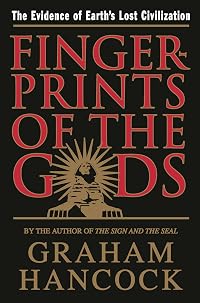
On This Page
Description
Could the story of mankind be far older than we have previously believed? Using tools as varied as archaeo-astronomy, geology, and computer analysis of ancient myths, Graham Hancock presents a compelling case to suggest that it is. "A fancy piece of historical sleuthing . . . intriguing and entertaining and sturdy enough to give a long pause for thought."--Kirkus Reviews In Fingerprints of the Gods, Hancock embarks on a worldwide quest to put together all the pieces of the vast and show more fascinating jigsaw of mankind's hidden past. In ancient monuments as far apart as Egypt's Great Sphinx, the strange Andean ruins of Tihuanaco, and Mexico's awe-inspiring Temples of the Sun and Moon, he reveals not only the clear fingerprints of an as-yet-unidentified civilization of remote antiquity, but also startling evidence of its vast sophistication, technological advancement, and evolved scientific knowledge. A record-breaking number one bestseller in Britain, Fingerprints of the Gods contains the makings of an intellectual revolution, a dramatic and irreversible change in the way that we understand our past--and so our future. And Fingerprints of God tells us something more. As we recover the truth about prehistory, and discover the real meaning of ancient myths and monuments, it becomes apparent that a warning has been handed down to us, a warning of terrible cataclysm that afflicts the Earth in great cycles at irregular intervals of time--a cataclysm that may be about to recur. "Readers will hugely enjoy their quest in these pages of inspired storytelling."--The Times (UK) show lessTags
Recommendations









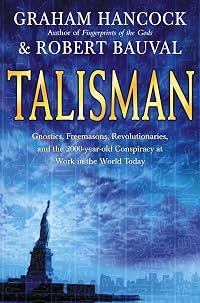











Member Reviews
Hancock's first stab at his now infinitely more popular theories is insightful in just how much of the more hyperbolic and less popular alternative ideas he's ditched through the years (here the crust displacement hypothesis plays a very prominent role in trying to make it all add up despite evidence to the contrary). Clearly written with an eye toward the success of Däniken's Chariots of the Gods, Hancock can act confident as he stabs the 'need for an alien hypothesis' in the side, replacing it with a far less extravagant prior (atlantean) civilization, of which we ultimately learn next to nothing.
Still it's hard not to get sucked in to the enthusiasm and travelogue sections. There's always that kernel of something interesting in the show more center and the connective tissues in familiar civilizational developments across the world just seems all too coincidental. Which is probably why he's been more successful the less he speaks about sound vibrations used for drilling or levitating blocks of rock with psychic powers. show less
Still it's hard not to get sucked in to the enthusiasm and travelogue sections. There's always that kernel of something interesting in the show more center and the connective tissues in familiar civilizational developments across the world just seems all too coincidental. Which is probably why he's been more successful the less he speaks about sound vibrations used for drilling or levitating blocks of rock with psychic powers. show less
This is an amazing book that allows the reader to delve into history with a new kind of flashlight. One that allows them to ask questions, and seek answers, without fear of being told "that's just wrong". The parallels Hancock identifies, as well as the similarities between cultures cut off from one another by thousands of miles, and thousands of years is mind boggling. Is it just that we humans are damned to repeat our actions, with no way of stopping the merry-go-round, or is it just a curious coincidence? We may never know, but if you want a book to get your mental juices flowing, THIS IS IT!!!
On the first day of class this semester, I stated that I never read nonfiction because it’s “boring.” My professor challenged me to read in nonfiction for one of my annotations. I rose to that challenge. Reading the nonfiction book rotated between torturous and wonderful. I pushed through the less interesting parts, though, and I’m a big enough person to admit that the end product was not at all boring.
I read Fingerprints of the Gods by Graham Hancock. Some readers will already be familiar with the basis of Hancock’s work. If you’ve seen Stargate, 10,000 BC, or 2012 you’ll recognize the research behind those films. It’s no coincidence that all were directed by Roland Emmerich. In truth, that’s why I decided to read show more this book. I’m a voracious Stargate fan.
Fingerprints of the Gods presents a view of history that, like the films based on its research, has earned the scorn of traditional archeologists. It point-by-point contradicts the established timeline of human civilization. As a historian (or at least, someone with a BA in History), I’m trained to scoff at these types of books. And yet, Hancock’s evidence is so much more comprehensive than traditional archeologists’ that I find myself unable to ignore the research in this book. In fact, I find myself convinced.
Hancock starts the book by presenting a series of maps. Despite being drawn circa 1531, they look familiar enough to modern readers. And that is why Hancock presents them first. He poses a very simple question. How does a map drawn in 1531 have an accurate representation of Antarctica when the southern continent was not discovered until 1818? It is possible Antarctica was not discovered, butrediscovered in 1818? From there, Hancock examines myths, histories, and architectures from across the ancient world. The most compelling portions of the book are the astronomic, geologic, and anthropologic evidence that suggests a global, technologically advanced civilization has been lost to history.
Historians generally accept that monuments such as the pyramids in Mexico and Egypt were built to align with the stars. Hancock points out that in all cases, the alignments do not match the modern sky, but would have done so perfectly circa 10,450 BC when human civilization was supposed to have been primitive. Geologists have unanimously agreed that the evidence suggests water damage was done to the Great Sphinx at Giza, but Giza last flooded during the most recent Ice Age, meaning that its attribution to the Fourth Dynasty must be incorrect.
Equally thought-provoking as the scientific evidence is the anthropologic arguments Hancock makes. There is no evidence of early cultural evolution in ancient Mesopotamia, Egypt, or the Americas. These ancient civilizations seem to have sprung out of the ground fully ready to build the Great Pyramids and Chichen Itza. This confounds all social science theories. Furthermore, in what logical world could the ancient Americans calculate an accurate solar calendar, but lack the science to invent the wheel?
And these are only a few of Hancock’s compelling arguments.
There were places where the science was over my head. Much as I loved my Astronomy and Geology courses, they were only introductory classes. The photographs and diagrams help to visually explain, and Hancock does a diligent job writing out all the mathematical calculations for the readers who have not studied Trigonometry or Geometry. This book is fifteen years old, and so some parts do seem slightly dated, but only in the sense that some astronomical events Hancock calls ‘future’ have already taken place.
Fingerprints of the Gods raises more questions than it answers, but I’m comfortable with that. I read to be challenged by ideas, not to be bludgeoned with facts. Furthermore, my mind has always been open to new theories. It was no great leap of faith for me to accept that there is more to our history than what we know.
I would recommend this book to anyone who enjoys “secret histories” or Roland Emmerich’s films. I also think it would make excellent reading for patrons who are willing (or eager) to challenge traditional academia. show less
I read Fingerprints of the Gods by Graham Hancock. Some readers will already be familiar with the basis of Hancock’s work. If you’ve seen Stargate, 10,000 BC, or 2012 you’ll recognize the research behind those films. It’s no coincidence that all were directed by Roland Emmerich. In truth, that’s why I decided to read show more this book. I’m a voracious Stargate fan.
Fingerprints of the Gods presents a view of history that, like the films based on its research, has earned the scorn of traditional archeologists. It point-by-point contradicts the established timeline of human civilization. As a historian (or at least, someone with a BA in History), I’m trained to scoff at these types of books. And yet, Hancock’s evidence is so much more comprehensive than traditional archeologists’ that I find myself unable to ignore the research in this book. In fact, I find myself convinced.
Hancock starts the book by presenting a series of maps. Despite being drawn circa 1531, they look familiar enough to modern readers. And that is why Hancock presents them first. He poses a very simple question. How does a map drawn in 1531 have an accurate representation of Antarctica when the southern continent was not discovered until 1818? It is possible Antarctica was not discovered, butrediscovered in 1818? From there, Hancock examines myths, histories, and architectures from across the ancient world. The most compelling portions of the book are the astronomic, geologic, and anthropologic evidence that suggests a global, technologically advanced civilization has been lost to history.
Historians generally accept that monuments such as the pyramids in Mexico and Egypt were built to align with the stars. Hancock points out that in all cases, the alignments do not match the modern sky, but would have done so perfectly circa 10,450 BC when human civilization was supposed to have been primitive. Geologists have unanimously agreed that the evidence suggests water damage was done to the Great Sphinx at Giza, but Giza last flooded during the most recent Ice Age, meaning that its attribution to the Fourth Dynasty must be incorrect.
Equally thought-provoking as the scientific evidence is the anthropologic arguments Hancock makes. There is no evidence of early cultural evolution in ancient Mesopotamia, Egypt, or the Americas. These ancient civilizations seem to have sprung out of the ground fully ready to build the Great Pyramids and Chichen Itza. This confounds all social science theories. Furthermore, in what logical world could the ancient Americans calculate an accurate solar calendar, but lack the science to invent the wheel?
And these are only a few of Hancock’s compelling arguments.
There were places where the science was over my head. Much as I loved my Astronomy and Geology courses, they were only introductory classes. The photographs and diagrams help to visually explain, and Hancock does a diligent job writing out all the mathematical calculations for the readers who have not studied Trigonometry or Geometry. This book is fifteen years old, and so some parts do seem slightly dated, but only in the sense that some astronomical events Hancock calls ‘future’ have already taken place.
Fingerprints of the Gods raises more questions than it answers, but I’m comfortable with that. I read to be challenged by ideas, not to be bludgeoned with facts. Furthermore, my mind has always been open to new theories. It was no great leap of faith for me to accept that there is more to our history than what we know.
I would recommend this book to anyone who enjoys “secret histories” or Roland Emmerich’s films. I also think it would make excellent reading for patrons who are willing (or eager) to challenge traditional academia. show less
The Cyclical Interpretation of History
Late Modernity has proven to be a gradual retreat from the old gradualist uniformitarianism type of science that I was taught decades ago. This science assumed that the physical and geological laws operating in (and the manifest behavior of) the world today have always been in effect in our world, at least during the time of Man. However, this notion lately (i.e., in my lifetime) has began to unravel, both in popular culture and science itself. Scientifically, after witnessing the spectacular collision of Shoemaker-Levy 9 with Jupiter, it has become impossible to argue that catastrophic events can no longer happen in our solar system. Even the Tunguska Event (1908) is now thought to (perhaps) have show more been caused by a comet. But this book is not interested in that. Its brand of 'catastrophism' is of an entirely terrestrial origin. While I am not convinced by the book, I must admit I am intrigued by it. In this review I would like to (very broadly) give some indication of its argument and then some possibilities of how it might be accepted and also some consequences that might follow if this quite 'speculaive history' were to be generally accepted.
The Argument of this Book in a Nutshell:
This book argues, in a manner that does not include recourse to the 'supernatural', sentient beings from other planets, or some harebrained conspiracy, that advanced civilizations have existed in the past but their knowledge (and also the very knowledge of their existence!) was lost due to global catastrophe. This world-wide catastrophe, Graham Hancock argues, is due to the slippage of the lithosphere around the upper mantle. He settles on this remarkable supposition, ultimately, because of the extreme difficulty of completely hiding even the few remaining shards of any great fallen civilization. These remains, if this theory of Lithosphere slippage is correct, could be found beneath the antarctic ice cap. This idea is not original with our author, he got it from the Flem-Ath's (see their "When the Sky Fell: In Search of Atlantis").
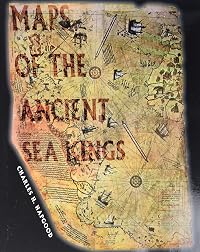
The book opens with the perusal of several remarkable old maps which could not possibly know what they manifestly do know. (The key text here is "Maps of the Ancient Sea Kings: Evidence of Advanced Civilization in the Ice Age", by Charles H. Hapgood.) The depiction of topographic features of antarctica (rivers, mountain ranges, gulfs) that were hidden by glaciers throughout historic time is particularly eye-opening. These features were only recently discovered (perhaps I should say 'rediscovered') using the most advanced technologies. There is no way any known ancient civilization could have possessed this information. But the discrepancy is far worse than that; current theory places an un-glaciated Antarctica so far in the past that it predates the rise of humanity (i.e., homo sapiens) itself! This is where the theory of periodic Lithosphere slippage comes in especially handy. The rigid outer 'skin' of the earth periodically (even predictably!) slipping explains how civilization could (perhaps even repeatedly) rise and be destroyed, with only a tiny few scraps of information, cloaked in myth, escaping into the distant future.
I know, all this sounds remarkably improbable. I too am not a follower of the 'speculative history' propounded in these pages (or anywhere else). But consider these thoughts of Einstein regarding the danger of the accumulation of ice at the polar ice-caps and the resulting slippage:
"The earth's rotation acts on these unsymmetrically deposited masses, and produces centrifugal momentum that is transmitted to the rigid crust of the earth. The constantly increasing centrifugal momentum produced this way will, when it reaches a certain point, produce a movement of the earth's crust over the earth's body, and this will displace the polar regions towards the equator. (quoted p. 468.)"
Of course, Einstein's remarks do not in any way prove that slippage of the Lithosphere actually occurs. What it does show is that this is a scientific theory, which evidence may (or may not) prove to be true at a later date. A usually unnoticed consequence of this theory of Lithosphere slippage due to the accumulation of ice is that 'global-warming' may in fact prove to be a positive good. What?!? How? By suppressing the size of the ice-caps humanity may have found the only way to indefinitely defer the slippage of the Lithosphere.
And this theory of slippage also neatly explains how it is possible that antarctica would be without ice during the time of Man in the later Pleistocene Era thanks to the supposition that this slippage occurs every few thousand years. Of course, the slippage of the Lithosphere entails horrific damage on a world-wide scale. But where is the evidence? Besides several types of archeological anomalies (like "apparently 'flash-frozen' mammoths in northern Siberia and Alaska", for instance) our author finds the best evidence in the recurring constants of Myth. These mythical motifs occur across all continents and vastly different civilizations. He infers from these constants that these myths are not merely delusions. Hancock here leans heavily on the famous book ("Hamlet's Mill: An Essay Investigating the Origins of Human Knowledge And Its Transmission Through Myth") by Giorgio De Santillana and Hertha von Dechen in making his argument.
Our author invites us to imagine, if our present civilization were entirely destroyed and the few survivors were forced back to a very primitive subsistence level, how this humanity would speak of events like Hiroshima after 10,000 years. He quotes several passages from the Bhagavata Purana (see pages 448-449) to show how myth might preserve the memory of such terrible events. Now, thanks to the popular TV show, 'Life After People', we are all today much more aware of how quickly the various physical artifacts of our civilization would disappear if not cared for by civilized Man. If our civilization were somehow destroyed wouldn't its few remaining traces eventually be mythologized into memorable narratives by the (nearly) 'feral' survivors?
Now, myth doesn't only contain tales of world-wide catastrophe and trauma; it preserves vital information regarding this catastrophe: most importantly, when it occurred and even when it will likely recur. Referring to some remarks by Josephus and also some anonymous Egyptian traditions regarding the antediluvian world our author states:
"Taken at face value, the message of both these myths seems crystal clear: certain mysterious structures scattered around the world were built to preserve and transmit the knowledge of an advanced civilization of remote antiquity which was destroyed by a terrifying upheaval." (p. 490).
How does myth do this? Through the 'universal language' of mathematics and the smart utilization of the terrestrial facts regarding the precession of the equinoxes.
But why make use of earth's axial precession to say 'we were here'? Our author explains that this is due to
"the beautiful predictability of the earth's axial precession, which has the effect of slowly and regularly altering the declination of the entire star-field in relation to a viewer at a fixed point, and which equally slowly and regularly revolves the equinoctial point in relation to the twelve zodiacal constellations. From the predictability of this motion it follows that if we could find a way to declare: WE LIVED WHEN THE VERNAL EQUINOX WAS IN THE CONSTELLATION OF PISCES we would provide a means of specifying our epoch to within a single 2160-year period in every grand precessional cycle of 25,920 years.
The only drawback to this scheme would become evident if a civilization equivalent to our own failed to arise within 12,000 or even 20,000 years of the cataclysm, but took much longer - perhaps as much as 30,000 years. (pp. 492-493.)"
In the latter case the precessional evidence of the past civilization, while pointing to a previous period 'X' in a certain zodiacal sign, the civilization would actually have existed in period X minus 25,920 years, which is the time of a full precessional cycle and the occurrence of the zodiacal sign in the earlier cycle. There doesn't seem to be any way to rid precessional timekeeping of this central ambiguity.
In order for myth to preserve and transmit information regarding the precession it seems that the following numbers must be repeatedly encoded in these various myths:
"12 = the number of constellations in the zodiac;
30 = the number of degrees allocated along the ecliptic to each zodiacal constellation;
72 = the number of years required for the equinoctial sun to complete a precessional shift of one degree along the ecliptic;
360 = the total number of degrees in the ecliptic;
72 X 30 = 2160 (the number of years required for the sun to complete a passage of 30 degrees along the ecliptic, i.e., to pass entirely through any one of the twelve zodiacal constellations);
2160 X 12 = 25920 (the number of years in one complete precessional cycle or 'Great Year', and thus the total number of years required to bring about the 'Great Return');.
Other figures and combination of figures also emerge, for example:
36, the number of years required for the equinoctial sun to complete a precessional shift of half a degree along the ecliptic;
4320, the number of years required for the eqiunoctial sun to complete a precessional shift of 60 degrees (i.e., two zodiacal constellations). (pps. 257-258.)"
Now, our author will strive to show how these numeric relationships are encoded in myths and surviving ancient monuments.
There are also many anomalies noted throughout this book. Those interested in archeological anomalies should almost certainly begin their study with the classic "Forbidden Archeology: The Hidden History of the Human Race," by Michael A. Cremo. One such anomaly in the book before us is the age of the Sphinx. Egyptologists, though admitting that "there is no direct way to date the Sphinx itself, because the Sphinx is carved out of natural rock" date the monument to the Fourth Dynasty. However, geologists typically date the Sphinx thousands of years earlier, around 10,000 BC., based on the evidence of weathering. The reason that this date is unacceptable to archeologists and Egyptologists is that there is no known civilization in that period. One important book concerning the age of the Sphinx is "Serpent in the Sky" by John Anthony West. West puts the geological argument in a nutshell:
"Once you've established that water was the agent that eroded the Sphinx the answer is almost childishly simple. It can be explained to anybody who reads the 'National Enquirer' or the 'News of the World'. It's almost moronically simple... The Sphinx is supposed to have been built by Khafre around 2500 BC, but since the beginning of dynastic times -say 3000 BC onwards- there just hasn't been enough rain on the Giza plateau to have caused the very extensive erosion that we see all over the Sphinx's body. You really have to go back before 10,000 BC to find a wet enough climate in Egypt to account for weathering of this type and on this scale. It therefore follows that the Sphinx must have been built before 10,000 BC and since it's a massive, sophisticated work of art it also follows that it must have been built by a high civilization. (pp. 419-420.)"
And that is the impasse we have reached: The geologists say there hasn't been enough water in dynastic times in Egypt to account for the weathering of the Sphinx. The Egyptologist say that there was no civilization 12,000 years ago to build the Sphinx. Both find their views perfectly obvious and their doubters very foolish.
I'd like to conclude this section of my review by noting another anomaly in Egypt. It seems that the monuments on the Giza Plateau are aligned with the stars as they would have been in 10, 450 BC! Of course , it is possible that some cult in Fourth Dynasty Egypt wished to align the site with "the lowest point in Orion's precessional cycle" for reasons of ritual. But, as a collaborator of Hancock, Robert Bauval, states:
"OK. That's one explanation. But the second explanation, which I personally favour -and which I think the geological evidence also supports- is that the whole Giza Necropolis was developed and built up over an enormously long period of time. I think it's more than possible that the site was originally planned and laid out at around 10,150 BC, so that its geometry would reflect the skies as they looked then, but that the work was completed, and the shafts of the Great Pyramid aligned, around 2450 BC. (p. 449.)"
I suppose the place to start reading Bauval is his "The Orion Mystery: Unlocking the Secrets of the Pyramids".
I've only hit what I regarded as the most important points of Hancock in this review. There is plenty more in this book; especially regarding South and Central America, that I haven't mentioned. Now, for the remainder of the review, I would like to discuss the prospects for (and the possible consequences of) the acceptance of the notion of ancient civilizations and scientific catastrophism in the modern world.
Possibilities:
Late Modernity, as I said above, has proven to be a gradual retreat from 'gradualist' and 'uniformitarian' scientific notions. All that is needed to turn this retreat into a rout is a decade or two (or three!) of extreme earth activity: volcanoes, earthquakes, tsunamis, hurricanes, drought, floods, drastically changed weather patterns (whether rapid warming or freezing is immaterial), meteor / asteroid strikes, etc, with the strength of this activity far exceeding statistical expectations. The acceptance of a scientific notion of Catastrophism certainly does not require either space aliens or the 'supernatural'; all it really requires to become plausible to the modern mind is a sustained period of increased natural catastrophe. In this scenario there would be absolutely no 'leap of faith' at all; modern science studies recurring natural phenomena.
Once modern civilization loses belief in its own supposed inevitability and necessity, due to an era of (seemingly) ever-increasing catastrophe, the notion of the existence of long forgotten advanced ancient civilizations that collapsed due to recurring natural disasters will cease to be repugnant to it. And then the many anomalies of archaeology (and other scientific disciplines) discussed in this book could coalesce into a new universal history that entails the necessary rise and fall of civilizations due entirely to natural causes. This new understanding will probably include an extremely speculative history of several cycles of the rise and fall of civilization. However, this acceptance of destructive natural cycles will also, I fear, likely spell the end of belief in our progressive secular theories of history, such as liberalism and socialism.
Now, with the fall of progressive secular ideologies one could also expect a rise in religious belief throughout our secular world even though, strictly speaking, scientific Catastrophism and the speculative history of our author (as embodied in this book) certainly requires no such belief. If people cease to believe that they and theirs can have a better material future in this world then they may well come to believe in a better spiritual future in the 'next world'. I suspect that this is one of the main unspoken reasons so many secular-minded people abominate the natural cyclical viewpoint expounded in this book. It is not the existence of advanced ancient civilizations per se that greatly bothers them; no, it is, on the one hand, the fear that as a consequence of the cyclical viewpoint modern progress itself first slows and then grinds to a halt. And, on the other hand, there is a fear that a belief in civilizational cycles leads inevitably to a 're-mythification' of the world and thus (eventually) the loss of scientific rationalism and secularism itself.
And even though scientific Catastrophism, strictly speaking, requires none of these results, I suspect that they are probable in the long run. I think that another stumbling-block for the overwhelming majority of its opponents is how 'amoral', at bottom, this cyclical viewpoint is. Humanity tends to believe that things happen due to our goodness or badness; that is to say, we tend to view the events around us as rewards or punishments for our behavior. Thus global warming must be due to modern industry and not the cycles of the sun and the incremental variations in earth's orbit, even though we know full well that there has been temperature variations (global warmings and coolings) throughout the natural history of our planet. (And thus periods of warming and cooling occurred long before there was any human intervention.) And so, even a scientific theory like global warming must be presented to all the world as a morality play. If it is ever believed that global catastrophe recurs every several thousand years, even whether humanity exists or not, then the ubiquitous 'moral view of history' is likely dead.
Now, I fear that Human History will always be akin to a puzzle that is missing many pieces. Or, perhaps more aptly, a text that is missing many words, - and even some letters within words! Naturally, the further back one goes in historical study the more appropriate this metaphor becomes. When we study 'prehistory' through the tools that archeology surely provides we find ourselves in a situation similar to someone trying to understand a thousand page novel with 95% of the text missing. In these circumstances, it is unrealistic to expect everyone to agree with your interpretation of the evidence. How might agreement then arise? That is the real question.
I think that the adherents of (whatever variety of) 'speculative history' should stop expecting people to one day confess they were all mistaken due to some new discovery. (For instance, the Antarctic ice shelf melting and revealing the remains of an ancient civilization.) Instead, they should inquire into the ways scientific world-views rise and fall. An excellent place to begin this study is "The Structure of Scientific Revolutions" by Thomas Kuhn. Now, to the best of my memory, Hancock doesn't even mention Kuhn in this book. But I believe Kuhn's book is germane to Hancock's argument. Kuhn discusses how theory replacement (he call this a 'paradigm-shift') occurs in science. It is a very complex argument and I don't dare even summarize it here. One point to note is that the accumulation of anomalies (phenomena unexplained by current theory) can eventually overwhelm the field investigating them and this itself may eventually lead to a paradigm shift. That is why I think a few decades of extreme weather and earth activity (volcanoes, earthquakes, etc.) could lead to the sort of 'paradigm shift' (in our understanding of ancient history) that Kuhn writes about. Extreme earth activity, far beyond the statistical norm, might indeed provide enough anomalies to cause a paradigm shift.
Another point that Kuhn discusses is incommensurable theories. Although friends and foes of 'speculative history' might think that it is entirely incompatible with 'accepted history', I don't believe this is the case. The history and anthropology that Hancock here expounds is, strictly speaking, not incommensurable with 'accepted history'. Hancock's position, as delineated in this book, has nothing new to say about (for instance) the rise of industrialism or the French and Russian Revolutions. It is only in deep antiquity that his novelty lies. This is not, strictly speaking, an example of incommensurable theories. Incommensurable theories would be, for example, the physics of Aristotle and our modern physics. Even very different theories are not necessarily incommensurable. Physicist today use both Newtonian and our modern physics (Quantum/Relativity) in their everyday work. And thus I think it is a mistake to believe that it is necessary that the victory of Hancock's 'speculative history' must overturn everything. There really is no need for it to do so. - And the less it overturns the easier its acceptance.
Four stars for a very interesting read in a genre I usually do not read and turning what I would usually dismiss as impossible into the merely improbable. The possible acceptance of our author's thesis is hostage to events he cannot control. For instance, - the actual slippage of the Lithosphere, the melting of the antarctic ice cap and the revelation of an ancient civilization, or a period of statistically improbable extreme earth activity. Of these, I think the latter the most likely. show less
Late Modernity has proven to be a gradual retreat from the old gradualist uniformitarianism type of science that I was taught decades ago. This science assumed that the physical and geological laws operating in (and the manifest behavior of) the world today have always been in effect in our world, at least during the time of Man. However, this notion lately (i.e., in my lifetime) has began to unravel, both in popular culture and science itself. Scientifically, after witnessing the spectacular collision of Shoemaker-Levy 9 with Jupiter, it has become impossible to argue that catastrophic events can no longer happen in our solar system. Even the Tunguska Event (1908) is now thought to (perhaps) have show more been caused by a comet. But this book is not interested in that. Its brand of 'catastrophism' is of an entirely terrestrial origin. While I am not convinced by the book, I must admit I am intrigued by it. In this review I would like to (very broadly) give some indication of its argument and then some possibilities of how it might be accepted and also some consequences that might follow if this quite 'speculaive history' were to be generally accepted.
The Argument of this Book in a Nutshell:
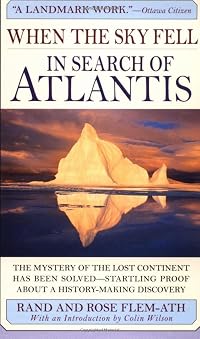
This book argues, in a manner that does not include recourse to the 'supernatural', sentient beings from other planets, or some harebrained conspiracy, that advanced civilizations have existed in the past but their knowledge (and also the very knowledge of their existence!) was lost due to global catastrophe. This world-wide catastrophe, Graham Hancock argues, is due to the slippage of the lithosphere around the upper mantle. He settles on this remarkable supposition, ultimately, because of the extreme difficulty of completely hiding even the few remaining shards of any great fallen civilization. These remains, if this theory of Lithosphere slippage is correct, could be found beneath the antarctic ice cap. This idea is not original with our author, he got it from the Flem-Ath's (see their "When the Sky Fell: In Search of Atlantis").
The book opens with the perusal of several remarkable old maps which could not possibly know what they manifestly do know. (The key text here is "Maps of the Ancient Sea Kings: Evidence of Advanced Civilization in the Ice Age", by Charles H. Hapgood.) The depiction of topographic features of antarctica (rivers, mountain ranges, gulfs) that were hidden by glaciers throughout historic time is particularly eye-opening. These features were only recently discovered (perhaps I should say 'rediscovered') using the most advanced technologies. There is no way any known ancient civilization could have possessed this information. But the discrepancy is far worse than that; current theory places an un-glaciated Antarctica so far in the past that it predates the rise of humanity (i.e., homo sapiens) itself! This is where the theory of periodic Lithosphere slippage comes in especially handy. The rigid outer 'skin' of the earth periodically (even predictably!) slipping explains how civilization could (perhaps even repeatedly) rise and be destroyed, with only a tiny few scraps of information, cloaked in myth, escaping into the distant future.
I know, all this sounds remarkably improbable. I too am not a follower of the 'speculative history' propounded in these pages (or anywhere else). But consider these thoughts of Einstein regarding the danger of the accumulation of ice at the polar ice-caps and the resulting slippage:
"The earth's rotation acts on these unsymmetrically deposited masses, and produces centrifugal momentum that is transmitted to the rigid crust of the earth. The constantly increasing centrifugal momentum produced this way will, when it reaches a certain point, produce a movement of the earth's crust over the earth's body, and this will displace the polar regions towards the equator. (quoted p. 468.)"
Of course, Einstein's remarks do not in any way prove that slippage of the Lithosphere actually occurs. What it does show is that this is a scientific theory, which evidence may (or may not) prove to be true at a later date. A usually unnoticed consequence of this theory of Lithosphere slippage due to the accumulation of ice is that 'global-warming' may in fact prove to be a positive good. What?!? How? By suppressing the size of the ice-caps humanity may have found the only way to indefinitely defer the slippage of the Lithosphere.
And this theory of slippage also neatly explains how it is possible that antarctica would be without ice during the time of Man in the later Pleistocene Era thanks to the supposition that this slippage occurs every few thousand years. Of course, the slippage of the Lithosphere entails horrific damage on a world-wide scale. But where is the evidence? Besides several types of archeological anomalies (like "apparently 'flash-frozen' mammoths in northern Siberia and Alaska", for instance) our author finds the best evidence in the recurring constants of Myth. These mythical motifs occur across all continents and vastly different civilizations. He infers from these constants that these myths are not merely delusions. Hancock here leans heavily on the famous book ("Hamlet's Mill: An Essay Investigating the Origins of Human Knowledge And Its Transmission Through Myth") by Giorgio De Santillana and Hertha von Dechen in making his argument.
Our author invites us to imagine, if our present civilization were entirely destroyed and the few survivors were forced back to a very primitive subsistence level, how this humanity would speak of events like Hiroshima after 10,000 years. He quotes several passages from the Bhagavata Purana (see pages 448-449) to show how myth might preserve the memory of such terrible events. Now, thanks to the popular TV show, 'Life After People', we are all today much more aware of how quickly the various physical artifacts of our civilization would disappear if not cared for by civilized Man. If our civilization were somehow destroyed wouldn't its few remaining traces eventually be mythologized into memorable narratives by the (nearly) 'feral' survivors?
Now, myth doesn't only contain tales of world-wide catastrophe and trauma; it preserves vital information regarding this catastrophe: most importantly, when it occurred and even when it will likely recur. Referring to some remarks by Josephus and also some anonymous Egyptian traditions regarding the antediluvian world our author states:
"Taken at face value, the message of both these myths seems crystal clear: certain mysterious structures scattered around the world were built to preserve and transmit the knowledge of an advanced civilization of remote antiquity which was destroyed by a terrifying upheaval." (p. 490).
How does myth do this? Through the 'universal language' of mathematics and the smart utilization of the terrestrial facts regarding the precession of the equinoxes.
But why make use of earth's axial precession to say 'we were here'? Our author explains that this is due to
"the beautiful predictability of the earth's axial precession, which has the effect of slowly and regularly altering the declination of the entire star-field in relation to a viewer at a fixed point, and which equally slowly and regularly revolves the equinoctial point in relation to the twelve zodiacal constellations. From the predictability of this motion it follows that if we could find a way to declare: WE LIVED WHEN THE VERNAL EQUINOX WAS IN THE CONSTELLATION OF PISCES we would provide a means of specifying our epoch to within a single 2160-year period in every grand precessional cycle of 25,920 years.
The only drawback to this scheme would become evident if a civilization equivalent to our own failed to arise within 12,000 or even 20,000 years of the cataclysm, but took much longer - perhaps as much as 30,000 years. (pp. 492-493.)"
In the latter case the precessional evidence of the past civilization, while pointing to a previous period 'X' in a certain zodiacal sign, the civilization would actually have existed in period X minus 25,920 years, which is the time of a full precessional cycle and the occurrence of the zodiacal sign in the earlier cycle. There doesn't seem to be any way to rid precessional timekeeping of this central ambiguity.
In order for myth to preserve and transmit information regarding the precession it seems that the following numbers must be repeatedly encoded in these various myths:
"12 = the number of constellations in the zodiac;
30 = the number of degrees allocated along the ecliptic to each zodiacal constellation;
72 = the number of years required for the equinoctial sun to complete a precessional shift of one degree along the ecliptic;
360 = the total number of degrees in the ecliptic;
72 X 30 = 2160 (the number of years required for the sun to complete a passage of 30 degrees along the ecliptic, i.e., to pass entirely through any one of the twelve zodiacal constellations);
2160 X 12 = 25920 (the number of years in one complete precessional cycle or 'Great Year', and thus the total number of years required to bring about the 'Great Return');.
Other figures and combination of figures also emerge, for example:
36, the number of years required for the equinoctial sun to complete a precessional shift of half a degree along the ecliptic;
4320, the number of years required for the eqiunoctial sun to complete a precessional shift of 60 degrees (i.e., two zodiacal constellations). (pps. 257-258.)"
Now, our author will strive to show how these numeric relationships are encoded in myths and surviving ancient monuments.
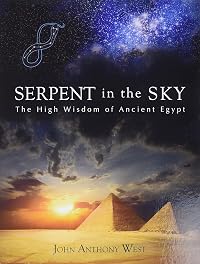
There are also many anomalies noted throughout this book. Those interested in archeological anomalies should almost certainly begin their study with the classic "Forbidden Archeology: The Hidden History of the Human Race," by Michael A. Cremo. One such anomaly in the book before us is the age of the Sphinx. Egyptologists, though admitting that "there is no direct way to date the Sphinx itself, because the Sphinx is carved out of natural rock" date the monument to the Fourth Dynasty. However, geologists typically date the Sphinx thousands of years earlier, around 10,000 BC., based on the evidence of weathering. The reason that this date is unacceptable to archeologists and Egyptologists is that there is no known civilization in that period. One important book concerning the age of the Sphinx is "Serpent in the Sky" by John Anthony West. West puts the geological argument in a nutshell:
"Once you've established that water was the agent that eroded the Sphinx the answer is almost childishly simple. It can be explained to anybody who reads the 'National Enquirer' or the 'News of the World'. It's almost moronically simple... The Sphinx is supposed to have been built by Khafre around 2500 BC, but since the beginning of dynastic times -say 3000 BC onwards- there just hasn't been enough rain on the Giza plateau to have caused the very extensive erosion that we see all over the Sphinx's body. You really have to go back before 10,000 BC to find a wet enough climate in Egypt to account for weathering of this type and on this scale. It therefore follows that the Sphinx must have been built before 10,000 BC and since it's a massive, sophisticated work of art it also follows that it must have been built by a high civilization. (pp. 419-420.)"
And that is the impasse we have reached: The geologists say there hasn't been enough water in dynastic times in Egypt to account for the weathering of the Sphinx. The Egyptologist say that there was no civilization 12,000 years ago to build the Sphinx. Both find their views perfectly obvious and their doubters very foolish.
I'd like to conclude this section of my review by noting another anomaly in Egypt. It seems that the monuments on the Giza Plateau are aligned with the stars as they would have been in 10, 450 BC! Of course , it is possible that some cult in Fourth Dynasty Egypt wished to align the site with "the lowest point in Orion's precessional cycle" for reasons of ritual. But, as a collaborator of Hancock, Robert Bauval, states:
"OK. That's one explanation. But the second explanation, which I personally favour -and which I think the geological evidence also supports- is that the whole Giza Necropolis was developed and built up over an enormously long period of time. I think it's more than possible that the site was originally planned and laid out at around 10,150 BC, so that its geometry would reflect the skies as they looked then, but that the work was completed, and the shafts of the Great Pyramid aligned, around 2450 BC. (p. 449.)"
I suppose the place to start reading Bauval is his "The Orion Mystery: Unlocking the Secrets of the Pyramids".
I've only hit what I regarded as the most important points of Hancock in this review. There is plenty more in this book; especially regarding South and Central America, that I haven't mentioned. Now, for the remainder of the review, I would like to discuss the prospects for (and the possible consequences of) the acceptance of the notion of ancient civilizations and scientific catastrophism in the modern world.
Possibilities:
Late Modernity, as I said above, has proven to be a gradual retreat from 'gradualist' and 'uniformitarian' scientific notions. All that is needed to turn this retreat into a rout is a decade or two (or three!) of extreme earth activity: volcanoes, earthquakes, tsunamis, hurricanes, drought, floods, drastically changed weather patterns (whether rapid warming or freezing is immaterial), meteor / asteroid strikes, etc, with the strength of this activity far exceeding statistical expectations. The acceptance of a scientific notion of Catastrophism certainly does not require either space aliens or the 'supernatural'; all it really requires to become plausible to the modern mind is a sustained period of increased natural catastrophe. In this scenario there would be absolutely no 'leap of faith' at all; modern science studies recurring natural phenomena.
Once modern civilization loses belief in its own supposed inevitability and necessity, due to an era of (seemingly) ever-increasing catastrophe, the notion of the existence of long forgotten advanced ancient civilizations that collapsed due to recurring natural disasters will cease to be repugnant to it. And then the many anomalies of archaeology (and other scientific disciplines) discussed in this book could coalesce into a new universal history that entails the necessary rise and fall of civilizations due entirely to natural causes. This new understanding will probably include an extremely speculative history of several cycles of the rise and fall of civilization. However, this acceptance of destructive natural cycles will also, I fear, likely spell the end of belief in our progressive secular theories of history, such as liberalism and socialism.
Now, with the fall of progressive secular ideologies one could also expect a rise in religious belief throughout our secular world even though, strictly speaking, scientific Catastrophism and the speculative history of our author (as embodied in this book) certainly requires no such belief. If people cease to believe that they and theirs can have a better material future in this world then they may well come to believe in a better spiritual future in the 'next world'. I suspect that this is one of the main unspoken reasons so many secular-minded people abominate the natural cyclical viewpoint expounded in this book. It is not the existence of advanced ancient civilizations per se that greatly bothers them; no, it is, on the one hand, the fear that as a consequence of the cyclical viewpoint modern progress itself first slows and then grinds to a halt. And, on the other hand, there is a fear that a belief in civilizational cycles leads inevitably to a 're-mythification' of the world and thus (eventually) the loss of scientific rationalism and secularism itself.
And even though scientific Catastrophism, strictly speaking, requires none of these results, I suspect that they are probable in the long run. I think that another stumbling-block for the overwhelming majority of its opponents is how 'amoral', at bottom, this cyclical viewpoint is. Humanity tends to believe that things happen due to our goodness or badness; that is to say, we tend to view the events around us as rewards or punishments for our behavior. Thus global warming must be due to modern industry and not the cycles of the sun and the incremental variations in earth's orbit, even though we know full well that there has been temperature variations (global warmings and coolings) throughout the natural history of our planet. (And thus periods of warming and cooling occurred long before there was any human intervention.) And so, even a scientific theory like global warming must be presented to all the world as a morality play. If it is ever believed that global catastrophe recurs every several thousand years, even whether humanity exists or not, then the ubiquitous 'moral view of history' is likely dead.
Now, I fear that Human History will always be akin to a puzzle that is missing many pieces. Or, perhaps more aptly, a text that is missing many words, - and even some letters within words! Naturally, the further back one goes in historical study the more appropriate this metaphor becomes. When we study 'prehistory' through the tools that archeology surely provides we find ourselves in a situation similar to someone trying to understand a thousand page novel with 95% of the text missing. In these circumstances, it is unrealistic to expect everyone to agree with your interpretation of the evidence. How might agreement then arise? That is the real question.
I think that the adherents of (whatever variety of) 'speculative history' should stop expecting people to one day confess they were all mistaken due to some new discovery. (For instance, the Antarctic ice shelf melting and revealing the remains of an ancient civilization.) Instead, they should inquire into the ways scientific world-views rise and fall. An excellent place to begin this study is "The Structure of Scientific Revolutions" by Thomas Kuhn. Now, to the best of my memory, Hancock doesn't even mention Kuhn in this book. But I believe Kuhn's book is germane to Hancock's argument. Kuhn discusses how theory replacement (he call this a 'paradigm-shift') occurs in science. It is a very complex argument and I don't dare even summarize it here. One point to note is that the accumulation of anomalies (phenomena unexplained by current theory) can eventually overwhelm the field investigating them and this itself may eventually lead to a paradigm shift. That is why I think a few decades of extreme weather and earth activity (volcanoes, earthquakes, etc.) could lead to the sort of 'paradigm shift' (in our understanding of ancient history) that Kuhn writes about. Extreme earth activity, far beyond the statistical norm, might indeed provide enough anomalies to cause a paradigm shift.
Another point that Kuhn discusses is incommensurable theories. Although friends and foes of 'speculative history' might think that it is entirely incompatible with 'accepted history', I don't believe this is the case. The history and anthropology that Hancock here expounds is, strictly speaking, not incommensurable with 'accepted history'. Hancock's position, as delineated in this book, has nothing new to say about (for instance) the rise of industrialism or the French and Russian Revolutions. It is only in deep antiquity that his novelty lies. This is not, strictly speaking, an example of incommensurable theories. Incommensurable theories would be, for example, the physics of Aristotle and our modern physics. Even very different theories are not necessarily incommensurable. Physicist today use both Newtonian and our modern physics (Quantum/Relativity) in their everyday work. And thus I think it is a mistake to believe that it is necessary that the victory of Hancock's 'speculative history' must overturn everything. There really is no need for it to do so. - And the less it overturns the easier its acceptance.
Four stars for a very interesting read in a genre I usually do not read and turning what I would usually dismiss as impossible into the merely improbable. The possible acceptance of our author's thesis is hostage to events he cannot control. For instance, - the actual slippage of the Lithosphere, the melting of the antarctic ice cap and the revelation of an ancient civilization, or a period of statistically improbable extreme earth activity. Of these, I think the latter the most likely. show less
When many speculation books attempt to drive the evidence to meet their conclusions the final result lacks credibility. Graham Hancock presents his evidence, offers his conclusions and lets the reader make up their own mind. This mature approach instantly made me like Hancock, his evidence can be researched and verified and his conclusions, while outside of how we understand history and open to alternate views, are sound. From the introduction and the Piri Reis Map onwards Hancock presents fascinating evidence for an older civilization that we have not yet discovered and unlike Von Daniken, his conclusions do not require a belief in aliens or ancient technologies left behind like a plot from Star Trek.
A very entertaining read and very show more thought provoking. show less
A very entertaining read and very show more thought provoking. show less
Recensione completa qui: http://thereadingpal.blogspot.it/2016/12/recensione-47-impronte-degli-dei.html
Non ero totalmente sicura che mi sarebbe piaciuto. Avevo la sensazione di qualcosa in stile "complottistico". Bene, non è così. Graham espone la sua teoria attraverso i miti e le leggende di tutti i popoli antichi e anche attraverso i monumenti da loro creati. C'è qualcosa di simile sia nei racconti tramandati sia nelle strutture fisiche che attraversano il globo, e Graham pensa che si possa ricondurre il tutto ad una unica cultura madre. Una cultura di cui però non si anno più tracce, scomparse da tempo. Attraverso le sue spiegazioni, le note, e riferimenti a scoperte, mappe, tesori archeologici ed altri test, Hancock ci guida show more nella spiegazione di questa sua (a mio dire possibilissima) teoria.
Il lavoro di Graham Hancock non è stato recensito dai suoi colleghi e non fa parte di nessuna raccolta accademica, ma questo dice solo parzialmente qualcosa.
Di sicuro mancano dei dati essenziali, ad esempio ritrovamenti di questa civiltà scomparsa, ma come studiosa di storia so che testi che dovrebbero essere ben più recenti, secondo Hancock, non sono stati ritrovati e sono stati persi fino a prova contraria. Questo potrebbe valere anche per oggetti e/o corpi, in quanto, se avvero questa civiltà è esistita, non possiamo sapere come essa li ha conservati e, nel caso dei testi, non possiamo sapere se la loro fosse solo tradizione orale o meno.
Detto questo, la lettura è stata decisamente interessante. So che di Graham Hancock è stato pubblicato recentemente in italiano il "seguito" di questo libro, e penso che cercherò di procurarmelo nel nuovo anno. show less
Non ero totalmente sicura che mi sarebbe piaciuto. Avevo la sensazione di qualcosa in stile "complottistico". Bene, non è così. Graham espone la sua teoria attraverso i miti e le leggende di tutti i popoli antichi e anche attraverso i monumenti da loro creati. C'è qualcosa di simile sia nei racconti tramandati sia nelle strutture fisiche che attraversano il globo, e Graham pensa che si possa ricondurre il tutto ad una unica cultura madre. Una cultura di cui però non si anno più tracce, scomparse da tempo. Attraverso le sue spiegazioni, le note, e riferimenti a scoperte, mappe, tesori archeologici ed altri test, Hancock ci guida show more nella spiegazione di questa sua (a mio dire possibilissima) teoria.
Il lavoro di Graham Hancock non è stato recensito dai suoi colleghi e non fa parte di nessuna raccolta accademica, ma questo dice solo parzialmente qualcosa.
Di sicuro mancano dei dati essenziali, ad esempio ritrovamenti di questa civiltà scomparsa, ma come studiosa di storia so che testi che dovrebbero essere ben più recenti, secondo Hancock, non sono stati ritrovati e sono stati persi fino a prova contraria. Questo potrebbe valere anche per oggetti e/o corpi, in quanto, se avvero questa civiltà è esistita, non possiamo sapere come essa li ha conservati e, nel caso dei testi, non possiamo sapere se la loro fosse solo tradizione orale o meno.
Detto questo, la lettura è stata decisamente interessante. So che di Graham Hancock è stato pubblicato recentemente in italiano il "seguito" di questo libro, e penso che cercherò di procurarmelo nel nuovo anno. show less
Hancock is a Scots journalist who made a fortune writing Best Sellers, most of which have the theme that everything we were taught about Fertile Crescent origins is wrong. He presents evidence of an ancestral people inhabiting coastlines which were flooded by rapid sea-rise as Ice Age melt raised the oceans. "Orthodox" historians regard him as a pseudo-scientist because he is selective with the material. He does not try for "balanced" views. He seems to enjoy putting the mystery back into the discoveries. As if it is disquieting to anyone that cultural evolution diversified in starts and stops, little boltings, instead of one smooth linear advancement. The importance of Hancock's work is that he knows how to get rich using beautiful and show more even hard-to-collect information, and it really is "information". Interpretion? He is better at asking questions than answering them. Aren't all civilizations "vanishing" right before our eyes?
This work begins with an introduction to "the maps". For example, one wonderful map was found in 1929, in the Imperial Palace of Constantinople, (the library of which is neglected and remains unexplored to this day). The Piri Reis riparian chart clearly depicts the New World coastlines, as well as portions of Antarctica -- Queen Maud's Land -- which were under ice at the time of Admiral Reis's recopying efforts. Piri Reis, a reknowned officer in the navy of the Ottoman Turks [12]was beheaded by Islamic fanatics in 1554. Hence, the map appears to be a legacy of a "lost civilization" or at least a voyage we do not know much about.
And what explains the accuracy of the number of early maps used, for example, by Mercator (the pseudonym of Gerard Kremer), and which were not matched by the technologies of his peers in the 1560's? John Harrison's marine chronometer was not developed until 1761 [28].
The "gods" of the title do not appear to be divine. Maybe they were "Viracochas" -- the bearded ones from across the sea who pieced together the 100-ton polygonal block walls of Sacsayhuaman. Even when relying upon Watch Tower Tracts [499] and Christian psychics [Edgar Cayce, 500], Hancock does not pretend a personal contemporary contact with a transcendental God, or even a numinous experience.
Hancock's vivid and present-tense presentation -- "I'm in southern Peru, flying over the Nazca lines" -- reveals a man on a quest, and it is an honor to accompany him. Feel like Watson to Hancock's Holmes. show less
This work begins with an introduction to "the maps". For example, one wonderful map was found in 1929, in the Imperial Palace of Constantinople, (the library of which is neglected and remains unexplored to this day). The Piri Reis riparian chart clearly depicts the New World coastlines, as well as portions of Antarctica -- Queen Maud's Land -- which were under ice at the time of Admiral Reis's recopying efforts. Piri Reis, a reknowned officer in the navy of the Ottoman Turks [12]was beheaded by Islamic fanatics in 1554. Hence, the map appears to be a legacy of a "lost civilization" or at least a voyage we do not know much about.
And what explains the accuracy of the number of early maps used, for example, by Mercator (the pseudonym of Gerard Kremer), and which were not matched by the technologies of his peers in the 1560's? John Harrison's marine chronometer was not developed until 1761 [28].
The "gods" of the title do not appear to be divine. Maybe they were "Viracochas" -- the bearded ones from across the sea who pieced together the 100-ton polygonal block walls of Sacsayhuaman. Even when relying upon Watch Tower Tracts [499] and Christian psychics [Edgar Cayce, 500], Hancock does not pretend a personal contemporary contact with a transcendental God, or even a numinous experience.
Hancock's vivid and present-tense presentation -- "I'm in southern Peru, flying over the Nazca lines" -- reveals a man on a quest, and it is an honor to accompany him. Feel like Watson to Hancock's Holmes. show less
Members
- Recently Added By
Lists

Non-fiction that you shouldn't waste your time on
45 works; 15 members
Author Information

60+ Works 7,563 Members
Some Editions
Awards and Honors
Notable Lists
Series

Work Relationships
Is contained in
Contains
Is expanded in
Common Knowledge
- Canonical title
- Fingerprints of the Gods
- Original title
- Fingerprints of the Gods
- Alternate titles
- Fingerprints of the Gods: The Evidence of Earth's Lost Civilization; Fingerprints of the Gods: A Quest for the Beginning and the End
- Original publication date
- 1995
- Important places
- Antarctica; Atlantis; Egyptian Museum, Cairo, Egypt; British Museum, London, England, UK; Giza, Egypt
- Important events
- Geological Cataclysm; Great Deluge
- Related movies
- 2012 (2009/II | IMDb | Related Indirectly)
- Dedication
- For Satha... for being there. With all my love.
- First words
- Despite the deadpan language, Ohlymeyer's letter is a bombshell. If Queen Maud Land was mapped before it was covered by ice, the original cartography must have been done an extraordinarily long time ago.
- Last words
- (Click to show. Warning: May contain spoilers.)And perhaps there is, indeed nothing new under the sun.
- Canonical DDC/MDS
- 930.18
Classifications
- Genres
- Anthropology, General Nonfiction, History, Nonfiction, Religion & Spirituality
- DDC/MDS
- 930.18 — History & geography History of ancient world (to ca. 499) Ancient History: China, Egypt, Rome, Greece Archaeology Pseudo-archeology
- LCC
- GN751 .H293 — Geography, Anthropology and Recreation Anthropology Anthropology Prehistoric archaeology
- BISAC
Statistics
- Members
- 2,114
- Popularity
- 9,795
- Reviews
- 36
- Rating
- (3.67)
- Languages
- 12 — Chinese, Czech, Dutch, English, Estonian, French, German, Hungarian, Italian, Japanese, Spanish, Turkish
- Media
- Paper, Audiobook, Ebook
- ISBNs
- 49
- UPCs
- 2
- ASINs
- 12