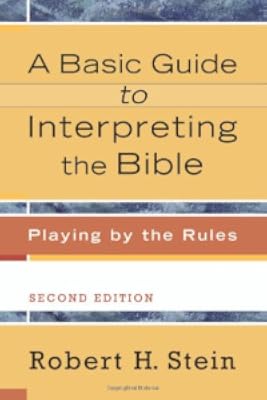
A Basic Guide to Interpreting the Bible: Playing by the Rules
by Robert H. Stein
On This Page
Description
"In this accessible guide to interpreting the Bible, senior New Testament scholar Robert Stein helps readers identify various biblical genres, understand the meaning of biblical texts, and apply that meaning to contemporary life. This edition has been completely revised throughout to reflect Stein's current thinking and changes to the discipline over the past decade. Students of the Bible will find the book effective in group settings" -- Publisher description.Tags
Recommendations


Member Reviews
The content is sound, but the conceit of the book is annoying to me as a reader, and I fear will not wear well. It's designed for a layperson's introduction to hermeneutics, with each chapter a different genre with "rules" for "playing the game." I thought Leland Ryken's book on genres to be better written and less condescending.
This is the perfect book for one who is getting familiar with how to better interpret the Bible and avoid misunderstanding that would mislead one to either misapply it's meaning to practical life or discounting as impractical or irrelevant for life. The author begins by naming the components involved in hermeneutics to different types of Scripture how to identify the general rules to apply to each type. Stein even proposes that the Spirit of God in intimately involved in the process of interpreting texts and discusses some terms as "illumination" and "foolishness" as it is applied in relation to the Spirit.
Stein provides many and various Biblical texts of all types as examples how each should b interpreted according to its genre. He show more provides some simple illustrations that help visualize and, thereby, apprehend more clearly the issues of interpretation being discussed.
The reading is clear, simple, focused and to the point. I recommend it highly for beginners like me in gaining a coherent understanding of the Biblical texts.
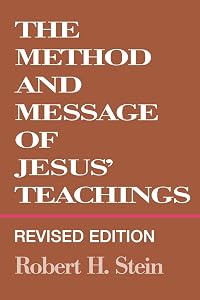
I also recommend his two others of his books, "Difficult Passages in the New Testament" and "The Method and Message of Jesus' Teachings." In the former, he rehearses passages that may seem puzzling and, in the latter, he concentrates on the form and content of Jesus' teachings. Interestingly enough, in the "Method and Message," Stein devotes a full chapter, almost 30 pages, to the parables.
For those new to the Bible, Christian or not, who want to gain a better grasp of how to approach the Bible and for older believers who just wish a refresher course, these three books are a great place to start. show less
Stein provides many and various Biblical texts of all types as examples how each should b interpreted according to its genre. He show more provides some simple illustrations that help visualize and, thereby, apprehend more clearly the issues of interpretation being discussed.
The reading is clear, simple, focused and to the point. I recommend it highly for beginners like me in gaining a coherent understanding of the Biblical texts.
I also recommend his two others of his books, "Difficult Passages in the New Testament" and "The Method and Message of Jesus' Teachings." In the former, he rehearses passages that may seem puzzling and, in the latter, he concentrates on the form and content of Jesus' teachings. Interestingly enough, in the "Method and Message," Stein devotes a full chapter, almost 30 pages, to the parables.
For those new to the Bible, Christian or not, who want to gain a better grasp of how to approach the Bible and for older believers who just wish a refresher course, these three books are a great place to start. show less
My review as posted on amazon.com
Robert Stein (professor of NT at Bethel Theological Seminary) explains the importance of playing by the rules of Bible interpretation to grasp the author's original intent.
One point the author makes is to establish the Rules of Interpretation. Stein breaks this into a four part teaching consisting of Hermeneutics, Vocabulary, Spiritual and Biblical, and the different Forms of Scripture. Stein lays out the roles of the Author, the Text, and the Reader. The second main point in the book is the specific rules of the individual games such as; Wisdom, Prediction, Poetry, Idioms, Hyperbole, Parables, Biblical Narrative, Epistles and Treaties, Laws, and Songs.
Another concept that is covered is the literary show more genre (literary form) being used by the author that governs that form. An example is the author had previously struggled with the correct meaning of the Beatitudes. Stein realizes that the Beatitudes were not addressed as "conditions for membership" rather, as blessing addressed to "as blessings pronounced upon those already within the kingdom" The author gives very convincing details as to why we should believe this interpretation.
A final important point is the Sensus Plenior (fuller meaning) of the text in chapter six. And the difficulties when this speaks about when the author willed to convey one truth, God had a different truth he willed to convey by the same vocabulary and grammar. An example of this is addressed in Isaiah 7:14 and Hosea 11:1 (Isaiah's day) which would mean a maiden (described as a virgin in the NT) would give birth to a son named Immanuel.
In conclusion, "A Basic Guide to Interpreting the BIBLE" by Robert H. Stein discusses a myriad of scriptures, putting them in the proper literary form to discover the original intention of the author. The author has presented the necessary steps needed to put the scriptures in proper context as the Biblical authors intended.
My opinion of the book is that the author has spent a great deal of time in his research, and he has a vast knowledge of scripture. Many valuable resources are utilized within the book, and the book is very well outlined from start to finish. I found the book challenging and somewhat difficult to read at times, yet it heightened my awareness to the importance of proper hermeneutics. If you are countering struggles in understanding scriptures, I highly recommend adding this book to your shelf as a valuable reference tool whether you are an apologist or lay Christian. Each chapter ends with a questionnaire to get you engaged with the concepts. show less
Robert Stein (professor of NT at Bethel Theological Seminary) explains the importance of playing by the rules of Bible interpretation to grasp the author's original intent.
One point the author makes is to establish the Rules of Interpretation. Stein breaks this into a four part teaching consisting of Hermeneutics, Vocabulary, Spiritual and Biblical, and the different Forms of Scripture. Stein lays out the roles of the Author, the Text, and the Reader. The second main point in the book is the specific rules of the individual games such as; Wisdom, Prediction, Poetry, Idioms, Hyperbole, Parables, Biblical Narrative, Epistles and Treaties, Laws, and Songs.
Another concept that is covered is the literary show more genre (literary form) being used by the author that governs that form. An example is the author had previously struggled with the correct meaning of the Beatitudes. Stein realizes that the Beatitudes were not addressed as "conditions for membership" rather, as blessing addressed to "as blessings pronounced upon those already within the kingdom" The author gives very convincing details as to why we should believe this interpretation.
A final important point is the Sensus Plenior (fuller meaning) of the text in chapter six. And the difficulties when this speaks about when the author willed to convey one truth, God had a different truth he willed to convey by the same vocabulary and grammar. An example of this is addressed in Isaiah 7:14 and Hosea 11:1 (Isaiah's day) which would mean a maiden (described as a virgin in the NT) would give birth to a son named Immanuel.
In conclusion, "A Basic Guide to Interpreting the BIBLE" by Robert H. Stein discusses a myriad of scriptures, putting them in the proper literary form to discover the original intention of the author. The author has presented the necessary steps needed to put the scriptures in proper context as the Biblical authors intended.
My opinion of the book is that the author has spent a great deal of time in his research, and he has a vast knowledge of scripture. Many valuable resources are utilized within the book, and the book is very well outlined from start to finish. I found the book challenging and somewhat difficult to read at times, yet it heightened my awareness to the importance of proper hermeneutics. If you are countering struggles in understanding scriptures, I highly recommend adding this book to your shelf as a valuable reference tool whether you are an apologist or lay Christian. Each chapter ends with a questionnaire to get you engaged with the concepts. show less
Ratings
Members
- Recently Added By
Lists

Trinity Norman Recommended Christian Readings
170 works; 5 members
Author Information

24+ Works 3,724 Members
Robert H. Stein (PhD, Princeton Theological Seminary), now retired, served as senior professor of New Testament interpretation at The Southern Baptist Theological Seminary. He is the author of several books, including Mark in the Baker Exegetical Commentary on the New Testament, Studying the Synoptic Gospels, Luke, and Jesus the Messiah.
Common Knowledge
- Canonical title
- A Basic Guide to Interpreting the Bible: Playing by the Rules
Classifications
Statistics
- Members
- 762
- Popularity
- 36,835
- Reviews
- 3
- Rating
- (3.71)
- Languages
- English, Finnish
- Media
- Paper, Ebook
- ISBNs
- 5
- ASINs
- 5