On This Page
Description
The Simney family, of Hazelwood Hall, have a dubious history. Sir George Simney, who was travelling in Australia before the baronetcy fell to him, sleeps with a shotgun by his side. When he is found dead in the library, the Reverend Adrian Deamer will not rest until he has discovered who is responsible. This is an absorbing tale narrated by Simney's widow, Nicolette, and by young Harold, who has just joined the C.I.D.Tags
Recommendations
















Member Reviews
Summary: The master of Hazelwood Hall is murdered shortly after Australian relatives join a manor of people who hate him.
What Happened at Hazelwood is Michael Innes’ version of a country manor murder mystery. One of the unusual features is that the story is narrate by two narrators in three parts. Firstly, Lady Simney, the unhappy actress wife of the murdered Sir George Simney narrates events up to the murder. Then the assistant of Inspector Cadover (no Appleby!) narrates their investigation. Finally, Lady Simney narrates the denouement, an ending that surprises her as well as many readers.
Sir George Simney is the master of Hazelwood Hall, the ancestral country seat of the Simney’s. Sir George is not well-liked and the household an show more unhappy one. As a young man, he ventured to Australia, surviving an accident killing his brother Denzell, pulling off a swindle of relatives known as the Dismal Swamp affair, and landing back in England as Lord of the manor. His butler Alfred Owden has a son, Timmy, who looks like a Simney. A widowed sister, Lucy, has a son, Mervyn, who could be a twin of Timmy. There is also an unmarried sister Grace, who in cohoots with the local vicar, wants to stamp out sin in the manor. A younger brother, Bevis is also visiting, with his artist son Willoughby.
A fight breaks out among them at dinner, only to be interrupted by the arrival of Australian relatives. Hippias Simney is accompanied by his son Gerard and Gerard’s wife, Joyleen, who subsequently has a flirtation with George. Immediately, a quarrel breaks out about the Dismal Swamp. And later that night, an encounter with the guests results in Albert dropping a tray full of crystal.
Without going into all the doings of the next unhappy day, the household turns in on a snowy night. Then Alfred enters Sir George’s library, bring refreshment as he is accustomed to do when he discovers Sir George dead from a blow to the back of the head. There is a look of surprise and terror on the dead man’s face.
Cadover’s assistant then picks up the narrative. He renders the account of the household’s whereabouts and movements. There are tracks in the snow to explain as well as a pair of boots in Sir George’s safe (and nothing else). The arrival of an old flame of Lady Simney’s in town adds another wrinkle. The problem is, while there are a lot of subjects, the evidence on hand does not clearly point at any of them.
Lady Simney narrates the final part. One more person dies. Timmy reads a letter. Cadover unravels the manner of Simney’s death. All of this is full of surprises for the readers, and for some of the characters.
This book was uncharacteristic for those of Innes I have read. He takes a long time to unfold the plot. I found implausible a number of elements. The change of narrators seemed a bit clumsy. Yet I liked the conclusion. But it just seemed that the plot to get there was not as elegant as other Innes books. show less
What Happened at Hazelwood is Michael Innes’ version of a country manor murder mystery. One of the unusual features is that the story is narrate by two narrators in three parts. Firstly, Lady Simney, the unhappy actress wife of the murdered Sir George Simney narrates events up to the murder. Then the assistant of Inspector Cadover (no Appleby!) narrates their investigation. Finally, Lady Simney narrates the denouement, an ending that surprises her as well as many readers.
Sir George Simney is the master of Hazelwood Hall, the ancestral country seat of the Simney’s. Sir George is not well-liked and the household an show more unhappy one. As a young man, he ventured to Australia, surviving an accident killing his brother Denzell, pulling off a swindle of relatives known as the Dismal Swamp affair, and landing back in England as Lord of the manor. His butler Alfred Owden has a son, Timmy, who looks like a Simney. A widowed sister, Lucy, has a son, Mervyn, who could be a twin of Timmy. There is also an unmarried sister Grace, who in cohoots with the local vicar, wants to stamp out sin in the manor. A younger brother, Bevis is also visiting, with his artist son Willoughby.
A fight breaks out among them at dinner, only to be interrupted by the arrival of Australian relatives. Hippias Simney is accompanied by his son Gerard and Gerard’s wife, Joyleen, who subsequently has a flirtation with George. Immediately, a quarrel breaks out about the Dismal Swamp. And later that night, an encounter with the guests results in Albert dropping a tray full of crystal.
Without going into all the doings of the next unhappy day, the household turns in on a snowy night. Then Alfred enters Sir George’s library, bring refreshment as he is accustomed to do when he discovers Sir George dead from a blow to the back of the head. There is a look of surprise and terror on the dead man’s face.
Cadover’s assistant then picks up the narrative. He renders the account of the household’s whereabouts and movements. There are tracks in the snow to explain as well as a pair of boots in Sir George’s safe (and nothing else). The arrival of an old flame of Lady Simney’s in town adds another wrinkle. The problem is, while there are a lot of subjects, the evidence on hand does not clearly point at any of them.
Lady Simney narrates the final part. One more person dies. Timmy reads a letter. Cadover unravels the manner of Simney’s death. All of this is full of surprises for the readers, and for some of the characters.
This book was uncharacteristic for those of Innes I have read. He takes a long time to unfold the plot. I found implausible a number of elements. The change of narrators seemed a bit clumsy. Yet I liked the conclusion. But it just seemed that the plot to get there was not as elegant as other Innes books. show less
Shortly after the arrival of some Australian relatives, the "bad baronet" Sir George Simney is murdered. The tale of the circumstances and investigation is told at first by his wife, then taken up by the young assistant to the all-knowing investigator. The true story emerges in bits and pieces, with the usual red herrings and dead ends competing for our attention before the complicated truth is revealed.
Innes's style and pacing are enjoyable. The narration provided by each viewpoint character tells us about those characters as well as the facts of the story. The little bit of karma or comeuppance we see is fairly gentle. The detective drags in bits of Cuvier and Gilbert and Sullivan, giving a certain Victorian flair to the proceedings. show more
In the interest of verisimilitude, the eldest of the Australian Simneys does "drop some Ns" in the course of describing the practice of "blackbirding." To have used a more PC term would have seemed out of place in this context, and the offensive term should not have the same effect it would have in a more modern story or if spoken by a contemporary character.
Overall the book is a nice combination of police procedure and humorous telling, with some exotic background facts and an entertaining conclusion. Not a great book but definitely a fun read. show less
Innes's style and pacing are enjoyable. The narration provided by each viewpoint character tells us about those characters as well as the facts of the story. The little bit of karma or comeuppance we see is fairly gentle. The detective drags in bits of Cuvier and Gilbert and Sullivan, giving a certain Victorian flair to the proceedings. show more
In the interest of verisimilitude, the eldest of the Australian Simneys does "drop some Ns" in the course of describing the practice of "blackbirding." To have used a more PC term would have seemed out of place in this context, and the offensive term should not have the same effect it would have in a more modern story or if spoken by a contemporary character.
Overall the book is a nice combination of police procedure and humorous telling, with some exotic background facts and an entertaining conclusion. Not a great book but definitely a fun read. show less
When the arrival of Australian relations produces even more turbulence amongst the Simney family than they manage by themselves, the result is murder.
I don't think I've ever read this Innes before, and it really isn't one of his better ones. When Nicolette resumes the narrative after the part narrated by Harold, Inspector Cadover's sidekick, I was momentarily confused in several places as I thought Harold was still the narrator. And even amongst the weird and wonderful solutions Michael Innes and Edmund Crispin indulge in, this solution stands out as pretty unbelievable.
I don't think I've ever read this Innes before, and it really isn't one of his better ones. When Nicolette resumes the narrative after the part narrated by Harold, Inspector Cadover's sidekick, I was momentarily confused in several places as I thought Harold was still the narrator. And even amongst the weird and wonderful solutions Michael Innes and Edmund Crispin indulge in, this solution stands out as pretty unbelievable.
Ratings
Members
- Recently Added By
Lists

Must Read Detective Stories (Nick Fuller)
278 works; 2 members
Author Information

101+ Works 10,658 Members
John Innes Mackintosh Stewart was born in Edinburgh. He attended Oxford where he studied English. He taught English in universities at the University of Adelaide, in South Australia. Stewart published novels, short stories, studies in literature, biographies, and plays. Under his name, he wrote scholarly works such as Character and Motive in show more Shakespeare, Rudyard Kipling, and Thomas Hardy. As Michael Innes, he wrote over fifty detective novels with Inspector John Appleby of Scotland Yard in London as the main character. These titles include Death at the President's Lodging, The Journeying Boy, Lament for a Maker, Operation Pax, the Crabtree Affair and Silence Observed. Stewart died on November 12, 1994. (Bowker Author Biography) show less
Some Editions
Series

Belongs to Publisher Series
Penguin Books (2650)
Common Knowledge
- Canonical title
- What Happened at Hazelwood
- Original publication date
- 1946
- People/Characters
- Adrian Deamer (the Reverend); Inspector Cadover; Lucy Cockayne (Sir George's sister); Mervyn Cockayne (Lucy's son); Christopher Hoodless (anthropologist); Timmy Owdon (show all 15); Bevis Simney; Denzell Simney; Gerard Simney (Hippias' son); Sir George Simney; Grace Simney (Sir George's sister); Hippias Simney; Joyleen Simney (Gerard's wife); Nicolette Simney; Willoughby Simney (Bevis' son)
- Important places
- England, UK; Hazelwood
- First words
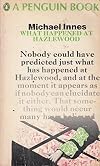
- Nobody could have predicted just what has happened at Hazelwood, and at the moment it appears as if nobody can elucidate it either.
- Last words
- (Click to show. Warning: May contain spoilers.)'Now, look here,' he said - and his tone was at once ingratiating and aggrieved - 'about that bally low trick your father played us over Dismal Swamp...'
- Disambiguation notice
- There seems to be confusion over the spelling of the title, which appears as 'Hazlewood' on the cover of some editions. However, the name is spelt 'Hazelwood' in the text.
Classifications
Statistics
- Members
- 150
- Popularity
- 217,627
- Reviews
- 3
- Rating
- (3.85)
- Languages
- English, Spanish, Swedish
- Media
- Paper, Audiobook, Ebook
- ISBNs
- 7
- ASINs
- 11