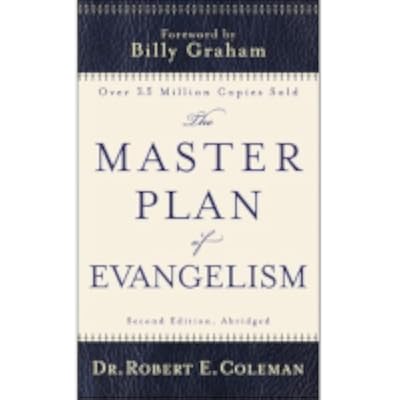
The Master Plan of Evangelism
by Robert E. Coleman
On This Page
Description
For more than forty years this classic study has challenged and instructed more than 1.5 million readers in reaching the world for Christ. With a foreword by Billy Graham and now repackaged for a new generation of readers, The Master Plan of Evangelism will show every Christian how to minister to the people God brings into their lives. Instead of drawing on the latest popular fad or the newest selling technique, Robert E. Coleman looks to the Bible to find the answer to the question, What show more was Christ's strategy for evangelism? Through a thorough examination of the gospel accounts, Coleman points out unchanging, simple, yet profound biblical principles of how to emulate Christ to others. show lessTags
Recommendations




























Member Reviews
The best book outside of the Bible I have read about evangelism, and one that truly needs to be studied by more pastors and anyone who wants to be used by the Lord in this manner. Coleman's vision is one that we are probably not used to. In fact, it can make us a little uncomfortable. Basically, what he advocates above almost anything else in evangelism is time. Cold evangelism in a mall may cause many to profess a belief, but it is usually either a stunted belief that will never grow or a false convert. Christ did it differently. He dedicated the time it took to raise up leaders rather than simply settling for a conversion. Those leaders then raised up their own students, and the world was changed.
Coleman's classic book on discipleship (yes, that's right) is titled The Master Plan of Evangelism. The thesis is that Jesus' plan for evangelism was the making of mature disciples. Little more than an examination of the gospels to study Jesus' example of discipleship, this little book provides needed insight into what discipleship is and isn't in a day when the church has largely forgotten it's call to make disciples rather than converts.
Coleman lays out 8 basic principles gleaned from study of the gospels: Selection, Association, Consecration, Impartation, Demonstration, Delegation, Supervision, and Reproduction.
While not spell-binding, a very worthwhile read!
Coleman lays out 8 basic principles gleaned from study of the gospels: Selection, Association, Consecration, Impartation, Demonstration, Delegation, Supervision, and Reproduction.
While not spell-binding, a very worthwhile read!
Concise, clear and compelling. Coleman lays out the meaning and method of raising up men to transform the world. Looking at the life of Jesus, Coleman relates Jesus' method of training men to carry on the task of evangelizing the world, and this method, Coleman says, should be adopted by Jesus' followers if they want to make an impact on the world. With all the latest methods and programs, this 1963 book is as good as they get.
This is the kind of work that deserves to have "paradigm shifts" attributed to its pages. It is my belief that the lack of qualified leadership in the Church is a result of the rejection of Christ's model as understood in Coleman's book.
Coleman, Robert E. The Master Plan of Evangelism. Grand Rapids: Fleming H. Revell. 200 pp. $12.99
If one judges a book’s worth by its length of continuous years in print, then Robert Coleman’s Master Plan of Evangelism may well be accurately considered the master plan. At the very least it should be in the running if such a designation existed. This unpretentious little book has been in print for over forty-seven consecutive years now. Another testimony to its significance is that I have been in three degree programs in the field of biblical and theological study and this book has been required in each of them. Surely, this warrants the status of classic.
Robert E. Coleman is professor emeritus of evangelism at Trinity Evangelical show more Divinity School in Deerfield, Illinois. He has been at Trinity since 1983. Dr. Coleman came to Trinity from Asbury Theological Seminary, where he taught evangelism for 27 years. Prior to that, he spent six years pastoring United Methodist churches in Indiana, New Jersey, and Iowa.
Dr. Coleman’s areas of expertise include the evangelism of Jesus, discipleship, the theology of evangelism, contemporary church evangelism, the history and theology of revival, evangelistic preaching, and the songs of heaven. He is a member of the Evangelical Theological Society, the Evangelical Missiological Society, and the Academy for Evangelism in Theological Education. He is director of the Billy Graham Institute of Evangelism at Wheaton and dean of the International Schools of Evangelism. He is a founding member of the Lausanne Committee for World Evangelism and the president of the Christian Outreach Foundation. He serves on the board of the OMS International.
Coleman has written 21 books, and his books have been translated into 95 languages, English editions alone having a total circulation of more than five million copies. Dr. Coleman also wrote The Master’s Way of Personal Evangelism, The Heartbeat of Evangelism, The Mind of the Master, The Master Plan of Discipleship, The Great Commission Lifestyle, Nothing To Do but Save Souls: John Wesley’s Charge to His Preachers, and The Coming World Revival, among others.
In a day of novelty and innovation for the sheer purpose of standing out, the genius of The Master Plan of Evangelism is that it is based on indisputable biblical principles set in a very simple and straight-forward format. Coleman’s teaching gift is self-evident by the manner in which he organizes his material. The sad part is that despite the soundness of the principles set forth, and the ease with which the book’s content can be accessed, some churches and pastors seem to have missed the message. Many, however, have responded positively to some of Coleman’s admonitions. As I reread the pages of this book, I recollected how it shaped my own thinking about means and methodologies of evangelism and disciple-making.
The book’s stated aim is to discover, from the pages of the gospels, and set forth the underlying principles that guided Jesus’ methods of evangelism and disciple-making. Coleman’s driving contention is that the Bible, particularly the gospels, is our best textbook for evangelism. The book is organized around eight principles that are derived, described, and demonstrated in each of their respective chapters. One word descriptors of the principles serve as the chapter headings. These one word headings serve to make the principles an ease for commitment to memory. In addition, if one is not careful, this may be missed. Each chapter head has a key verse associated with it. For instance, for chapter 2 whose heading is the principle of association, the corresponding verse is Matthew 28:20, “Lo, I am with you always.” For chapter eight the principle is reproduction, and the supporting verse comes from John 16:16, “Go and bring forth fruit.” I love the accessibility and ease with which Coleman has arranged his material. The book is clearly written with the goal of imparting knowledge, not novelty.
The eight one word principles that Coleman sets forth as the underlying principles of Jesus’ ministry are selection, association, consecration, impartation, demonstration, delegation, supervision, and reproduction. Coleman insists that these are not necessarily in chronological order, however, selection will likely be first and reproduction will always be the goal as disciples inherently multiply themselves. Coleman’s work here endures because he has not written a book here on methodologies, but principles that must guide us into faithful and fruitful methods. The methods may change due to contextual considerations, but the principles, if sound, should in fact work cross-culturally.
The aspect of fruitfulness or outcomes brings to mind another helpful attribute of this work. Coleman has written a patient book here. By that I mean he makes clear that Jesus was not haphazardly or hurriedly aiming to amass crowds, but rather he was intentionally and patiently building his kingdom. Coleman makes no effort here to give eight ways to triple your baptisms this year. Instead, he readies his reader for the difficult work of evangelism and disciple-making.
One of the strengths of Coleman’s approach to evangelism in this book is that it unites evangelism and discipleship. Though one ought not to have to unite what the Bible never separates, we know this happens. It happens with justification and sanctification, and in some ways these woeful but real man-made dichotomies are connected. Many treat evangelism as a program within the church that folks can either sign up for or not. They do the same with discipleship, making it seem as though discipleship is for the really serious church members in the congregation, and evangelism is for the really weird ones. Coleman convincingly shows that Jesus intentionally invested himself on various levels concentrically with increasing attention to intention, given the size of the group with which he was working. One might consider the crowd, congregation, core model as the visual for how Jesus invested himself. This method should not be interpreted, as some obviously have, to think that only the core represent evangelistic disciple-makers. Coleman demonstrates how Jesus invested in the select core to go reproduce themselves in others who will do the same. It is the principle of multiplication or to be consistent with Coleman’s terminology, reproduction. Every believer should be enlisted, equipped, and encouraged to go and make disciples, a reality that Coleman designates, delegation.
As many in the church today are trying to figure out where all the men have gone in our congregations, church leaders would do well to be reminded of the principle of association that Coleman draws out. Jesus selected and used men, ordinary men, to be with them and thus replicate his ministry in them. Pastors cannot be with everyone, in the same way and with the same amount of influence, but they can invest in others in a concentrated and intentional way that will equip men to reach and teach others. Some pastors have chosen, because the relational challenges that have to be navigated in order to intently focus on the few while ministering to the many, to not be with anyone. This is a fatal mistake. Perhaps what needs to be written about is how a pastor might communicate the need to employ Jesus’ methodology while at the same time implementing it in the life of the church so that others don’t feel neglected. When we do ministry Jesus’ way, we can be certain that we will find ourselves dealing with the same sinful social dynamics in our church life that our Lord dealt with among the twelve. Remember the “who is the greatest” debate? A servant is not greater than his master. This difficulty in the church setting does not warrant the reality that if we are going to win and make disciples who duplicate themselves, then we are going to have to spend time with people. Some may argue that in mega church settings pastors do this without such close and intentional attention, but I would argue that they may be duplicating their pulpit personality from afar. However, it is not likely they are discipling others within the congregation. Even those pastors should be involved in the process of winning and making disciples.
The usefulness of this book is its simplicity. I believe that the principles are biblically sound and universally applicable. This is not, nor is it intended to be a “What would Jesus do?” book. Rather, Coleman has keenly identified the underlying principles that help us understand the unobtrusive method of Jesus, so that we ourselves might readily employ them in our setting. Later versions of Master Plan have included a study guide so that the book is perfectly suited for small group study or leader retreats. Coleman has written in such a way that a pastor may confidently place it in the hands of the most humble member and not be afraid of intimidating them and yet at the same time challenges the most seasoned believer. What an accomplishment!
Correctly understood and applied, the principles contained herein can effectively help us rescue evangelism from being something seen as seasonal or special and bring it where it belongs as the normative activity of every born again believer. In addition, it reminds us that the converted are also committed to an obedient pattern of discipleship which grows outward into the world. show less
If one judges a book’s worth by its length of continuous years in print, then Robert Coleman’s Master Plan of Evangelism may well be accurately considered the master plan. At the very least it should be in the running if such a designation existed. This unpretentious little book has been in print for over forty-seven consecutive years now. Another testimony to its significance is that I have been in three degree programs in the field of biblical and theological study and this book has been required in each of them. Surely, this warrants the status of classic.
Robert E. Coleman is professor emeritus of evangelism at Trinity Evangelical show more Divinity School in Deerfield, Illinois. He has been at Trinity since 1983. Dr. Coleman came to Trinity from Asbury Theological Seminary, where he taught evangelism for 27 years. Prior to that, he spent six years pastoring United Methodist churches in Indiana, New Jersey, and Iowa.
Dr. Coleman’s areas of expertise include the evangelism of Jesus, discipleship, the theology of evangelism, contemporary church evangelism, the history and theology of revival, evangelistic preaching, and the songs of heaven. He is a member of the Evangelical Theological Society, the Evangelical Missiological Society, and the Academy for Evangelism in Theological Education. He is director of the Billy Graham Institute of Evangelism at Wheaton and dean of the International Schools of Evangelism. He is a founding member of the Lausanne Committee for World Evangelism and the president of the Christian Outreach Foundation. He serves on the board of the OMS International.
Coleman has written 21 books, and his books have been translated into 95 languages, English editions alone having a total circulation of more than five million copies. Dr. Coleman also wrote The Master’s Way of Personal Evangelism, The Heartbeat of Evangelism, The Mind of the Master, The Master Plan of Discipleship, The Great Commission Lifestyle, Nothing To Do but Save Souls: John Wesley’s Charge to His Preachers, and The Coming World Revival, among others.
In a day of novelty and innovation for the sheer purpose of standing out, the genius of The Master Plan of Evangelism is that it is based on indisputable biblical principles set in a very simple and straight-forward format. Coleman’s teaching gift is self-evident by the manner in which he organizes his material. The sad part is that despite the soundness of the principles set forth, and the ease with which the book’s content can be accessed, some churches and pastors seem to have missed the message. Many, however, have responded positively to some of Coleman’s admonitions. As I reread the pages of this book, I recollected how it shaped my own thinking about means and methodologies of evangelism and disciple-making.
The book’s stated aim is to discover, from the pages of the gospels, and set forth the underlying principles that guided Jesus’ methods of evangelism and disciple-making. Coleman’s driving contention is that the Bible, particularly the gospels, is our best textbook for evangelism. The book is organized around eight principles that are derived, described, and demonstrated in each of their respective chapters. One word descriptors of the principles serve as the chapter headings. These one word headings serve to make the principles an ease for commitment to memory. In addition, if one is not careful, this may be missed. Each chapter head has a key verse associated with it. For instance, for chapter 2 whose heading is the principle of association, the corresponding verse is Matthew 28:20, “Lo, I am with you always.” For chapter eight the principle is reproduction, and the supporting verse comes from John 16:16, “Go and bring forth fruit.” I love the accessibility and ease with which Coleman has arranged his material. The book is clearly written with the goal of imparting knowledge, not novelty.
The eight one word principles that Coleman sets forth as the underlying principles of Jesus’ ministry are selection, association, consecration, impartation, demonstration, delegation, supervision, and reproduction. Coleman insists that these are not necessarily in chronological order, however, selection will likely be first and reproduction will always be the goal as disciples inherently multiply themselves. Coleman’s work here endures because he has not written a book here on methodologies, but principles that must guide us into faithful and fruitful methods. The methods may change due to contextual considerations, but the principles, if sound, should in fact work cross-culturally.
The aspect of fruitfulness or outcomes brings to mind another helpful attribute of this work. Coleman has written a patient book here. By that I mean he makes clear that Jesus was not haphazardly or hurriedly aiming to amass crowds, but rather he was intentionally and patiently building his kingdom. Coleman makes no effort here to give eight ways to triple your baptisms this year. Instead, he readies his reader for the difficult work of evangelism and disciple-making.
One of the strengths of Coleman’s approach to evangelism in this book is that it unites evangelism and discipleship. Though one ought not to have to unite what the Bible never separates, we know this happens. It happens with justification and sanctification, and in some ways these woeful but real man-made dichotomies are connected. Many treat evangelism as a program within the church that folks can either sign up for or not. They do the same with discipleship, making it seem as though discipleship is for the really serious church members in the congregation, and evangelism is for the really weird ones. Coleman convincingly shows that Jesus intentionally invested himself on various levels concentrically with increasing attention to intention, given the size of the group with which he was working. One might consider the crowd, congregation, core model as the visual for how Jesus invested himself. This method should not be interpreted, as some obviously have, to think that only the core represent evangelistic disciple-makers. Coleman demonstrates how Jesus invested in the select core to go reproduce themselves in others who will do the same. It is the principle of multiplication or to be consistent with Coleman’s terminology, reproduction. Every believer should be enlisted, equipped, and encouraged to go and make disciples, a reality that Coleman designates, delegation.
As many in the church today are trying to figure out where all the men have gone in our congregations, church leaders would do well to be reminded of the principle of association that Coleman draws out. Jesus selected and used men, ordinary men, to be with them and thus replicate his ministry in them. Pastors cannot be with everyone, in the same way and with the same amount of influence, but they can invest in others in a concentrated and intentional way that will equip men to reach and teach others. Some pastors have chosen, because the relational challenges that have to be navigated in order to intently focus on the few while ministering to the many, to not be with anyone. This is a fatal mistake. Perhaps what needs to be written about is how a pastor might communicate the need to employ Jesus’ methodology while at the same time implementing it in the life of the church so that others don’t feel neglected. When we do ministry Jesus’ way, we can be certain that we will find ourselves dealing with the same sinful social dynamics in our church life that our Lord dealt with among the twelve. Remember the “who is the greatest” debate? A servant is not greater than his master. This difficulty in the church setting does not warrant the reality that if we are going to win and make disciples who duplicate themselves, then we are going to have to spend time with people. Some may argue that in mega church settings pastors do this without such close and intentional attention, but I would argue that they may be duplicating their pulpit personality from afar. However, it is not likely they are discipling others within the congregation. Even those pastors should be involved in the process of winning and making disciples.
The usefulness of this book is its simplicity. I believe that the principles are biblically sound and universally applicable. This is not, nor is it intended to be a “What would Jesus do?” book. Rather, Coleman has keenly identified the underlying principles that help us understand the unobtrusive method of Jesus, so that we ourselves might readily employ them in our setting. Later versions of Master Plan have included a study guide so that the book is perfectly suited for small group study or leader retreats. Coleman has written in such a way that a pastor may confidently place it in the hands of the most humble member and not be afraid of intimidating them and yet at the same time challenges the most seasoned believer. What an accomplishment!
Correctly understood and applied, the principles contained herein can effectively help us rescue evangelism from being something seen as seasonal or special and bring it where it belongs as the normative activity of every born again believer. In addition, it reminds us that the converted are also committed to an obedient pattern of discipleship which grows outward into the world. show less
Good content. I just got tired of it by the end. I felt like I understood the basic principles less than halfway through, and it was kind of monotonous to keep reading after that.
The Master Plan of Evangelism will show every Christian how to minister to the people God brings into their lives. Instead of drawing on the latest popular fad or the newest selling technique, Robert E. Coleman looks to the Bible to find the answer to the question, What was Christ's strategy for evangelism? Through a thorough examination of the gospel accounts, Coleman points out unchanging, simple, yet profound biblical principles of how to emulate Christ to others.
Members
- Recently Added By
Lists

Develop Your Personal Christian Library
101 works; 15 members

Top 50 Books That Have Shaped Evangelical Christians
49 works; 6 members
How to Read a Christian Book Three-Year Plan
36 works; 2 members

Xenos Christian Fellowship Book Suggestions
102 works; 2 members
Trinity Norman Recommended Christian Readings
170 works; 5 members
Author Information

57+ Works 6,255 Members
Robert E. Coleman is distinguished professor of evangelism and discipleship at Gordon-Conwell Theological Seminary. He also served as dean of the Billy Graham International Schools of Evangelism as well as director of the Billy Graham Center Institute of Evangelism at Wheaton College. He is the author of The Master Plan of Evangelism, which has show more sold more than three million copies. show less
Awards and Honors
Notable Lists
Series
Belongs to Publisher Series
Common Knowledge
- Original title
- The Master Plan of Evangelism
- Alternate titles
- 跟耶穌學佈道; 佈道大計; 佈道大計: 訓練門徒作佈道的智慧錦囊
- Original publication date
- 1963
- Dedication
- To Lyman and Margaret who dared to follow the Master Plan
- First words
- It all started by Jesus calling a few men to follow him.
- Last words
- (Click to show. Warning: May contain spoilers.)The relevance of all that we do waits on its verdict, and in turn, the destiny of the multitudes hangs in the balance.
- Blurbers
- Graham, Billy
Classifications
Statistics
- Members
- 4,048
- Popularity
- 3,836
- Reviews
- 20
- Rating
- (3.91)
- Languages
- 7 — Chinese, Dutch, English, German, Italian, Spanish, Swedish
- Media
- Paper, Audiobook, Ebook
- ISBNs
- 25
- ASINs
- 36