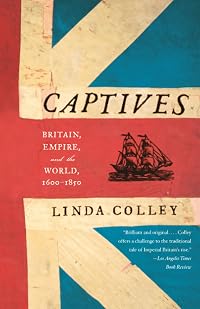
Captives: Britain, Empire, and the World, 1600-1850
by Linda Colley
On This Page
Description
Re-examines the history of the British empire from the perspective of those held captive, exploring the dynamics between invader and invaded, the character of cross-cultural conflicts, and the meaning of empire.Tags
Recommendations




























Member Recommendations

Member Reviews
I bought this book on a whim from a charity shop as it looked interesting and it didn't disappoint. It examines stories and experiences of Britons in captivity in three contexts: those captured in North Africa and in the Mediterranean area, in North America and India, in different phases of British attempts to increase its sphere of influence. Colley also looks like the publishing and other dissemination of the stories and the reactions to them. A fascinating book.
Move on, those of you who hoped to read titillating tiles of the white slave trade. No such thing here. The book starts with a relatively short part on British captives in Northern Africa, a second part on settlers in North America (who would occasionally go to live with the Indians, either voluntarily or forcibly), and a rather long and tedious part on conditions of army soldiers in India. These soldiers are called 'military captives', so as not to do too much injustice to the dramatic title (to no avail; it does feel like a dissertation on the military rank-and-file in India was given an garnish of two hastily written overviews of captives in Northern Africa and North America in order to justify the dramatic title). Even within this show more conceptual inconsistency, the book veers back and forth between general statements and individual stories, but neither are explored to the reader's full satisfaction.
The perspective remains staunchly Britain-centric throughout; little time or sympathy is spent on other captives (eg from other European countries in North Africa, or from France in North America).
The author does a good job of explaining popular sentiment in Britain during the American Revolution and on Indian matters, although it could all have done without the numerous repetitions. All in all, very uneven. show less
The perspective remains staunchly Britain-centric throughout; little time or sympathy is spent on other captives (eg from other European countries in North Africa, or from France in North America).
The author does a good job of explaining popular sentiment in Britain during the American Revolution and on Indian matters, although it could all have done without the numerous repetitions. All in all, very uneven. show less
Ratings
Members
- Recently Added By
Lists

Works Cited in The History of White People by Nell Irvin Painter
321 works; 2 members
Author Information

13+ Works 1,894 Members
Linda Colley was professor of history at yale University from 1982-1997 when she accepted an appointment at the London School of Economics and Political Science. She has just accepted a position as professor of history at Princeton which will begin in the Fall of 2003.
Series
Belongs to Publisher Series
The Wiles Lectures (1997)
Common Knowledge
- Original publication date
- 2002
- Important places
- British Empire
- Epigraph
- 'When the prison doors are opened, the real dragon will fly out.'
Ho Chi Minh, Prison Diary (Hanoi, 1962) - Dedication
- In memory of my mother Marjorie Colley, née Hughes; 1920-1998
- First words
- Two parables exist about the making and meanings of the British empire.
- Last words*
- (Click to show. Warning: May contain spoilers.)Il rischio che corriamo, altrimenti, è quello di caderne tutti prigionieri.
- Blurbers
- Barnes, Julian; Foster, Roy; Aldous, Richard; Gott, Richard
*Some information comes from Common Knowledge in other languages. Click "Edit" for more information.
Classifications
Statistics
- Members
- 374
- Popularity
- 83,864
- Reviews
- 2
- Rating
- (3.32)
- Languages
- English, Italian
- Media
- Paper, Ebook
- ISBNs
- 8
- ASINs
- 5