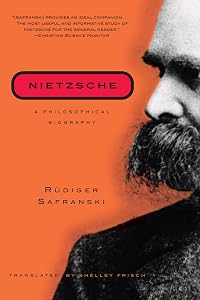
Nietzsche: A Philosophical Biography
by Rüdiger Safranski
On This Page
Description
No other modern philosopher has proved as influential as Friedrich Nietzsche (1844-1990) & none is as poorly understood. In the first major biography in decades, Rudiger Safranski re-creates the anguished life of Nietzsche while simultaneously assessing the philosophical implications of his morality, religion, & art. Plagued by illness & profoundly shaped by his tortured sexuality, Nietzsche was a man of masks & mood swings, a thinker who called himself "dynamite" yet labored under the show more weight of compulsive self-consciousness. Posing apt questions & at time offering unorthodox interpretations of Nietzsche's philosophical writings, Safranski offers a brilliant portrait of a historical figure in a work that is as groundbreaking as it will be long-lasting. show lessTags
Recommendations



















Member Reviews
One of the problems in studying philosophy historically is that philosophers are taken as an 'event' rather than as a 'process'. A master work is chosen as exemplar or the writer of a book tries to set down the philosophy of a thinker as if it was a thing out of time or out of cultural place.
This forgets that philosophers are thinking in time and over a life-cycle of their own from birth (as incipient personality) to culmination in death and that philosophers are not only responding to the past but to the shifting politics and social and cultural changes of their own era.
Safranski's 'Nietzsche' is very much the story of a process of thought, a 'philosophical biography', that lodges Nietzsche's thinking within a life (less so within a show more culture) and tracks how his thinking changed over decades until madness overtook him.
Seen in this way, his thought unfolds in three broad phases that match the way a man thinks as he grows and matures. How Nietzsche took something in his core personality and expanded it into something that changed our whole culture is the story of this book.
I write 'in his core personality' because, from a very early age, Nietzsche is thinking 'differently' and showing a driven quality to pursue thought to its limits. His life is 'thinking to its limits' in ways that were literally 'unthinkable' to his contemporaries and to the vast majority of our species even today.
The first phase of his thought is that largely of his twenties until his final breach with Wagner (1876, Age 32). Influenced by Schopenhauer, his early philosophy might be seen as interesting more in its potential rather than the actual. It is a philosophy of over-enthusiastic late romantic aesthetics.
A man of high intelligence drawn into academicism, he rebels because his thought processes see how dessicated was the world that he had joined professionally. Art (not art but Art) as a total Dionysian experience appeared to be a way out as he developed a theory of culture.
'The Birth of Tragedy' provides a grounding for his later thought, situated between his own reaction to Greek thought and what will become an emergent psychology - the bicameral tension between Dionysiac excess and Apollonian order.
The disillusion with Wagner (when he sees Bayreuth as just another example of what we might call 'show business') permits the second phase of his thinking which, in my view, is the most important of all - from 1876 until his transcendent peak experience in August 1881.
This relatively brief period in his mid-thirties allows him to escape German Idealism entirely and think, without restraint, about the relationship between himself and the world and so, more generally, about what it is to be human in relation to existence.
This is a period of both personal misery and sometimes ecstatic insight. He is making profound contributions to epistemology but also to psychology in ways that not merely anticipate Freud but, frankly, are vastly superior to the thinking of the later founder of the psychoanalytic wrong turn.
Above all, Nietzsche is a phenomenologist, observing with care how his own mind works in relation to the world and drawing general conclusions about the human condition. From there, he draws, less reliably, further conclusions about culture and society.
It is at this point that we might have hoped he would retain his full sanity and come to terms with the 'world-shattering' vision he was developing. But the link to personal misery, much of it expressed psychosomatically, and manic depression meant that things were not going to end well.
Given the culture into which he was born and his undoubtedly unstable personality, the idea that he could have somehow transformed himself into Heidegger 'avant la lettre' and explored his thinking about our relation to Being with dogged academic determination is absurd.
Nietzsche simply did not have the all the mental tools to sit back and observe his own thought in the way that he seemed to demand as necessary. He 'lived' his thought. His body 'lived' his thought. And he never found a way of conquering the psychological conflicts that his thought created.
One of the most interesting aspects of that thought is the transfer of his initially academic Dionysian-Apollonian analysis of culture and the human condition to psychology. Bicamerality is today seen as neuroscientifically real as our minds try to cope with balancing two hemispheres in the brain.
Nietzsche's intuitions about bicameral conflict, extended beyond the individual to society and culture as a whole, now look remarkably astute. Attempts to reconcile the impulses in one part of our brain with the cognitive apparatus of the other raise fundamental questions about perceived reality.
Our relationship to Being is complicated by physical responses to the fact of our being in Being (questions for Heidegger to deal with although he lost this bicameral psychological assessment in doing so). Nietzsche's real physical reaction to the process of thinking is part of the thought.
At the Surej boulder in 1881 (age 37), Nietzsche goes on a very different path. We might consider that the final phase before his collapse into madness in 1889 (Age 45) is one extended mid-life crisis in which he attempts to resolve his contradictions through assertion.
What we see is a drive towards self-expression as the 'will to power' amidst a new mythology of the 'eternal recurrence' and the promotion of his poetic character of Zarathustra. It is fertile stuff culturally but often hard to pin down as reliable 'philosophy'.
This final phase (if we discount the subsequent decade of insanity) is nevertheless of immense cultural importance although (I would argue) more philosophically barren. Sometimes it seems like a constant scream of egoistic 'look at me', increasingly monomaniac as time passes.
This is not to say that these powerful final works are not important but only that the thinking, which is often contradictory and extreme, sometimes has the feel of a tormented man letting rip on the psychologist's couch. Yet it is these works that mostly define what Nietzsche is to the public.
The power of these late works (which Safranski significantly spends relatively little time analysing) lies in the effect that their no-holds-barred narcissism has on Europeans looking for an excuse for high emotional expression in a repressive culture. Humans always need excuses.
A final chapter on the way Nietzsche's work came to be employed after his death is invaluable in this context especially because of its German focus, indicating how his thoughts came to be used before Heidegger, Adorno/Horkheimer and Foucault employed them as seeds for their own thought.
Can Nietzsche be 'blamed' for national socialism? Only a fool would not see that Nietzsche's late thought leads inexorably to its use as a tormented brutalism that follows logically from his refusal to compromise on his vision of the human condition. But 'blame' is absurd.
Indeed, it is hard to fault Nietzsche's logic (such as it is). Or, in some respects, even Hitler's and that of the national socialist philosophers like Bauemler, a rival to Rosenberg, who Safranski recognises as sophisticated. Nietzsche's brutal logic can imply national socialism without much difficulty.
Yes, his sister and brother-in-law twisted his legacy to serve German nationalism and, no, Nietzsche was anti-anti-semitic and highly critical of nationalism but special pleading cannot hide the continuity between the philosophy of existence and anti-Christian Nazi Darwinian struggle.
It is at this deeper (the scientific, in its time) level of existential skirting of nihilism with an invented commitment to will that we see the affinity between Nietzsche and National Socialism and not at the secondary level of antisemitism, militarism, nationalism and imperialism.
This is the problem with Nietzsche. The more you read his brute analysis of the human condition (the thinking of Truth including the non-Truth of Truth), the more plausible it becomes although there is no doubt that his struggle was always against the consequent logic arising from this of nihilism.
To avoid the nihilistic interpretation of reality, Nietzsche required a will to something, a human engagement in Life and this engagement in Life married to the darkness of Being resulted in a cruel and vicious view of life that failed to live up to the fanatic expectations for Life itself.
That this Truth troubled Nietzsche despite his attempt to think things through according to the facts of the matter becomes clear in snatches and it strikes me as no accident that he finally goes mad in response to the beating of a horse which could stand for inner revolt against his own philosophy.
It is as if he thought himself into a corner from which there was no escape but insanity and at times, being an honest man intellectually, he could see the way of the meek as a form of will to power whose conquest of the brute might perhaps be part of the Truth too.
Whenever he comes close to systematising his thought, his intellectual honesty (which is undoubted) would periodically break through in force to ask an awkward question of himself that might unravel the psychological scaffolding that held him together.
If we accept that Nietzsche describes our condition accurately once God is recognised to be dead (God stands for all past solutions to the human condition invented to avoid the Truth), then we are left with decisions about what to invent in its place.
Making the invention consonant with science as it was understood in the 1870s and 1880s in Europe means over-accepting science in the construction of the Overman (Ubermensch) and allowing Darwinism to become over-privileged in defining the human condition.
In other words, a correct assessment of our relation to the world as material existence (a different issue than the relation to Being as Heidegger would attempt to understand the problem) can get bogged down in inadequate assumptions about our scientific understanding of that world.
Nietzschean thought is literally 'beyond good and evil' because it can end up anywhere. Much of non-analytical philosophy since Nietzsche has, therefore, been spent trying to analyse the world in ways that restore some sort of value or re-jigs Truth to be more palatable (that is, not-Truth).
Each attempt to do so must be of its time and place much as Nietzsche's own solutions, which were less 'truthful' than the Truth, were bound by its (or rather his) conditions of existence. At this level, all philosophy is personal and about knowing where to sever derivative truths from the Truth itself.
In Nietzsche's case (Safranski is very informative on this), our philosopher was embedding his truth in the fact of science (the Appollonian/left hemisphere) in tension with the Dionysiac and so scientific materialism (not the Marxist version) became central to his will to power.
This is where Truth becomes problematic for our species - the innocent Darwin set off a chain of events that led to Auschwitz and Nietzsche was no more responsible for that than Darwin was. In both cases, ideas that were true became tools and weapons in the struggle for human meaning.
So, Nietzsche sits as a child of mid-century Germany trying to cope with personal turmoil, the death of God (which Heidegger found equally problematic), the rise of science, cultural philistinism, the chatter of the blind and the conventional and he came to certain conclusions.
For example, his analysis of Christianity in 'On The Genealogy of Morals' was only too accurate although his assesssment of socialism remained that of a spoiled bourgeois brat. What we do with his analyses is what counts and that includes fundamental criticism of the limitations of his thought.
Where Nietzsche 'went wrong' is only in failing to continue to think along the lines he was thinking in his second phase - phenomenologically, psychologically, epistemologically as well as existentially - and jumping into the cultural fray with a form of 'revelation' that over-privileged the Dionysiac.
This seems to be core to Nietzsche and to Nietzscheans - the centrality of the rational Apollonian in their assessment of reality but under conditions where they desperately yearn for the Dionysiac, the animal spirits of music, poetry and religion and try to force an older animal brain into action.
At a certain point, like an 'old man in a hurry' as if he knew time was limited, Nietzsche wanted to make a mark on the world, to be 'important, the centre of attention, a prophet, perhaps (through Zarathustra) a founder of new world religion or at least national culture.
In fact, Nietzsche was not inherently Dionysiac. He wanted it desperately. He thought himself into this state out of this desperation and perhaps it helped tip him over the edge into insanity. Certainly, the psychosomatic aspects of the second phase merge into near-monomania in the third.
He never stopped writing important things in that third phase but we, the reader, find ourselves shifting from the thought as a whole to abstracting the thoughts we find useful from a huge corpus of ranting and aphoristic position-taking which is exhausting and time-consuming to say the least.
Nietzsche must be counted a true genius if an unstable one but one around which we should be careful to retain our critical faculties. Safranski has thus done us a great service by showing his thought as a process within a particular context underpinned by a very definite personality.
What exactly we do with Nietzsche is down to our particular contexts and our particular personalities but one thing is clear. If we are at all serious about thinking, we have to start, in effect, from the Truth of our situation in relation to the world that this genius exposed to us.
His thought is only the beginning of our own thought and is not for the faint-hearted. It was always potentially very dangerous to individual and society alike. The continuing denial of its truth may indicate just how deluded about our condition we necessarily have to be in order to be human. show less
This forgets that philosophers are thinking in time and over a life-cycle of their own from birth (as incipient personality) to culmination in death and that philosophers are not only responding to the past but to the shifting politics and social and cultural changes of their own era.
Safranski's 'Nietzsche' is very much the story of a process of thought, a 'philosophical biography', that lodges Nietzsche's thinking within a life (less so within a show more culture) and tracks how his thinking changed over decades until madness overtook him.
Seen in this way, his thought unfolds in three broad phases that match the way a man thinks as he grows and matures. How Nietzsche took something in his core personality and expanded it into something that changed our whole culture is the story of this book.
I write 'in his core personality' because, from a very early age, Nietzsche is thinking 'differently' and showing a driven quality to pursue thought to its limits. His life is 'thinking to its limits' in ways that were literally 'unthinkable' to his contemporaries and to the vast majority of our species even today.
The first phase of his thought is that largely of his twenties until his final breach with Wagner (1876, Age 32). Influenced by Schopenhauer, his early philosophy might be seen as interesting more in its potential rather than the actual. It is a philosophy of over-enthusiastic late romantic aesthetics.
A man of high intelligence drawn into academicism, he rebels because his thought processes see how dessicated was the world that he had joined professionally. Art (not art but Art) as a total Dionysian experience appeared to be a way out as he developed a theory of culture.
'The Birth of Tragedy' provides a grounding for his later thought, situated between his own reaction to Greek thought and what will become an emergent psychology - the bicameral tension between Dionysiac excess and Apollonian order.
The disillusion with Wagner (when he sees Bayreuth as just another example of what we might call 'show business') permits the second phase of his thinking which, in my view, is the most important of all - from 1876 until his transcendent peak experience in August 1881.
This relatively brief period in his mid-thirties allows him to escape German Idealism entirely and think, without restraint, about the relationship between himself and the world and so, more generally, about what it is to be human in relation to existence.
This is a period of both personal misery and sometimes ecstatic insight. He is making profound contributions to epistemology but also to psychology in ways that not merely anticipate Freud but, frankly, are vastly superior to the thinking of the later founder of the psychoanalytic wrong turn.
Above all, Nietzsche is a phenomenologist, observing with care how his own mind works in relation to the world and drawing general conclusions about the human condition. From there, he draws, less reliably, further conclusions about culture and society.
It is at this point that we might have hoped he would retain his full sanity and come to terms with the 'world-shattering' vision he was developing. But the link to personal misery, much of it expressed psychosomatically, and manic depression meant that things were not going to end well.
Given the culture into which he was born and his undoubtedly unstable personality, the idea that he could have somehow transformed himself into Heidegger 'avant la lettre' and explored his thinking about our relation to Being with dogged academic determination is absurd.
Nietzsche simply did not have the all the mental tools to sit back and observe his own thought in the way that he seemed to demand as necessary. He 'lived' his thought. His body 'lived' his thought. And he never found a way of conquering the psychological conflicts that his thought created.
One of the most interesting aspects of that thought is the transfer of his initially academic Dionysian-Apollonian analysis of culture and the human condition to psychology. Bicamerality is today seen as neuroscientifically real as our minds try to cope with balancing two hemispheres in the brain.
Nietzsche's intuitions about bicameral conflict, extended beyond the individual to society and culture as a whole, now look remarkably astute. Attempts to reconcile the impulses in one part of our brain with the cognitive apparatus of the other raise fundamental questions about perceived reality.
Our relationship to Being is complicated by physical responses to the fact of our being in Being (questions for Heidegger to deal with although he lost this bicameral psychological assessment in doing so). Nietzsche's real physical reaction to the process of thinking is part of the thought.
At the Surej boulder in 1881 (age 37), Nietzsche goes on a very different path. We might consider that the final phase before his collapse into madness in 1889 (Age 45) is one extended mid-life crisis in which he attempts to resolve his contradictions through assertion.
What we see is a drive towards self-expression as the 'will to power' amidst a new mythology of the 'eternal recurrence' and the promotion of his poetic character of Zarathustra. It is fertile stuff culturally but often hard to pin down as reliable 'philosophy'.
This final phase (if we discount the subsequent decade of insanity) is nevertheless of immense cultural importance although (I would argue) more philosophically barren. Sometimes it seems like a constant scream of egoistic 'look at me', increasingly monomaniac as time passes.
This is not to say that these powerful final works are not important but only that the thinking, which is often contradictory and extreme, sometimes has the feel of a tormented man letting rip on the psychologist's couch. Yet it is these works that mostly define what Nietzsche is to the public.
The power of these late works (which Safranski significantly spends relatively little time analysing) lies in the effect that their no-holds-barred narcissism has on Europeans looking for an excuse for high emotional expression in a repressive culture. Humans always need excuses.
A final chapter on the way Nietzsche's work came to be employed after his death is invaluable in this context especially because of its German focus, indicating how his thoughts came to be used before Heidegger, Adorno/Horkheimer and Foucault employed them as seeds for their own thought.
Can Nietzsche be 'blamed' for national socialism? Only a fool would not see that Nietzsche's late thought leads inexorably to its use as a tormented brutalism that follows logically from his refusal to compromise on his vision of the human condition. But 'blame' is absurd.
Indeed, it is hard to fault Nietzsche's logic (such as it is). Or, in some respects, even Hitler's and that of the national socialist philosophers like Bauemler, a rival to Rosenberg, who Safranski recognises as sophisticated. Nietzsche's brutal logic can imply national socialism without much difficulty.
Yes, his sister and brother-in-law twisted his legacy to serve German nationalism and, no, Nietzsche was anti-anti-semitic and highly critical of nationalism but special pleading cannot hide the continuity between the philosophy of existence and anti-Christian Nazi Darwinian struggle.
It is at this deeper (the scientific, in its time) level of existential skirting of nihilism with an invented commitment to will that we see the affinity between Nietzsche and National Socialism and not at the secondary level of antisemitism, militarism, nationalism and imperialism.
This is the problem with Nietzsche. The more you read his brute analysis of the human condition (the thinking of Truth including the non-Truth of Truth), the more plausible it becomes although there is no doubt that his struggle was always against the consequent logic arising from this of nihilism.
To avoid the nihilistic interpretation of reality, Nietzsche required a will to something, a human engagement in Life and this engagement in Life married to the darkness of Being resulted in a cruel and vicious view of life that failed to live up to the fanatic expectations for Life itself.
That this Truth troubled Nietzsche despite his attempt to think things through according to the facts of the matter becomes clear in snatches and it strikes me as no accident that he finally goes mad in response to the beating of a horse which could stand for inner revolt against his own philosophy.
It is as if he thought himself into a corner from which there was no escape but insanity and at times, being an honest man intellectually, he could see the way of the meek as a form of will to power whose conquest of the brute might perhaps be part of the Truth too.
Whenever he comes close to systematising his thought, his intellectual honesty (which is undoubted) would periodically break through in force to ask an awkward question of himself that might unravel the psychological scaffolding that held him together.
If we accept that Nietzsche describes our condition accurately once God is recognised to be dead (God stands for all past solutions to the human condition invented to avoid the Truth), then we are left with decisions about what to invent in its place.
Making the invention consonant with science as it was understood in the 1870s and 1880s in Europe means over-accepting science in the construction of the Overman (Ubermensch) and allowing Darwinism to become over-privileged in defining the human condition.
In other words, a correct assessment of our relation to the world as material existence (a different issue than the relation to Being as Heidegger would attempt to understand the problem) can get bogged down in inadequate assumptions about our scientific understanding of that world.
Nietzschean thought is literally 'beyond good and evil' because it can end up anywhere. Much of non-analytical philosophy since Nietzsche has, therefore, been spent trying to analyse the world in ways that restore some sort of value or re-jigs Truth to be more palatable (that is, not-Truth).
Each attempt to do so must be of its time and place much as Nietzsche's own solutions, which were less 'truthful' than the Truth, were bound by its (or rather his) conditions of existence. At this level, all philosophy is personal and about knowing where to sever derivative truths from the Truth itself.
In Nietzsche's case (Safranski is very informative on this), our philosopher was embedding his truth in the fact of science (the Appollonian/left hemisphere) in tension with the Dionysiac and so scientific materialism (not the Marxist version) became central to his will to power.
This is where Truth becomes problematic for our species - the innocent Darwin set off a chain of events that led to Auschwitz and Nietzsche was no more responsible for that than Darwin was. In both cases, ideas that were true became tools and weapons in the struggle for human meaning.
So, Nietzsche sits as a child of mid-century Germany trying to cope with personal turmoil, the death of God (which Heidegger found equally problematic), the rise of science, cultural philistinism, the chatter of the blind and the conventional and he came to certain conclusions.
For example, his analysis of Christianity in 'On The Genealogy of Morals' was only too accurate although his assesssment of socialism remained that of a spoiled bourgeois brat. What we do with his analyses is what counts and that includes fundamental criticism of the limitations of his thought.
Where Nietzsche 'went wrong' is only in failing to continue to think along the lines he was thinking in his second phase - phenomenologically, psychologically, epistemologically as well as existentially - and jumping into the cultural fray with a form of 'revelation' that over-privileged the Dionysiac.
This seems to be core to Nietzsche and to Nietzscheans - the centrality of the rational Apollonian in their assessment of reality but under conditions where they desperately yearn for the Dionysiac, the animal spirits of music, poetry and religion and try to force an older animal brain into action.
At a certain point, like an 'old man in a hurry' as if he knew time was limited, Nietzsche wanted to make a mark on the world, to be 'important, the centre of attention, a prophet, perhaps (through Zarathustra) a founder of new world religion or at least national culture.
In fact, Nietzsche was not inherently Dionysiac. He wanted it desperately. He thought himself into this state out of this desperation and perhaps it helped tip him over the edge into insanity. Certainly, the psychosomatic aspects of the second phase merge into near-monomania in the third.
He never stopped writing important things in that third phase but we, the reader, find ourselves shifting from the thought as a whole to abstracting the thoughts we find useful from a huge corpus of ranting and aphoristic position-taking which is exhausting and time-consuming to say the least.
Nietzsche must be counted a true genius if an unstable one but one around which we should be careful to retain our critical faculties. Safranski has thus done us a great service by showing his thought as a process within a particular context underpinned by a very definite personality.
What exactly we do with Nietzsche is down to our particular contexts and our particular personalities but one thing is clear. If we are at all serious about thinking, we have to start, in effect, from the Truth of our situation in relation to the world that this genius exposed to us.
His thought is only the beginning of our own thought and is not for the faint-hearted. It was always potentially very dangerous to individual and society alike. The continuing denial of its truth may indicate just how deluded about our condition we necessarily have to be in order to be human. show less
Safranski's treatment of Nietzsche's life is, as the subtitle indicates, predominately a philosophical biography. As such, speculations regarding Nietzsche's love interests, or details pertaining to the causes of his mental collapse and behavior during the subsequent decade leading up to his eventual death, remain sparse and are left largely unexplored. The reader who is looking for insight into these themes will be disappointed with this book. That said, what actually makes it into the book is admirably balanced and thorough, and gives an excellent chronological account of the development of Nietzsche's thought as it related to his life. From his early work in philology and his engagement with the works of Schopenhauer and Wagner, to show more his later developments and semi-obsession with ideas like the eternal recurrence, Ubermensch and will to power, Safranski does a fantastic job of contextualizing Nietzsche's thought with the intellectual trends of his day. One gets a strong sense that although many of Nietzsche's ideas may have been selectively appropriated by a variety of crowds for some esoteric and less that respectable purposes, his trajectory stood alone and he likely never would have aligned himself with any sort of organized group or systematic philosophy -- a true wanderer and pillar unto himself. show less
Uma biografia da vida e do pensamento do filósofo mais popular do Ocidente. O homem que apenas com a força de suas palavras é capaz de provocar transformações na vida de quem as lê. E não é para menos. Nietzsche levou a filosofia aonde ela nunca tinha chegado antes. Passou um rolo compressor nos próprios conceitos de verdade e de conhecimento. E até na forma foi revolucionário: com ele, a linguagem filosófica se aproximou da poesia e da literatura. Essa magistral biografia feita por um dos mais eminentes filósofos do mundo, o alemão Rüdiger Safranski, acompanha não só a vida, mas também o pensamento de Friedrich Nietzsche. A linguagem é acessível e envolvente, e sem simplicações. O resultado é um livro que acaba show more sendo lido tal qual os livros de Nietzsche. show less
Nietzsche is one of those philosophers that you don't just pick up and read and digest and move on. Really you have to wrestle with his ideas over the course of your life. The young and ambitious are attracted to his ideas about rebellion - I think most people, at some point in their lives, view themselves as "exceptional" . . . while the older and experienced readers might be attracted to some of the more of the cynical side of N.'s writing.
This biography illuminates some of his more difficult or obtuse concepts, but I think Nietzsche really defies easy summarizing. Because he can be very indirect(but also one of the most literary and poetic of philosophers), you really have to kind of immerse yourself in his worldview to come out show more with a coherent set of ideas. That kind of immersion is impossible with this kind of "philosophical biography". Thanks for reading. show less
This biography illuminates some of his more difficult or obtuse concepts, but I think Nietzsche really defies easy summarizing. Because he can be very indirect(but also one of the most literary and poetic of philosophers), you really have to kind of immerse yourself in his worldview to come out show more with a coherent set of ideas. That kind of immersion is impossible with this kind of "philosophical biography". Thanks for reading. show less
A critical reappraisal of Nietzsche's thought and its relation to his life. This is a worthy addition to the shelves of Nietzsche criticism and exegesis.
Sommige gedachten zijn zo krachtig en diepgaand dat ze een eigen leven gaan leiden. Dat geldt zeker voor een aantal begrippen uit de filosofie van Nietzsche zoals `Dionysisch' en `Apollinisch', de eeuwige wederkeer en de `Übermensch'. Nietzsche formuleerde zijn gedachten bovendien met een grote, provocerende scherpte. Hij was a.h.w. bezeten van zijn denken. Als men bekijkt hoe sommige delen van zijn oeuvre ontstaan zijn, kan men moeilijk over iets anders dan een roes spreken.
Safranski begint zijn werk over deze gepassioneerde filosoof met het aanstippen van de twee hartstochten die Nietzsche zijn hele leven hebben beziggehouden: de muziek en het immense. Nietzsche worstelde reeds als gymnasiast in een aantal autobiografische opstellen show more met het immense van zijn eigen leven. Daarbij ervoer hij zichzelf eerder als een “dividuum”, dan een “individuum” omdat hij bij zichzelf een pijnlijke scheiding waarnam tussen zijn ik en zijn leven. Al heel vroeg had Nietzsche de overtuiging dat de mens zichzelf moet vormen om dichter van zijn leven en baas over de eigen deugden te worden. Een dergelijke zelfwording heeft echter het karakter van een worsteling. Zijn leven lang heeft Nietzsche strijd geleverd met zijn eigen aard, zijn `eerste natuur', zijn komaf, lot en karakter en poogde hij die te overwinnen door een krachtige `tweede natuur' te cultiveren, waaruit een aantal van zijn vermeende zwakheden zorgvuldig verwijderd waren. Ten diepste echter is het zijn zelf een wonde, dat “alleen als esthetisch fenomeen gerechtvaardigd kan worden”.
Vandaar is de passie voor het esthetische als tweede constante in Nietzsches leven te begrijpen. Maar in tegenstelling tot de gangbare visie die in cultuur de overwinning op de barbarij ziet, ontdekt Nietzsche de wreedheid die aan de basis ligt van elke cultuur. De kunst biedt geen troost voor het onrecht in de wereld, maar voegt er in tegendeel nog een onrechtvaardigheid aan toe. Om een grote cultuur te krijgen moeten de gewone mensen zich ondergeschikt maken aan het welzijn van de hoogste enkelingen. Zij zijn de lichtbeelden van een hogere cultuur. In de klassieke oudheid was de maatschappij eerlijk genoeg om deze wrede ondergrond niet te ontkennen of verhullen. Men gaf openlijk toe slaven nodig te hebben. Volgens Nietzsche heeft elke maatschappij vlijtige handen nodig die voor een geprivilegieerde klasse de materiële voorwaarden creëert om een hoge cultuur tot stand te brengen. Daarom ook zal Nietzsche hard van leer trekken tegen de democratie. Als de smaak van de massa triomfeert verdwijnt na de dood van God alle resterende zin. Socialistische utopieën maken het lijden van de massa bovendien alleen maar groter door hen het waanbeeld van een rechtvaardige wereld voor te spiegelen.
Safranski volgt de grote thema's van Nietzsches denken doorheen zijn leven en geeft er op die manier een context aan. Nietzsches hermunting van alle waarden, de eeuwige wederkeer, de gedachte aan een `overmens', (vertaling van Mark Wildschut), het gevecht tegen de decadentie en zijn aanvallen op het christendom komen uitvoerig aan bod, maar ook de link met de belangrijke gebeurtenissen van zijn leven, zoals zijn vriendschap en breuk met Wagner, de moeilijke omgang met zijn familie, de relatie met Lou Salomé en zijn gevoel niet de eer te krijgen die hem toekwam. Toch blijft de klemtoon altijd op het denken van Nietzsche liggen. Deze aanpak maakt het bovendien mogelijk zowel de evolutie als de samenhang van zijn filosofie te tonen. Daarbij laat Safranski de filosoof voortdurend zelf aan het woord. De sympathie voor Nietzsche die uit het hele boek spreekt, staat echter een kritisch oordeel niet in de weg.
In het slothoofdstuk laat Safranski zien hoe snel Nietzsches denken zijn weg heeft gevonden naar een hele schare van denkers. De erkenning die hij tijdens zijn leven zo verlangde, maar hem grotendeels onthouden werd, kreeg hij des te meer na zijn dood. Tijdens de eerste wereldoorlog werd zijn Zarathoestra, samen met de evangelies en Goethes Faust voor de soldaten gedrukt. In de lijst van mensen die door hem beïnvloed werden, bevinden zich tal van grote namen zoals de filosofen Bergson, Heidegger, Jaspers, Adorno, Horkheimer en Foucault, de auteurs Ernst Jünger en Thomas Mann, maar ook enkele nazi-ideologen. Tot vandaag blijft Nietzsche filosofen en schrijvers inspireren en houdt de stroom van Nietzsche-studies aan.
De lezer moet van deze studie geen verrassende nieuwe inzichten verwachten. Wel ademt het hele boek een grote degelijkheid en grondigheid uit, waardoor het bijzonder geschikt is als inleiding in Nietzsches denken. Met Nietzsche. Een biografie van zijn denken heeft Rüdiger Safranski in elk geval een waardige opvolger van zijn Schopenhauer- en Heideggerboeken geschreven. show less
Safranski begint zijn werk over deze gepassioneerde filosoof met het aanstippen van de twee hartstochten die Nietzsche zijn hele leven hebben beziggehouden: de muziek en het immense. Nietzsche worstelde reeds als gymnasiast in een aantal autobiografische opstellen show more met het immense van zijn eigen leven. Daarbij ervoer hij zichzelf eerder als een “dividuum”, dan een “individuum” omdat hij bij zichzelf een pijnlijke scheiding waarnam tussen zijn ik en zijn leven. Al heel vroeg had Nietzsche de overtuiging dat de mens zichzelf moet vormen om dichter van zijn leven en baas over de eigen deugden te worden. Een dergelijke zelfwording heeft echter het karakter van een worsteling. Zijn leven lang heeft Nietzsche strijd geleverd met zijn eigen aard, zijn `eerste natuur', zijn komaf, lot en karakter en poogde hij die te overwinnen door een krachtige `tweede natuur' te cultiveren, waaruit een aantal van zijn vermeende zwakheden zorgvuldig verwijderd waren. Ten diepste echter is het zijn zelf een wonde, dat “alleen als esthetisch fenomeen gerechtvaardigd kan worden”.
Vandaar is de passie voor het esthetische als tweede constante in Nietzsches leven te begrijpen. Maar in tegenstelling tot de gangbare visie die in cultuur de overwinning op de barbarij ziet, ontdekt Nietzsche de wreedheid die aan de basis ligt van elke cultuur. De kunst biedt geen troost voor het onrecht in de wereld, maar voegt er in tegendeel nog een onrechtvaardigheid aan toe. Om een grote cultuur te krijgen moeten de gewone mensen zich ondergeschikt maken aan het welzijn van de hoogste enkelingen. Zij zijn de lichtbeelden van een hogere cultuur. In de klassieke oudheid was de maatschappij eerlijk genoeg om deze wrede ondergrond niet te ontkennen of verhullen. Men gaf openlijk toe slaven nodig te hebben. Volgens Nietzsche heeft elke maatschappij vlijtige handen nodig die voor een geprivilegieerde klasse de materiële voorwaarden creëert om een hoge cultuur tot stand te brengen. Daarom ook zal Nietzsche hard van leer trekken tegen de democratie. Als de smaak van de massa triomfeert verdwijnt na de dood van God alle resterende zin. Socialistische utopieën maken het lijden van de massa bovendien alleen maar groter door hen het waanbeeld van een rechtvaardige wereld voor te spiegelen.
Safranski volgt de grote thema's van Nietzsches denken doorheen zijn leven en geeft er op die manier een context aan. Nietzsches hermunting van alle waarden, de eeuwige wederkeer, de gedachte aan een `overmens', (vertaling van Mark Wildschut), het gevecht tegen de decadentie en zijn aanvallen op het christendom komen uitvoerig aan bod, maar ook de link met de belangrijke gebeurtenissen van zijn leven, zoals zijn vriendschap en breuk met Wagner, de moeilijke omgang met zijn familie, de relatie met Lou Salomé en zijn gevoel niet de eer te krijgen die hem toekwam. Toch blijft de klemtoon altijd op het denken van Nietzsche liggen. Deze aanpak maakt het bovendien mogelijk zowel de evolutie als de samenhang van zijn filosofie te tonen. Daarbij laat Safranski de filosoof voortdurend zelf aan het woord. De sympathie voor Nietzsche die uit het hele boek spreekt, staat echter een kritisch oordeel niet in de weg.
In het slothoofdstuk laat Safranski zien hoe snel Nietzsches denken zijn weg heeft gevonden naar een hele schare van denkers. De erkenning die hij tijdens zijn leven zo verlangde, maar hem grotendeels onthouden werd, kreeg hij des te meer na zijn dood. Tijdens de eerste wereldoorlog werd zijn Zarathoestra, samen met de evangelies en Goethes Faust voor de soldaten gedrukt. In de lijst van mensen die door hem beïnvloed werden, bevinden zich tal van grote namen zoals de filosofen Bergson, Heidegger, Jaspers, Adorno, Horkheimer en Foucault, de auteurs Ernst Jünger en Thomas Mann, maar ook enkele nazi-ideologen. Tot vandaag blijft Nietzsche filosofen en schrijvers inspireren en houdt de stroom van Nietzsche-studies aan.
De lezer moet van deze studie geen verrassende nieuwe inzichten verwachten. Wel ademt het hele boek een grote degelijkheid en grondigheid uit, waardoor het bijzonder geschikt is als inleiding in Nietzsches denken. Met Nietzsche. Een biografie van zijn denken heeft Rüdiger Safranski in elk geval een waardige opvolger van zijn Schopenhauer- en Heideggerboeken geschreven. show less
Sep 6, 2014Dutch
1
Zum 100. Todestag Friedrich Nietzsches veröffentlichte der Philosoph Rüdiger Safranski etwas, was es bisher noch nicht gegeben hat: eine Biographie von Nietzsches Denken. Ende 2010 wurde dieses Buch auch in lettischer Sprache im Verlag „Dienas Gramatas“ publiziert.
Nietzsche wollte, wie er einmal gesagt hat, zum Dichter seines Lebens werden durch sein Denken. Er hat Rollen und Masken gewählt als Freigeist, Psychologe, Moralist, Prophet und Narr, und doch ist sein Denken existentiell, weil es um die Gestaltung des eigenen Lebens geht. Sein Denken ist experimentell, weil darin die ganze Erkenntnis- und Moraltradition auf den Prüfstand gestellt wird. Und es ist exemplarisch ist in seinen Antworten auf das Problem des Nihilismus. show more Rüdiger Safranski erzählt die Abenteuer dieses Denkens und zieht zugleich die Bilanz seiner Wirkungen show less
Nietzsche wollte, wie er einmal gesagt hat, zum Dichter seines Lebens werden durch sein Denken. Er hat Rollen und Masken gewählt als Freigeist, Psychologe, Moralist, Prophet und Narr, und doch ist sein Denken existentiell, weil es um die Gestaltung des eigenen Lebens geht. Sein Denken ist experimentell, weil darin die ganze Erkenntnis- und Moraltradition auf den Prüfstand gestellt wird. Und es ist exemplarisch ist in seinen Antworten auf das Problem des Nihilismus. show more Rüdiger Safranski erzählt die Abenteuer dieses Denkens und zieht zugleich die Bilanz seiner Wirkungen show less
Jan 10, 2011German
Members
- Recently Added By
Published Reviews
ThingScore 100
Dennoch ist Safranskis Nietzsche-Buch von den vielen Büchern, die zum hundertsten Todestag des Philosophen bisher erschienen sind, zweifellos eines der besten und erstaunlichsten.
added by Indy133
Author Information

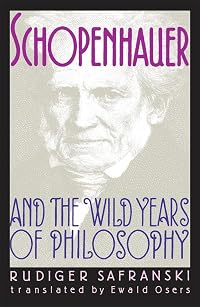
Rudiger Safranski, a freelance writer living in Berlin, is the author of Schopenhauer and the Wild Years of Philosophy (Harvard).
Common Knowledge
- Original title
- Nietzsche: Biographie seines Denkens
- Original publication date
- 2000 (German) (German); 2002 (English translation) (English translation)
- People/Characters
- Nietzsche, Friedrich Wilhelm, 1844-1900; Schopenhauer, Arthur, 1788-1860; Lou Salomé
- Epigraph
- It is absolutely unnecessary, and not even desirable, for you to argue in my favor; on the contrary, a dose of curiosity, as if you were looking at an alien plant with ironic distance, would strike me as an incomparable more ... (show all)intelligent attitude toward me. - Nietzsche in a letter to Carl Fuchs, July 29, 1888.
- First words
- Nietzsche experienced music as authentic reality and colossal power.
- Blurbers
- Nagel, Thomas; Banville, John; Berkowitz, Peter
Classifications
Statistics
- Members
- 595
- Popularity
- 49,363
- Reviews
- 10
- Rating
- (4.02)
- Languages
- 11 — Danish, Dutch, English, French, German, Hungarian, Italian, Polish, Portuguese (Portugal), Spanish, Swedish
- Media
- Paper, Audiobook, Ebook
- ISBNs
- 34
- ASINs
- 2