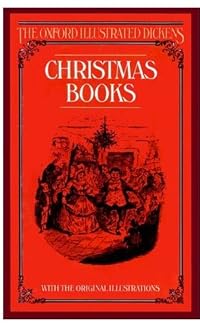
Christmas Books
by Charles Dickens
The Christmas Books of Charles Dickens (Collections and Selections — 1-5)
On This Page
Description
No other author made a greater contribution to the literature of Christmas than the master himself, Charles Dickens. Collected here in one volume are his five famous Christmas Books: A Christmas Carol, The Chimes, The Cricket on the Hearth, The Battle of Life, and The Haunted Man and the Ghost's Bargain. Read and reread these heartwarming classics to yourself or to a loved one every holiday season.Tags
Recommendations













Member Recommendations
anonymous user The Greatest Gift is the book that was turned into It's a Wonderful Life, probably the second best Christmas story after A Christmas Carol!

andejons It's almost like Lagerlöf set out to write a follow-up to Dicken's five Christmas stories:
Set at Christmas or New Years Eve: check.
Social commentary: check.
Supernatural mechanisms: check.
Reformed characters: check.
Her book is a bit more scary and less cheerful, though.
Member Reviews
The Chimes
The Haunted Man
The Cricket on the Hearth
The Battle of Life
A Christmas Carol
I read this collection of stories for a Book Club and we all agreed that none of the other stories is a patch on "A Christmas Carol". I'd advise anyone not to start by reading "The Battle of Life" like I did, as it's possibly the most annoying story I have ever read!
The Battle of Life
This was the first of the stories I read and I hated it! The main reason I hated it is all the stupid self-sacrifice. Who in their right minds would think that pretending to have eloped abroad while in reality hiding out at their aunt's house for SIX YEARS was a good idea? I certainly didn't spot that plot twist! It is so far-fetched as to be totally ridiculous.
The Cricket show more on the Hearth
This is a suspenseful story of possible infidelity. I was getting a bit stressed reading it, as I couldn't see how things could possibly turn out ok, but I needn't have worried. I especially liked the way that the guardian spirits of the home tried to convince the carter that he had a happy home and a loving wife.
The Chimes
This story was written a year after "A Christmas Carol" and has a similar story, with Trotty who has supposedly fallen to his death from the church bell tower being shown three future New Years by the spirits of the chimes and the ghost of a young girl who dies in one of those future visions. I was impressed by how subtly Dickens implied that Lillian had become a prostitute - it was immediately obvious even though he never actually came out and said it. I suppose that an open discussion of prostitution wasn't the done thing in Victorian stories! And the idea that the spirits of the chimes were active only as long as the bells chimes actually lasted and disappeared as the last echoes died away, was inspired.
The Haunted Man and the Ghost's Bargain
Having finished this story, it struck me that there are three stories in this book (the other two being "The Chimes" & "A Christmas Carol") in which various types of spirit show the protagonist the error of his ways, with a happy ending on the Christmas Day/New Year's Day followed by a celebration for friends and family. In this story, unlike the other two, it appears that the changes resulting from Redlaw's bargain with his doppelganger are real and not just visions, but Dickens hedges his bets right at the end: "Some people have said since, that he only thought what has been herein set down; others, that he read it in the fire, one winter night about the twilight time; others, that the Ghost was but the representation of his gloomy thoughts, and Milly the embodiment of his better wisdom. _I_ say nothing."
A Christmas Carol
Reading all these stories so close together, one thing that comes across very strongly is how much Dickens sympathises with the poor and uses his stories too point out the hypocritical attitudes of the Victorian establishment towards them. For example, in 'A Christmas Carol", Scrooge berates the Ghost of Christmas Present, saying that people are campaigning for the bake houses to be closed on Sundays, thus depriving the poor of a hot meal, and the Ghost says although people claim to be doing it in his name, their bigotry and selfishness are nothing to do with him. show less
The Haunted Man
The Cricket on the Hearth
The Battle of Life
A Christmas Carol
I read this collection of stories for a Book Club and we all agreed that none of the other stories is a patch on "A Christmas Carol". I'd advise anyone not to start by reading "The Battle of Life" like I did, as it's possibly the most annoying story I have ever read!
The Battle of Life
This was the first of the stories I read and I hated it! The main reason I hated it is all the stupid self-sacrifice. Who in their right minds would think that pretending to have eloped abroad while in reality hiding out at their aunt's house for SIX YEARS was a good idea? I certainly didn't spot that plot twist! It is so far-fetched as to be totally ridiculous.
The Cricket show more on the Hearth
This is a suspenseful story of possible infidelity. I was getting a bit stressed reading it, as I couldn't see how things could possibly turn out ok, but I needn't have worried. I especially liked the way that the guardian spirits of the home tried to convince the carter that he had a happy home and a loving wife.
The Chimes
This story was written a year after "A Christmas Carol" and has a similar story, with Trotty who has supposedly fallen to his death from the church bell tower being shown three future New Years by the spirits of the chimes and the ghost of a young girl who dies in one of those future visions. I was impressed by how subtly Dickens implied that Lillian had become a prostitute - it was immediately obvious even though he never actually came out and said it. I suppose that an open discussion of prostitution wasn't the done thing in Victorian stories! And the idea that the spirits of the chimes were active only as long as the bells chimes actually lasted and disappeared as the last echoes died away, was inspired.
The Haunted Man and the Ghost's Bargain
Having finished this story, it struck me that there are three stories in this book (the other two being "The Chimes" & "A Christmas Carol") in which various types of spirit show the protagonist the error of his ways, with a happy ending on the Christmas Day/New Year's Day followed by a celebration for friends and family. In this story, unlike the other two, it appears that the changes resulting from Redlaw's bargain with his doppelganger are real and not just visions, but Dickens hedges his bets right at the end: "Some people have said since, that he only thought what has been herein set down; others, that he read it in the fire, one winter night about the twilight time; others, that the Ghost was but the representation of his gloomy thoughts, and Milly the embodiment of his better wisdom. _I_ say nothing."
A Christmas Carol
Reading all these stories so close together, one thing that comes across very strongly is how much Dickens sympathises with the poor and uses his stories too point out the hypocritical attitudes of the Victorian establishment towards them. For example, in 'A Christmas Carol", Scrooge berates the Ghost of Christmas Present, saying that people are campaigning for the bake houses to be closed on Sundays, thus depriving the poor of a hot meal, and the Ghost says although people claim to be doing it in his name, their bigotry and selfishness are nothing to do with him. show less
The Christmas Books, while not always being set during the festive season, each exemplify some aspect of the spirit of charity and "goodwill to all men" that Dickens felt so important in the celebration of Christ's birth, and which he did so much to forge into what is now seen as "a traditional Christmas".
The Battle of Life: Self-sacrifice and familial love are the messages here. Some wonderfully drawn characters in Clemency Newcome (servant) and Messrs. Snitchey and Craggs (lawyers). Expectations are nicely confounded in this one.
(It had been my intention to write a review of each story as I finished them - clearly that project is 'in progress'. Hopefully, the next time I read them...)
The Battle of Life: Self-sacrifice and familial love are the messages here. Some wonderfully drawn characters in Clemency Newcome (servant) and Messrs. Snitchey and Craggs (lawyers). Expectations are nicely confounded in this one.
(It had been my intention to write a review of each story as I finished them - clearly that project is 'in progress'. Hopefully, the next time I read them...)
A Christmas Carol has been adhered to fairly well in the adaptations I've seen -- I was a bit surprised. All of the others had a disturbing bent as well. The Haunted Man, though, would be the one I considered to be the best. The basic premise is that one can not truly appreciate the good things in life unless one has experienced adversity and hardship. Otherwise the good just doesn't mean as much. Powerful imagery throughout. I liked the line, "My mind is going blind."
I reread A Christmas Carol by Charles Dickens just about every Christmas. I love the story of personal redemption as Ebenezer Scrooge learns from his past, recognizes the facts of the present, and learns to hope for the best in the future. For me, the appeal of this ghostly tale is the recognition that I likewise forget the past, present, and future; hopefully I can recognize my errors before I become a “ba-humbug!”.
More on my blog
Some of the other Christmas novellas were more interesting than others. The superiority of A Christmas Carol makes it clear to me why it has lasted as a “classic” through the years, and while most of these others have not. Thoughts on the other novellas here
More on my blog
Some of the other Christmas novellas were more interesting than others. The superiority of A Christmas Carol makes it clear to me why it has lasted as a “classic” through the years, and while most of these others have not. Thoughts on the other novellas here
Review of “The Chimes.”
“Christmas Yet to Come,” a series of dire consequences resulting from the Utilitarian views of local authorities, is previewed to Trotty Veck by church bells. Since he, unlike Ebenezer Scrooge, has no influence over any of the events, it is unclear why he undergoes this experience. To the relief of the confused reader, it is all a nightmare and everyone in fact lives happily ever after.
I found this pretty lame.
“Christmas Yet to Come,” a series of dire consequences resulting from the Utilitarian views of local authorities, is previewed to Trotty Veck by church bells. Since he, unlike Ebenezer Scrooge, has no influence over any of the events, it is unclear why he undergoes this experience. To the relief of the confused reader, it is all a nightmare and everyone in fact lives happily ever after.
I found this pretty lame.
This collection has the short stories "A Christmas Carol," "The Chimes," "The Cricket on the Hearth," "The Battle of Life," and "The Haunted Man." All are seasonally evocative, but it is easy to see why Christmas Carol remains the one that endured in public consciousness.
A Christmas Carol is a perennial favourite. The Chimes has its moments, but the rest of what I read is rather dull. Unfinished and now listed on bookmooch
Members
- Recently Added By
Lists

Comfort Reads
221 works; 41 members

Folio Society
831 works; 49 members

Christmas Books
370 works; 40 members

Books Read in 2014
2,343 works; 86 members

Books Read in 2017
4,249 works; 130 members

CCE 1000 Good Books List
1,033 works; 12 members

Ambleside Books
459 works; 18 members

The Books I Read in 2017
96 works; 1 member
Author Information

2,578+ Works 313,139 Members
Charles Dickens, perhaps the best British novelist of the Victorian era, was born in Portsmouth, Hampshire, England on February 7, 1812. His happy early childhood was interrupted when his father was sent to debtors' prison, and young Dickens had to go to work in a factory at age twelve. Later, he took jobs as an office boy and journalist before show more publishing essays and stories in the 1830s. His first novel, The Pickwick Papers, made him a famous and popular author at the age of twenty-five. Subsequent works were published serially in periodicals and cemented his reputation as a master of colorful characterization, and as a harsh critic of social evils and corrupt institutions. His many books include Oliver Twist, David Copperfield, Bleak House, Great Expectations, Little Dorrit, A Christmas Carol, and A Tale of Two Cities. Dickens married Catherine Hogarth in 1836, and the couple had nine children before separating in 1858 when he began a long affair with Ellen Ternan, a young actress. Despite the scandal, Dickens remained a public figure, appearing often to read his fiction. He died in 1870, leaving his final novel, The Mystery of Edwin Drood, unfinished. (Bowker Author Biography) show less
Some Editions
Series

Belongs to Publisher Series
Work Relationships
Is contained in
Common Knowledge
- Canonical title
- Christmas Books
- Original title
- Christmas Books
- Original publication date
- 1843: "A Christmas Carol"; 1844: "The Chimes"; 1845: "The Cricket on the Hearth"; 1846: "The Battle of Life"; 1848: "The Haunted Man"
- People/Characters
- Ebenezer Scrooge; Jacob Marley; Ghost of Christmas Present; Ghost of Christmas Past; Ghost of Christmas Yet to Come; Bob Cratchit (show all 24); Tiny Tim Cratchit; Mr. Fezziwig; Will Fern; Toby Veck; Lillian Fern; Caleb Plummer; Bertha Plummer; Edward Plummer; Tilly Slowboy; Benjamin Brittain; Dr. Anthony Jeddler; Grace Jeddler; Marion Jeddler; Mr. Redlaw; Milly Swidger; Edmund Denham; Charles Dickens; Cricket on the Hearth
- Important places
- London, England, UK; England, UK
- Important events
- Christmas; Victorian Era; 19th century
- First words
- The narrow space within which it was necessary to confine these Christmas Stories when they were originally published, rendered their construction a matter of some difficulty, and almost necessitated what is peculiar in their... (show all) machinery. (Author's Preface)
Marley was dead, to begin with. (A Christmas Carol)
There are not many people - and as it is desirable that a story-teller and a story-reader should establish a mutual understanding as soon as possible, I beg it to be noticed that I confine this observation neither to young pe... (show all)ople nor to little people, but extend it to all conditions of people: little and big, young and old: yet growing up, or already growing down again - there are not, I say, many people who would care to sleep in a church. (The Chimes)
The kettle began it! (The Cricket on the Hearth)
Once upon a time, it matters little when, and in stalwart England, it matters little where, a fierce battle was fought. (The Battle of Life)
Everybody said so. (The Haunted Man) - Last words
- (Click to show. Warning: May contain spoilers.)Deepened in its gravity by the firelight, and gazing from the darkness of the paneled wall like life, the sedate face in the portrait, with the beard and ruff, looked down at them from under its verdant wreath of holly, as they looked up at it; and, clear and plain below, as if a voice had uttered them, were the words Lord! Keep my Memory Green! (The Haunted Man)
- Original language
- English
- Canonical DDC/MDS
- 823.83
- Disambiguation notice
- Includes the five Christmas novels: A Christmas Carol (1843), The Chimes (1844), The Cricket on the Hearth (1845), The Battle of Life (1846), The Haunted Man (1848)
Classifications
Statistics
- Members
- 2,735
- Popularity
- 6,709
- Reviews
- 23
- Rating
- (4.03)
- Languages
- 9 — Catalan, Czech, Dutch, English, French, German, Hungarian, Italian, Spanish
- Media
- Paper, Audiobook, Ebook
- ISBNs
- 105
- UPCs
- 1
- ASINs
- 92