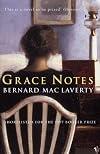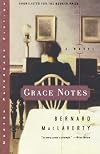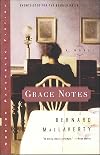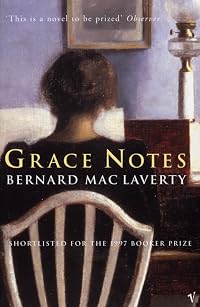
Grace Notes
by Bernard MacLaverty
On This Page
Description
A single mother is torn between duty to her child and her career as a pianist and composer. The woman is Irish and her problem is aggravated by church and parents. Lots of detail on musical composition.Tags
Recommendations














Member Recommendations

Member Reviews
Cathy is hosting #ReadingIrelandMonth at 746 Books, so I hunted through the TBR and found Grace Notes, by Bernard MacLaverty (which had been lurking there since 2010). MacLaverty was born in Belfast, but moved to Glasgow in 1975, and although Wikipedia summarises Grace Notes as a conflict between a desire for creativity and motherhood, I think it’s about more than that. I think it’s also about a desire to escape an intractable conflict which soured every aspect of life in Northern Ireland.
The novel begins with Catherine’s return to Belfast for her father’s funeral after an estrangement of some years. The novel predates the Good Friday Agreement (1998) and though on the bus home she watched the familiar landmarks she used as a show more child pass one by one, things are not the same in the town.
Catherine has been living in Glasgow since winning a scholarship and deciding not to come home after graduating. She has been living in safety while her family’s neighbourhood was bombed all around them, and she didn’t even know about it. A vast gulf now separates her from her mother, who, not knowing anything about Catherine’s new life, achievements and responsibilities, is still entertaining hopes that her only child will stay home now. But paradoxically, since it could be bombed at any time, ‘home’ is stasis, predictable, judgemental, rigid and under siege. She grieves for her father despite his flaws; she wishes she could get on better with her mother but she no longer shares her faith nor her values.
In a tense and claustrophobic atmosphere, Part One of the novel traces the brief couple of days of mourning and the funeral, with Catherine trying hard not to react to irritations from her nagging mother, and trying also to work out when and how to tell her mother a piece of news she isn’t going to want to hear.
To read the rest of my review please visit https://anzlitlovers.com/2021/03/20/grace-notes-by-bernard-maclaverty/ show less
The novel begins with Catherine’s return to Belfast for her father’s funeral after an estrangement of some years. The novel predates the Good Friday Agreement (1998) and though on the bus home she watched the familiar landmarks she used as a show more child pass one by one, things are not the same in the town.
In the town itself she was surprised to see a Chinese restaurant and a new grey fortress of a police barracks. She stood, ready to get off at her stop. There was something odd about the street. She bent at the knees, crouched to look out at where she used to live. It was hardly recognisable. Shop-fronts were covered in hardboard, the Orange Hall and other buildings bristled with scaffolding. Some roofs were covered in green tarpaulins, others were protected by lath and sheets of polythene.
‘What happened here?’ she asked the bus driver.
‘It got blew up. A bomb in October.’
‘Was anybody hurt?’
‘They gave a warning. The whole place is nothing but a shell.’
She stepped down onto the pavement and felt her knees shake. A place of devastation. (pp.9-10)
Catherine has been living in Glasgow since winning a scholarship and deciding not to come home after graduating. She has been living in safety while her family’s neighbourhood was bombed all around them, and she didn’t even know about it. A vast gulf now separates her from her mother, who, not knowing anything about Catherine’s new life, achievements and responsibilities, is still entertaining hopes that her only child will stay home now. But paradoxically, since it could be bombed at any time, ‘home’ is stasis, predictable, judgemental, rigid and under siege. She grieves for her father despite his flaws; she wishes she could get on better with her mother but she no longer shares her faith nor her values.
In a tense and claustrophobic atmosphere, Part One of the novel traces the brief couple of days of mourning and the funeral, with Catherine trying hard not to react to irritations from her nagging mother, and trying also to work out when and how to tell her mother a piece of news she isn’t going to want to hear.
To read the rest of my review please visit https://anzlitlovers.com/2021/03/20/grace-notes-by-bernard-maclaverty/ show less
In Grace Notes, Bernard MacLaverty has composed a wonderful piece about a talented young woman from every human angle: as daughter, single mother, victim (her alcoholic partner's physically abuses her),friend,student, colleague and finally composer! It's a book about death,parents and parenting, the Troubles, Communism,religion,mentoring, depression, passion and music.
The beginning of the novel introduces us to Catherine McKenna, a struggling young composer who comes home to Belfast from Scotland for her father's funeral. The relationship between her and her parents has been strained for some years; Catherine no longer practices her Catholic religion and unbeknownst to her parents, has given birth to a daughter while in Scotland. As show more Grace Notes unfolds, we witness Catherine trying to find a place for herself in the male-dominated profession of composing, caring for her baby while suffering from post-partum depression, living on welfare and and carving out time to create her music.
This is my first MacLaverty read: not easy, his pacing and depth need close attention. I found myself wondering how a man could write a woman's mind and emotions so authentically. Read the scene where Catherine gives birth: physically and emotionally, it's pitch perfect!
Grace notes are "notes between notes" that ornament a phrase but don't count in the rhythm...I still haven't figured that one out...
8 out of 10 Highly recommended show less
The beginning of the novel introduces us to Catherine McKenna, a struggling young composer who comes home to Belfast from Scotland for her father's funeral. The relationship between her and her parents has been strained for some years; Catherine no longer practices her Catholic religion and unbeknownst to her parents, has given birth to a daughter while in Scotland. As show more Grace Notes unfolds, we witness Catherine trying to find a place for herself in the male-dominated profession of composing, caring for her baby while suffering from post-partum depression, living on welfare and and carving out time to create her music.
This is my first MacLaverty read: not easy, his pacing and depth need close attention. I found myself wondering how a man could write a woman's mind and emotions so authentically. Read the scene where Catherine gives birth: physically and emotionally, it's pitch perfect!
Grace notes are "notes between notes" that ornament a phrase but don't count in the rhythm...I still haven't figured that one out...
8 out of 10 Highly recommended show less
Like "The Saint Who Loved Me", this gets inside what it must (might? - it's written by a man) actually feel like to be a woman. It also gives great & (to me) convincing insight into the process of composing music.
MacLaverty is from Belfast but moved to Scotland in his thirties. Grace Notes is partly set on Islay, with some scenes in Glasgow. However, Part One occurs entirely in Northern Ireland to where Catherine Anne McKenna is returning to her childhood home for the funeral of her father. She has been estranged from her Catholic parents for years, effectively since leaving home to go to University. They were very strict when she was young, with an embedded sense of right and wrong, and she drifted away from them, her failure to come home one Christmas causing her father to say she would no longer be welcome. In the meantime she has, unknown to them, had a child, Anna, out of wedlock; a child whose father, Dave, “is no longer on the scene.” show more She still suffers from the effects of post-natal depression but has begun to ascend out of it. While back “home” she takes the opportunity to visit her first piano teacher, Miss Bingham, showing us the roots of her vocation as a composer. Before she leaves again, her mother seems to be coming round to her situation but is still aggrieved at the thought of a grandchild her husband never knew.
Part Two deals with Catherine’s early composing career while a teacher on Islay, her relationship with Dave, Anna’s birth, the descent into depression, Dave’s increasing distance as his alcohol consumption gets out of control, and Catherine beginning to come out of her despond on a beach as she hears in her head a set of notes which will become the new symphony whose first performance ends the book.
The portrait of Catherine’s feelings as she gives birth and the ensuing onset of her depression is finely done and Dave is a familiar enough character if a little undercooked. In the end though the novel is about music (grace notes being non-essential “notes between notes” but which add colour to a piece - the literary equivalent being detail in description of scene and action.) MacLaverty conveys music’s power and atmosphere very well and at one point deploys that tremendous Scottish phrase “black affronted”.
Throughout we get the sense of Catherine as a real person. So too are her parents and Miss Bingham but Dave seemed less of an individual and more of a type. It has to be acknowledged though that there are many versions of him about.
MacLaverty’s skill as an author means the book is very readable. One of Scotland’s 100 best? Better than quite a few which feature on the list. show less
Part Two deals with Catherine’s early composing career while a teacher on Islay, her relationship with Dave, Anna’s birth, the descent into depression, Dave’s increasing distance as his alcohol consumption gets out of control, and Catherine beginning to come out of her despond on a beach as she hears in her head a set of notes which will become the new symphony whose first performance ends the book.
The portrait of Catherine’s feelings as she gives birth and the ensuing onset of her depression is finely done and Dave is a familiar enough character if a little undercooked. In the end though the novel is about music (grace notes being non-essential “notes between notes” but which add colour to a piece - the literary equivalent being detail in description of scene and action.) MacLaverty conveys music’s power and atmosphere very well and at one point deploys that tremendous Scottish phrase “black affronted”.
Throughout we get the sense of Catherine as a real person. So too are her parents and Miss Bingham but Dave seemed less of an individual and more of a type. It has to be acknowledged though that there are many versions of him about.
MacLaverty’s skill as an author means the book is very readable. One of Scotland’s 100 best? Better than quite a few which feature on the list. show less
I found this to be an excellent book. That opinion, however, comes from the perspective of someone who is not: a woman; a mother; a musician. So when MacLaverty writes from the voice of a mother, and I find it completely believable, I'm prepared to concede that others may know better than me. Nonetheless, the issues raised, the depth in which they are considered and the emotions of the participants seemed very convincing to me. These are very much three-dimensional characters, in so far as we are shown all sides of them. The protagonist's partner and father of her child, is believable, but I am at a loss to explain or understand his alcohol dependence. I guess he's depressed, but is not able to adequately understand himself to be able show more to come to that conclusion. The protagonist's father is also presented as a rather shallow person with fixed ideas and poor relationship skills (so that's definitely a male characteristic in this book - could that possibly be true of men in general?!), and I suppose it's a deliberate point that MacLaverty is making by having the father as a publican.
I'm interested in "classical" music, so the music connections in the book were of particular interest to me, especially the aspects of creativity and composition. The ending of the book seemed to me, however, to be a little to 'technical' in musical terms for this reader and I was somewhat disappointed that it finished that way. But that's probably my lack of imagination that's at fault. Normal readers would be most likely quite comfortable with the content.
This was my first MacLaverty book and I'd like to read more . . . but I'm not sure that I want to read about The Troubles of Northern Ireland, and all his other works seem to have that focus. show less
I'm interested in "classical" music, so the music connections in the book were of particular interest to me, especially the aspects of creativity and composition. The ending of the book seemed to me, however, to be a little to 'technical' in musical terms for this reader and I was somewhat disappointed that it finished that way. But that's probably my lack of imagination that's at fault. Normal readers would be most likely quite comfortable with the content.
This was my first MacLaverty book and I'd like to read more . . . but I'm not sure that I want to read about The Troubles of Northern Ireland, and all his other works seem to have that focus. show less
This may seem a simple little book, with not much happening. But if you go to the trouble to read between the lines, you will get a lot in return. For grace notes are the unobtrusive notes that seemingly hardly have a function, but that in some undefinable way make a piece of music into something special. That is what happens in this book about North-Irish composer and young mother Catherine McKenna. The author moreover shows an empathy with a woman's emotional life that is rare for a man. A sensitive and subtle novel.
Disturbing book about a girl's difficult relationship to her parents and herself. She questions her talent, her thinking and her heritage, her love of everything her parents and the place she comes from. She wants to be free of those influences and at the same time cannot escape them because of the love that binds her to them.
Quote: A girl who doesn't tell her parents of her success is more estranged than one who conceals her mistakes.
Quote: A girl who doesn't tell her parents of her success is more estranged than one who conceals her mistakes.
Members
- Recently Added By
Published Reviews
ThingScore 75
added by geocroc
Lists

Booker Prize
491 works; 62 members
Booker Prize Shortlist: Titles Read
103 works; 10 members

music to my eyes
86 works; 12 members

Man Booker Prize Longlist 1997
6 works; 2 members

BBC Radio 4 Bookclub
341 works; 13 members
Author Information

Some Editions
Awards and Honors
Awards
Common Knowledge
- Canonical title*
- Anna's lied
- Original title
- Grace Notes
- Original publication date
- 1997
- People/Characters
- Catherine Anne McKenna; Anna
- Important places
- Northern Ireland, UK; Islay, Argyll and Bute, Scotland, UK
- Dedication
- For John
- First words
- She went down the front steps and walked along the street to the main road.
- Last words
- (Click to show. Warning: May contain spoilers.)He looked down into the audience and beckoned Catherine with a high wave to the podium. Bravo. She rose.
- Blurbers
- Moore, Brian; Barker, Elspeth; Adair, Tom; Kemp, Peter; Hill, Tobias; Massie, Allan (show all 9); Mundow, Anna; McFarland, Dennis; Barrett, Andrea
- Original language*
- Engels
*Some information comes from Common Knowledge in other languages. Click "Edit" for more information.
Classifications
Statistics
- Members
- 511
- Popularity
- 59,022
- Reviews
- 13
- Rating
- (3.81)
- Languages
- 5 — Dutch, English, German, Italian, Slovenian
- Media
- Paper, Audiobook, Ebook
- ISBNs
- 20
- ASINs
- 2