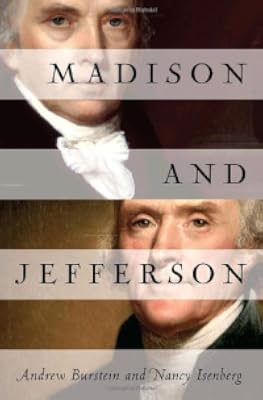
Madison and Jefferson
by Andrew Burstein, Nancy Isenberg
On This Page
Description
“[A] monumental dual biography . . . a distinguished work, combining deep research, a pleasing narrative style and an abundance of fresh insights, a rare combination.”—The Dallas Morning NewsThe third and fourth presidents have long been considered proper gentlemen, with Thomas Jefferson’s genius overshadowing James Madison’s judgment and common sense. But in this revelatory book about their crucial partnership, both are seen as men of their times, hardboiled operatives in a show more gritty world of primal politics where they struggled for supremacy for more than fifty years. With a thrilling and unprecedented account of early America as its backdrop, Madison and Jefferson reveals these founding fathers as privileged young men in a land marked by tribal identities rather than a united national personality. Esteemed historians Andrew Burstein and Nancy Isenberg capture Madison’s hidden role—he acted in effect as a campaign manager—in Jefferson’s career. In riveting detail, the authors chart the courses of two very different presidencies: Jefferson’s driven by force of personality, Madison’s sustained by a militancy that history has been reluctant to ascribe to him.
Supported by a wealth of original sources—newspapers, letters, diaries, pamphlets—Madison and Jefferson is a watershed account of the most important political friendship in American history.
“Enough colorful characters for a miniseries, loaded with backstabbing (and frontstabbing too).”—Newsday
“An important, thoughtful, and gracefully written political history.”—Publishers Weekly (starred review). show less
Tags
Recommendations








Member Reviews
If you've read David McCullough's excellent John Adams, you're aware of the interesting friendship Adams had with Thomas Jefferson, both men dying within hours of each other on July 4, exactly fifty years after the signing of the Declaration of Independence. But even that relationship pales in comparison to the one between Jefferson and James Madison, the 4th president. And in this excellent dual political biography, Andrew Burstein and Nancy Isenberg have turned the order of the presidents around in their title in an effort to reassert the forgotten contributions of Madison. (Well, that and maybe the fact that Jefferson and Madison as a title had already been used.) Madison wasn't simply Jefferson's "junior," but more like the driving show more force behind Jefferson's reentry into politics in 1796.
As I've read and studied about the founding of our nation, in my mind George Washington perhaps stands closest to the ideal of a truly noble hero. John Adams is likewise admirable, although hampered by his vanity and having the misfortune to follow in Washington's very long shadow. By the time I get to Thomas Jefferson, though, things get ugly. The nastiness of party politics becomes intractable - and Jefferson was a natural at hardball politics.
Both Jefferson and Madison were Virginians first, which heavily influenced their politics. Jefferson, the idealist and philosopher, is quite frequently seen as a walking contradiction. His lofty ideals and eloquent way with words had a way of swaying opinion. His fear of monarchial tendencies in government drove his policies, and he sought to maintain states rights and limit the power of the federal government (even while, as president, he greatly enlarged federal power). Madison, credited as the "Father of the Constitution" for his monumental efforts in 1787, is seen wrongly as a continuation of the Jefferson presidency, and many assumed Jefferson was still pulling the strings. In spite of their close friendship, they frequently differed in opinions and the courses of action they took. And while Jefferson appears as cordial and pleasant, Madison is portrayed unfairly as cold and unemotional. And Burstein and Isenberg do a good job of highlighting the important role played by Madison in the history both had such a huge role in.
This is a lengthy book with the narrative being almost 650 pages long, with dense writing that requires careful attention. As such, it's probably directed at serious readers of history rather than casual ones. The focus is mostly on politics, although there's enough information on their personal lives to give it a good balance. With two authors it sometimes feels a little uneven, although the book doesn't suffer for it. The ending, however, seemed almost disconnected and I vaguely suspected the authors of inserting some of their own personal present-day politics into the story. But even this doesn't take away from the terrific work they've compiled, and in spite of the length and depth it kept my interest throughout. show less
As I've read and studied about the founding of our nation, in my mind George Washington perhaps stands closest to the ideal of a truly noble hero. John Adams is likewise admirable, although hampered by his vanity and having the misfortune to follow in Washington's very long shadow. By the time I get to Thomas Jefferson, though, things get ugly. The nastiness of party politics becomes intractable - and Jefferson was a natural at hardball politics.
Both Jefferson and Madison were Virginians first, which heavily influenced their politics. Jefferson, the idealist and philosopher, is quite frequently seen as a walking contradiction. His lofty ideals and eloquent way with words had a way of swaying opinion. His fear of monarchial tendencies in government drove his policies, and he sought to maintain states rights and limit the power of the federal government (even while, as president, he greatly enlarged federal power). Madison, credited as the "Father of the Constitution" for his monumental efforts in 1787, is seen wrongly as a continuation of the Jefferson presidency, and many assumed Jefferson was still pulling the strings. In spite of their close friendship, they frequently differed in opinions and the courses of action they took. And while Jefferson appears as cordial and pleasant, Madison is portrayed unfairly as cold and unemotional. And Burstein and Isenberg do a good job of highlighting the important role played by Madison in the history both had such a huge role in.
This is a lengthy book with the narrative being almost 650 pages long, with dense writing that requires careful attention. As such, it's probably directed at serious readers of history rather than casual ones. The focus is mostly on politics, although there's enough information on their personal lives to give it a good balance. With two authors it sometimes feels a little uneven, although the book doesn't suffer for it. The ending, however, seemed almost disconnected and I vaguely suspected the authors of inserting some of their own personal present-day politics into the story. But even this doesn't take away from the terrific work they've compiled, and in spite of the length and depth it kept my interest throughout. show less
If you've read David McCullough's excellent John Adams, you're aware of the interesting friendship Adams had with Thomas Jefferson, both men dying within hours of each other on July 4, exactly fifty years after the signing of the Declaration of Independence. But even that relationship pales in comparison to the one between Jefferson and James Madison, the 4th president. And in this excellent dual political biography, Andrew Burstein and Nancy Isenberg have turned the order of the presidents around in their title in an effort to reassert the forgotten contributions of Madison. (Well, that and maybe the fact that Jefferson and Madison as a title had already been used.) Madison wasn't simply Jefferson's "junior," but more like the driving show more force behind Jefferson's reentry into politics in 1796.
As I've read and studied about the founding of our nation, in my mind George Washington perhaps stands closest to the ideal of a truly noble hero. John Adams is likewise admirable, although hampered by his vanity and having the misfortune to follow in Washington's very long shadow. By the time I get to Thomas Jefferson, though, things get ugly. The nastiness of party politics becomes intractable - and Jefferson was a natural at hardball politics.
Both Jefferson and Madison were Virginians first, which heavily influenced their politics. Jefferson, the idealist and philosopher, is quite frequently seen as a walking contradiction. His lofty ideals and eloquent way with words had a way of swaying opinion. His fear of monarchial tendencies in government drove his policies, and he sought to maintain states rights and limit the power of the federal government (even while, as president, he greatly enlarged federal power). Madison, credited as the "Father of the Constitution" for his monumental efforts in 1787, is seen wrongly as a continuation of the Jefferson presidency, and many assumed Jefferson was still pulling the strings. In spite of their close friendship, they frequently differed in opinions and the courses of action they took. And while Jefferson appears as cordial and pleasant, Madison is portrayed unfairly as cold and unemotional. And Burstein and Isenberg do a good job of highlighting the important role played by Madison in the history both had such a huge role in.
This is a lengthy book with the narrative being almost 650 pages long, with dense writing that requires careful attention. As such, it's probably directed at serious readers of history rather than casual ones. The focus is mostly on politics, although there's enough information on their personal lives to give it a good balance. With two authors it sometimes feels a little uneven, although the book doesn't suffer for it. The ending, however, seemed almost disconnected and I vaguely suspected the authors of inserting some of their own personal present-day politics into the story. But even this doesn't take away from the terrific work they've compiled, and in spite of the length and depth it kept my interest throughout. show less
As I've read and studied about the founding of our nation, in my mind George Washington perhaps stands closest to the ideal of a truly noble hero. John Adams is likewise admirable, although hampered by his vanity and having the misfortune to follow in Washington's very long shadow. By the time I get to Thomas Jefferson, though, things get ugly. The nastiness of party politics becomes intractable - and Jefferson was a natural at hardball politics.
Both Jefferson and Madison were Virginians first, which heavily influenced their politics. Jefferson, the idealist and philosopher, is quite frequently seen as a walking contradiction. His lofty ideals and eloquent way with words had a way of swaying opinion. His fear of monarchial tendencies in government drove his policies, and he sought to maintain states rights and limit the power of the federal government (even while, as president, he greatly enlarged federal power). Madison, credited as the "Father of the Constitution" for his monumental efforts in 1787, is seen wrongly as a continuation of the Jefferson presidency, and many assumed Jefferson was still pulling the strings. In spite of their close friendship, they frequently differed in opinions and the courses of action they took. And while Jefferson appears as cordial and pleasant, Madison is portrayed unfairly as cold and unemotional. And Burstein and Isenberg do a good job of highlighting the important role played by Madison in the history both had such a huge role in.
This is a lengthy book with the narrative being almost 650 pages long, with dense writing that requires careful attention. As such, it's probably directed at serious readers of history rather than casual ones. The focus is mostly on politics, although there's enough information on their personal lives to give it a good balance. With two authors it sometimes feels a little uneven, although the book doesn't suffer for it. The ending, however, seemed almost disconnected and I vaguely suspected the authors of inserting some of their own personal present-day politics into the story. But even this doesn't take away from the terrific work they've compiled, and in spite of the length and depth it kept my interest throughout. show less
This book exposes and explores what could easily be considered one of the most important political friendships in all of American history. 'Madison and Jefferson' does a splendid job of showing how these two gentlemen worked closely together throughout the beginnings of the United States, from the revolutionary days to the War of 1812.
To start with, the title of the book intentionally lists Madison first and throughout the book does much to bring to light this often misunderstood founder who many think of as uninteresting. Nothing could be further from the truth. The authors show that Madison did indeed have a rather interesting personality that is often ignored. But, the authors spend equal time on Jefferson, discussing the often show more touted intellect as well as his less talked about weaknesses. The friendship between these two is almost unbreakable throughout their history, but it is not without disagreements between the two.
The narrative that goes through the timeline of Madison and Jefferson is very engaging; at no point was I ever bored with it as can sometimes be the case with more dryly written biographies. And because the book is split up into very distinct periods, it was easy to pick back up if I had to put it down for a while.
I highly recommend this book to anyone who studies or has an interest in the founding of our nation, particularly these two individuals. You'll also find plenty of information about other founding fathers and the perspective that Madison and Jefferson held on them; I think I found this to be the most interesting part of this dual biography. show less
To start with, the title of the book intentionally lists Madison first and throughout the book does much to bring to light this often misunderstood founder who many think of as uninteresting. Nothing could be further from the truth. The authors show that Madison did indeed have a rather interesting personality that is often ignored. But, the authors spend equal time on Jefferson, discussing the often show more touted intellect as well as his less talked about weaknesses. The friendship between these two is almost unbreakable throughout their history, but it is not without disagreements between the two.
The narrative that goes through the timeline of Madison and Jefferson is very engaging; at no point was I ever bored with it as can sometimes be the case with more dryly written biographies. And because the book is split up into very distinct periods, it was easy to pick back up if I had to put it down for a while.
I highly recommend this book to anyone who studies or has an interest in the founding of our nation, particularly these two individuals. You'll also find plenty of information about other founding fathers and the perspective that Madison and Jefferson held on them; I think I found this to be the most interesting part of this dual biography. show less
Informative--an excellent piece of scholarship--but the authors appear to be somewhat selective in terms of how they depict secondary central characters. Admire them sticking up for Jefferson a little--he gets something of a raw deal in our age. But he definitely has his flaws.
I found this book intriguing and an enjoyable read. The book is a combination work by two authors covering the biographies of James Madison and Thomas Jefferson. Many know that they were not only the fourth and third president, respectively, of the United States of America (U.S.A.) but were instrumental in the formation of our governing system. These founding fathers of the U.S.A. has Jefferson considered the author of the Declaration of Independence and Madison the father of the constitution.
It seems that this book tries to bring Madison more into the light of day and his proper place in history. The book is taken from primary sources, mainly letters of the individuals involved, diaries of contemporaries that had interaction with the show more subjects, the subjects own publications and those of their opposition as well as newspaper accounts of the day. All this information that is gathered is used and documented in its proper context.
This book delves into the history of these two men and their friendship and political relationship. Not both always of one mind, but allies. Where Jefferson was emotional and knew how to politic, Madison was calm and understated. We also learn much of the other personalities involved in this period of history; George Washington, Alexander Hamilton, as well as other influential men of the time.
The glossy history most learn in history books that is somewhat revised at times does not show just how human all these “founding fathers” were. Like all of use they had their own convictions, vanities and frailties. Reading this biography gave me a greater insight too who these gentlemen were in public and their thoughts when willing to place pen to paper in writing to a close friend or confident. People forget it took a decade for the U.S.A. to finally develop the what became the U.S.A. Constitution.
This biography is a political history of these men and only covers the period where they or their mentors became politically involved in matters of their colony. In this case Virginia. What I learned new in this book was how large Virginia really was, I was aware of their economic might at the time. And most people with a basic background in the founding of the U.S.A. knows how contentious the Constitutional Conventions were with each state protecting its interests. The authors do a good job of sharing with use the personalities of the men over the course of decades.
What is most interesting but not surprising is that the politics of the early republic have not changed much and neither has the misinformation of the biased press. I would recommend this book that is rich with information to anyone who likes reading history or about politics. show less
It seems that this book tries to bring Madison more into the light of day and his proper place in history. The book is taken from primary sources, mainly letters of the individuals involved, diaries of contemporaries that had interaction with the show more subjects, the subjects own publications and those of their opposition as well as newspaper accounts of the day. All this information that is gathered is used and documented in its proper context.
This book delves into the history of these two men and their friendship and political relationship. Not both always of one mind, but allies. Where Jefferson was emotional and knew how to politic, Madison was calm and understated. We also learn much of the other personalities involved in this period of history; George Washington, Alexander Hamilton, as well as other influential men of the time.
The glossy history most learn in history books that is somewhat revised at times does not show just how human all these “founding fathers” were. Like all of use they had their own convictions, vanities and frailties. Reading this biography gave me a greater insight too who these gentlemen were in public and their thoughts when willing to place pen to paper in writing to a close friend or confident. People forget it took a decade for the U.S.A. to finally develop the what became the U.S.A. Constitution.
This biography is a political history of these men and only covers the period where they or their mentors became politically involved in matters of their colony. In this case Virginia. What I learned new in this book was how large Virginia really was, I was aware of their economic might at the time. And most people with a basic background in the founding of the U.S.A. knows how contentious the Constitutional Conventions were with each state protecting its interests. The authors do a good job of sharing with use the personalities of the men over the course of decades.
What is most interesting but not surprising is that the politics of the early republic have not changed much and neither has the misinformation of the biased press. I would recommend this book that is rich with information to anyone who likes reading history or about politics. show less
This book is well-written and informative. I bought this book not because I want to learn about the presidency of jefferson and madison (read too many books already about that), but because I want to learn about Jefferson and Madison after their presidencies. Not only did this book satisfy my curiosity about their post=presidency, but it also gave me a unique insight on various issues on which madison and Jeffeson differed in opinion. I highly recommend this book!
If you've read David McCullough's excellent John Adams, you're aware of the interesting friendship Adams had with Thomas Jefferson, both men dying within hours of each other on July 4, exactly fifty years after the signing of the Declaration of Independence. But even that relationship pales in comparison to the one between Jefferson and James Madison, the 4th president. And in this excellent dual political biography, Andrew Burstein and Nancy Isenberg have turned the order of the presidents around in their title in an effort to reassert the forgotten contributions of Madison. (Well, that and maybe the fact that Jefferson and Madison as a title had already been used.) Madison wasn't simply Jefferson's "junior," but more like the driving show more force behind Jefferson's reentry into politics in 1796.
As I've read and studied about the founding of our nation, in my mind George Washington perhaps stands closest to the ideal of a truly noble hero. John Adams is likewise admirable, although hampered by his vanity and having the misfortune to follow in Washington's very long shadow. By the time I get to Thomas Jefferson, though, things get ugly. The nastiness of party politics becomes intractable - and Jefferson was a natural at hardball politics.
Both Jefferson and Madison were Virginians first, which heavily influenced their politics. Jefferson, the idealist and philosopher, is quite frequently seen as a walking contradiction. His lofty ideals and eloquent way with words had a way of swaying opinion. His fear of monarchial tendencies in government drove his policies, and he sought to maintain states rights and limit the power of the federal government (even while, as president, he greatly enlarged federal power). Madison, credited as the "Father of the Constitution" for his monumental efforts in 1787, is seen wrongly as a continuation of the Jefferson presidency, and many assumed Jefferson was still pulling the strings. In spite of their close friendship, they frequently differed in opinions and the courses of action they took. And while Jefferson appears as cordial and pleasant, Madison is portrayed unfairly as cold and unemotional. And Burstein and Isenberg do a good job of highlighting the important role played by Madison in the history both had such a huge role in.
This is a lengthy book with the narrative being almost 650 pages long, with dense writing that requires careful attention. As such, it's probably directed at serious readers of history rather than casual ones. The focus is mostly on politics, although there's enough information on their personal lives to give it a good balance. With two authors it sometimes feels a little uneven, although the book doesn't suffer for it. The ending, however, seemed almost disconnected and I vaguely suspected the authors of inserting some of their own personal present-day politics into the story. But even this doesn't take away from the terrific work they've compiled, and in spite of the length and depth it kept my interest throughout. show less
As I've read and studied about the founding of our nation, in my mind George Washington perhaps stands closest to the ideal of a truly noble hero. John Adams is likewise admirable, although hampered by his vanity and having the misfortune to follow in Washington's very long shadow. By the time I get to Thomas Jefferson, though, things get ugly. The nastiness of party politics becomes intractable - and Jefferson was a natural at hardball politics.
Both Jefferson and Madison were Virginians first, which heavily influenced their politics. Jefferson, the idealist and philosopher, is quite frequently seen as a walking contradiction. His lofty ideals and eloquent way with words had a way of swaying opinion. His fear of monarchial tendencies in government drove his policies, and he sought to maintain states rights and limit the power of the federal government (even while, as president, he greatly enlarged federal power). Madison, credited as the "Father of the Constitution" for his monumental efforts in 1787, is seen wrongly as a continuation of the Jefferson presidency, and many assumed Jefferson was still pulling the strings. In spite of their close friendship, they frequently differed in opinions and the courses of action they took. And while Jefferson appears as cordial and pleasant, Madison is portrayed unfairly as cold and unemotional. And Burstein and Isenberg do a good job of highlighting the important role played by Madison in the history both had such a huge role in.
This is a lengthy book with the narrative being almost 650 pages long, with dense writing that requires careful attention. As such, it's probably directed at serious readers of history rather than casual ones. The focus is mostly on politics, although there's enough information on their personal lives to give it a good balance. With two authors it sometimes feels a little uneven, although the book doesn't suffer for it. The ending, however, seemed almost disconnected and I vaguely suspected the authors of inserting some of their own personal present-day politics into the story. But even this doesn't take away from the terrific work they've compiled, and in spite of the length and depth it kept my interest throughout. show less
Members
- Recently Added By
Lists

James Madison
19 works; 1 member

Best U.S. History Books (1754-1828)
363 works; 18 members
Author Information

15+ Works 1,528 Members
Andrew Burstein is a full professor and co-holder of the Mary Frances Barnard Chair in U.S. History at the University of Tulsa

8+ Works 4,066 Members
Nancy Isenberg received her Ph. D. from the University of Wisconsin-Madison in 1990. She is the T. Harry Williams Professor of History at Louisiana State University. She is the author of Sex and Citizenship in Antebellum America; Fallen Founder: The Life of Aaron Burr (winner of the 2008 Oklahoma Book Award for non-fiction); Madison and Jefferson, show more co-authored with Andrew Burstein, was named one of the top five non-fiction titles of 2010 by Kirkus; and White Trash: The 400-Year Untold History of Class in America, which is a 2016 New York Times Bestseller. She has been featured on C-SPAN2 "Book TV," and on various NPR programs. She and Andrew Burstein are regular contributors to Salon.com. (Bowker Author Biography) show less
Awards and Honors
Distinctions
Common Knowledge
- Canonical title
- Madison and Jefferson
- Original publication date
- 2010-09-28
- People/Characters
- James Madison; Thomas Jefferson; Alexander Hamilton; George Washington; Patrick Henry
Classifications
- Genres
- History, Nonfiction, Biography & Memoir, General Nonfiction
- DDC/MDS
- 973.4 — History & geography History of North America United States Constitutional period (1789-1809)
- LCC
- E332.2 .B864 — History of the United States United States Revolution to the Civil War, 1775/1783-1861 By period 1789-1809. Constitutional period Jefferson's administrations, 1801-1809
- BISAC
Statistics
- Members
- 361
- Popularity
- 87,285
- Reviews
- 7
- Rating
- (4.20)
- Languages
- English
- Media
- Paper, Ebook
- ISBNs
- 3
- ASINs
- 1