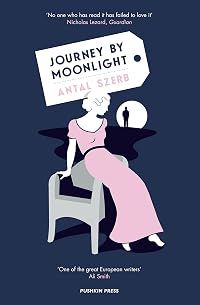
Journey by Moonlight
by Antal Szerb
On This Page
Description
In the 1930s, a couple honeymoon in Italy. Mihaly and Erszi are dutiful conformists but their encounter with a dark and magical Italy threatens their uneasy harmony. They are separated at a station and Mihaly starts a mystical and dazzling journey. Erszi leaves for Paris to contemplate her failed marriage.Tags
Recommendations





























Member Recommendations

Van Sandor Maraï tot Magda Szabo .Klassieke Hongaarse romans uit de 20e eeuw by Jolanta Jastrze̜bska
gust Deze bundel essays bevat een verhelderende bespreking van deze roman.
Member Reviews
The one book hardly anyone has ever heard of that everyone must read.
Antal Szerb writes in that ironic, self-reflective, clever way of Eastern Europeans brought up on a diet of good literature, music and art. There’s a comfort in the forms of art and the mind. His writing life was spent in between the wars; Journey by Moonlight is a product of that time - the late 1930s. Set in Italy, the protagonist, Mihaliy often asks whether the locals are as happy under the gaze of Il Duce as they appear to be. Mihaliy calls the errand boy a little fascista, no artist can resist wise-cracking about the puffed up ideas of dictators and the machinery with which they operate the land. Despite all this, Mihaliy is free to travel around and spend his show more money; you see he’s on his honeymoon with the beautiful and well brought up Erszi. Italy, with its nostalgic equivocating romance for the past, is the perfect setting for Mihaliy’s actual journey - backwards in time to his own love of beautiful Eva and the friendship group that centred on her house with her brother Tamas. Some of the plot lines are so silly, you wonder how it all comes together. It's as though the novel takes place in a brief, inspired emotionally charged moment of time.
It’s a fun ride, full of lateral story-lines: Erzsi’s ex husband is pursuing her with his own true love for her, too. Despite his 'love' for Erzsi, Mihalyi lives in the half-light of moonlight throughout, an irrational zone of possibilities. He is easily deceived by an old friend who once stole his gold watch, who then tries to steal Erzsi away from him then selling her off to either the ex-husband or a shady Persian opium seller making a movie about how down to earth and decent opium farmers are. The half light world of moonlight stages everything in this novel. Monastary rules prohibit Fr Severius, really an old friend who converted from Judaism to catholicism, meeting Mihalyi until midnight. He too suffered from the love of the past and the beautiful Eva. Perhaps he's in hiding as a monk, living a half-life to forget her. In a fugue moment, Mihaliy leaves a town and spends the night in a forest, ending up half mad with exhaustion.
Umbria and Tuscany are wonderful places to get lost in. No one ends up seeing all the art and architecture on show. Mihayli and Erzsi plan to: it doesn’t happen. Is that a joke, perhaps about honeymooners who supposedly only ever see the inside of their hotel rooms? And there are English speakers everywhere: the doctor who heals Mihayli's exhaustion and the young American art historian on a self-funded tour of everything an art historian must see in Italy. This was all before the era of mass tourism, when an American needed the extensive notes of a teacher to advise where to go, and a copy of Baedeker. Was an Italy controlled by fascists the perfect place for an American to holiday? The Rockefellers loved fascists.
Will Mihaliy ever see Eva again? The real plot-line. It’s all a little soap-opera-ish when you tell it. Most of what happens in this novel is absurd, as was the world at the time. Reminds me of Iron Curtain writing from Czech, Poland and the like. You can’t really describe the world as it is - you’d never get published. But then the world under dictatorships, left or right, doesn't make sense, so how can anyone write realism? The long chapter on Mihaly, Eva and Tamas as teenagers role playing is so weird, only great writing can pull it off. It is so absorbing while simultaneously incredulous. Perhaps that’s what moonlight is like to travel in.
Szerb’s little travel book Red Tower is set on holiday in Italy around 1935 or 36. The attitude is the same about fascism, it’s a great place to take a holiday if you don’t notice the dictatorship.
Szerb is one of those ‘if only’ writers of the 20thC. Had he survived the war, he may be more popular, or well known, or lauded. Certainly any outspoken anti-fascist after WW2 would’ve been highly regarded. Instead he died like everyone else fighting a corrupt world. He’s worth remembering as our own times darken a little every day. show less
Antal Szerb writes in that ironic, self-reflective, clever way of Eastern Europeans brought up on a diet of good literature, music and art. There’s a comfort in the forms of art and the mind. His writing life was spent in between the wars; Journey by Moonlight is a product of that time - the late 1930s. Set in Italy, the protagonist, Mihaliy often asks whether the locals are as happy under the gaze of Il Duce as they appear to be. Mihaliy calls the errand boy a little fascista, no artist can resist wise-cracking about the puffed up ideas of dictators and the machinery with which they operate the land. Despite all this, Mihaliy is free to travel around and spend his show more money; you see he’s on his honeymoon with the beautiful and well brought up Erszi. Italy, with its nostalgic equivocating romance for the past, is the perfect setting for Mihaliy’s actual journey - backwards in time to his own love of beautiful Eva and the friendship group that centred on her house with her brother Tamas. Some of the plot lines are so silly, you wonder how it all comes together. It's as though the novel takes place in a brief, inspired emotionally charged moment of time.
It’s a fun ride, full of lateral story-lines: Erzsi’s ex husband is pursuing her with his own true love for her, too. Despite his 'love' for Erzsi, Mihalyi lives in the half-light of moonlight throughout, an irrational zone of possibilities. He is easily deceived by an old friend who once stole his gold watch, who then tries to steal Erzsi away from him then selling her off to either the ex-husband or a shady Persian opium seller making a movie about how down to earth and decent opium farmers are. The half light world of moonlight stages everything in this novel. Monastary rules prohibit Fr Severius, really an old friend who converted from Judaism to catholicism, meeting Mihalyi until midnight. He too suffered from the love of the past and the beautiful Eva. Perhaps he's in hiding as a monk, living a half-life to forget her. In a fugue moment, Mihaliy leaves a town and spends the night in a forest, ending up half mad with exhaustion.
Umbria and Tuscany are wonderful places to get lost in. No one ends up seeing all the art and architecture on show. Mihayli and Erzsi plan to: it doesn’t happen. Is that a joke, perhaps about honeymooners who supposedly only ever see the inside of their hotel rooms? And there are English speakers everywhere: the doctor who heals Mihayli's exhaustion and the young American art historian on a self-funded tour of everything an art historian must see in Italy. This was all before the era of mass tourism, when an American needed the extensive notes of a teacher to advise where to go, and a copy of Baedeker. Was an Italy controlled by fascists the perfect place for an American to holiday? The Rockefellers loved fascists.
Will Mihaliy ever see Eva again? The real plot-line. It’s all a little soap-opera-ish when you tell it. Most of what happens in this novel is absurd, as was the world at the time. Reminds me of Iron Curtain writing from Czech, Poland and the like. You can’t really describe the world as it is - you’d never get published. But then the world under dictatorships, left or right, doesn't make sense, so how can anyone write realism? The long chapter on Mihaly, Eva and Tamas as teenagers role playing is so weird, only great writing can pull it off. It is so absorbing while simultaneously incredulous. Perhaps that’s what moonlight is like to travel in.
Szerb’s little travel book Red Tower is set on holiday in Italy around 1935 or 36. The attitude is the same about fascism, it’s a great place to take a holiday if you don’t notice the dictatorship.
Szerb is one of those ‘if only’ writers of the 20thC. Had he survived the war, he may be more popular, or well known, or lauded. Certainly any outspoken anti-fascist after WW2 would’ve been highly regarded. Instead he died like everyone else fighting a corrupt world. He’s worth remembering as our own times darken a little every day. show less
Journey by moonlight sometimes reads like Where angels fear to tread as rewritten by someone brought up in the spirit of German romanticism. Mihály is an emotionally-troubled young man who after years of drifting has tried to anchor himself in the bourgeois "real world" by marrying Erszi. Unfortunately, she has married him largely for the opposite reason: she is looking for a Tyger to drag her away from boring respectability. So it's perhaps not such a surprise that when, a week or so into their Italian honeymoon, Mihály accidentally gets on the wrong train and loses touch with his new bride, he doesn't make any great effort to find her again.
Mihály is still carrying around a lot of emotional baggage from his claustrophobic teenage show more friendships with a group of avant-la-lettre goths, addicted to role-playing games and death-imagery. In the meantime one of them has taken his own life (or possibly been murdered), another has become a Franciscan friar, another has adopted the persona of a wheeler-dealer crook, and only Éva, the girl they were all (including her brother) in love with, seems to have turned out halfway normal.
Lots of glorious Italian tourist-trail atmosphere, hardly spoilt by the posters of Mussolini on every wall, lots of romantic longing and fantasising about death, but all set off against common-sense reality with a delightfully ironic detachment. As in Forster, the Italian zest for life is set up in opposition to northern melancholy and over-analytical thinking, but unlike Forster he's clear that work and business belong on the "life" side of the scales, together with sex and pasta, whilst art and love and (mystical-)religion are classified with the other death-wish items. show less
Mihály is still carrying around a lot of emotional baggage from his claustrophobic teenage show more friendships with a group of avant-la-lettre goths, addicted to role-playing games and death-imagery. In the meantime one of them has taken his own life (or possibly been murdered), another has become a Franciscan friar, another has adopted the persona of a wheeler-dealer crook, and only Éva, the girl they were all (including her brother) in love with, seems to have turned out halfway normal.
Lots of glorious Italian tourist-trail atmosphere, hardly spoilt by the posters of Mussolini on every wall, lots of romantic longing and fantasising about death, but all set off against common-sense reality with a delightfully ironic detachment. As in Forster, the Italian zest for life is set up in opposition to northern melancholy and over-analytical thinking, but unlike Forster he's clear that work and business belong on the "life" side of the scales, together with sex and pasta, whilst art and love and (mystical-)religion are classified with the other death-wish items. show less
Mihály is on his honeymoon in Italy, when he becomes overwhelmed with nostalgia for his childhood, especially his friendship with Éva and Tamás Ulpius. The Ulpius household was very unusual, in part because they eschewed the bourgeois upbringing of Mihály's middle-class family. But his relationship with the Ulpius children was also unusual in that they played with the notion of death as the ultimate form of love and loyalty. Mihály is now obsessed with the questions of whether he "sold out" when he became an office worker and "married well", and with the fate of his friends, one of whom died in mysterious circumstances. As Mihály becomes more and more fixated on mortality, his life in the mortal world becomes disorganized, and he show more wanders pilgrim-like, not is search of God or truth, but death.
Despite the darkness of the novel's plot, it's not a dreary read. Szerb is in turns humorous, ironic, and acerbic. His writing is both entertaining and thought-provoking. He frequently alludes to Dante and the Divine Comedy, but his novel turns the plot on it's head: the first chapter is "Honeymoon" and the last is "At Hell's Gate." There is a manipulative and death-loving Beatrice; and a con artist and petty thief who plays the role of Virgil. I'm sure a grad student could have a lot of fun picking this theme apart. As for me, I look forward to reading another novel by Szerb; Rebbecanyc had particularly recommended The Pendragon Legend. show less
Despite the darkness of the novel's plot, it's not a dreary read. Szerb is in turns humorous, ironic, and acerbic. His writing is both entertaining and thought-provoking. He frequently alludes to Dante and the Divine Comedy, but his novel turns the plot on it's head: the first chapter is "Honeymoon" and the last is "At Hell's Gate." There is a manipulative and death-loving Beatrice; and a con artist and petty thief who plays the role of Virgil. I'm sure a grad student could have a lot of fun picking this theme apart. As for me, I look forward to reading another novel by Szerb; Rebbecanyc had particularly recommended The Pendragon Legend. show less
This is a book that lingers on my mind long after I have read it. This was written in the 1930s but felt so contemporary. I identified with Mihaly and I am sure many could identify with his travails as he tries to live a life pleasing to his family while suffocating himself. I love the author's writing and Mihaly's words, for example, living is exhaustion and work makes you anonymous. I wished I could go on an escapade like Mihaly too. He went on an escapade in Italy, wandering through the country and waiting for something to happen. Finally he met Eva. He thought he wanted to die for her but realised on the night he was supposed to kill himself, he never thought of her at all. I am sure all readers can see that and felt glad too that show more this was not lost on Mihaly. Finally, Mihaly's father came to fetch him home. What an apt ending - family is still the sanctuary for us all. show less
In the blurb this is described as "the consummate European novel of the inter-war period" – and it really is. The novel opens with a quote from Villon: "Mutinously I submit to the claims of law and order. What will happen? I wait for my journey's wages. In a world that accepts and rejects me."
We meet Mihály and Erszi on their honeymoon, and we are quickly led to understand that there is at least a little bit of tension in the air: "On the train, everything seemed fine. The trouble began in Venice, with the back-alleys."
Venice is just one step on their journey, that is to take them through Italy with stops in Ravenna, Florence, Rome and Capri, but while this is Mihály’s first trip to Italy (and a long awaited one), Erszi has been show more to Italy before and they differ greatly in their attitudes towards their journey. Already in the opening pages Mihály goes out on his own to get a drink and gets lost in the back-alleys of Venice – while Erszi stays at the hotel, worrying about him. In Ravenna, they briefly bump into Mihály’s childhood-friend Janós, a meeting which leads Mihály to tell Erszi a long and detailed story about his past in Buda, or was it Pest, and his close-knit group of friends there. Among them are Tamás and Éva Ulpius, brother and sister, brought up in a lavish, aristocratic setting, surrounded by antiques. "Once I'd left school, I often spent the night there. Later I read in a famous English essay that the chief characteristic of the Celts was rebellion against the tyranny of facts. Well, in this respect the two of them were true Celts. In fact, as I recall, both Tamás and I were crazy about the Celts, the world of Parsifal and the Holy Grail. Probably the reason why I felt so at home with them was that they were so much like Celts. With them I found my real self. I remember why I always felt so ashamed of myself, so much an outsider, in my parents' house. Because there, facts were supreme. At the Ulpius house, I was at home. I went there every day, and spent all my free time with them." (p. 28)
There’s also a darker side to the kind of liberation from his bourgeois upbringing Mihály experiences in the Ulpius house: and obsession with sex and death. They improvise scenes from the stories they read and Mihály confides to Erszi that he enjoyed being sacrificial victim in these improvisations "for erotic reasons, if you follow me. I think … yes." Then there’s Janós, who competes with Mihály for the attentions of the beautiful Éva. Janós is a bit of an adventurous rogue and an unscrupulous sort of fellow, who eventually develops into a sort of conman.
And then there’s the Jewish boy Ervin, a convert to Catholicism: "I do believe there was something in him that craved austerity the way other people crave pleasure. In a word, all the usual reasons why outsiders convert … And he became a model Catholic. But there was another side to it too, which I didn't see so clearly at the time. Ervin, like everyone else in the Ulpius house except me, was a role-player by nature. When I think back now, even as a younger pupil he was always playing at being something. He played the intellectual and the revolutionary. He was never relaxed and natural, the way a boy should be, not by a long way. Every word and gesture was studied. He used archaic words, he was always aloof, always wanting the biggest role for himself. But his acting wasn't like Tamás's and Éva's. They would just walk away from their part the moment it was over and look for something new. He wanted a role to fill with his whole being, and in the Catholic religion he finally found the hugely demanding role he could respect. After that he never altered his posture again. The part just grew deeper and deeper." (p. 35)
Mihály’s journey is both an existential journey and what the translator in his afterword calls "a collapse into adolescent disarray." – While on their way from Florence to Rome, Erszi declares that she’s bored with travelling and that she wishes they were already in Capri. Mihály gets off at one station to have a coffee and then gets on the wrong train. He isn't particularly upset about this - it just could be that he feels he has confided too much to her, or it might be that he also has received a letter from her ex-husband, anyway, he is surely not the first husband to have second thoughts on a honeymoon. Mihály now finds himself on his way to Perugia on an express train. After arriving there he sets off by foot to Assisi, half hoping to meet Ervin who has by now become a monk, then he continues to Spoleto, where he manages to send off a short telegram to his wife ("I am well. Don’t try to find me") and then on to Norcia by train. He walks into the hills and goes on from village to village. "All he knew was that there was no going back. The whole horde of people and things pursuing him, the lost years and the entire middle-class establishment, fused in his visionary consciousness into a concrete, nightmarish shape. The very thought of his father's firm was like a great steel bar raised to strike him." (p. 74) He eventually gets lost in the landscape, disoriented and exhausted, after several days of walking and in a feverish condition he’s in a "deep, well-like valley" where he slithers down a ditch and doesn’t have the strength to get up again. There is something Dante-esque about the way Mihály gets lost in the Italian countryside – though there is no Virgil to guide him but rather some peddlers on mules that brings him to a hospital in Foligno.
Classical references actually abound in this novel. While they are on the train Mihály tells Erszi: "There’s nothing more frivolous than travelling by train. One should go on foot, or rather in a mailcoach, like Goethe."
Another reference to Dante is Mihály’s obsession with Éva – later, in Rome, where he decides to remain after getting a glimpse of the elusive Éva, "he got drunk on his own, and when he woke later in the night with a violently palpitating heart he again knew the terrible feeling of mortality which in his younger days had been the strongest symptom of his passion for Éva. (...) Not tomorrow, and not the day after, but one day he and Éva would meet, and, until then, he would live. His life would begin anew, not as it had been during all the wasted years. Incipit vita nova." (p. 144)
It struck me while reading how thoroughly read Szerb must have been because of the countless references to European literature. In the afterword, Len Rix mentions that Szerb was "an authority on the German, Italian, French and English traditions, and his enduring monument is, besides the fiction, a ground-breaking History of World Literature. As a despairing colleague wrote: "He knew everything"..." – that finally cleared things up for me.
During Mihály’s stay at the hospital in Foligno, he finds a friend in his English-Italian doctor, Ellesley, who happens to share his passion for history. One evening they sit outside the main coffee-house of the town - an American girl approaches them and a most entertaining conversation ensues:
"I've been to Florence, Rome, Naples, Venice, and a whole lot of other places whose names I can't read just now, the light's so bad here. The last place was Per ... Perugia. Did I say that right?"
"Yes."
"In the museum there I met a French gentleman. He was French, that's why he was so kind. He explained everything beautifully, and then told me that I absolutely must go to Foligno, because there is a very famous picture there, painted by Leonardo da Vinci, you know, the guy who did the Last Supper. So I came here. And I looked for this picture the whole day and didn't find it. And nobody in this revolting little bird's nest can direct me to it. Would you please tell me where they hide this painting?"
Mihály and the doctor looked at one another.
"A Leonardo? There's never been one in Foligno," replied the doctor.
"That's impossible," said the girl, somewhat offended. "The French gentleman said there was. He said there's a wonderful cow in it, with a goose and a duck."
Mihaly burst out laughing.
"My dear lady, it's very simple. The French gentleman was having you on. There is no Leonardo in Foligno. And although I'm no expert, I have the feeling that there is no such picture by Leonardo, with a cow, a goose and a duck."
"But why did he say there was?"
"Probably because cynical Europeans tend to liken women to these animals. Only European women, of course."
"I don't get it. You're not telling me the French gentleman was playing a trick on me?" she asked, red-faced.
(...)
Her eyes filled with tears. Ellesley consoled her:
"But there's no great harm done. Now you can write in your notebook that you've been to Foligno."
"I already did," she said with a sniffle.
"Well, there you are," said Mihaly. "Tomorrow you'll go happily back to Perugia and continue your studies. I'll take you to the train. I've already had the experience of getting on the wrong one."
"That's not the point. The shame of it, the shame of it! To treat a poor defenceless girl like that! Everyone told me not to trust Europeans. But I'm such a straightforward person myself. Can you get whisky here?"
And they sat together until midnight.
The girl's presence had a lively effect on Mihaly. He too drank whisky, and became talkative, although mostly it was the girl who spoke. The little doctor became very quiet, being naturally shy, and finding her rather attractive.
The girl, whose name was Millicent Ingram, was quite wonderful. Especially as an art historian. She knew of Luca della Robbia that it was a city on the Arno, and claimed that she had been with Watteau in his Paris studio. "A very kind old man," she insisted, "but his hands were dirty, and I didn't like the way he kissed my neck in the hallway." That aside, she talked about art history, passionately and pompously, without stopping."
Of course sweet music develops between our man-on-the-run and the magnificent Millicent. Show me the man who hasn't felt that type of attraction - as Szerb puts it: "In the deepest stupidity there is a kind of dizzying, whirlpool attraction, like death: the pull of the vacuum."
The "whirlpool" is a metaphor that appears in other parts of this novel as well, in those cases, I took it as a description of existential angst; in his adolescence Mihály suffers from panic attacks where the he feels a whirlpool is opening in front of him. He is in the middle of such an experience the first time he meets Tamás, but after that meeting the attacks disappear. Tamás, who becomes his best friend as well as a sort of saviour, later commits suicide - with the help of Éva - but Tamás stays on in a ghostlike presence in Mihály’s consciousness - elusive like Éva, who has a similar place in his life.
The book is divided into four parts: 'Honeymoon', 'In Hiding', 'Rome' and 'At Hell’s Gate'. In the opening of the third part, 'Rome', Szerb quotes Shelley: "Go thou to Rome,—at once the Paradise, The Grave, the City, and the Wilderness." It is actually his childhood-friend Ervin, now become Father Severinus, whom Mihály meets in Gubbio (after following a trace in a story Ellesley tells him), that prompts him to go to Rome: "So many pilgrims, exiles, refugees have gone to Rome, over the course of centuries, and so much has happened there … really, everything has always happened in Rome." And, indeed, everything happens in Rome, but at first nothing happens. "All that happened was Rome itself, so to speak." When Mihály doesn’t wander around visiting the historical sites of the city, he reads the newspapers:
"Every day he read the newspapers, but with rather mixed feelings. He enjoyed the paradox that they were written in Italian, that potent and voluminous language, but (in their case) with the effect of a mighty river driving a sewing-machine." (p. 145) It is through this reading that he discovers that a university friend, Rodolfo Waldheim, "the world-famous Hungarian classical philologist and religious historian", is in Rome, and he manages to track him down. This Waldheim (possibly based on the German historian Franz Altheim) is a brilliant man and scholar, though leading a decidedly Bohemian sort of life – evidently making up for his strict and conservative upbringing:
"..."I'm extremely fond of women," Waldheim announced as they walked along. "Perhaps excessively. You know, when I was young I didn't get my share of women as I wanted to, and as I should have, partly because when you're young you're so stupid, and partly because my strict upbringing forbade it. I was brought up by my mother, who was the daughter of a pfarrer, a real Imperial German parish priest. As a child I was once with them and for some reason I asked the old man who Mozart was. ‘Der war ein Scheunepurzler,' he said, which means, more or less, someone who does somersaults in a barn to amuse the yokels. For the old man all artists fell into that category." (p. 152)
Via Waldheim, we are led into a discussion about death-symbolism, tying in with the theme of sex and death developed earlier in the book: "Dying is an erotic process, or if you like, a form of sexual pleasure. At least in the perception of ancient cultures like the Etruscans, the Homeric Greeks, the Celts," says Waldheim. He is trying to get Mihály interested in academic study as an escape from bourgeois desk-job he is running from. Waldheim continues:
"The real death-cultists were the races of the north, the Germans, woodsmen of the long nights, and the Celts. Especially the Celts. The Celtic legends are full of the islands of the dead. (...) Sadly it isn't my field, the Celts. But you should take them up. You would have to learn, quickly and without fail, Irish and Welsh, there's no other way. And you would have to go to Dublin."
"Fine," said Mihály. "But say a bit more, if you would. You've no idea how much this interests me. Why did it come to an end, this human yearning for the islands of the dead? Or perhaps the feeling is still with us? In a word, where does the story end?"
"I can only answer with a bit of home-made Spenglerism. When the people of the north came into the community of Christendom, in other words European civilisation, one of the first consequences was, if you remember, that for two hundred years everything revolved around death. I'm referring to the tenth and eleventh centuries, the centuries of the monastic reforms begun at Cluny. In early Roman times Christianity lived under constant physical threat, so that it became the darkest of death-cults, rather like the religion of the Mexican Indians. Later of course it took on its truly Mediterranean and humane character. What happened? The Mediterraneans succeeded in sublimating and rationalising the yearning for death, or, in plain language, they watered down the desire for death into desire for the next world, they translated the terrifying sex-appeal of the death-sirens into the heavenly choirs and rows of angels singing praises. Nowadays you can yearn comfortably after the glorious death that awaits the believer: not the dying pagan's yearning for erotic pleasure, but the civilised and respectable longing for heaven. The raw, ancestral pagan death-desire has gone into exile, into the dark under-strata of religion. Superstition, witchcraft, Satanism, are among its manifestations. The stronger civilisation becomes, the more our yearning for death thrives in the subconscious." (p. 159)
There is a hint of Thomas Mann in Szerb's novel that is even topped (at least for me) by these historical and philological references, e.g. when Waldheim comments: "To the civilised mind this instinct is all the more dangerous because in civilised man the raw appetite for life is so much weaker. Which is why it has to suppress the other instinct with every weapon available. But this suppression isn't always successful. The counter-instinct breaks surface in times of decadence, and manages to overrun the territory of the mind to a surprising degree. Sometimes whole classes of society almost consciously dig their own graves, like the French aristocracy before the Revolution." (p. 160)
I’ll not give away a lot more about how the story develops. There is also a Dostoyevskyan richness of characters and developments here that doesn’t neatly fit in a review. (Just consider the above jumble I made, though I hope it’s nevertheless more enlightening than confusing.) His wife first ends up in Paris, where she among other things gets briefly involved with Janós – ever the rival of Mihály.. Szerb manages to make her as well an interesting and developing character, showing her fascination with men who are totally different from both Mihály and her former husband Zoltán, like the rich Persian businessman and opium-dealer who attempts to seduce her, and who she is wildly attracted to. She sees him "as an imperfectly tamed tiger - the impression created by those burning eyes." ("Do you know, every time I look at him I think of the words of an old English nonsense poem," said Erzsi, visited suddenly by a flash of her former intellectuality: "Tiger, Tiger, burning bright / In the forests of the night … ")
Szerb's novel, moving with ease from Budapest to Venice and Florence, across the mountains of Umbria, through the ruins and back-alleys of Rome, as well as to Paris; from religious asceticism to carefree bohemianism to a historical consciousness of a present torn between the bourgeois and "anti-bourgeois" (in all its different forms and shapes) is a consummate novel, and deserves to be a lot better known than it is. "The academics had taught him that there are degrees of Being, and that only the Perfect was wholly, truly alive. The time he spent in quest of Éva had been more alive, far more truly caught up in reality, than all the months and years without her. However good or bad, however bound up with hideous anxiety and trouble, he knew that this was the life.." (p. 180) Mihály’s quest for his lost youth becomes a quest of self-discovery, and through all the absurd situations, the playfulness and the irony of the descriptions, Szerb manages to convey a contagious sense of passion for life. I picked up this book almost at random, deliberately looking for literature from Central Europe for some reason I now have forgotten, and I didn’t really expect too much, or in fact I didn’t quite know what to expect, but this was in every respect a great read, and I don’t hesitate with placing this book among the major classics of the 20th century.
The only thing is that from now on I probably won't be able to look at a painting by Leonardo without thinking about the cow, and the goose and the duck...
This work is licensed under a Creative Commons Attribution-NonCommercial-ShareAlike 3.0 Unported License. show less
We meet Mihály and Erszi on their honeymoon, and we are quickly led to understand that there is at least a little bit of tension in the air: "On the train, everything seemed fine. The trouble began in Venice, with the back-alleys."
Venice is just one step on their journey, that is to take them through Italy with stops in Ravenna, Florence, Rome and Capri, but while this is Mihály’s first trip to Italy (and a long awaited one), Erszi has been show more to Italy before and they differ greatly in their attitudes towards their journey. Already in the opening pages Mihály goes out on his own to get a drink and gets lost in the back-alleys of Venice – while Erszi stays at the hotel, worrying about him. In Ravenna, they briefly bump into Mihály’s childhood-friend Janós, a meeting which leads Mihály to tell Erszi a long and detailed story about his past in Buda, or was it Pest, and his close-knit group of friends there. Among them are Tamás and Éva Ulpius, brother and sister, brought up in a lavish, aristocratic setting, surrounded by antiques. "Once I'd left school, I often spent the night there. Later I read in a famous English essay that the chief characteristic of the Celts was rebellion against the tyranny of facts. Well, in this respect the two of them were true Celts. In fact, as I recall, both Tamás and I were crazy about the Celts, the world of Parsifal and the Holy Grail. Probably the reason why I felt so at home with them was that they were so much like Celts. With them I found my real self. I remember why I always felt so ashamed of myself, so much an outsider, in my parents' house. Because there, facts were supreme. At the Ulpius house, I was at home. I went there every day, and spent all my free time with them." (p. 28)
There’s also a darker side to the kind of liberation from his bourgeois upbringing Mihály experiences in the Ulpius house: and obsession with sex and death. They improvise scenes from the stories they read and Mihály confides to Erszi that he enjoyed being sacrificial victim in these improvisations "for erotic reasons, if you follow me. I think … yes." Then there’s Janós, who competes with Mihály for the attentions of the beautiful Éva. Janós is a bit of an adventurous rogue and an unscrupulous sort of fellow, who eventually develops into a sort of conman.
And then there’s the Jewish boy Ervin, a convert to Catholicism: "I do believe there was something in him that craved austerity the way other people crave pleasure. In a word, all the usual reasons why outsiders convert … And he became a model Catholic. But there was another side to it too, which I didn't see so clearly at the time. Ervin, like everyone else in the Ulpius house except me, was a role-player by nature. When I think back now, even as a younger pupil he was always playing at being something. He played the intellectual and the revolutionary. He was never relaxed and natural, the way a boy should be, not by a long way. Every word and gesture was studied. He used archaic words, he was always aloof, always wanting the biggest role for himself. But his acting wasn't like Tamás's and Éva's. They would just walk away from their part the moment it was over and look for something new. He wanted a role to fill with his whole being, and in the Catholic religion he finally found the hugely demanding role he could respect. After that he never altered his posture again. The part just grew deeper and deeper." (p. 35)
Mihály’s journey is both an existential journey and what the translator in his afterword calls "a collapse into adolescent disarray." – While on their way from Florence to Rome, Erszi declares that she’s bored with travelling and that she wishes they were already in Capri. Mihály gets off at one station to have a coffee and then gets on the wrong train. He isn't particularly upset about this - it just could be that he feels he has confided too much to her, or it might be that he also has received a letter from her ex-husband, anyway, he is surely not the first husband to have second thoughts on a honeymoon. Mihály now finds himself on his way to Perugia on an express train. After arriving there he sets off by foot to Assisi, half hoping to meet Ervin who has by now become a monk, then he continues to Spoleto, where he manages to send off a short telegram to his wife ("I am well. Don’t try to find me") and then on to Norcia by train. He walks into the hills and goes on from village to village. "All he knew was that there was no going back. The whole horde of people and things pursuing him, the lost years and the entire middle-class establishment, fused in his visionary consciousness into a concrete, nightmarish shape. The very thought of his father's firm was like a great steel bar raised to strike him." (p. 74) He eventually gets lost in the landscape, disoriented and exhausted, after several days of walking and in a feverish condition he’s in a "deep, well-like valley" where he slithers down a ditch and doesn’t have the strength to get up again. There is something Dante-esque about the way Mihály gets lost in the Italian countryside – though there is no Virgil to guide him but rather some peddlers on mules that brings him to a hospital in Foligno.
Classical references actually abound in this novel. While they are on the train Mihály tells Erszi: "There’s nothing more frivolous than travelling by train. One should go on foot, or rather in a mailcoach, like Goethe."
It struck me while reading how thoroughly read Szerb must have been because of the countless references to European literature. In the afterword, Len Rix mentions that Szerb was "an authority on the German, Italian, French and English traditions, and his enduring monument is, besides the fiction, a ground-breaking History of World Literature. As a despairing colleague wrote: "He knew everything"..." – that finally cleared things up for me.
During Mihály’s stay at the hospital in Foligno, he finds a friend in his English-Italian doctor, Ellesley, who happens to share his passion for history. One evening they sit outside the main coffee-house of the town - an American girl approaches them and a most entertaining conversation ensues:
"I've been to Florence, Rome, Naples, Venice, and a whole lot of other places whose names I can't read just now, the light's so bad here. The last place was Per ... Perugia. Did I say that right?"
"Yes."
"In the museum there I met a French gentleman. He was French, that's why he was so kind. He explained everything beautifully, and then told me that I absolutely must go to Foligno, because there is a very famous picture there, painted by Leonardo da Vinci, you know, the guy who did the Last Supper. So I came here. And I looked for this picture the whole day and didn't find it. And nobody in this revolting little bird's nest can direct me to it. Would you please tell me where they hide this painting?"
Mihály and the doctor looked at one another.
"A Leonardo? There's never been one in Foligno," replied the doctor.
"That's impossible," said the girl, somewhat offended. "The French gentleman said there was. He said there's a wonderful cow in it, with a goose and a duck."
Mihaly burst out laughing.
"My dear lady, it's very simple. The French gentleman was having you on. There is no Leonardo in Foligno. And although I'm no expert, I have the feeling that there is no such picture by Leonardo, with a cow, a goose and a duck."
"But why did he say there was?"
"Probably because cynical Europeans tend to liken women to these animals. Only European women, of course."
"I don't get it. You're not telling me the French gentleman was playing a trick on me?" she asked, red-faced.
(...)
Her eyes filled with tears. Ellesley consoled her:
"But there's no great harm done. Now you can write in your notebook that you've been to Foligno."
"I already did," she said with a sniffle.
"Well, there you are," said Mihaly. "Tomorrow you'll go happily back to Perugia and continue your studies. I'll take you to the train. I've already had the experience of getting on the wrong one."
"That's not the point. The shame of it, the shame of it! To treat a poor defenceless girl like that! Everyone told me not to trust Europeans. But I'm such a straightforward person myself. Can you get whisky here?"
And they sat together until midnight.
The girl's presence had a lively effect on Mihaly. He too drank whisky, and became talkative, although mostly it was the girl who spoke. The little doctor became very quiet, being naturally shy, and finding her rather attractive.
The girl, whose name was Millicent Ingram, was quite wonderful. Especially as an art historian. She knew of Luca della Robbia that it was a city on the Arno, and claimed that she had been with Watteau in his Paris studio. "A very kind old man," she insisted, "but his hands were dirty, and I didn't like the way he kissed my neck in the hallway." That aside, she talked about art history, passionately and pompously, without stopping."
Of course sweet music develops between our man-on-the-run and the magnificent Millicent. Show me the man who hasn't felt that type of attraction - as Szerb puts it: "In the deepest stupidity there is a kind of dizzying, whirlpool attraction, like death: the pull of the vacuum."
The "whirlpool" is a metaphor that appears in other parts of this novel as well, in those cases, I took it as a description of existential angst; in his adolescence Mihály suffers from panic attacks where the he feels a whirlpool is opening in front of him. He is in the middle of such an experience the first time he meets Tamás, but after that meeting the attacks disappear. Tamás, who becomes his best friend as well as a sort of saviour, later commits suicide - with the help of Éva - but Tamás stays on in a ghostlike presence in Mihály’s consciousness - elusive like Éva, who has a similar place in his life.
The book is divided into four parts: 'Honeymoon', 'In Hiding', 'Rome' and 'At Hell’s Gate'. In the opening of the third part, 'Rome', Szerb quotes Shelley: "Go thou to Rome,—at once the Paradise, The Grave, the City, and the Wilderness." It is actually his childhood-friend Ervin, now become Father Severinus, whom Mihály meets in Gubbio (after following a trace in a story Ellesley tells him), that prompts him to go to Rome: "So many pilgrims, exiles, refugees have gone to Rome, over the course of centuries, and so much has happened there … really, everything has always happened in Rome." And, indeed, everything happens in Rome, but at first nothing happens. "All that happened was Rome itself, so to speak." When Mihály doesn’t wander around visiting the historical sites of the city, he reads the newspapers:
"Every day he read the newspapers, but with rather mixed feelings. He enjoyed the paradox that they were written in Italian, that potent and voluminous language, but (in their case) with the effect of a mighty river driving a sewing-machine." (p. 145) It is through this reading that he discovers that a university friend, Rodolfo Waldheim, "the world-famous Hungarian classical philologist and religious historian", is in Rome, and he manages to track him down. This Waldheim (possibly based on the German historian Franz Altheim) is a brilliant man and scholar, though leading a decidedly Bohemian sort of life – evidently making up for his strict and conservative upbringing:
"..."I'm extremely fond of women," Waldheim announced as they walked along. "Perhaps excessively. You know, when I was young I didn't get my share of women as I wanted to, and as I should have, partly because when you're young you're so stupid, and partly because my strict upbringing forbade it. I was brought up by my mother, who was the daughter of a pfarrer, a real Imperial German parish priest. As a child I was once with them and for some reason I asked the old man who Mozart was. ‘Der war ein Scheunepurzler,' he said, which means, more or less, someone who does somersaults in a barn to amuse the yokels. For the old man all artists fell into that category." (p. 152)
Via Waldheim, we are led into a discussion about death-symbolism, tying in with the theme of sex and death developed earlier in the book: "Dying is an erotic process, or if you like, a form of sexual pleasure. At least in the perception of ancient cultures like the Etruscans, the Homeric Greeks, the Celts," says Waldheim. He is trying to get Mihály interested in academic study as an escape from bourgeois desk-job he is running from. Waldheim continues:
"The real death-cultists were the races of the north, the Germans, woodsmen of the long nights, and the Celts. Especially the Celts. The Celtic legends are full of the islands of the dead. (...) Sadly it isn't my field, the Celts. But you should take them up. You would have to learn, quickly and without fail, Irish and Welsh, there's no other way. And you would have to go to Dublin."
"Fine," said Mihály. "But say a bit more, if you would. You've no idea how much this interests me. Why did it come to an end, this human yearning for the islands of the dead? Or perhaps the feeling is still with us? In a word, where does the story end?"
"I can only answer with a bit of home-made Spenglerism. When the people of the north came into the community of Christendom, in other words European civilisation, one of the first consequences was, if you remember, that for two hundred years everything revolved around death. I'm referring to the tenth and eleventh centuries, the centuries of the monastic reforms begun at Cluny. In early Roman times Christianity lived under constant physical threat, so that it became the darkest of death-cults, rather like the religion of the Mexican Indians. Later of course it took on its truly Mediterranean and humane character. What happened? The Mediterraneans succeeded in sublimating and rationalising the yearning for death, or, in plain language, they watered down the desire for death into desire for the next world, they translated the terrifying sex-appeal of the death-sirens into the heavenly choirs and rows of angels singing praises. Nowadays you can yearn comfortably after the glorious death that awaits the believer: not the dying pagan's yearning for erotic pleasure, but the civilised and respectable longing for heaven. The raw, ancestral pagan death-desire has gone into exile, into the dark under-strata of religion. Superstition, witchcraft, Satanism, are among its manifestations. The stronger civilisation becomes, the more our yearning for death thrives in the subconscious." (p. 159)
There is a hint of Thomas Mann in Szerb's novel that is even topped (at least for me) by these historical and philological references, e.g. when Waldheim comments: "To the civilised mind this instinct is all the more dangerous because in civilised man the raw appetite for life is so much weaker. Which is why it has to suppress the other instinct with every weapon available. But this suppression isn't always successful. The counter-instinct breaks surface in times of decadence, and manages to overrun the territory of the mind to a surprising degree. Sometimes whole classes of society almost consciously dig their own graves, like the French aristocracy before the Revolution." (p. 160)
I’ll not give away a lot more about how the story develops. There is also a Dostoyevskyan richness of characters and developments here that doesn’t neatly fit in a review. (Just consider the above jumble I made, though I hope it’s nevertheless more enlightening than confusing.) His wife first ends up in Paris, where she among other things gets briefly involved with Janós – ever the rival of Mihály.. Szerb manages to make her as well an interesting and developing character, showing her fascination with men who are totally different from both Mihály and her former husband Zoltán, like the rich Persian businessman and opium-dealer who attempts to seduce her, and who she is wildly attracted to. She sees him "as an imperfectly tamed tiger - the impression created by those burning eyes." ("Do you know, every time I look at him I think of the words of an old English nonsense poem," said Erzsi, visited suddenly by a flash of her former intellectuality: "Tiger, Tiger, burning bright / In the forests of the night … ")
Szerb's novel, moving with ease from Budapest to Venice and Florence, across the mountains of Umbria, through the ruins and back-alleys of Rome, as well as to Paris; from religious asceticism to carefree bohemianism to a historical consciousness of a present torn between the bourgeois and "anti-bourgeois" (in all its different forms and shapes) is a consummate novel, and deserves to be a lot better known than it is. "The academics had taught him that there are degrees of Being, and that only the Perfect was wholly, truly alive. The time he spent in quest of Éva had been more alive, far more truly caught up in reality, than all the months and years without her. However good or bad, however bound up with hideous anxiety and trouble, he knew that this was the life.." (p. 180) Mihály’s quest for his lost youth becomes a quest of self-discovery, and through all the absurd situations, the playfulness and the irony of the descriptions, Szerb manages to convey a contagious sense of passion for life. I picked up this book almost at random, deliberately looking for literature from Central Europe for some reason I now have forgotten, and I didn’t really expect too much, or in fact I didn’t quite know what to expect, but this was in every respect a great read, and I don’t hesitate with placing this book among the major classics of the 20th century.
The only thing is that from now on I probably won't be able to look at a painting by Leonardo without thinking about the cow, and the goose and the duck...
This work is licensed under a Creative Commons Attribution-NonCommercial-ShareAlike 3.0 Unported License. show less
On honeymoon in Italy, Mihály chooses a solitary nocturnal ramble in the back alleys of Venice over the pleasures of the bridal bed. It doesn’t take a psychology guru to realise that the marriage is not off to the best of starts. His wife Erszi knows that, this being her dreamy and eccentric Mihály (rather than her practical first husband Zoltán), the explanation for his erratic behaviour is most likely complex and slightly illogical. And that’s exactly what it turns out to be.
After a (not so) chance encounter with an old acquaintance - János Szepetneki – Mihály decides to recount to Erszi his obsessive youthful friendship with siblings Tamás and Éva Ulpius, to whose “ring” he belonged together with said János and the show more ascetic Ervin. Oiled by a bottle of Italian wine, and egged on by Erszi’s insistent questions, Mihály implicitly reveals (despite his protestation to the contrary) that his relationship with Tamás and Éva had strong erotic overtones and that this might have something to do with his strange and evident discomfiture with the marital state. What is certainly clear is that Tamás’s eventual tragic death left a long-term mark on the close coterie of friends.
This long “psychoanalytic” session reminded me of a very different novel – Murakami’s [b:Colorless Tsukuru Tazaki and His Years of Pilgrimage|19549052|Colorless Tsukuru Tazaki and His Years of Pilgrimage|Haruki Murakami|https://d.gr-assets.com/books/1392761109s/19549052.jpg|24593525] . And, like Murakami’s, this novel does develop into a “pilgrimage” of sorts - its first part ends with Mihály, not altogether innocently, contriving to catch a wrong train and separating himself from Erszi. In the subsequent parts of the book, we follow Mihály as, against the backdrop of an Italy exotic, magical, seductive and frightening, he tries to recapture the decadent aura of his youth.
Antal Szerb’s 1937 “Journey by Moonlight” (or, to give its title in its literal translation, “Traveller and the Moonlight”) is one of the best-known of modern Hungarian novels. It certainly deserves to be much better appreciated outside Szerb’s native country. Like all great classics, it is a multilayered work which lends itself to a variety of readings. It is, in its own weird way, a comedy of manners, with a streak of playfully sardonic humour always bubbling just beneath the surface. It is also a novel of “magical realism” written before the term was invented. It is an exploration of pre-World War II society – indeed, at its most obvious and superficial level, it presents to us a cast of characters who are all trying, unsuccessfully, to escape the bourgeoisie they find so suffocating.
But, as translator Peter Czipott points out in the insightful afterword to this Alma Classics edition, a major theme in the novel is Szerb’s exploration of “nostalgia”. What Mihály is after are the dreams and ideals of his youth, now sadly replaced by humdrum, everyday life. But is it at all possible to go back in time? At one point towards the end, one character warns another not to try to live “someone else’s life”. But, the novel seems to be telling us, our youthful selves are as distant from us as “someone else”.
Szerb was not primarily a novelist, but a literary scholar who published respected works on the history of Hungarian and world literature. He lived for a time in Italy – his descriptions of the country are partly autobiographical but, in a quasi-postmodern twist, they also (knowingly) reflect common literary portrayals of the Bel Paese which Szerb knew so well through his studies. Indeed, one cannot help feeling that this is not the Italy of the Italians, or even that of the Rough Guides and Lonely Planet. This is, by turns, the darkly fascinating and haunting Italy of the Continental Gothic novels, the decadent Italy of fin-de-siecle writers (Mann’s [b:Death in Venice|53061|Death in Venice|Thomas Mann|https://d.gr-assets.com/books/1410132000s/53061.jpg|17413130] comes to mind), Goethe’s sun-washed Land, wo die Zitronen blühn...
Journey by Moonlight might not always be an easy read, but it certainly is one which repays the effort and which is likely to reveal new depths if revisited. This Alma Classics edition is highly recommended, not only for its fluent translation, but also for its useful explanatory notes. show less
After a (not so) chance encounter with an old acquaintance - János Szepetneki – Mihály decides to recount to Erszi his obsessive youthful friendship with siblings Tamás and Éva Ulpius, to whose “ring” he belonged together with said János and the show more ascetic Ervin. Oiled by a bottle of Italian wine, and egged on by Erszi’s insistent questions, Mihály implicitly reveals (despite his protestation to the contrary) that his relationship with Tamás and Éva had strong erotic overtones and that this might have something to do with his strange and evident discomfiture with the marital state. What is certainly clear is that Tamás’s eventual tragic death left a long-term mark on the close coterie of friends.
This long “psychoanalytic” session reminded me of a very different novel – Murakami’s [b:Colorless Tsukuru Tazaki and His Years of Pilgrimage|19549052|Colorless Tsukuru Tazaki and His Years of Pilgrimage|Haruki Murakami|https://d.gr-assets.com/books/1392761109s/19549052.jpg|24593525] . And, like Murakami’s, this novel does develop into a “pilgrimage” of sorts - its first part ends with Mihály, not altogether innocently, contriving to catch a wrong train and separating himself from Erszi. In the subsequent parts of the book, we follow Mihály as, against the backdrop of an Italy exotic, magical, seductive and frightening, he tries to recapture the decadent aura of his youth.
Antal Szerb’s 1937 “Journey by Moonlight” (or, to give its title in its literal translation, “Traveller and the Moonlight”) is one of the best-known of modern Hungarian novels. It certainly deserves to be much better appreciated outside Szerb’s native country. Like all great classics, it is a multilayered work which lends itself to a variety of readings. It is, in its own weird way, a comedy of manners, with a streak of playfully sardonic humour always bubbling just beneath the surface. It is also a novel of “magical realism” written before the term was invented. It is an exploration of pre-World War II society – indeed, at its most obvious and superficial level, it presents to us a cast of characters who are all trying, unsuccessfully, to escape the bourgeoisie they find so suffocating.
But, as translator Peter Czipott points out in the insightful afterword to this Alma Classics edition, a major theme in the novel is Szerb’s exploration of “nostalgia”. What Mihály is after are the dreams and ideals of his youth, now sadly replaced by humdrum, everyday life. But is it at all possible to go back in time? At one point towards the end, one character warns another not to try to live “someone else’s life”. But, the novel seems to be telling us, our youthful selves are as distant from us as “someone else”.
Szerb was not primarily a novelist, but a literary scholar who published respected works on the history of Hungarian and world literature. He lived for a time in Italy – his descriptions of the country are partly autobiographical but, in a quasi-postmodern twist, they also (knowingly) reflect common literary portrayals of the Bel Paese which Szerb knew so well through his studies. Indeed, one cannot help feeling that this is not the Italy of the Italians, or even that of the Rough Guides and Lonely Planet. This is, by turns, the darkly fascinating and haunting Italy of the Continental Gothic novels, the decadent Italy of fin-de-siecle writers (Mann’s [b:Death in Venice|53061|Death in Venice|Thomas Mann|https://d.gr-assets.com/books/1410132000s/53061.jpg|17413130] comes to mind), Goethe’s sun-washed Land, wo die Zitronen blühn...
Journey by Moonlight might not always be an easy read, but it certainly is one which repays the effort and which is likely to reveal new depths if revisited. This Alma Classics edition is highly recommended, not only for its fluent translation, but also for its useful explanatory notes. show less
Usually I write reviews for books immediately upon finishing them, or at most the day after, but I really had to let this one percolate. When I finished Journey by Moonlight, I knew I'd enjoyed it, but I couldn't really say why, or what I'd experienced... I'm not sure I'm much closer to an answer now.
This is a very layered book, smuggling the richness of the text through the deceptive lightness of the prose. It's a chronicle of the dissolution of a marriage; a spiritual journey; a peregrination across Italy by a man who is haunted by his inadequacy and infected by his nostalgia. This is a book about desire, our innermost desire, the uncomfortable, contradictory desire we can scarcely admit to ourselves, let alone our loved ones--it's show more about what happens when we come face to face with that desire, and ultimately it's also about turning away from it. Because we have to.
But Journey by Moonlight isn't as tragic as all that, somehow it still manages to be very funny, beautiful, and even relatable despite a protagonist, Mihály, who is a pathetic failure on almost every level. His doomed relationship with his wife Erzsi only becomes apparent to him--and later to her--on their honeymoon, when he misses a train and, for reasons he can't quite articulate, never catches up with her at their destination, opting instead to wander through Umbrian villages and eventually eke out a meager life in Rome without ever contacting her. Later on we get Erszi's side of things too, in a series of chapters told from her perspective (which are some of the most interesting of the book):
And this is to say nothing of Erszi's ex-husband, or the ghosts of Mihály's past who are still very much alive... you'll have to read the book to learn their roles in this story! Like de Assis' The Posthumous Memoirs of Bras Cubas, Journey by Moonlight has the wonderful, rare effect of having aged remarkably little despite the nearly hundred years since its publication, it feels like a story that could be told by a contemporary author just as successfully; there's so little dust on these pages so to speak. Len Rix's translation is wonderful and his brief afterword is a lovely characterization of the book. This is a gem of Hungarian lit that I'm so glad has been made available to us English speakers!
____________________
Global Challenge: Hungary show less
This is a very layered book, smuggling the richness of the text through the deceptive lightness of the prose. It's a chronicle of the dissolution of a marriage; a spiritual journey; a peregrination across Italy by a man who is haunted by his inadequacy and infected by his nostalgia. This is a book about desire, our innermost desire, the uncomfortable, contradictory desire we can scarcely admit to ourselves, let alone our loved ones--it's show more about what happens when we come face to face with that desire, and ultimately it's also about turning away from it. Because we have to.
But Journey by Moonlight isn't as tragic as all that, somehow it still manages to be very funny, beautiful, and even relatable despite a protagonist, Mihály, who is a pathetic failure on almost every level. His doomed relationship with his wife Erzsi only becomes apparent to him--and later to her--on their honeymoon, when he misses a train and, for reasons he can't quite articulate, never catches up with her at their destination, opting instead to wander through Umbrian villages and eventually eke out a meager life in Rome without ever contacting her. Later on we get Erszi's side of things too, in a series of chapters told from her perspective (which are some of the most interesting of the book):
All her life she had been the model of a good girl, adored by her nannies and fräuleins, her father's pride and joy, the best pupil in the form, sent abroad to academic competitions. Her whole life had been sheltered and ordered, the good bourgeois life consecrated to a sternly supervised moral order. In due course she married a wealthy man, dressed elegantly, took on a grand house and presided over it as a model housewife. She always wore the identical hat sported by every other woman of the same rank in society. She took her summer holidays where fashion dictated, held the same opinions about theatrical productions, uttered the turns of phrase currently de rigueur. In everything she was a conformist, as Mihály would say. Then she began to get bored. The boredom developed into a full neurosis, and then she chose Mihály for herself, because she felt that he was not entirely conformist, that in him there was something utterly alien to the conventions of bourgeois existence. She believed that through him she too could get beyond the walls, into the badlands, the wide flood-plain and what lay there in the unknown distances. But Mihály was simply trying, through her, to become a conformist himself, using her as a means to become a regular bourgeois, only stealing out into the badlands, into the bushes, furtively and alone, until conformity no longer bored him and he was used to it.
And this is to say nothing of Erszi's ex-husband, or the ghosts of Mihály's past who are still very much alive... you'll have to read the book to learn their roles in this story! Like de Assis' The Posthumous Memoirs of Bras Cubas, Journey by Moonlight has the wonderful, rare effect of having aged remarkably little despite the nearly hundred years since its publication, it feels like a story that could be told by a contemporary author just as successfully; there's so little dust on these pages so to speak. Len Rix's translation is wonderful and his brief afterword is a lovely characterization of the book. This is a gem of Hungarian lit that I'm so glad has been made available to us English speakers!
____________________
Global Challenge: Hungary show less
Members
- Recently Added By
Published Reviews
ThingScore 100
There is something almost divine about this - and that Szerb's great intelligence didn't force him to produce a work of arid perfectionism makes it all the more remarkable. (I salute Rix's wonderful translation, which makes it look as though the book was somehow written in English in the first place.) It's got everything - great travelogues, the messiest study in the world, daft, rich American show more art students called Millicent ("'Millicent,' he said. 'There's someone in the world actually called Millicent!'"), great jokes about suicide, and superb aperçus: "November in London isn't a month - it's a state of mind." Pushkin Press, in bringing this to our attention, have excelled themselves. show less
added by wandering_star
Lists

Recommend the 20 best books you've read in the last five years
2,168 works; 609 members

Books Set in Italy
167 works; 19 members

Blue Pyramid 1,276 Best Books of All Time
1,248 works; 32 members

Tonikat reading completed on Librarything journals
329 works; 2 members
Author Information

28+ Works 2,501 Members
Some Editions
Awards and Honors
Notable Lists
Series
Belongs to Publisher Series
Common Knowledge
- Canonical title
- Journey by Moonlight
- Original title
- Utas és holdvilág; Utas és Holdvilág
- Alternate titles
- The Traveler; Traveller and the Moonlight
- Original publication date
- 1937; 2001 (English translation) (English translation)
- People/Characters*
- Mihály; Erzsi
- Important places
- Budapest, Hungary; Venice, Veneto, Italy; Gubbio, Umbria, Italy; Hallstatt, Austria; Rome, Italy
- First words
- On the train everything seemed fine.
- Quotations
- "There's nothing wrong with you," said the doctor, "just horrendous exhaustion. What were you doing, to get yourself so tired?" "Me?" he asked meditatively. "Nothing. Just living." And he fell asleep again.
Mihaly had not wept because he had no relations, just the opposite - because he had so many - and he feared he would not long be able to preserve the solitude he so much enjoyed in the hospital.
He knew that there was no going back. The whole horde of people and things pursuing him, the lost years and the entire middle-class establishment, fused in his visionary consciousness into a concrete, nightmarish shape. The v... (show all)ery thought of his father's firm was like a great steel bar raised to strike him.
You start off as Mr X, who happens to be an engineer, and sooner or later you're just an engineer who happens to be called Mr X.
The discussion was becoming interminable. The matter could in fact have been resolved quite simply if all those around the table had been equally intelligent. But in this life that is rarely given.
Later I read in a famous English essay that the chief characteristic of the Celts was rebellion against the tyranny of facts. - Last words
- (Click to show. Warning: May contain spoilers.)And while there is life there is always the chance that something might happen ...
- Blurbers
- Bailey, Paul; Crossley-Holland, Kevin; Lezard, Nicholas; Szirtes, George
- Original language
- Hungarian
*Some information comes from Common Knowledge in other languages. Click "Edit" for more information.
Classifications
- Genres
- General Fiction, Fiction and Literature
- DDC/MDS
- 894.51133 — Literature & rhetoric Literatures of other languages Literatures of Altaic, Uralic, Hyperborean, Dravidian languages; literatures of miscellaneous languages of south Asia Finno-Ugric languages Ugric languages Hungarian Hungarian fiction 1900–2000
- LCC
- PH3351 .S86 .U813 — Language and Literature Uralic languages. Basque language Uralic. Basque Hungarian
- BISAC
Statistics
- Members
- 1,243
- Popularity
- 19,925
- Reviews
- 41
- Rating
- (3.97)
- Languages
- 14 — Bulgarian, Catalan, Dutch, English, Estonian, French, German, Hungarian, Italian, Portuguese, Serbian, Spanish, Swedish, Turkish
- Media
- Paper, Audiobook, Ebook
- ISBNs
- 71
- ASINs
- 15