
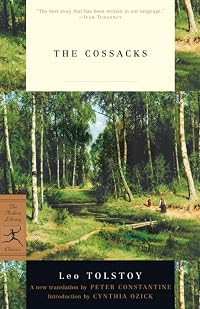
The Cossacks
by Leo Tolstoy
On This Page
Description
A young man, Olenin, is stationed in the Caucasus, where he falls in love with the place, the people, and the simple way of life. Though he has fallen in love with the betrothed of a man he has befriended, he believes that he can be self-sacrificing, until a fellow Russian brings the complexity of Moscow-thinking back to Olenin..
Tags
Recommendations










Member Reviews
The protagonist Olenin casts himself out of well-heeled Russian society to try and find meaning with the Terek Cossacks in the Causasus, but inevitably fails dismally to connect with the likes of the old drunken hunter Eroshka and the young pragmatic maiden Maryanka. Reminded me of my human rights tourism to Guatemala and vain attempts to bond with rural folk there. Even in this earlier work, Tolstoy has mastered the clear-eyed ability to distinquish the real from the romantic, although the book does feel a bit uneven. His rhapsody on seeing mountains cannot be begrudged though, "when he had realised the distance between himself and them and the sky and whole immensity of the mountains, and felt the infinitude of all that beauty..." Ah show more I know that feeling. show less
In this lovely and perceptive novella, the beauty of the Caucasus region, where, the Russians are fighting with the Chechens -- its mountains, streams, forests, and wildlife -- jumps off the page. Tolstoy also portrays the wilder, "simpler" lives of the Cossacks who live there, lives that seem so attractive to his somewhat naive protagonist, a young Moscow aristocrat, Olenin, who joins the Russian army largely as a way to keep himself from gambling, running up debts, and leading a dissolute life. (This, in fact, mirrors some of Tolstoy's own experiences as a young man.) He meets some of the local people, goes hunting, and then falls in love, or so he thinks, with the daughter of his landlord, who is also loved by one of the young show more Cossacks. One of the beauties of the book is that the reader simultaneously sees the world through Olenin's eyes and through the more experienced eyes of the author. show less
The Cossacks is considered Tolstoy's best novel from his early years. Begun in 1853 and completed in 1862, after nearly 10 years of fits and starts, he was compelled to finish it after loosing badly at cards to pay the debt. The novel describes life among the martial Cossacks as seen through the eyes of a young Russian soldier stationed in a native village on the frontier. Descriptions of Caucuses geography and wildlife are the strongest part of the novel in my opinion, the story itself is slow and uneventful. The Cossack's are a clannish community and the outsider Olenin who tries to penetrate it with modest success discovers himself in the process. It's like Dances with Wolves where a soldier who is sent to subjugate and civilize on show more the frontier instead discovers indigenous wisdom and attempts to go native but finds in the end he can never fully cross over and returns a changed man. show less
Really cool love triangle that considers the way that cultures clash when feelings get involved.
On second read: moves slower than I remember, but still good story.
On second read: moves slower than I remember, but still good story.
Really cool love triangle that considers the way that cultures clash when feelings get involved.
On second read: moves slower than I remember, but still good story.
On second read: moves slower than I remember, but still good story.
I really did enjoy reading this book a lot, I like the story and the way it was written. However, Russian literature is drowned in metaphors and rich history so it can be hard to digest at a fast past so it took me a while to read. Overall, I like Tolstoys writing a lot. 10/18/25
A short novel based on Tolstoy's early life as a soldier in the Caucusus. It has the energy and poetry of youth while at the same time foreshadowing the great themes of Tolstoy's later years. Tolstoy explores the birth and death of love and the transience of life.
Members
- Recently Added By
Published Reviews
I want to share with you some recommendations why you should read this book in Russian. Reading "Cossacks" in its original Russian allows readers to experience Tolstoy's unique style, tone, and nuances that may be lost in translation. The rhythm and beauty of the language are an integral part of the narrative. Understanding the cultural references and subtleties embedded in the Russian show more language provides deeper insights into the characters and their motivations, enhancing the reading experience. Engaging with the original text fosters a stronger connection with Tolstoy's thoughts and feelings, enabling readers to appreciate his philosophical reflections on life, nature, and society. Tolstoy's literary mastery is evident in his use of imagery, symbolism, and dialogue. Experiencing these elements firsthand in Russian enriches the reader's understanding and appreciation of his work. Reading "Cossacks" in Russian not only enhances comprehension but also deepens the emotional and intellectual engagement with Tolstoy's timeless themes and vivid storytelling. Find it here: https://zelluloza.ru/books/18685-Kazak... show less
added by perskewyn
Lists

Russian Literature
184 works; 35 members

Books Read in 2023
5,547 works; 145 members

Russian Literature Sequence
28 works; 1 member

My 100 Favorite Books of All Time
57 works; 2 members

Caucasus
122 works; 2 members

Bibliografia essenziale
86 works; 2 members

Book wishlist
78 works; 1 member
Author Information

2,497+ Works 129,472 Members
Count Lev Nikolayevich Tolstoy was born on September 9, 1828 in Russia. He is usually referred to as Leo Tolstoy. He was a Russian author who is regarded as one of the greatest authors of all time. Leo Tolstoy is best known for his novels War and Peace (1869) and Anna Karenina (1877). Tolstoy's fiction includes dozens of short stories and several show more novellas such as The Death of Ivan Ilyich, Family Happiness, and Hadji Murad. He also wrote plays and numerous philosophical essays. Tolstoy had a profound moral crisis and spiritual awakening in the 1870's which he outlined in his work, A Confession. His literal interpretation of the ethical teachings of Jesus, centering on the Sermon on the Mount, caused him to become a fervent Christian anarchist and pacifist. His ideas of nonviolent resistance which he shared in his works The Kingdom of God is Within You, had a profund impact on figures such as Mohandas Gandhi and Martin Luther King, Jr. On September 23, 1862 Tolstoy married Sophia Andreevna Behrs. She was the daughter of a court physician. They had 13 children, eight of whom survived childhood. Their early married life allowed Tolstoy much freedom to compose War and Peace and Anna Karenina with his wife acting as his secretary and proofreader. The Tolstoy family left Russia in the aftermath of the Russian Revolution and the subsequent establishment of the Soviet Union. Leo Tolstoy's relatives and descendants moved to Sweden, Germany, the United Kingdom, France and the United States. Tolstoy died of pneumonia at Astapovo train station, after a day's rail journey south on November 20, 1910 at the age of 82. (Bowker Author Biography) Count Leo Tolstoy was born in 1828 on the family estate of Yasnaya Polyana in the Tula province. He married in 1862 & was the father of 13 children. Tolstoy managed the estate of Yasnaya Polyana & ran its peasant schools, while writing his great novels, "War & Peace" (1869) & "Anna Karenina" (1877). He died in 1910. (Publisher Provided) show less
Some Editions
Awards and Honors
Awards
Series
Belongs to Publisher Series
Work Relationships
Is contained in
Has the adaptation
Common Knowledge
Classifications
- Genres
- Fiction and Literature, General Fiction
- DDC/MDS
- 813 — Literature & rhetoric American literature in English American fiction in English
- LCC
- PG3366 .K4 — Language and Literature Slavic languages and literatures. Baltic languages. Albanian language Slavic. Baltic. Albanian Russian literature Individual authors and works 1800-1870 Tolstoi
- BISAC
Statistics
- Members
- 1,115
- Popularity
- 22,668
- Reviews
- 19
- Rating
- (3.68)
- Languages
- 17 — Catalan, Danish, Dutch, English, Estonian, Finnish, French, German, Greek, Hungarian, Italian, Norwegian (Bokmål), Portuguese, Russian, Spanish, Swedish, Turkish
- Media
- Paper, Audiobook, Ebook
- ISBNs
- 123
- ASINs
- 62