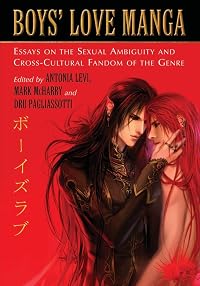
Boys' Love Manga: Essays on the Sexual Ambiguity and Cross-Cultural Fandom of the Genre
by Antonia Levi
On This Page
Description
""Boys' love," a male-male homoerotic genre written primarily by women for women, enjoys global popularity and is one of the most rapidly growing publishing niches in the United States. This collection of 14 essays addresses boys' love as it has been received and modified by fans outside Japan as a commodity, controversy, and culture"--Provided by publisher.Tags
Recommendations










Member Reviews
There’s a fair amount of repetition across the essays in this book, which was nonetheless quite useful to me. The ethnographic parts focus on non-Japanese fans, mostly German and American (with some mentions of Korean manhwa and Korean fans), though the bibliography includes some pieces more about Japanese fans specifically. A lot of the contributions talk about the debate over whether BL is feminist/liberating or appropriative of gay men’s lives (or, maybe, both?), but reach the same lack of resolution that similar discussions of slash have—turns out there were active debates on pretty much the same terms among Japanese and Korean fans.
Overall, unsurprisingly, the participants were highly sympathetic to BL and its fans. Spot the show more contradictions about the genre and its readers in Pagliassotti’s account: “Although write-in choices were generally in accord with stereotypes for the seme (e.g., bad boy, dominance, confidence), the write-in responses included a few strong rejections of the uke stereotype, including the uke’s perceived ‘femininity’ …. This rejection of the uke’s tendency to be assigned stereotypically feminine qualities seems to fit in with Western BL manga readers’ response that they appreciate the subgenre’s freedom from gender stereotypes.” I did like the note that because Japanese laws have traditionally suppressed genital display, “many Japanese BL manga contain scenes in which hands grip blank spaces that spurt liquids or one character penetrates another with emptiness, bringing a whole new meaning to the concept of the absent phallus.” Pagliassotti also, like many of the contributors, talks about BL as “for us by us”: not being present in the narrative doesn’t mean being powerless; indeed we rarely think of mainstream porn as being an expression of women’s power even though women are the focus—as Francesca Coppa says, there’s protection and power in being behind the camera/pen instead of in front of it.
But that leads, of course, to the issue of “nothing about us without us,” the objection of some gay men to slash/yaoi, and the validity of the common response, “well, it’s not really about you” in a world in which some people—including some young gay men--may take their expectations of how gay men should behave from slash/yaoi. Mark John Isola’s contribution is probably the best discussion of these questions, and their airing in the BL community, in the volume.
Alexis Hall investigates the standards for “realism” applied by Western fans to yaoi, concluding that their definitions often focus on coming out and embracing a gay identity/experiencing discrimination, even though that is not a universal for gay men in Japan or even in the US. She notes that Western fans often defer to Western gay men as arbiters of “realness,” privileging sexual identity over national identity (so realism/accuracy is not judged by asking Japanese women about it). American audiences thus read both ethnocentrically (assuming a universal gay identity) and exotifyingly (enjoying the otherness/difference of Japanese culture). But she sees potential too in BL’s cross-cultural influences and readers’ understanding that what seems natural may be encultured. show less
Overall, unsurprisingly, the participants were highly sympathetic to BL and its fans. Spot the show more contradictions about the genre and its readers in Pagliassotti’s account: “Although write-in choices were generally in accord with stereotypes for the seme (e.g., bad boy, dominance, confidence), the write-in responses included a few strong rejections of the uke stereotype, including the uke’s perceived ‘femininity’ …. This rejection of the uke’s tendency to be assigned stereotypically feminine qualities seems to fit in with Western BL manga readers’ response that they appreciate the subgenre’s freedom from gender stereotypes.” I did like the note that because Japanese laws have traditionally suppressed genital display, “many Japanese BL manga contain scenes in which hands grip blank spaces that spurt liquids or one character penetrates another with emptiness, bringing a whole new meaning to the concept of the absent phallus.” Pagliassotti also, like many of the contributors, talks about BL as “for us by us”: not being present in the narrative doesn’t mean being powerless; indeed we rarely think of mainstream porn as being an expression of women’s power even though women are the focus—as Francesca Coppa says, there’s protection and power in being behind the camera/pen instead of in front of it.
But that leads, of course, to the issue of “nothing about us without us,” the objection of some gay men to slash/yaoi, and the validity of the common response, “well, it’s not really about you” in a world in which some people—including some young gay men--may take their expectations of how gay men should behave from slash/yaoi. Mark John Isola’s contribution is probably the best discussion of these questions, and their airing in the BL community, in the volume.
Alexis Hall investigates the standards for “realism” applied by Western fans to yaoi, concluding that their definitions often focus on coming out and embracing a gay identity/experiencing discrimination, even though that is not a universal for gay men in Japan or even in the US. She notes that Western fans often defer to Western gay men as arbiters of “realness,” privileging sexual identity over national identity (so realism/accuracy is not judged by asking Japanese women about it). American audiences thus read both ethnocentrically (assuming a universal gay identity) and exotifyingly (enjoying the otherness/difference of Japanese culture). But she sees potential too in BL’s cross-cultural influences and readers’ understanding that what seems natural may be encultured. show less
Ratings
Members
- Recently Added By
Lists

Anime/Manga Studies
111 works; 3 members
Author Information
2 Works 117 Members
Classifications
- Genres
- Nonfiction, Literature Studies and Criticism, LGBTQ+, Graphic Novels & Comics
- DDC/MDS
- 741.5 — Arts & recreation Drawing & decorative arts Drawing Comic books, graphic novels, fotonovelas, cartoons, caricatures, comic strips
- LCC
- PN6710 .B67 — Language and Literature Literature (General) Literature (General) Collections of general literature Comic books, strips, etc.
- BISAC
Statistics
- Members
- 21
- Popularity
- 1,236,170
- Reviews
- 1
- Rating
- (3.17)
- Languages
- English
- Media
- Paper, Ebook
- ISBNs
- 2