On This Page
Description
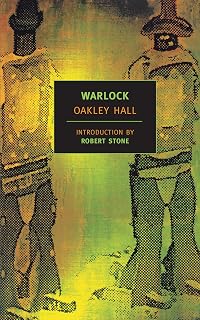
Oakley Hall's legendary Warlock revisits and reworks the traditional conventions of the Western to present a raw, funny, hypnotic, ultimately devastating picture of American unreality. First published in the 1950s, at the height of the McCarthy era, Warlock is not only one of the most original and entertaining of modern American novels but a lasting contribution to American fiction.Tags
Recommendations




Member Reviews
In his introduction, [author:Oakley Hall|44545] said that "The pursuit of truth, not of facts, is the business of fiction.' Although Warlock is a fictional story about a fictional town in a fictional state, it offers up more truth and insight into the events that happened in Tombstone, Arizona, than did any of the hundreds of so-called Factual accounts of those historical events.
What we know about the fictional town of Warlock is that it is a silver mining town situated near the border with Mexico. Outside of town live what are called cowboys by friends and rustlers by just about everyone else. The distinction appears to be that some don’t consider crossing the border to round up cattle belonging to Mexican rancheros as rustling, show more illegal, or even disreputable. Problems arise when these high-spirited cowboys go into town, get a snoot full, and start to act up (i.e.: shoot the barber for giving a bad cut, or the piano player for missing a note). As Warlock is unincorporated, there is no official court or law enforcement, so the town’s businessmen take it upon themselves to form a Citizens’ Committee which proceeds to hire a Marshal (aka skilled gunman) to restore order. Add to this a mine with its usual mix of nasty mine manager and unhappy miners and you pretty much get the picture.
What separates Warlock from other westerns with similar plots is that Hall uses it to carefully examine the subject of justice in general, and frontier justice in particular. There are few black hats in this story and no white hats at all. The so-called good guys all have their demons and the bad guys, for the most part, have their softer sides, if you probe long enough.
Friedrich Nietzsche wrote, “Battle not with monsters, lest ye become a monster, and if you gaze into the abyss, the abyss gazes also into you.” Thomas Pynchon, in his review, wrote that It is the deep sensitivity to abysses that makes Warlock, I think, one of our best American novels.
Society, then and now, is a fragile thing. Per Pynchon, "the collective awareness that is Warlock must face its own inescapable Horror: that what is called society, with its law and order, is as frail, as precarious, as flesh and can be snuffed out and assimilated back into the desert as easily as a corpse can." show less
What we know about the fictional town of Warlock is that it is a silver mining town situated near the border with Mexico. Outside of town live what are called cowboys by friends and rustlers by just about everyone else. The distinction appears to be that some don’t consider crossing the border to round up cattle belonging to Mexican rancheros as rustling, show more illegal, or even disreputable. Problems arise when these high-spirited cowboys go into town, get a snoot full, and start to act up (i.e.: shoot the barber for giving a bad cut, or the piano player for missing a note). As Warlock is unincorporated, there is no official court or law enforcement, so the town’s businessmen take it upon themselves to form a Citizens’ Committee which proceeds to hire a Marshal (aka skilled gunman) to restore order. Add to this a mine with its usual mix of nasty mine manager and unhappy miners and you pretty much get the picture.
What separates Warlock from other westerns with similar plots is that Hall uses it to carefully examine the subject of justice in general, and frontier justice in particular. There are few black hats in this story and no white hats at all. The so-called good guys all have their demons and the bad guys, for the most part, have their softer sides, if you probe long enough.
Friedrich Nietzsche wrote, “Battle not with monsters, lest ye become a monster, and if you gaze into the abyss, the abyss gazes also into you.” Thomas Pynchon, in his review, wrote that It is the deep sensitivity to abysses that makes Warlock, I think, one of our best American novels.
Society, then and now, is a fragile thing. Per Pynchon, "the collective awareness that is Warlock must face its own inescapable Horror: that what is called society, with its law and order, is as frail, as precarious, as flesh and can be snuffed out and assimilated back into the desert as easily as a corpse can." show less
Warlock is a rare book: a novel whose Western setting couldn't be further from the drawing rooms of England, but what George Eliot did for Middlemarch, Hall does for Warlock— a New Mexico (maybe) mining town that owes a lot to Tombstone, Arizona. To find a modern work that might compare to this, you have to look to another medium: David Milch's cable series Deadwood — to which this book served as an obvious inspiration. But the book, as is usually the case, is richer.
To be sure, the book requires a bit of work for those (like me) whose attention span has been shortened and dulled by online media. There are many scenes that, although fully described, have a meaning that may not become clear until many pages later. Sometimes you read show more them and wonder what you're missing, when in truth, you haven't missed anything. On the other hand, sometimes a character says something that you don't quite get, and you're left to remember what that character happened to see or hear in a previous chapter in order to make sense of it. Adding to this, the idiom that many of the character speak, though authentic-seeming, doesn't always match the conventional movie-Western idiom we're used to. It adds to the sense of realism, but sometimes it leaves you scratching your head. What does it mean to crawfish? What exactly is the difference between a jack and a mucker? In short, reading Warlock requires a brain; it may be a Western, but it's no mere airport read.
I regret that this book is set in a (violent) man's world. Amidst a couple of dozen well drawn males, there are only two significant female characters: one weak and controlling, one strong but ineffectual. Even in a rough, frontier mining town, that half of the human race deserves more representation. That said, the major characters are deep and believable, even while they occupy stock roles: Johnny Gannon, the inwardly sensitive but outwardly stoic deputy, always underestimated; Clay Blaisedell, the Gary Cooper gunslinger who finds himself bending under the weight of the role of town Superman; Tom Morgan, the despicable killer-gambler who is nonetheless Blaisedell's only true friend, and many more.
In short, this book is to your typical Western as a Jane Austen novel is to Bridget Jones' Diary. Warlock presents an unsentimental mix of complex characters and lets their internal and external struggles throw light on issues of individual and social morality that are relevant in all places and eras, and never more so than today. Rich, long, and increasingly absorbing as you do the necessary work of paying attention, it's the first novel I've read in several years that made me want to return to the first page and start again. show less
To be sure, the book requires a bit of work for those (like me) whose attention span has been shortened and dulled by online media. There are many scenes that, although fully described, have a meaning that may not become clear until many pages later. Sometimes you read show more them and wonder what you're missing, when in truth, you haven't missed anything. On the other hand, sometimes a character says something that you don't quite get, and you're left to remember what that character happened to see or hear in a previous chapter in order to make sense of it. Adding to this, the idiom that many of the character speak, though authentic-seeming, doesn't always match the conventional movie-Western idiom we're used to. It adds to the sense of realism, but sometimes it leaves you scratching your head. What does it mean to crawfish? What exactly is the difference between a jack and a mucker? In short, reading Warlock requires a brain; it may be a Western, but it's no mere airport read.
I regret that this book is set in a (violent) man's world. Amidst a couple of dozen well drawn males, there are only two significant female characters: one weak and controlling, one strong but ineffectual. Even in a rough, frontier mining town, that half of the human race deserves more representation. That said, the major characters are deep and believable, even while they occupy stock roles: Johnny Gannon, the inwardly sensitive but outwardly stoic deputy, always underestimated; Clay Blaisedell, the Gary Cooper gunslinger who finds himself bending under the weight of the role of town Superman; Tom Morgan, the despicable killer-gambler who is nonetheless Blaisedell's only true friend, and many more.
In short, this book is to your typical Western as a Jane Austen novel is to Bridget Jones' Diary. Warlock presents an unsentimental mix of complex characters and lets their internal and external struggles throw light on issues of individual and social morality that are relevant in all places and eras, and never more so than today. Rich, long, and increasingly absorbing as you do the necessary work of paying attention, it's the first novel I've read in several years that made me want to return to the first page and start again. show less
A true Revisionist Western with gray moral lines and a hero with an impossible task. Showcases the human desire to build up heroes while setting unachievable standards to watch them climb and ultimately fail. Pynchon called this "a novel of abysses" - and it's a perfect encapsulation.
Like many, I bought this book after reading that Thomas Pynchon was a big fan of it, and he was absolutely right about it. His capsule review on the back of my edition has an astute emphasis on the unique role that the western novel/film has come to play in the American psyche: mementoes of the second, true Founding, where the country was clawed from the earth by the miners and gunfighters and criminals unable or unwilling to fit in anywhere else, blowing thin soap bubbles of civilization that would all too often pop and leave only death behind. If you've ever seen The Man Who Shot Liberty Valance you'll find a lot that's familiar here, in particular the parts about the economics of the frontier and the desperate struggles for survival show more that consumed many formerly prosperous towns: Warlock, like so many other boomtowns, is more Tombstone than Phoenix. Where Warlock really captivated me was in its treatment of the classic black hat/white hat battle between the hired sheriff, Clay Blaisedell, and his opponent Abe McQuown. The book is clearly aiming on some level to be partly a discussion on why people need heroes (the book's version of the shootout at the OK Corral is particularly explicit about this), so after finishing it you can easily spend hours thinking about what it really means when some Reagan/Bush-type character puts on a cowboy hat and starts talking about Law and Order or Wanted Dead or Alive, and why they feel compelled to do it in the first place. But this western isn't boring in the slightest; its themes of labor struggles, amorality, and myth-busting flow smoothly from the action and the characters, all of whom have their own special relationship to the town and each other. Deputy Johnny Gannon is particularly interesting. Warlock is one of the best and deepest westerns I've ever read; the writers of Deadwood probably have a few well-read copies of it. show less
Warlock is a microcosmic tale of man's obsession and struggle for power. The small, fictional South-Western town is the fulcrum on which the righteous and wicked vie to rule, the town's inhabitants perpetually caught in the crossfire.
Since Warlock is not deemed substantial enough to deserve its own county seat, and the nearest court being a day's ride away in Bright's City - the law of the land is somewhat hamstrung, amounting to a single jail in a ramshackle hut where the lengthening deputies' names scratched into the wall show the monotonous loss of life and cost of the power struggle.
In an attempt to take matters into their own hands, the inhabitants create a citizen's committee which decides to hire a cultish, golden gunned warden show more by the name of Clay Blaisedell, in order to gain their own standing in Warlock and kick back at the outlander band of troublemakers and their notorious leader, Abe McGowan.
The path of Oakley Hall's story is far from simple. Truth, morality and honour become convoluted and circumspect in the melting pot of power, righteousness a pinball ricocheting against the countless variables: wonts, desires and limitations of his dustbowl denizens.
“Is not the history of the world no more than a record of violence and death cut in stone? It is a terrible, lonely, loveless thing to know it, and see—as I realize now the doctor saw before me—that the only justification is in the attempt, not in the achievement, for there is no achievement; to know that each day may dawn fair or fairer than the last, and end as horribly wretched or more. Can those things that drive men to their ends be ever stilled, or will they only thrive and grow and yet more hideously clash one against the other so long as man himself is not stilled? Can I look out at these cold stars in this black sky and believe in my heart of hearts that it was this sky that hung over Bethlehem, and that a star such as these stars glittered there to raise men’s hearts to false hopes forever?”
Hall pens the complexity of life expertly and the reader, like his characters, become embroiled in and sullied by his prose. Warlock is a highly crafted and memorable tale that is well worth a read. show less
Since Warlock is not deemed substantial enough to deserve its own county seat, and the nearest court being a day's ride away in Bright's City - the law of the land is somewhat hamstrung, amounting to a single jail in a ramshackle hut where the lengthening deputies' names scratched into the wall show the monotonous loss of life and cost of the power struggle.
In an attempt to take matters into their own hands, the inhabitants create a citizen's committee which decides to hire a cultish, golden gunned warden show more by the name of Clay Blaisedell, in order to gain their own standing in Warlock and kick back at the outlander band of troublemakers and their notorious leader, Abe McGowan.
The path of Oakley Hall's story is far from simple. Truth, morality and honour become convoluted and circumspect in the melting pot of power, righteousness a pinball ricocheting against the countless variables: wonts, desires and limitations of his dustbowl denizens.
“Is not the history of the world no more than a record of violence and death cut in stone? It is a terrible, lonely, loveless thing to know it, and see—as I realize now the doctor saw before me—that the only justification is in the attempt, not in the achievement, for there is no achievement; to know that each day may dawn fair or fairer than the last, and end as horribly wretched or more. Can those things that drive men to their ends be ever stilled, or will they only thrive and grow and yet more hideously clash one against the other so long as man himself is not stilled? Can I look out at these cold stars in this black sky and believe in my heart of hearts that it was this sky that hung over Bethlehem, and that a star such as these stars glittered there to raise men’s hearts to false hopes forever?”
Hall pens the complexity of life expertly and the reader, like his characters, become embroiled in and sullied by his prose. Warlock is a highly crafted and memorable tale that is well worth a read. show less
The town of Warlock is terrorized by a group of rowdy cowboys, until a committee of town businessmen hire a marshal to keep the peace. The marshal declares that the cowboys aren't allowed in town, by punishment of death, which raises questions about who has the right to declare and enforce laws.
The book turns that question over and over. Some of the book is written in the form of journals of one of the businessmen on the town council, who asks himself repeatedly if he himself is guilty of murder if the marshal kills someone for entering the town. Meanwhile, one of the town's prominent businessmen is also a cheater and a murderer, but the law applies differently to him.
While this is an excellent examination of the moral ambiguity of show more frontier law, it is also an enjoyable Western, full of the expected cast of cowboys, deputies, and prostitutes and some very tense action scenes.
I listened to the audiobook, and although the narrator is very good, it's a confusing book to listen to because Hall has a habit of naming a character in the first sentence of a chapter, and then just saying "he" for the rest of the chapter, and if you don't catch the name the first time around, you're confused for the rest of the chapter about who this is. There are a lot of characters, and it's hard to keep them straight over audio. I probably missed a lot of nuance because I had trouble following the story. show less
The book turns that question over and over. Some of the book is written in the form of journals of one of the businessmen on the town council, who asks himself repeatedly if he himself is guilty of murder if the marshal kills someone for entering the town. Meanwhile, one of the town's prominent businessmen is also a cheater and a murderer, but the law applies differently to him.
While this is an excellent examination of the moral ambiguity of show more frontier law, it is also an enjoyable Western, full of the expected cast of cowboys, deputies, and prostitutes and some very tense action scenes.
I listened to the audiobook, and although the narrator is very good, it's a confusing book to listen to because Hall has a habit of naming a character in the first sentence of a chapter, and then just saying "he" for the rest of the chapter, and if you don't catch the name the first time around, you're confused for the rest of the chapter about who this is. There are a lot of characters, and it's hard to keep them straight over audio. I probably missed a lot of nuance because I had trouble following the story. show less
Sharply, even beautifully, written. But as a whole did not cohere for me. The complex hatreds, loves, of Morgan, Dollar, Jessie, and Blaisedell were too self-serious, too maudlin. It all felt weighted down by thick layers of shellacking, despite the spare prose.
Members
- Recently Added By
Published Reviews
ThingScore 50
1880 in the border town of Warlock was the year when the law-abiding townsmen decided to subdue the unruly element represented by Abe McQuown and his cowboys by importing a marshal famed as a gunman. Clay Blaisdell brought order to Warlock, but in a violent way the townsfolk had not counted on. And before he rode away the whole town including Blaisdell were forced to search their consciences show more and re-examine their ideas of what justice is and whether the ends justify the means. show less
added by Richardrobert
Lists

Recommend the 20 best books you've read in the last five years
2,168 works; 608 members

Best Historical Fiction
620 works; 258 members

Top Five Books of 2013
1,562 works; 721 members

Read These Too
458 works; 9 members

Franklit
95 works; 1 member
Author Information

30+ Works 2,247 Members
He is the author of more than twenty works of fiction, including The Downhill Racers, Warlock, The Bad Lands & Separations. For twenty years, he was professor English & director of programs in writing at the University of California at Irvine. He is also the director of the Squaw Valley Writing Program. In 1998, he received a PEN center USA West show more Award of Honor for a lifetime of literary achievement. He lives in San Francisco. (Publisher Provided) Author Oakley M. Hall was born in San Diego in 1920. He graduated from the University of California at Berkeley. He joined the Marines and served in the Pacific during World War II. Taking advantage of the G. I. Bill after the war, he studied in Europe and received a Masters of Fine Arts degree in creative writing from the Iowa Writers' Workshop. He founded the creative writing program at the University of California at Irvine and co-founded the Squaw Valley Community of Writers. He wrote the Ambrose Bierce Mystery series and his best known novels are Downhill Racers and Warlock. He died of kidney disease and cancer on May 13, 2008. (Bowker Author Biography) show less
Some Editions
Awards and Honors
Distinctions
Series

Belongs to Publisher Series
Work Relationships
Common Knowledge
- Canonical title
- Warlock
- Original publication date
- 1958
- People/Characters
- Clay Blaisedell; Tom Morgan; John Gannon; Abe McQuown; Kate Dollar; Miss Jessie Marlow
- Important places
- Warlock, California, USA (imaginary place)
- Related movies
- Warlock (1959 | IMDb)
- First words
- Deputy Canning had been Warlock's hope.
- Quotations
- The pursuit of truth, not of facts, is the business of fiction.
The man has had the capacity throughout his career for giving miserable and inexcusable fiasco the semblance of a thrilling victory. - Publisher's editor*
- Galaxia Gutenberg
- Canonical DDC/MDS
- 813.54
- Canonical LCC
- PS3558.A373
*Some information comes from Common Knowledge in other languages. Click "Edit" for more information.
Classifications
Statistics
- Members
- 1,022
- Popularity
- 25,565
- Reviews
- 28
- Rating
- (4.19)
- Languages
- English, French, Italian, Spanish
- Media
- Paper, Audiobook, Ebook
- ISBNs
- 21
- ASINs
- 6