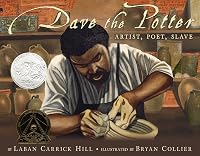
Dave the Potter: Artist, Poet, Slave
by Laban Carrick Hill
On This Page
Description
Chronicles the life of Dave, a nineteenth-century slave who went on to become an influential poet, artist, and potter.Tags
Recommendations
Member Reviews
I had purposed this book to be apart of an ongoing History discussion I was having with my children --boy and girl, 8 and 10 -- on the Civil War. I meant to personalize the historical era which is basically incomprehensible to children this young if you don't give them someone they can understand. And eventually we did get around to this discussion, but first it had to wait. Why? Because my children were awestruck by Bryan Collier's beautiful illustrations. His drawings just grabbed their attention and they had to examine them thoroughly before we could get back to the text. (There's something just magically about how a pot can be pulled out of the blob of clay, and they just had to go through the process multiple times before we could show more move on :)
Dave's hands, buried
in the mounded mud,
pulled out the shape of a jar.
Like a
magician
pulling
a rabbit
out of
a hat...
How true. And Bryan's palate of rich browns and ochres brought that magic to life. And served to make Dave "real" to my kids. So that when we got around to that conversation about what the Civil War was about we could talk about how amazing his artwork and poems were in the context of a time when it was illegal to teach a slave to read and write.
THE SKINNY:::
Dave is a fascinating man and I think the author and illustrator made this perfectly clear.
Besides putting slavery in perspective, I really liked how inspirational his story was. Dave managed, somehow, in a time when it was illegal to teach slaves to read and write, to produce poetry. And his story is really one of the inextinguishable human spirit.
I wish the book had included some information about the rest of Dave's life. He was eventually emancipated after all, and took the last name Drake, and I wonder what happened to him. But then again not knowing the rest of the story, perhaps there's a reason it was omitted. (Parents and teachers might still want to do some more research to tell 'the whole story'.)
I also wish that there had been some notes explaining some of the more cryptic poems. We had fun trying to figure out what some of them might have meant, but I would have liked to have an authoritative source give us their opinions.
Simply fabulous artwork.
Pam T~
mom/blogger
booksforkids-reviews.com show less
Dave's hands, buried
in the mounded mud,
pulled out the shape of a jar.
Like a
magician
pulling
a rabbit
out of
a hat...
How true. And Bryan's palate of rich browns and ochres brought that magic to life. And served to make Dave "real" to my kids. So that when we got around to that conversation about what the Civil War was about we could talk about how amazing his artwork and poems were in the context of a time when it was illegal to teach a slave to read and write.
THE SKINNY:::
Dave is a fascinating man and I think the author and illustrator made this perfectly clear.
Besides putting slavery in perspective, I really liked how inspirational his story was. Dave managed, somehow, in a time when it was illegal to teach slaves to read and write, to produce poetry. And his story is really one of the inextinguishable human spirit.
I wish the book had included some information about the rest of Dave's life. He was eventually emancipated after all, and took the last name Drake, and I wonder what happened to him. But then again not knowing the rest of the story, perhaps there's a reason it was omitted. (Parents and teachers might still want to do some more research to tell 'the whole story'.)
I also wish that there had been some notes explaining some of the more cryptic poems. We had fun trying to figure out what some of them might have meant, but I would have liked to have an authoritative source give us their opinions.
Simply fabulous artwork.
Pam T~
mom/blogger
booksforkids-reviews.com show less
This book is perfect. Perfect even in its details. I believe the author must have tried his hand at making pottery because the descriptions of how a potter's hands feel is spot on and brought sensations from my pottery days forty years ago vividly back to memory. If this was done in the spirit of research for the book, wow. More authors should be so thorough. The illustrations are also perfect for the book. At the end of the book, there is more about Dave's life and art, his poetry carved on many of his pots, and how the book came to be written.
A poetic picture-book examination of the life and work of Dave, a potter, poet and slave in nineteenth-century South Carolina, Dave the Potter follows the story of the clay itself, from clouds of dust on the ground (?), through Dave's skilled hands, to its final form as a pot. A strong man who could throw sixty-pound pots, Dave was an artist and a writer, occasionally inscribing short poems - "I wonder where is all my relation / friendship to all - and, every nation" - on his creations, before they hardened.
Chosen as a Caldecott Honor Book this year, and given the Coretta Scott King Award for Illustrators as well, this visually intense picture-book brings to light a little-known but fascinating artist, and for that I am glad. That said, show more I think I agree with the reviewer who stated that the afterword, in which more information about Dave and his life is given, was my favorite part of the book. I wanted to know more, and while I understand that there is limited information available about Dave, I wasn't entirely satisfied with the way the narrative focused on his process, rather than on him, leaving out even those few details that are known. I enjoyed Bryan Collier's earth-toned illustrations, and can definitely see why they were honored with so many awards, but I also would have liked to see more photographs, in the rear, of Dave's actual work.
Still, despite these quibbles, Dave the Potter is a book I would recommend, to young readers interesting in pottery and poetry, or in the institution of slavery in American history. show less
Chosen as a Caldecott Honor Book this year, and given the Coretta Scott King Award for Illustrators as well, this visually intense picture-book brings to light a little-known but fascinating artist, and for that I am glad. That said, show more I think I agree with the reviewer who stated that the afterword, in which more information about Dave and his life is given, was my favorite part of the book. I wanted to know more, and while I understand that there is limited information available about Dave, I wasn't entirely satisfied with the way the narrative focused on his process, rather than on him, leaving out even those few details that are known. I enjoyed Bryan Collier's earth-toned illustrations, and can definitely see why they were honored with so many awards, but I also would have liked to see more photographs, in the rear, of Dave's actual work.
Still, despite these quibbles, Dave the Potter is a book I would recommend, to young readers interesting in pottery and poetry, or in the institution of slavery in American history. show less
To us it is just dirt, the ground we walk on... But to Dave it was clay, the plain and basic stuff upon which he formed a life as a slave nearly 200 years ago.
Dave was an extraordinary artist, poet, and potter living in South Carolina in the 1800s. He combined his superb artistry with deeply observant poetry, carved onto his pots, transcending the limitations he faced as a slave. In this inspiring and lyrical portrayal, National Book Award nominee Laban Carrick Hill's elegantly simple text and award-winning artist Bryan Collier's resplendent, earth-toned illustrations tell Dave's story, a story rich in history, hope, and long-lasting beauty.
Dave was an extraordinary artist, poet, and potter living in South Carolina in the 1800s. He combined his superb artistry with deeply observant poetry, carved onto his pots, transcending the limitations he faced as a slave. In this inspiring and lyrical portrayal, National Book Award nominee Laban Carrick Hill's elegantly simple text and award-winning artist Bryan Collier's resplendent, earth-toned illustrations tell Dave's story, a story rich in history, hope, and long-lasting beauty.
A picture book biography of a 19th century African American pot maker who was also a poet, and apparently a slave.
I don't think anyone's going to let that summary slide without my saying something about it first. When I look at a picture book biography I have to step back and read it through the eyes of the intended audience, or try to at least. When the subtitle promises to tell me three things about the subject, and text only conveys two of those three effectively, it leaves me feeling something is missing. That Dave is depicted as an artist making pots comes across in both the detailed verse describing the process and the well-researched images. But all we see of Dave is him at work in his shop and maybe a few details the convey the show more general era of the story and nothing, text or image, that necessarily informs us of Dave's slavery.
Does it have to? Can we simply put the word 'slave' on the cover and assume the reader will understand what is necessary for the context of the story? Here's my problem then with the text – we learn in the back matter that Dave's profession was unusual for a slave, which I think is safe to assume because what we tend to hear about slaves in the American South leans toward house and field. The fact that he's an artisan is an important distinction, but I instantly want to know: who does a slave potter make his pots for? Were they commissioned by his owners to be sold locally? Did his make them for his master's house? In the back matter we are told one of the earliest records is of 17 year old Dave looking to get a loan for a house – was this for his business? Was he freed? So many questions around his identity as a slave which are important only in so far as they help us understand who he was creating his pots for. He doesn't begin to write poems on his pots until he's in his 30s as far as we know – another clue, he's been educated and has a facility with rhyme – which might suggest that his stature had been secured as a local artist that he didn't fear his pots would be rejected for having been inscribed by a slave. So many things I wish I understood about this aspect of Dave's life.
Is it right to want so much from a picture book? Perhaps not, but again, if it's important enough to put on the cover of the book I think it isn't unreasonable to have it addressed within the main text. This becomes part of my problem with back matter in nonfiction picture books. So much information is jumped to the back after the main text that it begins to feel like everything that proceeds it is like the carrot before the stick, and the reader is going to get both. Yes, sometimes the details aren't going to fit the narrative flow of a story, which is perhaps why we should question this method of delivering nonfiction to younger readers because if we are presenting fact in the guise of fiction we risk readers walking away with only half the story. Out of context of the narrative – literally, separated from the text – the back matter is easily ignored by a reader who wants the gist of the story and only reads the main portion. And in Dave the Potter there is little in that main text to explain enough of Dave's story to justify the word 'slave' on the cover or in the subtitle.
Having said all that, Hill does a nice job of giving us the process involved in 19th century pottery. It's a very close narrative, told in verse, an extremely tactile and physical study of what it meant to be literally a man of the earth. Hill captures that sense of what it means to be an artist, working along, knowing only what the artist can about how such things look like during their creation. The dedication, the shaping, the pride of craftsmanship, much of what is written can be applied to any art or craft. On the poetic front I might have liked to see more of Dave's little couplets incorporated into the story as opposed to the back matter, but it can equally be argued that there is poetry in his craft. I can't think of a more appropriate approach to a poet's life than to write in verse, as Hill does here, so bonus points for that.
Ignore my misgivings; I think the book deserves its Caldecott Honor and Coretta Scott King awards. Dave the Potter is a well-told examination of a craftsman's life in the early 19th century, beautifully illustrated and carefully researched, and a fine portrait of an African American plying a trade few did during that particular time in history. I simply wish I had a better sense of the subject in that time. show less
I don't think anyone's going to let that summary slide without my saying something about it first. When I look at a picture book biography I have to step back and read it through the eyes of the intended audience, or try to at least. When the subtitle promises to tell me three things about the subject, and text only conveys two of those three effectively, it leaves me feeling something is missing. That Dave is depicted as an artist making pots comes across in both the detailed verse describing the process and the well-researched images. But all we see of Dave is him at work in his shop and maybe a few details the convey the show more general era of the story and nothing, text or image, that necessarily informs us of Dave's slavery.
Does it have to? Can we simply put the word 'slave' on the cover and assume the reader will understand what is necessary for the context of the story? Here's my problem then with the text – we learn in the back matter that Dave's profession was unusual for a slave, which I think is safe to assume because what we tend to hear about slaves in the American South leans toward house and field. The fact that he's an artisan is an important distinction, but I instantly want to know: who does a slave potter make his pots for? Were they commissioned by his owners to be sold locally? Did his make them for his master's house? In the back matter we are told one of the earliest records is of 17 year old Dave looking to get a loan for a house – was this for his business? Was he freed? So many questions around his identity as a slave which are important only in so far as they help us understand who he was creating his pots for. He doesn't begin to write poems on his pots until he's in his 30s as far as we know – another clue, he's been educated and has a facility with rhyme – which might suggest that his stature had been secured as a local artist that he didn't fear his pots would be rejected for having been inscribed by a slave. So many things I wish I understood about this aspect of Dave's life.
Is it right to want so much from a picture book? Perhaps not, but again, if it's important enough to put on the cover of the book I think it isn't unreasonable to have it addressed within the main text. This becomes part of my problem with back matter in nonfiction picture books. So much information is jumped to the back after the main text that it begins to feel like everything that proceeds it is like the carrot before the stick, and the reader is going to get both. Yes, sometimes the details aren't going to fit the narrative flow of a story, which is perhaps why we should question this method of delivering nonfiction to younger readers because if we are presenting fact in the guise of fiction we risk readers walking away with only half the story. Out of context of the narrative – literally, separated from the text – the back matter is easily ignored by a reader who wants the gist of the story and only reads the main portion. And in Dave the Potter there is little in that main text to explain enough of Dave's story to justify the word 'slave' on the cover or in the subtitle.
Having said all that, Hill does a nice job of giving us the process involved in 19th century pottery. It's a very close narrative, told in verse, an extremely tactile and physical study of what it meant to be literally a man of the earth. Hill captures that sense of what it means to be an artist, working along, knowing only what the artist can about how such things look like during their creation. The dedication, the shaping, the pride of craftsmanship, much of what is written can be applied to any art or craft. On the poetic front I might have liked to see more of Dave's little couplets incorporated into the story as opposed to the back matter, but it can equally be argued that there is poetry in his craft. I can't think of a more appropriate approach to a poet's life than to write in verse, as Hill does here, so bonus points for that.
Ignore my misgivings; I think the book deserves its Caldecott Honor and Coretta Scott King awards. Dave the Potter is a well-told examination of a craftsman's life in the early 19th century, beautifully illustrated and carefully researched, and a fine portrait of an African American plying a trade few did during that particular time in history. I simply wish I had a better sense of the subject in that time. show less
This is children's nonfiction at its best. Dave was a remarkable man who lived and worked in South Carolina as a slave. His story is an often-overlooked peice of African American history. The art is realistic and connotes the sensitivity of the man. The text is accesible to young readers. A moving and important book.
Beautiful illustrations fill the pages of an important book written about a uniquely talented, but unknown slave potter or Dave the Potter. As the reader grows to learn more about Dave and his work, the illustrations show his strong hands shaping and guiding the clay. The reader quickly learns what an amazing feat his creations would be for anyone, let along a slave with a kick-turn potting wheel! Dave is an artist and anyone can marvel at what he managed to create and inscribe with poetic lines.
Text does not fill the page and a reader can mull over the spare, but necessary lines of the story while enjoying the illustrations. Each picture offers a multimedia look into the ceramic process while providing vignettes of plantation life. show more For instance, Dave stops his wheel to add a lip to the jar and is flanked by complied images of slaves working in the filed. In layering illustrations and scenes, the book places Dave and his work in an important context and offers approachable means to vital conversations about our history. show less
Text does not fill the page and a reader can mull over the spare, but necessary lines of the story while enjoying the illustrations. Each picture offers a multimedia look into the ceramic process while providing vignettes of plantation life. show more For instance, Dave stops his wheel to add a lip to the jar and is flanked by complied images of slaves working in the filed. In layering illustrations and scenes, the book places Dave and his work in an important context and offers approachable means to vital conversations about our history. show less
Members
- Recently Added By
Lists

Picture Books About Civil Rights
51 works; 4 members

6th Grade
68 works; 4 members

Caldecott Honor Books
296 works; 23 members

Books Read in 2023
5,638 works; 145 members
Author Information

41 Works 2,344 Members
Laban Carrick Hill has been researching the Harlem Renaissance for more than a decade. The author of nearly twenty novels for young adults, he has also taught writing at Columbia University, Baruch College, and St. Michael's College in Vermont. His poems have been included in the Contemporary Poetry of New England anthology and in numerous show more literary magazines, including the Tar River Review, the Denver Quarterly, and American Letters and Commentary show less
All Editions
Awards and Honors
Awards
Distinctions
Notable Lists
Common Knowledge
- Original publication date
- 2010
- Dedication
- For Lorrie Smith and Jennifer Hunt, both of whom made this book possible. --L.C.H.
I dedicate this book to all artists, and everyone who loves picture books. Because this story is really about the power of the human spirit, artistry, and truth, and that cannot be silenced by bondage of any kind. --B.C. - First words
- To us it is just dirt, the ground we walk on.
- Last words
- (Click to show. Warning: May contain spoilers.)I, made this Jar, all of cross
If, you dont [sic] repent, you will be, lost==
Classifications
Statistics
- Members
- 1,014
- Popularity
- 25,717
- Reviews
- 137
- Rating
- (4.10)
- Languages
- English
- Media
- Paper, Audiobook
- ISBNs
- 8
- ASINs
- 2