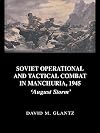
Soviet Operational and Tactical Combat in Manchuria, 1945: 'August Storm' (Soviet (Russian) Study of War)
by David M. Glantz
Leavenworth Papers (8)
On This Page
Description
At the request of the other Allies, on 9th August 1945, a force of over 1.5 million Red Army soldiers unleashed a massive attack against the Japanese in Manchuria. Volume 2 covers the detailed course of operational and tactical fighting in virtually every combat sector.Tags
Recommendations





























Member Reviews
Glantz is something of an expert on Soviet combat operations during the Second World War, about which he has written a number of thick books. This particular one deals with the Soviet conquest of Manchuria in August 1945, and is organized as a set of case studies of the crucial operations. It's rather a specialized military book, but I thought I'd give a quick review.
The good: Incredibly detailed orders of battle. Some real insights into how the Soviets carried out the campaign. Good description of unit movements and actions. A good structured format, with detailed description of the local geography, the Japanese defense plans, the Soviet operational plans, and the outcome.
The bad: The maps are absolutely atrocious; maybe two out of the show more whole book were actually useful. They appear to be mostly very poor reproductions of military topographical maps. Most are all but unreadable.
Surprises: Glantz concludes that the Soviets were quite willing to throw an awful lot of firepower against the Japanese to ensure a quick and crushing victory. They were not willing to expend a lot of soldier's lives to do it; their operations were carried out to minimize casualties. I doubt this was any avuncular concern for his men on Stalin's part; more likely he didn't want to waste trained and experienced troops that he might soon need elsewhere.
The operations in Manchuria overcame heavy fortifications and daunting terrain through fairly impressive planning and conduct of operations. The Japanese kept discovering that their assumptions about where heavy military forces could operate were wrong, and they hardly knew what had hit them as a result. Think eight separate Battles of the Bulge.
THe operations Sakhalin and the Kuriles were not nearly as successful as those in Manchuria. There was less room to maneuver and the Soviets were severely lacking in amphibious capability. None of these operations would have been possible if the Japanese still had any kind of functioning navy or had committed any sizable air force.
Not for the casual reader, but interesting to the serious student of military history. Except for the blasted maps. show less
The good: Incredibly detailed orders of battle. Some real insights into how the Soviets carried out the campaign. Good description of unit movements and actions. A good structured format, with detailed description of the local geography, the Japanese defense plans, the Soviet operational plans, and the outcome.
The bad: The maps are absolutely atrocious; maybe two out of the show more whole book were actually useful. They appear to be mostly very poor reproductions of military topographical maps. Most are all but unreadable.
Surprises: Glantz concludes that the Soviets were quite willing to throw an awful lot of firepower against the Japanese to ensure a quick and crushing victory. They were not willing to expend a lot of soldier's lives to do it; their operations were carried out to minimize casualties. I doubt this was any avuncular concern for his men on Stalin's part; more likely he didn't want to waste trained and experienced troops that he might soon need elsewhere.
The operations in Manchuria overcame heavy fortifications and daunting terrain through fairly impressive planning and conduct of operations. The Japanese kept discovering that their assumptions about where heavy military forces could operate were wrong, and they hardly knew what had hit them as a result. Think eight separate Battles of the Bulge.
THe operations Sakhalin and the Kuriles were not nearly as successful as those in Manchuria. There was less room to maneuver and the Soviets were severely lacking in amphibious capability. None of these operations would have been possible if the Japanese still had any kind of functioning navy or had committed any sizable air force.
Not for the casual reader, but interesting to the serious student of military history. Except for the blasted maps. show less
If you've read any of the author's other works you know what you're getting here; close analysis of the Red Army in World War II based on Russian sources. I particularly liked the special attention paid to the topographic and climatic challenges the Russians faced in planning this campaign. As for the Japanese, I was particularly struck by how a force which generally did not let issues of the terrain stop them from planning their operations allowed themselves to be lulled into the delusion that much of their Manchurian border was naturally impassable.
Ratings
Members
- Recently Added By
Author Information

95+ Works 3,595 Members
David M. Glantz is founder and former director of the U.S. Army's Foreign Military Studies Office.
Series

Common Knowledge
Classifications
Statistics
- Members
- 60
- Popularity
- 516,474
- Reviews
- 2
- Rating
- (4.20)
- Languages
- English
- Media
- Paper, Ebook
- ISBNs
- 5
- ASINs
- 8