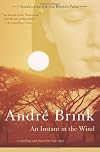
An Instant in the Wind
by André Brink
On This Page
Description
Shortlisted for the 1976 Booker PrizeThe year is 1749, when the Boers ruled South Africa. And so it has come to his Baas's final command to his Hottentot slave Adam, to flog his mother, because she refuses to prune the master's vineyard in order to attend her own beloved mother's funeral. And when he refuses to do so, and his Baas smashes his face with a piece of wood, Adam turns on him, and beats him almost to death. Then he flees to South Africa's veld. There he comes to the rescue of show more Elizabeth, a white woman, and the only person to survive her husband's expedition in the vast South African interior. Alone and terrified, she pleads with the runaway slave to bring her back to the Cape and her home. Adam agrees because he believes by rescuing Elizabeth, he will be awarded his own freedom.
This, then is the stunning story of their trek together, how they find in each other their mutual need and humanity, and finally how their days together turn into an unforgettable, tender love story.
. show less
Tags
Recommendations






















Member Reviews
There was a disjointed style to this that took a while to settle in but then it became incredibly gripping. A failed expedition into the interior of later 1700s Cape colony in South Africa turns into a very complicated story of Elizabeth and Adam (Aob) figuring out how they can survive together or apart. It is brutally honest at times about their relationship and their own pasts and also just a terrifying story of survival in a very harsh world. The constantly shifting point of view was extremely effective, sometimes from one sentence to the next and made both the characters an equal part of the story. The ending was left somewhat enigmatic until I went back to read the front chapter again. Then just tragic.
This must have been a very brave book to write in mid-70s South Africa. This historical romance may be a little fanciful in places but is still a very powerful story. The setting is the hinterland of Cape Town in 1749. The background is set by the first chapter, which lays out the bare bones of the story in a dry academic style, and gives away the lack of a fairytale ending.
Elisabeth Louw is a young woman of mixed Dutch and French parentage who was brought up in Cape Town. She meets and marries an older Swedish naturalist Erik Larsson, thinking he will offer her a route out of the narrow expectations of colonial society. She joins him on an ill-fated expedition to explore the hinterland of the Cape colony where he hopes to classify the show more local wildlife. Their expedition fails - an attack by a lion proves Larsson a coward, their so-called guide kills himself and their Hottentot helpers desert them along with most of their mules, and Larsson himself disappears while chasing a bird. Elisabeth is left alone with her wagon and two mules many days from help, but is found by Adam, a former slave who has escaped from Robben Island and leads an itinerant life, learning survival skills from the local Hottentots.
Most of the book describes Elisabeth's changing relationship with Adam as he helps her return to the Cape - a dangerous journey in which they come close to death many times and learn that the harsh realities and societal expectations that separate them are much less important than their common humanity. We know from the start that their relationship cannot survive the return to the colony.
This is a wonderful book which fully merited its Booker shortlisting and could easily have won. show less
Elisabeth Louw is a young woman of mixed Dutch and French parentage who was brought up in Cape Town. She meets and marries an older Swedish naturalist Erik Larsson, thinking he will offer her a route out of the narrow expectations of colonial society. She joins him on an ill-fated expedition to explore the hinterland of the Cape colony where he hopes to classify the show more local wildlife. Their expedition fails - an attack by a lion proves Larsson a coward, their so-called guide kills himself and their Hottentot helpers desert them along with most of their mules, and Larsson himself disappears while chasing a bird. Elisabeth is left alone with her wagon and two mules many days from help, but is found by Adam, a former slave who has escaped from Robben Island and leads an itinerant life, learning survival skills from the local Hottentots.
Most of the book describes Elisabeth's changing relationship with Adam as he helps her return to the Cape - a dangerous journey in which they come close to death many times and learn that the harsh realities and societal expectations that separate them are much less important than their common humanity. We know from the start that their relationship cannot survive the return to the colony.
This is a wonderful book which fully merited its Booker shortlisting and could easily have won. show less
An Instant in the Wind is an intriguing and thought-provoking novel. The book was banned in South Africa when it was published. In it Brink was challenging the boundaries of Afrikaans literature and was also using it to speak against apartheid (more here on Brink). This book clearly does both.
Set in 1749, in the South African interior, An Instant in the Wind tells the love story of a Adam, a black, runaway slave, and Elizabeth Larssen, a white woman and only survivor of an exploratory expedition led by her husband. When the two meet, deep in the interior, in them clashes two very different ways of thinking. It is this conflict of attitudes and the changes in them that I found the most interesting part of the book. In order for that show more change to occur, Brink has isolated his characters from the society that has shaped their respective worldviews. Eventually, overcoming a rather volatile relationship, the two fall in love and book becomes a bit of a sexual romp in an Eden-like paradise, the two of them alone and naked in it. While there is temptation to stay in this blissful state, they decide they will make the long trek back to the Cape and face/confront society with their love (she will procure him a pardon certainly). Their trek eventually takes them through the Karoo, the desert, a kind of Biblical crucible, and the story becomes one of survival. Miraculously they make it through, but as the reader, one cannot help but have a sense of foreboding as they near the Cape.
Brink writes beautifully about the landscape of South Africa, whether it be the lush or arid parts, the mountains or the sea. I enjoyed this book, but found myself impatient with some parts of the romp and survival stories. At times, it seemed a bit melodramatic (or cinematic?) and I wondered how this might have read to me if I had read it in the 70s. The book brought to mind Valerie Martin's Property, but also McCarthy's The Road, mostly in the way that he has isolated his characters in order to tell a kind of Biblical-style tale. show less
Set in 1749, in the South African interior, An Instant in the Wind tells the love story of a Adam, a black, runaway slave, and Elizabeth Larssen, a white woman and only survivor of an exploratory expedition led by her husband. When the two meet, deep in the interior, in them clashes two very different ways of thinking. It is this conflict of attitudes and the changes in them that I found the most interesting part of the book. In order for that show more change to occur, Brink has isolated his characters from the society that has shaped their respective worldviews. Eventually, overcoming a rather volatile relationship, the two fall in love and book becomes a bit of a sexual romp in an Eden-like paradise, the two of them alone and naked in it. While there is temptation to stay in this blissful state, they decide they will make the long trek back to the Cape and face/confront society with their love (she will procure him a pardon certainly). Their trek eventually takes them through the Karoo, the desert, a kind of Biblical crucible, and the story becomes one of survival. Miraculously they make it through, but as the reader, one cannot help but have a sense of foreboding as they near the Cape.
Brink writes beautifully about the landscape of South Africa, whether it be the lush or arid parts, the mountains or the sea. I enjoyed this book, but found myself impatient with some parts of the romp and survival stories. At times, it seemed a bit melodramatic (or cinematic?) and I wondered how this might have read to me if I had read it in the 70s. The book brought to mind Valerie Martin's Property, but also McCarthy's The Road, mostly in the way that he has isolated his characters in order to tell a kind of Biblical-style tale. show less
Set in the late 1700s, Elizabeth Larsson, an enterprising white woman, accompanies her new husband on an exploratory trip into the South African interior, where he abandons her. Alone, she is found by a black man, Adam Mantoor, who has escaped slavery and imprisonment, after refusing to beat his own mother at the behest of the baas. Adam takes pity on Elizabeth, and together they try to get back to civilization across the harsh, unfriendly wilds of South Africa, trekking through the tropical forests of the Eastern Cape, across swollen, raging floodwaters, through lush forests, battling wildlife, and across the burning desert, the Karoo. As they learn to rely more and more upon one another, their bond deepens, eventually falling in love show more by shedding their prejudices and suspicions. Their resolve to remain together along with their relationship was undermined by the hostile environment, and their path home to the Cape seemed needlessly long. Brink's writing is evocative. show less
In early 1749 a white woman and a black man are stranded together in the wilderness of the South African interior. She is an educated person, totally helpless in the wilds. He is a runaway slave. As they face the long trek back to civilization, a fellowship emerges between them.
"Don’t you think people are landscapes too to be explored" (Elizabeth to Larsson)
Afrique du Sud, vers 1750. Une femme blanche de bonne famille, dont le mari est décédé au cours d'une expédition scientifique, et un esclave en fuite se voient contraints de traverser le pays ensemble pour retourner au Cap. S'ensuit une longue et éprouvante route, une véritable quête initiatique et existentielle, la découverte de la liberté et de ses contraintes, la montée du désir et le dépassement des tabous. Un roman d'une sensualité âpre, d'une force évocatrice rare, et une bouleversante description de la lutte pour la survie. Une grande histoire de passion et une magnifique déclaration d'amour à l'Afrique.
May 25, 2015French
Members
- Recently Added By
Lists

Booker Prize
491 works; 62 members

Man Booker Prize Longlist 1976
6 works; 1 member

Booker Prize Shortlist: Titles Not Yet Read
161 works; 4 members

Stories set on African soil
183 works; 2 members
Author Information

94+ Works 4,917 Members
André Brink was born on May 29, 1935 in Vrede, South Africa. He studied English and Afrikaans at the University in Potchefstroom and comparative literature in Paris. He was a South African writer and educator. He became a part of a group of writers known as Die Sestigers upon returning to South Africa in the 1960s. The group aimed to broaden show more Afrikaner fiction by writing about sexual and moral matters and the failings of the traditional political system. His books included Rumors of Rain, Looking on Darkness, A Dry White Season, and States of Emergency. Some of his books were banned in South Africa. He became a professor of Afrikaans and Dutch literature at Rhodes University and professor of English at the University of Cape Town. He has received the 1980 Martin Luther King Prize, the 1980 French Prix Medicis Etranger, and the 1982 Chevalier of the Legion d'Honneur. He was shortlisted for the Booker Prize twice and nominated for the Nobel Prize for literature on several occasions. He died on February 6, 2015 at the age of 79. (Bowker Author Biography) show less
Awards and Honors
Awards
Notable Lists
Series
Belongs to Publisher Series
Common Knowledge
- Canonical title
- An Instant in the Wind
- Original title
- 'n Oomblik in die Wind
- Original publication date
- 1976
- Important places*
- Zuid-Afrika
- Dedication
- For
Breyten
such a long journey ahead for you and me - First words
- Who were they? The names are known - Adam Mantoor and Elisabeth Larsson - and something of their history has been recorded.
*Some information comes from Common Knowledge in other languages. Click "Edit" for more information.
Classifications
Statistics
- Members
- 387
- Popularity
- 80,824
- Reviews
- 8
- Rating
- (3.95)
- Languages
- 11 — Afrikaans, Danish, Dutch, English, Finnish, French, German, Italian, Portuguese, Spanish, Swedish
- Media
- Paper, Ebook
- ISBNs
- 41
- UPCs
- 1
- ASINs
- 10