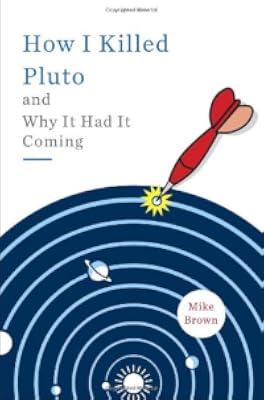
How I Killed Pluto and Why It Had It Coming
by Mike Brown
On This Page
Description
The astronomer who inadvertently triggered the "demotion" of Pluto in his effort to officially recognize the solar system's tenth planet describes the ensuing debates and public outcry while revealing the behind-the-scenes story of his discovery.Tags
Recommendations

















Member Recommendations

Member Reviews
Mike Brown is an astronomer who searches for objects in the Kuiper Belt, beyond Pluto. When he found Eris, an object slightly larger than Pluto, the definition of a planet was called into question. In the end, Eris was not named the tenth planet. Instead, Pluto had its planet status revoked. And school children everywhere sent Mike Brown hate mail.
But that's just the bare bones of the story. Mike Brown does a much better job of recounting Pluto's demise in this witty, engaging book. Along the way, we learn a lot about advances in astronomy, the process of naming objects in space, and the challenges of deciding when to announce a discovery. Because Mike welcomed his daughter Lilah about the time of his discovery, we also get some show more insight into his family life. (This is the part of the book that convinced me that Mike Brown is a good guy - definitely not deserving of the Pluto-related hate mail.)
Even if you only have a causal interest in space, this is a book that is worth reading. show less
But that's just the bare bones of the story. Mike Brown does a much better job of recounting Pluto's demise in this witty, engaging book. Along the way, we learn a lot about advances in astronomy, the process of naming objects in space, and the challenges of deciding when to announce a discovery. Because Mike welcomed his daughter Lilah about the time of his discovery, we also get some show more insight into his family life. (This is the part of the book that convinced me that Mike Brown is a good guy - definitely not deserving of the Pluto-related hate mail.)
Even if you only have a causal interest in space, this is a book that is worth reading. show less
An immensely engaging and personable account of the death of Pluto that will make you care about astronomical bodies you've never even heard of before. I particularly love the insight into the motivations and methodology of astronomy.
This a great book for a lot of reasons. This little gem is an excellent description of a scientist involved in his research but it is also a wonderful meditation on dealing with work, the big things and the mundane things, and what happens when life brings to us a partner and, ultimately, a child. I enjoyed reading about Mike Brown the astronomer, but I also was moved when the astronomer realized he was falling in love and the additional joy that came with the birth of his daughter. The issue of Pluto and the Kuiper Belt objects is still not settled. But this is a well written story of how icy minor plants were discovered.
Mike Brown is the discoverer of several smallish icy bodies out on the edge of the solar system, including three that have received a fair amount of attention: Quaoar, Sedna, and Eris (originally nicknamed Xena). That third one turned out to be slightly bigger than Pluto, thus precipitating the debate over astronomical definitions that eventually led to Pluto being downgraded from a planet to a mere "dwarf planet." Brown himself was a big advocate of "killing Pluto," despite the fact that it also meant losing the chance to be heralded as the only living discoverer of a planet. In this book he explains why, puts the concept of "planet" in scientific and historical context, and talks at length about his own discoveries and how they were show more made. The case he makes for the reclassification of Pluto is excellent, and he explains all the science involved in very clear, easy-to-understand terms, often with a dash of humor. His descriptions of his own research are also engaging and give the reader a good sense of how science is really done, complete with months of horrible tedium, moments of incredible excitement, and the occasional annoying controversy over who gets credit. And the way he ties together his professional and his personal life -- he proposed to his wife the same week Quaoar was discovered, and the existence of Eris was announced only three weeks after the birth of his daughter -- provides a nice touch of human interest. Definitely recommended to anyone interested in the subject. show less
I don’t usually go looking for memoirs. And I definitely don’t seek out science books. For as fascinated as I am by science fiction, reading actual scientific fact usually bores me. I want adventure! I want the high seas and forbidden magic! Something! The fact that How I Killed Pluto and Why It Had It Coming landed on my TBR at all was uncanny – the fact that it survived four years on my TBR without being cut is a miracle.
I’m really glad it did, because I found this book informative and fascinating.
In short, this is the story of Mike Brown and his journey to discover Eris (the “tenth planet”) which eventually led to the demotion of Pluto. He explains the procedure behind using telescopes and searching for “wanderers” in show more the sky with enough to detail to enlighten the uneducated reader (me) but not so much that it’s tedious. Mix in the story of his marriage and first child, and this was an easy read.
It’s also a bit embarrassing, but I learned way more about astronomy from this book than I did from my high school and college science classes.
This book was added to my TBR because I like Pluto. It was a good planet. There was a Disney dog involved. It was sad and far away and needed loving. After listening to this book, I’m no longer bitter about the demotion, not even nostalgic… not really. Brown presents his case pretty well here, and he makes it interesting. There’s even a little bit of drama with a stolen discovery to add a dramatic twist. How many memoirs actually have a nemesis? It was great.
If you’re interested in astronomy at all, Brown describes the tangled conundrum that is the definition of “planet.” the various bodies in our solar system, and even the process of naming a planet (there are rules!). It was all laid out in an interesting way, and doubly good as the narrator did a particularly excellent job making the reading engaging. I would definitely recommend this book to anyone still sore about Pluto, interested in astronomy, or just curious for a great real life tale involving planets and toddlers.
Also, just a thought, this would make a decent movie. Tom Hanks could play Mike Brown. show less
I’m really glad it did, because I found this book informative and fascinating.
In short, this is the story of Mike Brown and his journey to discover Eris (the “tenth planet”) which eventually led to the demotion of Pluto. He explains the procedure behind using telescopes and searching for “wanderers” in show more the sky with enough to detail to enlighten the uneducated reader (me) but not so much that it’s tedious. Mix in the story of his marriage and first child, and this was an easy read.
It’s also a bit embarrassing, but I learned way more about astronomy from this book than I did from my high school and college science classes.
This book was added to my TBR because I like Pluto. It was a good planet. There was a Disney dog involved. It was sad and far away and needed loving. After listening to this book, I’m no longer bitter about the demotion, not even nostalgic… not really. Brown presents his case pretty well here, and he makes it interesting. There’s even a little bit of drama with a stolen discovery to add a dramatic twist. How many memoirs actually have a nemesis? It was great.
If you’re interested in astronomy at all, Brown describes the tangled conundrum that is the definition of “planet.” the various bodies in our solar system, and even the process of naming a planet (there are rules!). It was all laid out in an interesting way, and doubly good as the narrator did a particularly excellent job making the reading engaging. I would definitely recommend this book to anyone still sore about Pluto, interested in astronomy, or just curious for a great real life tale involving planets and toddlers.
Also, just a thought, this would make a decent movie. Tom Hanks could play Mike Brown. show less
The guy whose team discovered Eris, a dwarf planet almost as large as - and more massive than - Pluto, argues for the declassification of Pluto as a planet. That's right, this guy argues himself out of the title of planet discoverer. And he makes a pretty good case. It's not as much about Pluto's size as it is about general definitions. If we say Pluto's a planet, then the Solar System technically has some 200 planets. The tilted and highly elliptical orbit don't help its case any either. After all, Ceres and the other larger asteroids were once called planets too, but no one is mourning them now. Beyond that discussion, though, what I found most fascinating was the description of how a lot of modern astronomy is done. There are show more millions of known objects in the sky; how do you know if you're seeing a new one? And how do you know where it is and what it's made of? What equipment and techniques do you use? Very cool stuff. show less
I have a minor quibble with the title. He didn't actually kill Pluto, he just corrected a classification error. Pluto is still out there!
Early in the book he gave some history - including the fact that the 4 largest asteroids were once considered planets. As one of those people who really resented the downgrade of Pluto, I had to eat my words. The astronomers were right, calling Pluto a planet was a mistake - understandable, but still a mistake.
The book alternates between the science story and Mike Brown's personal life - engagement, marriage, fatherhood. So it's truly a memoir rather than a book of science. I'll leave it on my science bookshelf anyway.
Early in the book he gave some history - including the fact that the 4 largest asteroids were once considered planets. As one of those people who really resented the downgrade of Pluto, I had to eat my words. The astronomers were right, calling Pluto a planet was a mistake - understandable, but still a mistake.
The book alternates between the science story and Mike Brown's personal life - engagement, marriage, fatherhood. So it's truly a memoir rather than a book of science. I'll leave it on my science bookshelf anyway.
Members
- Recently Added By
Published Reviews
ThingScore 50
“How I Killed Pluto” is a strange artifact, an unlikely hybrid of Dennis Overbye’s “Lonely Hearts of the Cosmos” and Anne Lamott’s “Operating Instructions.” It’s not a book about the former ninth planet — or even planetary astronomy — lightly salted with Brown’s family life.
[...]
This approach has a strength: Brown opens the emotional life of an actual scientist to the show more reader, belying the myth that he and his colleagues are automatons. But it also has a weakness: readers swept along by the thrill of a gigantic story — the discovery of a potential new planet — can be stopped by irrelevancies. show less
[...]
This approach has a strength: Brown opens the emotional life of an actual scientist to the show more reader, belying the myth that he and his colleagues are automatons. But it also has a weakness: readers swept along by the thrill of a gigantic story — the discovery of a potential new planet — can be stopped by irrelevancies. show less
added by lorax
Lists

Best Science Books for Non-Scientists
113 works; 57 members

Top Five Books of 2014
1,064 works; 398 members

al.vick-wishlist-science and nature
83 works; 1 member

Amusing Book Titles
146 works; 39 members

Penguin Random House
458 works; 4 members

The r/AskScience Reading List
159 works; 3 members

Books With the Most Memorable Titles
478 works; 158 members

In Our Time books
4,934 works; 2 members
Author Information

1 Work 882 Members
Some Editions
Awards and Honors
Common Knowledge
- Original publication date
- 2010-01-10
- Dedication
- For Diane and Lilah
- First words
- As an astronomer, I have long had a professional aversion to waking up before dawn, preferring instead to see sunrise not as an early-morning treat, but as the signal that the end of a long night of work has come and it is fi... (show all)nally time for overdue sleep.
- Last words
- (Click to show. Warning: May contain spoilers.)Even when we were continents apart, we'd always be looking for the things that moved in the sky.
- Blurbers
- Tyson, Neil deGrasse; Wallace, Benjamin; Carroll, Sean; Rinella, Steven; Loh, Sandra Tsing; Plait, Philip
Classifications
- Genres
- Science & Nature, Nonfiction, General Nonfiction, Biography & Memoir
- DDC/MDS
- 523.49 — Natural sciences & mathematics Astronomy The Solar System Planets, asteroids and trans-Neptunian objects Trans-Neptunian objects; Kuiper belt; Pluto
- LCC
- QB701 .B77 — Science Astronomy Astronomy Descriptive astronomy Solar system
- BISAC
Statistics
- Members
- 886
- Popularity
- 30,464
- Reviews
- 37
- Rating
- (4.08)
- Languages
- English
- Media
- Paper, Audiobook, Ebook
- ISBNs
- 4
- ASINs
- 5