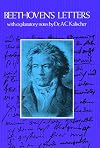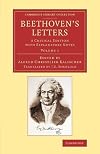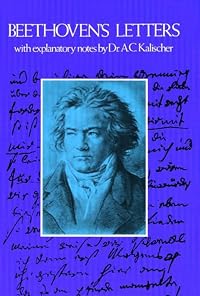
Beethoven's Letters
by Ludwig van Beethoven
On This Page
Description
Ludwig van Beethoven (1770-1827) was a prolific letter writer. Often written in great haste - he regularly signed off 'in der Eile' - his correspondence allows us to follow his anxieties and preoccupations. From his first letter, written at the age of thirteen, wherein he declared his lifelong commitment to the craft of music, through the poignant 'Heiligenstadt Testament', up to the final codicil to his will, these documents reveal the human figure behind some of the greatest music ever show more written. In this two-volume English translation of 1909, John South Shedlock (1843-1919) retains as far as possible the idiosyncratic and error-ridden texts as written by the great composer. Volume 1 covers the years to 1816, and includes the heartbreaking unsent 1802 letter to his brothers in which Beethoven reveals his misery over his increasing deafness and his determination to overcome his physical and emotional weaknesses. show lessTags
Recommendations

















Member Reviews
Beethoven's most candid letters dealing with such topics as his deafness, his declining health, other composers and their influence, his own work.
This could be used to do a project on a historical composer. This is an excellent primary source.
Interesting
Ratings
Members
- Recently Added By
Author Information

6,394+ Works 17,109 Members
Ludwig van Beethoven was born in Bonn, Germany, in 1770. His father Johann van Beethoven, a court musician and tenor, recognized early on that his son had great promise. Young Beethoven gave his first piano recital when he was 7 years old. After a period of training in piano, he enjoyed a career as a musician with the Bonn orchestra until 1787 show more when he left to study in Vienna with the famous Mozart. He was called back to Bonn almost immediately upon the death of his mother and assumed the major responsibility for caring for his family. In 1792 he returned to Vienna where he studied with Haydn, Albrechtsberger, Schenck, and Salieri. Beethoven gained a reputation as a pianist esteemed for brilliant improvisations. He was much admired by members of court, and patrons supported him as he continued to study and compose works of his own. As early as 1798 Beethoven noted a hearing loss that by 1818 left him completely deaf. Unable to admit his affliction, he withdrew from the public and distanced himself from family and friends. Contemplating ending his life, Beethoven finally confessed his illness to his brothers. Slowly, he began to communicate in writing with close friends. His letters are called the conversation notebooks, some of which survive today. There has been speculation about the identity of his Immortal Beloved addressed in the love letters, which were found after his death in March 1827. Beethoven's major output consists of nine symphonies, seven concertos, seventeen string quartets, thirty-two piano sonatas, ten sonatas for violin and piano, five sonatas for cello and piano, one opera, two masses, several overtures and numerous sets of piano variations, including the famous Fifth Symphony and Moonlight Sonata. Beethoven is considered one of the greatest composers of all time and his music remains part of our rich cultural heritage. (Bowker Author Biography) show less
Awards and Honors
Notable Lists
Series
Belongs to Publisher Series
Common Knowledge
- Original publication date
- 1926
- People/Characters
- Ludwig van Beethoven
Classifications
Statistics
- Members
- 125
- Popularity
- 260,214
- Reviews
- 3
- Rating
- (3.67)
- Languages
- English
- Media
- Paper, Ebook
- ISBNs
- 10
- UPCs
- 1
- ASINs
- 1