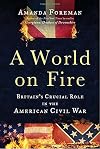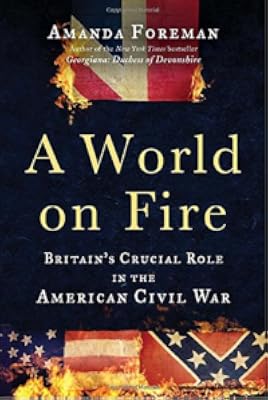
A World on Fire: Britain's Crucial Role in the American Civil War
by Amanda Foreman
On This Page
Description
Presents a history of the role of British citizens in the American Civil War that offers insight into the interdependencies of both nations and how the Union worked to block diplomatic relations between England and the Confederacy.Tags
Recommendations








Member Reviews
Foreman has written an exhaustive account of the American Civil War that takes into consideration Britain's role in the politics between the North and the South. This is a VERY long book - about 1000 pages of text plus extensive photos/illustrations, maps, notes, index, etc. I very much enjoyed reading it, and yet, in the end, it still left me a bit wondering about just how crucial Britain's role really was.
What I do know, now, is that officially the UK maintained neutrality through the war. They never openly acknowledge the South as its own country and did not contribute funds or military support directly to either side. This was not to say that they, in actuality, stayed completely out of it. Britain turned a blind eye to war ships show more being constructed in their ports by the South. They gladly purchased cotton illegally run through blockades (according to the U.S.'s view). There were also many British ships that ran the blockades delivering supplies to the Confederacy.
Why in the world would Britain, supposedly a bastion of anti-slavery, support the South? At least half - probably more - of the residents of the UK believed the South was in the right and the U.S. should let them secede. It's complicated, but Foreman's conclusions seem to be that there was a sort of "aristocratic" fellow-feeling between the British aristocracy and the Southern plantation owners. It seems the British thought that the South would naturally abolish slavery on its own once it seceded (haha, yeah right!).
Supposedly, Lincoln not coming right out at the beginning of the war and emancipating the enslaved made many British feel that the war wasn't really about slavery - that the Southerners just wanted to govern themselves. Um, also no. Lincoln shrewdly waited. He did not have the will of the Northern population yet to immediately emancipate the enslaved. Britains excused their support of the South by telling themselves the North was just as bad because they were too racist to want to liberate slaves.
Certainly, there was about half the British population that was solidly pro-North, mainly for abolition reasons. There were many British who fought in the Civil War on both sides. And in the end, Britain's neutrality certainly helped the U.S. win the war and retain the Southern states as part of the U.S. If Britain (or France) had openly supported the South, things could have been very different. In that respect, Britain did play a crucial role in the Civil War - by not getting too deeply involved.
Foreman spends a lot of time on the Americans from both the North and the South who were sent as diplomats to England. This I found very interesting and pertinent to her thesis. She also spends quite a bit of time on the British diplomats that were in the U.S. during the war - also interesting and pertinent. And then she spends quite a bit of time with some British newspaper reporters and a couple of examples of British men who volunteered to fight in the Civil War. This I found a little less pertinent. I also thought she spent too much time reliving battles - events that are covered in many other books and didn't have much to do with Britain at all, besides the presence of some British fighters. I thought if she had streamlined some of these sections, the book would have been a bit more effective and concise.
Even in this long review, I haven't even scratched the surface of the things I learned or the topics Foreman delves into. I really loved getting a slightly different perspective on the American Civil War - something I've read quite a bit about over the years through fiction and nonfiction. I wondered if, for me, this book would have come together a little better if Foreman had chosen just one or two people to really focus in on, and had made it more of a biography. I think she could have gotten most of the same info into the book, but the reader would feel a bit more connected to the information through the one or two people focused on.
In the end, I do recommend this. I think it is an impressive accomplishment. Overall, most of the book was engaging to read and kept my interest - and that's saying a lot considering the length. I think the Civil War is yet to be fully reconciled with in the U.S., despite being over for almost 160 years. show less
What I do know, now, is that officially the UK maintained neutrality through the war. They never openly acknowledge the South as its own country and did not contribute funds or military support directly to either side. This was not to say that they, in actuality, stayed completely out of it. Britain turned a blind eye to war ships show more being constructed in their ports by the South. They gladly purchased cotton illegally run through blockades (according to the U.S.'s view). There were also many British ships that ran the blockades delivering supplies to the Confederacy.
Why in the world would Britain, supposedly a bastion of anti-slavery, support the South? At least half - probably more - of the residents of the UK believed the South was in the right and the U.S. should let them secede. It's complicated, but Foreman's conclusions seem to be that there was a sort of "aristocratic" fellow-feeling between the British aristocracy and the Southern plantation owners. It seems the British thought that the South would naturally abolish slavery on its own once it seceded (haha, yeah right!).
Supposedly, Lincoln not coming right out at the beginning of the war and emancipating the enslaved made many British feel that the war wasn't really about slavery - that the Southerners just wanted to govern themselves. Um, also no. Lincoln shrewdly waited. He did not have the will of the Northern population yet to immediately emancipate the enslaved. Britains excused their support of the South by telling themselves the North was just as bad because they were too racist to want to liberate slaves.
Certainly, there was about half the British population that was solidly pro-North, mainly for abolition reasons. There were many British who fought in the Civil War on both sides. And in the end, Britain's neutrality certainly helped the U.S. win the war and retain the Southern states as part of the U.S. If Britain (or France) had openly supported the South, things could have been very different. In that respect, Britain did play a crucial role in the Civil War - by not getting too deeply involved.
Foreman spends a lot of time on the Americans from both the North and the South who were sent as diplomats to England. This I found very interesting and pertinent to her thesis. She also spends quite a bit of time on the British diplomats that were in the U.S. during the war - also interesting and pertinent. And then she spends quite a bit of time with some British newspaper reporters and a couple of examples of British men who volunteered to fight in the Civil War. This I found a little less pertinent. I also thought she spent too much time reliving battles - events that are covered in many other books and didn't have much to do with Britain at all, besides the presence of some British fighters. I thought if she had streamlined some of these sections, the book would have been a bit more effective and concise.
Even in this long review, I haven't even scratched the surface of the things I learned or the topics Foreman delves into. I really loved getting a slightly different perspective on the American Civil War - something I've read quite a bit about over the years through fiction and nonfiction. I wondered if, for me, this book would have come together a little better if Foreman had chosen just one or two people to really focus in on, and had made it more of a biography. I think she could have gotten most of the same info into the book, but the reader would feel a bit more connected to the information through the one or two people focused on.
In the end, I do recommend this. I think it is an impressive accomplishment. Overall, most of the book was engaging to read and kept my interest - and that's saying a lot considering the length. I think the Civil War is yet to be fully reconciled with in the U.S., despite being over for almost 160 years. show less
Amanda Foreman is best known for her biography of Georgianna, Duchess of Devonshire. Here she takes her hand at a very different subject: Anglo-American relations during the American Civil War; in particular, why did many Liberal English politicians side with the Confederacy rather than the Union? And why did many Englishmen living in the United States enlist in the Confederate Army? And how close did the USA and the UK come to war over the situation?
Forman originally set out to answer the second question, gathering material – letters home, diaries, reminiscences – of English citizens who had joined the Confederate (or Union) armies. It seems like Englishmen enlisted with the Confederates because they were more-or-less forced to. show more Citizenship was pretty blurry in 1860; if you had been living in the United States for a while your friends and neighbors considered you an American even if you were technically still a British subject, and if you lived in the Southern states and didn’t enlist, said friends and neighbors would make some comment upon it with results ranging from social exclusion all the way to threats of lynching. (Henry Morton Stanley, of eventual “Stanley and Livingstone” fame, received a maid’s uniform in the mail when he didn’t enlist and quickly joined an Arkansas unit). Foreman documents many British subjects who ended up, usually to their considerable surprise, serving in Confederate units. She follows the adventures of these men throughout.
In the north, there wasn’t that sort of pressure but Foreman documents British subjects who joined up out of idealism, and others who enlisted out of poverty. Many Irish enlisted with the idea that if there was going to be a war between the Union and the UK, they wanted to be on the Union side. One notable Union volunteer was Sir Percy Wyndham (his knighthood came from Victor Emmanuel for service with Garibaldi, not from Victoria), a man with an incredible set of mustachios but a credible cavalry commander; he formed and led the 1st New Jersey Cavaliers. Wyndham was one of the few Union cavalry commanders who held his own against J.E.B. Stuart in battle.
Foreman never actually sits down and summarizes the reasons why many British politicians supported the South; to be fair, the reasons oscillated back and forth during the war and the commentary is spread out through the book. Collecting the ideas, we can see the following: the English really didn’t understand United States politics, didn’t think much of Abraham Lincoln, saw the North as a nation of “rude mechanics” while the South was a country of gentleman farmers, and got most of their war news from the Virginia theater where (at first) it seemed like the Confederacy was on its way to victory.
Foreman’s third theme is discussing how close the Union and the United Kingdom came to war. There were several events that could have ticked things off; the most famous is the Trent affair. In 1861 the warship USS San Jacinto intercepted the RMS (Royal Mail Ship) Trent and removed two Confederate envoys. The situation caused immense outrage in England; Prince Albert, dying of typhoid, reworded a diplomatic note that gave the United States an “out”. The Lincoln administration did not apologize but did “disavow” the San Jacinto’s actions and sent the Confederates on. Foreman doesn’t go too much into the possible implications of war in 1861; the British commander on the North American station, Admiral Milne, didn’t anticipate any problem sweeping the Union navy off the seas (although he was instructed not to cooperate with the Confederate on land) but Royal Army personal felt that they couldn’t hold Canada against the Union (1861 was before the Union military had done so much successful fighting against the Confederates, so perhaps they were overly pessimistic).
As the war went on there were various calls for England to intervene for humanitarian reasons. English citizens were appalled by the carnage; the Battle of Antietam alone supposedly caused more casualties than England had lost in the entire Napoleonic Wars. Foreman notes that the Union made it clear that any attempt to intervene to end the fighting would be an act of war and England backed off; by this time the Union navy had become quite formidable and Foreman notes that the advent of ironclad vessels would have made things difficult or even disastrous for the Royal Navy.
Eventually Union strength became more apparent and the relative positions reversed. Union diplomats made it clear that if ships under construction in England were transferred to the Confederacy it would be an act of war. At the time, England was supporting Denmark in the conflict with Prussia over Schleswig-Holstein; but Foreman notes British politicians were nervous that if it were established that belligerents could build warships in a neutral country, nothing would prevent Prussia from building a fleet of commerce raiders in New York and sending them out to disrupt English trade.
The final diplomatically stressful situation was the Confederate use of Canada as a base for attacks into the Union. Confederate agents raided St. Albans, Vermont; conducted incendiary attacks against New York, and attempted to seize a vessel on the Great Lakes. Although the Canadians were generally sympathetic to the South they took action to prevent further Confederate actions. (For more, see Canadians in the Civil War).
This is a really masterful work. It’s huge (988 pages) but an absorbing read. I noticed a couple of minor errors – for example, at one point English vessels are reported visiting “the US Virgin Islands”, which weren’t US possessions until 1914 – but nothing that detracts from the overall quality of scholarship. There are excellent maps of various battles – which include the locations of the various English subjects Foreman is monitoring. There are numerous appropriate illustrations (I noted one was a photograph of a meeting Seward had with various foreign diplomats at the resort community of Trenton Falls, New York – I’ve stood in the exact position shown while doing field geology). The front mater includes a useful list of dramatis personae – English and American – and whether they were Union or Confederate supporters; this makes it easier to keep track of all the names that come up. There are extensive endnotes but no bibliography; instead relevant works are referenced in the endnotes. show less
Forman originally set out to answer the second question, gathering material – letters home, diaries, reminiscences – of English citizens who had joined the Confederate (or Union) armies. It seems like Englishmen enlisted with the Confederates because they were more-or-less forced to. show more Citizenship was pretty blurry in 1860; if you had been living in the United States for a while your friends and neighbors considered you an American even if you were technically still a British subject, and if you lived in the Southern states and didn’t enlist, said friends and neighbors would make some comment upon it with results ranging from social exclusion all the way to threats of lynching. (Henry Morton Stanley, of eventual “Stanley and Livingstone” fame, received a maid’s uniform in the mail when he didn’t enlist and quickly joined an Arkansas unit). Foreman documents many British subjects who ended up, usually to their considerable surprise, serving in Confederate units. She follows the adventures of these men throughout.
In the north, there wasn’t that sort of pressure but Foreman documents British subjects who joined up out of idealism, and others who enlisted out of poverty. Many Irish enlisted with the idea that if there was going to be a war between the Union and the UK, they wanted to be on the Union side. One notable Union volunteer was Sir Percy Wyndham (his knighthood came from Victor Emmanuel for service with Garibaldi, not from Victoria), a man with an incredible set of mustachios but a credible cavalry commander; he formed and led the 1st New Jersey Cavaliers. Wyndham was one of the few Union cavalry commanders who held his own against J.E.B. Stuart in battle.
Foreman never actually sits down and summarizes the reasons why many British politicians supported the South; to be fair, the reasons oscillated back and forth during the war and the commentary is spread out through the book. Collecting the ideas, we can see the following: the English really didn’t understand United States politics, didn’t think much of Abraham Lincoln, saw the North as a nation of “rude mechanics” while the South was a country of gentleman farmers, and got most of their war news from the Virginia theater where (at first) it seemed like the Confederacy was on its way to victory.
Foreman’s third theme is discussing how close the Union and the United Kingdom came to war. There were several events that could have ticked things off; the most famous is the Trent affair. In 1861 the warship USS San Jacinto intercepted the RMS (Royal Mail Ship) Trent and removed two Confederate envoys. The situation caused immense outrage in England; Prince Albert, dying of typhoid, reworded a diplomatic note that gave the United States an “out”. The Lincoln administration did not apologize but did “disavow” the San Jacinto’s actions and sent the Confederates on. Foreman doesn’t go too much into the possible implications of war in 1861; the British commander on the North American station, Admiral Milne, didn’t anticipate any problem sweeping the Union navy off the seas (although he was instructed not to cooperate with the Confederate on land) but Royal Army personal felt that they couldn’t hold Canada against the Union (1861 was before the Union military had done so much successful fighting against the Confederates, so perhaps they were overly pessimistic).
As the war went on there were various calls for England to intervene for humanitarian reasons. English citizens were appalled by the carnage; the Battle of Antietam alone supposedly caused more casualties than England had lost in the entire Napoleonic Wars. Foreman notes that the Union made it clear that any attempt to intervene to end the fighting would be an act of war and England backed off; by this time the Union navy had become quite formidable and Foreman notes that the advent of ironclad vessels would have made things difficult or even disastrous for the Royal Navy.
Eventually Union strength became more apparent and the relative positions reversed. Union diplomats made it clear that if ships under construction in England were transferred to the Confederacy it would be an act of war. At the time, England was supporting Denmark in the conflict with Prussia over Schleswig-Holstein; but Foreman notes British politicians were nervous that if it were established that belligerents could build warships in a neutral country, nothing would prevent Prussia from building a fleet of commerce raiders in New York and sending them out to disrupt English trade.
The final diplomatically stressful situation was the Confederate use of Canada as a base for attacks into the Union. Confederate agents raided St. Albans, Vermont; conducted incendiary attacks against New York, and attempted to seize a vessel on the Great Lakes. Although the Canadians were generally sympathetic to the South they took action to prevent further Confederate actions. (For more, see Canadians in the Civil War).
This is a really masterful work. It’s huge (988 pages) but an absorbing read. I noticed a couple of minor errors – for example, at one point English vessels are reported visiting “the US Virgin Islands”, which weren’t US possessions until 1914 – but nothing that detracts from the overall quality of scholarship. There are excellent maps of various battles – which include the locations of the various English subjects Foreman is monitoring. There are numerous appropriate illustrations (I noted one was a photograph of a meeting Seward had with various foreign diplomats at the resort community of Trenton Falls, New York – I’ve stood in the exact position shown while doing field geology). The front mater includes a useful list of dramatis personae – English and American – and whether they were Union or Confederate supporters; this makes it easier to keep track of all the names that come up. There are extensive endnotes but no bibliography; instead relevant works are referenced in the endnotes. show less
The American Civil War was a pivotal event in modern history. A violent, bitter, technology-driven clash between two cultures, two visions of what America was and was to become. Even today, 150 years after the War started and 145 after it ended, it raises great passions amongst Americans and divides them still.
The War is perceived and portrayed as an American event with little or no outside interference or impact. This book puts the lie to those ideas in a most detailed, instructive and engaging way. Amanda Foreman’s book is a history of the Civil War focusing on two areas: how the War played in Great Britain, from both the British and the American viewpoint; and, the experiences of Britons who fought on both sides or were there to show more report on the War.
The book examines these aspects of the War in great detail and with great authority. Many sources are used and used well, especially the personal accounts of participants and combatants in the fighting and the politicking. The narrative flow is chronological and shows to great effect the fog of war and the impact of too little information, often too late, on decision making and in shaping opinions.
This is a long book and requires concentration and effort to sustain the arguments, keep all the characters straight in one’s mind and generally follow what’s what. But all that effort pays off in the sweep of historical fact and analysis that brings the War into sharper focus, perhaps, to a British audience than a purely military or American narrative could.
I absolutely recommend this book. show less
The War is perceived and portrayed as an American event with little or no outside interference or impact. This book puts the lie to those ideas in a most detailed, instructive and engaging way. Amanda Foreman’s book is a history of the Civil War focusing on two areas: how the War played in Great Britain, from both the British and the American viewpoint; and, the experiences of Britons who fought on both sides or were there to show more report on the War.
The book examines these aspects of the War in great detail and with great authority. Many sources are used and used well, especially the personal accounts of participants and combatants in the fighting and the politicking. The narrative flow is chronological and shows to great effect the fog of war and the impact of too little information, often too late, on decision making and in shaping opinions.
This is a long book and requires concentration and effort to sustain the arguments, keep all the characters straight in one’s mind and generally follow what’s what. But all that effort pays off in the sweep of historical fact and analysis that brings the War into sharper focus, perhaps, to a British audience than a purely military or American narrative could.
I absolutely recommend this book. show less
While the Sesquicentennial of the American Civil War is fast approaching its first anniversary, a breathtaking title that challenges the historiographical orthodoxy has yet to appear (Foner's masterful examination of Abraham Lincoln's changing stance on slavery is the strongest contender to date.). Re-establishing the international context of the war is one of the promising areas. The Civil War started as a agrarian reactionary counter-revolution that was defeated by the industrialized North. In order to sustain the war, the North had to resort to a number of progressive innovations such as an income tax and the abolishment of slavery. No wonder that The Economist was no fan of Abraham Lincoln.
One of the early and key battlefields was show more the opinion not of mankind but a limited number of key states, foremost among them Great Britain. As the world's dominant power, a center of finance and major arms supplier, Great Britain was in the position to decide the outcome of the war. Its neutrality, severely tested by boorish US actions such as the Trent affair, guaranteed a Northern victory. Amanda Foreman's effort to write "an epic history of two nations divided" offers the possibility of examining the British influence on the war. While she succeeds quite well at capturing the reader, the main flaw of her approach is that the British influence became unimportant in the war of attrition after the Emancipation Proclamation. Thus, Great Britain is an important player from 1860 to 1863. Afterwards, not so much. Foreman tries to keep up the epic spirit in the second half of the book, hyping indecisive blockade runners and intrigues in England and Canada, Severe cuts to the second half of the book would have made a far stronger case for the British influence and a better read.
Her epic history told through British eyes suffers from the effect that most foreigners stay in the big cities and along the seaboard. A phenomenon that one can witness also in most American accounts of the Iraq War. The Civil War, however, was a continental war. The war in the West and in Tennessee are accorded too little space, especially compared to the extensive treatment of the hare-brained Confederate incursions from Canada. She often fails to truly discuss the Southern bias of many of her sources. Their reporting gives the book a pro-South bias unwarranted by the facts, e.g. she quotes the British war tourist LTC Fremantle on the good behavior of the Confederate forces during the Gettysburg campaign, which, apart from the war crime of enslaving free blacks, was a brutal requisition of all movable goods (see Brown's Retreat from Gettysburg for examples). On the positive side, the best character in her book is the misanthropic factotum in the American Legation in London, Benjamin Moran: Meanly denying African American "non-citizens" passports (in accordance with US policy at the time), complaining about his superiors, the American royal Adams family, and about the British. BY the time of the American Civil War, the British and the Americans had developed quite a number of national peculiarities. One joy of reading the book is noting how little has changed. The American aversion to international law is reflected in the American unwillingness to join the Paris Declaration Respecting Maritime Law of 1856 because it wanted to reserve its right to employ privateers (a nicer name for pirates).
Overall, an excellent read up to the battle of Gettysburg that gets lost in the author's chase of side shows in the second half to last third of the book. Recommended. show less
One of the early and key battlefields was show more the opinion not of mankind but a limited number of key states, foremost among them Great Britain. As the world's dominant power, a center of finance and major arms supplier, Great Britain was in the position to decide the outcome of the war. Its neutrality, severely tested by boorish US actions such as the Trent affair, guaranteed a Northern victory. Amanda Foreman's effort to write "an epic history of two nations divided" offers the possibility of examining the British influence on the war. While she succeeds quite well at capturing the reader, the main flaw of her approach is that the British influence became unimportant in the war of attrition after the Emancipation Proclamation. Thus, Great Britain is an important player from 1860 to 1863. Afterwards, not so much. Foreman tries to keep up the epic spirit in the second half of the book, hyping indecisive blockade runners and intrigues in England and Canada, Severe cuts to the second half of the book would have made a far stronger case for the British influence and a better read.
Her epic history told through British eyes suffers from the effect that most foreigners stay in the big cities and along the seaboard. A phenomenon that one can witness also in most American accounts of the Iraq War. The Civil War, however, was a continental war. The war in the West and in Tennessee are accorded too little space, especially compared to the extensive treatment of the hare-brained Confederate incursions from Canada. She often fails to truly discuss the Southern bias of many of her sources. Their reporting gives the book a pro-South bias unwarranted by the facts, e.g. she quotes the British war tourist LTC Fremantle on the good behavior of the Confederate forces during the Gettysburg campaign, which, apart from the war crime of enslaving free blacks, was a brutal requisition of all movable goods (see Brown's Retreat from Gettysburg for examples). On the positive side, the best character in her book is the misanthropic factotum in the American Legation in London, Benjamin Moran: Meanly denying African American "non-citizens" passports (in accordance with US policy at the time), complaining about his superiors, the American royal Adams family, and about the British. BY the time of the American Civil War, the British and the Americans had developed quite a number of national peculiarities. One joy of reading the book is noting how little has changed. The American aversion to international law is reflected in the American unwillingness to join the Paris Declaration Respecting Maritime Law of 1856 because it wanted to reserve its right to employ privateers (a nicer name for pirates).
Overall, an excellent read up to the battle of Gettysburg that gets lost in the author's chase of side shows in the second half to last third of the book. Recommended. show less
Amanda Foreman’s A World on Fire: Britain’s Crucial Role in the American Civil War is “an attempt to balance the vast body of work on Anglo-American history in the 1860s with the equally vast material left behind by witnesses and participants in the war – to depict the world as it was seen by Britons in America, and Americans in Britain, during a defining moment not just in U.S. history but in the relations between the two countries” (pg. 806). While Foreman is not the first to explore this relationship (she attributes that to E.D. Adams in 1925), she does use sources from either side of the Atlantic to corroborate each others’ perspectives and puts diplomats at the forefront of her narrative.
Beginning with the pre-war era, show more Foreman writes, “For many Britons, the eradication of slavery around the globe was not simply an ideal but an inescapable moral duty, since no other country had the navy or the wealth to see it through” (pg. 24). Not only did the continuance of slavery in America make many Britons uneasy, but America’s designs on Canada and denunciation of England to rouse popular working-class sentiment further threatened Anglo-American relations. Foreman argues that the Union’s move to blockade ports early in the war opened up unforeseen issues, as legal definitions of a blockade implied formal war between two belligerents, which would enable the South to seek foreign aid and recognition (pg. 79-80). After much negotiation and a desire to avoid direct conflict with the United States, William Howard Russell argued that a direct conflict “would wrap the world in fire” (pg. 122). Britain passed the Foreign Enlistment Act, which “forbade a belligerent nation from outfitting or equipping warlike vessels in British waters, but there was nothing to prevent the construction of a ship with an unusual design,” like the future CSS Alabama (pg. 146). Despite this attempt at neutrality, Captain Charles Wilkes’ detaining of the British mail packet Trent in order to capture two Confederate commissioners threatened to worsen relations (pg. 172).
Prior to Antietam, Lee “understood as well as the Confederate government that Europe was waiting for a clear-cut victory,” though his loss at that battle and the subsequent Emancipation Proclamation weakened the South’s diplomatic power (pg. 296). Foreman writes, “There was no single reason why the British cabinet voted against intervening in the war. Economically, it did not make sense to interfere; militarily; it would have meant committing Britain to war with the North and once again risking Canada and possibly the Caribbean for uncertain gains; politically, there was no support from either party or sufficient encouragement from the other Great Powers apart from France; and practically, the decision to intervene would have required a majority consensus from a cabinet that had never agreed on the meaning or significance of the war” (pg. 329). Finally, Seward successfully warned Britain off with threats of the consequences should they enter the war.
While many Britons felt the Emancipation Proclamation weak and contradictory, “The news that the U.S. Congress had ratified the Thirteenth Amendment, abolishing slavery, had an even greater effect on British public opinion than the North’s recent military victories. No amount of sneering by Henry Hotze in the Index could diminish the moral grandeur of emancipation” (pg. 742). Foreman concludes, “The United States had never supported Britain in any war, including the Crimean, and yet neither the North nor the South had seen the contradiction in demanding British aid once the situation was reversed. Both had unscrupulously stooped to threats and blackmail in their attempts to gain support, the South using cotton, the North using Canada. Both were guilty in their mistreatment of Negroes, both had shipped arms from England, and both had benefitted from British volunteers” (pg. 794). The Treaty of Washington “settled most disputes, potential and historical, for the next twenty years” (pg. 802). In resolving the Alabama claims, the treaty “brought the Civil War chapter of British-American history to a close. The prewar resentment between the two countries had finally played itself out and a new, less hysterical and suspicious relationship was forming” (pg. 805). show less
Beginning with the pre-war era, show more Foreman writes, “For many Britons, the eradication of slavery around the globe was not simply an ideal but an inescapable moral duty, since no other country had the navy or the wealth to see it through” (pg. 24). Not only did the continuance of slavery in America make many Britons uneasy, but America’s designs on Canada and denunciation of England to rouse popular working-class sentiment further threatened Anglo-American relations. Foreman argues that the Union’s move to blockade ports early in the war opened up unforeseen issues, as legal definitions of a blockade implied formal war between two belligerents, which would enable the South to seek foreign aid and recognition (pg. 79-80). After much negotiation and a desire to avoid direct conflict with the United States, William Howard Russell argued that a direct conflict “would wrap the world in fire” (pg. 122). Britain passed the Foreign Enlistment Act, which “forbade a belligerent nation from outfitting or equipping warlike vessels in British waters, but there was nothing to prevent the construction of a ship with an unusual design,” like the future CSS Alabama (pg. 146). Despite this attempt at neutrality, Captain Charles Wilkes’ detaining of the British mail packet Trent in order to capture two Confederate commissioners threatened to worsen relations (pg. 172).
Prior to Antietam, Lee “understood as well as the Confederate government that Europe was waiting for a clear-cut victory,” though his loss at that battle and the subsequent Emancipation Proclamation weakened the South’s diplomatic power (pg. 296). Foreman writes, “There was no single reason why the British cabinet voted against intervening in the war. Economically, it did not make sense to interfere; militarily; it would have meant committing Britain to war with the North and once again risking Canada and possibly the Caribbean for uncertain gains; politically, there was no support from either party or sufficient encouragement from the other Great Powers apart from France; and practically, the decision to intervene would have required a majority consensus from a cabinet that had never agreed on the meaning or significance of the war” (pg. 329). Finally, Seward successfully warned Britain off with threats of the consequences should they enter the war.
While many Britons felt the Emancipation Proclamation weak and contradictory, “The news that the U.S. Congress had ratified the Thirteenth Amendment, abolishing slavery, had an even greater effect on British public opinion than the North’s recent military victories. No amount of sneering by Henry Hotze in the Index could diminish the moral grandeur of emancipation” (pg. 742). Foreman concludes, “The United States had never supported Britain in any war, including the Crimean, and yet neither the North nor the South had seen the contradiction in demanding British aid once the situation was reversed. Both had unscrupulously stooped to threats and blackmail in their attempts to gain support, the South using cotton, the North using Canada. Both were guilty in their mistreatment of Negroes, both had shipped arms from England, and both had benefitted from British volunteers” (pg. 794). The Treaty of Washington “settled most disputes, potential and historical, for the next twenty years” (pg. 802). In resolving the Alabama claims, the treaty “brought the Civil War chapter of British-American history to a close. The prewar resentment between the two countries had finally played itself out and a new, less hysterical and suspicious relationship was forming” (pg. 805). show less
This is a fascinating, detailed international view of the American Civil War. There is as much about Liverpudlian plots, blockade running, and Secretary of Seward's complex diplomacy to stave off British involvement. Indeed, the view suggests both sides were in denial of the role of slavery in secession. The North didn't want to leap to emancipation and the South did not want to overtly move against its "peculiar institution". Britain, who for years had boarded American vessels in search of inhumane cargo, could have aligned behind a side taking such a stand as it did with the passage of the Thirteenth Amendment to the United States Constitution. Indeed, had the South disavowed slavery when Robert E. Lee dominated the battlefield, show more Britain could have been involved and thus it appears the secessionists lost their independence by clinging to the right to own human beings while claiming that was not the point.
Of course Britain did not send troops even as American resurrected its century old desire to annex Canada. Even the post-conflict consideration of the CSS Alabama was able to be settled as an important development in international law. Imagine if the states could have settled their differences in a court of law? show less
Of course Britain did not send troops even as American resurrected its century old desire to annex Canada. Even the post-conflict consideration of the CSS Alabama was able to be settled as an important development in international law. Imagine if the states could have settled their differences in a court of law? show less
I include "A World on Fire" in my list, even though I managed to read only the first 240 pages (10 chapters) of 807 pages before needing to return it to the library. Foreman weaves a very interesting story about Britain's careful and, it seems, very principled neutral stance (at least up through Spring 1862! -- which is when my time ran out) between the American belligerents and the Union's and Confederacy's attempts to take advantage of it for their respective causes. The book is as much about the American players (William Henry Steward, in particular, but also Charles Sumner and Jefferson Davis) as their Brit counterparts. Foreman blew away my old, crusty notions that Britain and France favored the South for the sake of preserving the show more cotton trade, leaving me with great respect for their anti-slavery principles despite the difficult economic hardships these values caused. I look forward to returning to and finishing Foreman's book. show less
Members
- Recently Added By
Published Reviews
ThingScore 50
Foreman is excellent on tactics, less good on strategy. She stays at ground level, close to the combatants, which means that the war – best understood from a detached vertical distance – remains a muddle. I ended her long book unsure of why it was fought; I also ended it wondering whether the tangled mess of individual stories, like the simultaneous plots of a Victorian novel, had reached show more any definite conclusion. I then remembered a visit a while ago to Richmond, Virginia, where, near the state capitol, I came upon a battalion of troops in Confederate uniforms camped out for a battle re-enactment that, complete with blood-curdling rebel yells, was due to take an entire weekend. The civil war did not end in 1865. It rages on, fought not along the Mason-Dixon Line but between red and blue states, or between the patriotic heartland and the effete, expendable east and west coasts. show less
added by souloftherose
Lists

THE WAR ROOM
813 works; 24 members

In Our Time books
4,934 works; 2 members
Talk Discussions
Past Discussions
Dishonest book reviews in History: On learning from and writing history (November 2011)
Author Information

6+ Works 4,021 Members
Awards and Honors
Awards
Common Knowledge
- Original publication date
- 2010-11
- Important events
- American Civil War (1861 | 1865)
- Dedication
- For the children
- First words
- Prologue
Washington society adored the Napiers.
For seventy-five years after the War of Independence, the British approach to dealing with the Americans had boiled down to one simple tactic: to be "very civil, very firm, and to go our own way." - Last words
- (Click to show. Warning: May contain spoilers.)". . . I never was thoroughly republican before . . . but I am so, thoroughly, now."
(Click to show. Warning: May contain spoilers.)Rossetti concluded his essay about Britain and the American Civil War with an apology that speaks for all those authors who venture into this complex history: "For anything I have said which may possibly sound egotistic or intrusive - still more for anything erroneous or unfair in my statements or point of view—I must commit myself to the candid construction of my reader, be he [or she] American or English." - Blurbers
- Beevor, Antony
Classifications
Statistics
- Members
- 768
- Popularity
- 36,339
- Reviews
- 18
- Rating
- (3.92)
- Languages
- English
- Media
- Paper, Audiobook, Ebook
- ISBNs
- 13
- ASINs
- 7