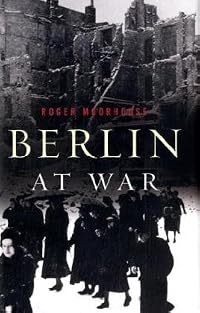
Berlin at War. Life and Death in Hitler's Capital, 1939-45
by Roger Moorhouse
On This Page
Description
Berlin was at the very center of the Second World War. Moorhouse uses diaries, memoirs, and interviews to provide a searing first-hand account of life, death, and chaos in the Nazi capital.Tags
Recommendations


























Member Reviews
A straightforward history of Berlin from 1939 to 1945 - from the height of Hitler’s power to his crushing defeat. Much of it is drawn from the diaries of ordinary Berliners who lived through terrible times and watched their city be destroyed because of their fascist leaders. How complicit was the ordinary citizen in the conduct of the Third Reich? The author gives us the facts and let’s us draw our own conclusions
Moorhouse portrays the life of the "average" German in Berlin from just before the war through its conclusion. For example, he notes how accidents went up significantly during the blackout; the murder rate rose; and in one lengthy passage describes the search by the Kriminal Polizei for a serial killer who bludgeoned dozens of women and then raped them, using the darkness as cover. Turns out he was a railroad worker who unrepentantly then blamed a Jewish doctor's wrong treatment for his gonorrhea. He was guillotined.
Following declaration of war by Britain after Hitler's invasion of Poland, Berlin remained in an uneasy quiet. Memories of WW I were still fresh, and support for the invasion was muted at best. Especially after the British show more began night bombing of Berlin, even though it was inconsequential.
Moorhouse describes the Kinderlandverschickung in some detail. During the fall of 1940, when it had become apparent that Goering would not be able to prevent the mass bombing of Berlin, the administration decided to evacuate children from Berlin. By the end of the year over 200,000 children had been sent to rural areas of the Reich and Czechoslovakia. Homes were requisitioned and special camps built to house the children. Recipients of the children were paid 3 DM per day, so of course, there was the usual opportunistic greed and some children became cheap labor. Some of the KLV camps --more than 9,000 camps existed by the end of the war -- were built as far away as Bulgaria which meant they needed to be evacuated west as Soviet troops pushed back on the eastern front. By the end of the war, some 900,000 children had been moved around out of the cities; an estimated 53,000 became orphans left to scavage at the end of the war. Experience varied. In some of the camps, run by the SS, political indoctrination and training for the Volksturm units was the norm. Others reported a rather carefree existence although Moorhouse reports rampant homesickness, an understandable sideffect. In the evening Fannenappel (flag call) was the norm. Moorhouse considered that a form of political indictrination, but it seems little different than the Pledge of Allegiance we all routinely say in this country.
I know it's become popular to blame all of society's ills on the latest technology: in the sixties it was television ruining our children, then the Internet, now it's cell phones. (Personally, I blame vegetables.) Germany was at the forefront of radio technology and its use for propaganda. Goebbels realized the importance of getting Hitler's message out to everyone and the Nazis heavily subsidized the cost of radios. 7,000,000 of an early low-cost set were sold in less than six years. But he also cleverly realized that propaganda could not be the sole content or people would tune out. So the proportion of music as a percentage of total broadcasting increased. Soon, everyone was sitting around the radio. Goebbels called radio the 8th great power and that the Nazis would never have achieved power without it. That coupled with Hitler's innovative use of the airplane to move around the country quickly gave the Nazis a huge edge.
But there was a downside for the Nazis to having all these radios available. It was a crime to listen to foreign broadcasts. Goebbels even insisted that red tags be affixed to every tuning dial warning of the severe penalities (11 people were executed for the crime, although this was rare) for listening to foreign broadcasts. They were constantly labeled as "fake news." But they were important to Germans as the British would broadcast the names of prisoners of war and since virtually everyone had a relation in the army, this information could become a solace. Unable to tell friends or relatives that some soldier was alive because of the broadcast, they would relate that this information came via a dream. Multiple people on the same street would have the same dream.
One interesting technology developed by the Nazis was their use of sending radio over telephone wires, a precursor to cable. This enabled people to received emergency broadcasts without any interference through the use of a splitter box attached to their radios.
A thoroughly fascinating book. show less
Following declaration of war by Britain after Hitler's invasion of Poland, Berlin remained in an uneasy quiet. Memories of WW I were still fresh, and support for the invasion was muted at best. Especially after the British show more began night bombing of Berlin, even though it was inconsequential.
Moorhouse describes the Kinderlandverschickung in some detail. During the fall of 1940, when it had become apparent that Goering would not be able to prevent the mass bombing of Berlin, the administration decided to evacuate children from Berlin. By the end of the year over 200,000 children had been sent to rural areas of the Reich and Czechoslovakia. Homes were requisitioned and special camps built to house the children. Recipients of the children were paid 3 DM per day, so of course, there was the usual opportunistic greed and some children became cheap labor. Some of the KLV camps --more than 9,000 camps existed by the end of the war -- were built as far away as Bulgaria which meant they needed to be evacuated west as Soviet troops pushed back on the eastern front. By the end of the war, some 900,000 children had been moved around out of the cities; an estimated 53,000 became orphans left to scavage at the end of the war. Experience varied. In some of the camps, run by the SS, political indoctrination and training for the Volksturm units was the norm. Others reported a rather carefree existence although Moorhouse reports rampant homesickness, an understandable sideffect. In the evening Fannenappel (flag call) was the norm. Moorhouse considered that a form of political indictrination, but it seems little different than the Pledge of Allegiance we all routinely say in this country.
I know it's become popular to blame all of society's ills on the latest technology: in the sixties it was television ruining our children, then the Internet, now it's cell phones. (Personally, I blame vegetables.) Germany was at the forefront of radio technology and its use for propaganda. Goebbels realized the importance of getting Hitler's message out to everyone and the Nazis heavily subsidized the cost of radios. 7,000,000 of an early low-cost set were sold in less than six years. But he also cleverly realized that propaganda could not be the sole content or people would tune out. So the proportion of music as a percentage of total broadcasting increased. Soon, everyone was sitting around the radio. Goebbels called radio the 8th great power and that the Nazis would never have achieved power without it. That coupled with Hitler's innovative use of the airplane to move around the country quickly gave the Nazis a huge edge.
But there was a downside for the Nazis to having all these radios available. It was a crime to listen to foreign broadcasts. Goebbels even insisted that red tags be affixed to every tuning dial warning of the severe penalities (11 people were executed for the crime, although this was rare) for listening to foreign broadcasts. They were constantly labeled as "fake news." But they were important to Germans as the British would broadcast the names of prisoners of war and since virtually everyone had a relation in the army, this information could become a solace. Unable to tell friends or relatives that some soldier was alive because of the broadcast, they would relate that this information came via a dream. Multiple people on the same street would have the same dream.
One interesting technology developed by the Nazis was their use of sending radio over telephone wires, a precursor to cable. This enabled people to received emergency broadcasts without any interference through the use of a splitter box attached to their radios.
A thoroughly fascinating book. show less
Well-organized and stays focused on the main topic. Covers how Berliners reacted to the Allied bombing; what life was like in the bomb shelters; and how each successive bombing raid created nagging doubts about the propaganda of the Nazi regime. It also covers topics such as war rationing, the removal of children from the city to "safety" in the countryside, and how foreign workers and Jews were treated during the trials that Berlin experienced.
Moorehouse draws from a wealth of primary source material and mixes it effectively with his narrative commentary. A good addition to the always vastly expanding World War Two reading collection.
Moorehouse draws from a wealth of primary source material and mixes it effectively with his narrative commentary. A good addition to the always vastly expanding World War Two reading collection.
This was a very interesting book. I kept it by my bedside and read a chapter or part of a chapter most nights. While I would consider it a historical book, it wasn't written like a conventional history, i.e., not in strict chronological order. Each chapter covered a different subject, such as what it was like when the blackout provisions were ordered, what it was like when the children were evacuated to the country, how Berliners got information, when subversives were rounded up and the treatments of the Jews. The latter chapters did describe Berlin towards the end of the war - the air raids that occurred at the end of the war and the Russian invasion. It was very informative with lots of quotes.
Interessant beretning om Berlin og berlinernes "dagligdag" under krigen, gennem dagbogsnotater og interviews. Godt og spændende sat sammen.
Apr 1, 2012Danish
Ratings
Members
- Recently Added By
Lists

Books About World War II
102 works; 29 members
Author Information

16+ Works 1,290 Members
Roger Moorhouse is a regular contributor to BBC History Magazine, coauthor with Norman Davies of Microcosm, and author of Killing Hitler. A graduate of the University of London, he lives in Buckinghamshire, England.
Some Editions
Awards and Honors
Awards
Distinctions
Common Knowledge
- Canonical title
- Berlin at War. Life and Death in Hitler's Capital, 1939-45
- Original title
- Berlin at War. Life and Death in Hitler's Capital, 1939-45
- Alternate titles
- Berlin at War
- Original publication date
- 2010
- Important places
- Berlin, Germany
- Important events
- World War II (1939 | 1945); World War II, German Home Front
- Dedication
- For
Amelia
in the hope that she
will never have to experience
times such as these - First words
- For all its breezy modernity, Berlin is a city that positively reeks of history. (Introduction)
Unbroken sunshine was forecast for Thursday 20 April 1939, Fuhrerwetter as it was known in Nazi Germany.(Prologue: 'Fuhrerweather')
The 1st of September 1939 was a day that began like any other. - Last words
- (Click to show. Warning: May contain spoilers.)'Was it the end of one nightmare', one diarist asked, 'or just the beginning of another one?'
(Click to show. Warning: May contain spoilers.)The 'dead city' had endured much, but it would rise again. (Epilogue: Hope) - Blurbers
- Beevor, Antony; Roberts, Andrew
Classifications
- Genres
- History, Nonfiction, General Nonfiction
- DDC/MDS
- 943.1550864 — History & geography History of Europe Germany and neighboring central European countries Northeastern Germany Brandenburg and Berlin Berlin Historical periods 1866- 1933-1945 : Third Reich
- LCC
- D757.9 .B4 .M65 — History of Europe, Asia, Africa and Oceania History (General) World War II (1939-1945)
- BISAC
Statistics
- Members
- 309
- Popularity
- 102,953
- Reviews
- 6
- Rating
- (4.18)
- Languages
- 6 — Danish, English, Norwegian (Bokmål), Norwegian, Polish, Swedish
- Media
- Paper, Audiobook, Ebook
- ISBNs
- 15
- ASINs
- 5