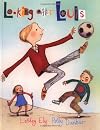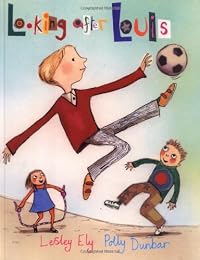
Looking after Louis
by Lesley Ely
On This Page
Description
When a new boy with autism joins their classroom, the children try to understand his world and to include him in theirs.Tags
Recommendations






































Member Reviews
I like this book but if I was to teach it I'd read it myself or pick an audiobook that reads slower. I love the illustrations in this book. I admire the students because they persistently talks to Louis and try to include him on what he's doing, especially the main character. I've seen people with disabilities being excluded several times. This book is realistic of the classroom lives of some students with disabilities. There are times when they talk out of turn and many do have another teacher with them to help them out. I think this book is suitable for k-3 because it is short and easy to understand. I also think that because I feel it is important to introduce situations like this as soon as possible just to help with understanding show more and try to limit bullying. show less
I really enjoyed this story and I think it's a great resource to teach someone about autism. Louis is autistic but it's written from the point of view of Louis' classmate. By doing this the reader gets a new perspective from someone who spends a lot of time with a student with a serious disability and how to work around their social deficiencies. In this case, the student and the teacher know that Louis loves to play soccer so they use soccer as a reward for him. I also feel like this book can help anyone who doesn't understand the intricacies of autism and the effect it can have on a child's peers as well as himself. The message I got from it is to be open and accepting of others even when you don't understand them.
Summary: This book is about kids in a class with a boy named Louis who is on the Autism spectrum. It talks about how Louis is different but also talks about what makes him happy and what makes him the same. In the end, they end up finding something Louis really likes to do which is soccer.
Opinion: As a special ed teacher, this is freaking amazing. It makes Louis's character seem so normal. The kids around him just treat him like any other kid. I feel as though Autism is represented very well in this book.
Opinion: As a special ed teacher, this is freaking amazing. It makes Louis's character seem so normal. The kids around him just treat him like any other kid. I feel as though Autism is represented very well in this book.
Louis is a new boy in school and he isn't like everybody else. The narrator looks after him and knows that Louis is special and has a tendency to repeat what he hears. At recess, Louis runs in and out of the boys' soccer game which makes the boys mad, but Louis doesn't notice. Sometimes Louis would talk at the wrong time, like when Miss Allie told everybody to sit up straight and Louis repeated her, but Miss Allie didn't get mad like she would if someone else had done that. One morning when Sam was showing off with his new soccer ball and Louis was watching him, Sam asked Louis if he wanted to play a game. Louis just repeated Sams. Sam dribbled the ball around the playground while Louis ran after him. Sam would pass the ball to Louis, show more but Louis didn't quite get it, so Sam kept the game going while Louis chased the ball. Every time Louis's foot touched the ball, Sam would yell, "Great game, Louis!" and Louis would smile. All afternoon Louis drew a picture and every time he picked a new color, he would say, "Great game," until he ran out of colors. The narrator girl told Louis to show his picture to Miss Allie and suggested that the picture was about soccer to Miss Allie, so she got Sam and Sam pointed out the ball, the game, Sam, and Louis. Sam then asked Miss Allie if him and Louis could go outside to play soccer, so Miss Allie asked Louis if he wanted to go play soccer, in which Louis responded by repeating Miss Allie. The two went out to play and the narrator girl was not happy because Miss Allie would never let everyone else go play outside when it wasn't recess and the narrator realized that sometimes we're allowed to break the rules for special people.
This was a good book. I really liked how much the other students included Louis, thanks to Miss Allie. The way Miss Allie ran her classroom created a very safe, inclusive, and accepting environment for all students, which I believe is why the students treated Louis the way they did. Although, I really did not like how Louis was always called special throughout the book. I felt like this just casted Louis as the victim, which is not something that should be done in books that highlight disabilities. I also felt like the teachers in the book favored Sam for being Louis's friend, like when they allowed the two to go outside and play when nobody was supposed to be outside. show less
This was a good book. I really liked how much the other students included Louis, thanks to Miss Allie. The way Miss Allie ran her classroom created a very safe, inclusive, and accepting environment for all students, which I believe is why the students treated Louis the way they did. Although, I really did not like how Louis was always called special throughout the book. I felt like this just casted Louis as the victim, which is not something that should be done in books that highlight disabilities. I also felt like the teachers in the book favored Sam for being Louis's friend, like when they allowed the two to go outside and play when nobody was supposed to be outside. show less
I really enjoyed Looking After Louis for a number of reasons. First, I liked how realistic the story is. There are so many children with autism and other disabilities and with the push for students to be in the Least Restrictive Environment (LRE) for their education, a lot of these students with different disabilities are in inclusive classrooms. The narrator of the story states, “There’s a new boy at school named Louis. Louis sits next to me and I look after him. Sometimes I wonder what he’s looking at.” The main character hasn’t been exposed to students with autism like Louis, so she and her other classmates learn a lot about Louis, autism, and how to include him in the classroom. In inclusion classes, this is the case for show more many students as a lot of times their first encounters with those who have disabilities are in schools. I also enjoyed this story because the illustrations were beautiful. They were fun, watercolor-looking illustrations that really helped convey the classroom and school environment for Louis and his classmates. I think the illustrations really help the readers relate the classroom setting in the book to their own real life classrooms, which helps them understand that there could be a student like Lewis in their class. Finally, I liked this story for its overall message. The overall message of the story was that it is possible to become friends and build relationships with students who are different than you. In this story, Louis and his classmates became friends through playing soccer. They all had a great time and learned that Louis’s autism wasn’t something that kept him from playing soccer and being able to relate to his classmates.
I would recommend this story for students in first through third grade because it only contains a little bit of text on each page and it’s really easy for students to understand. show less
I would recommend this story for students in first through third grade because it only contains a little bit of text on each page and it’s really easy for students to understand. show less
Louis is new in school and has autism he does not play soccer with others but instead runs through the game. One day the kids start following Louis' lead and realize he understands more than they realized. This story was great at helping a kid try to understand why sometimes the rules can be different for someone who needs special help. It also showed the kids entering into Louis' world instead of forcing him to be a part of what they were doing. It does not mention autism explicitly in the book but it does a good job at conveying realistic children's reactions and situations when engaging with someone with autism. I would recommend this book for a kinder-2nd grade classroom.
This book shows a classroom in which a child with Autistic Spectrum Disorder is included. the label is never mentioned in the book, Louis, the character, displays the behavior called 'echolalia', strongly associated with Autistic Spectrum Disorders, or A.S.D. The children in the class are welcoming and try to include Louis. One day they gain insight into his seemingly abstract drawings and atypical playground behavior, which leads to a breakthrough in social interaction for Louis- he wants to play soccer like all of the other boys. (Not sure why only the boys are playing soccer! One breakthrough milestone at a time, I suppose!) One of the most valuable aspects of this read are that it shows children not only being tolerant and kind to show more someone different from them, it shows how they seek to include him on a daily basis, investigate into his unique communication style and accept him for who he is. show less
Members
- Recently Added By
Author Information
3 Works 205 Members
Awards and Honors
Classifications
Statistics
- Members
- 202
- Popularity
- 161,329
- Reviews
- 57
- Rating
- (4.07)
- Languages
- English, Spanish
- Media
- Paper
- ISBNs
- 7
- ASINs
- 1