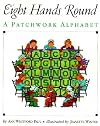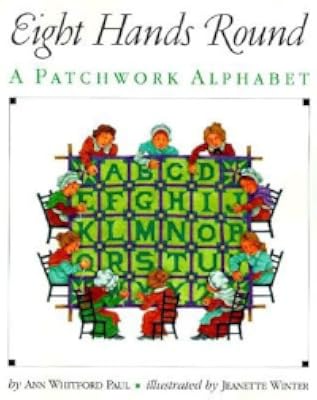
Eight Hands Round: A Patchwork Alphabet
by Ann Whitford Paul
On This Page
Description
Introduces the letters of the alphabet with names of early American patchwork quilt patterns and explains the origins of the designs by describing the activity or occupation they derive from.Tags
Recommendations





Member Reviews
I collect alphabet books, and also children's picture books about quilts and quilting. I wanted so much to like this book. The pictures are beautifully done; each page contains a large picture across the top depicting the subject of the quilt block in a naturalistic manner (e.g. the "Anvil" pattern has a picture of a blacksmith's shop) and at the bottom of the page is a painting of one block and beside it, of several blocks arranged in a quilt top. This is very important because the graphic effect of many blocks can't be properly appreciated until they're set edge to edge.
But the text. The text is so trite, so patronizing. I just couldn't even. The history part usually isn't too bad, but then for nearly every block the author attempt show more to suggest fanciful origins for the design. Please. "Maybe a blacksmith, or his wife, thought up this (Anvil) pattern. Or maybe the idea came to a customer waiting in his shop..." That's one of the less annoying suggestions. "Possibly a slave, exhausted from working many hours in a tobacco field, thought up this (Tobacco Leaves) pattern." Umm, sure. Just what an exhausted field slave lacking the means to buy fabric wanted to do. Doubtless.
There is at least one offensive choice of pattern: Old Tippecanoe celebrates William Henry Harrison's battle against the forces led by Tecumseh who was fighting against unjust land seizures. Indian Hatchet is also a rather peculiar choice, given the tension surrounding the use of Indian to describe indigenous peoples of the Americas (and this book was published in the 1990s not the 1960s), and "Perhaps someone who saw an Indian dance with his hatchet first made up this pattern" is a strange thing to say. Why not the better known Orange Peel for O (since the equally well known Ohio Star is taking up the V here, as Variable Star) and Irish Chain for I?
The whole idea of suggesting "someone who did such and such made the first quilt of this pattern" is strange to begin with. Judging by the variant names many traditional patterns have acquired over the years, very few were made up in an attempt at depicting a subject, and most seem to have been named according to what they suggest to the beholder; Churn Dash (her choice for C) is just as frequently known as Hole in the Barn Door; Storm at Sea is applied to at least one other pattern besides the one in the book. Jacob's Ladder (as depicted in the book) is often called Underground Railroad and vice versa; the latter is also well known as Railway Crossing. And on and on.
So. I love the concept of the book. I love the look of the book. I just couldn't bear to read it to children. Or reread it myself. show less
But the text. The text is so trite, so patronizing. I just couldn't even. The history part usually isn't too bad, but then for nearly every block the author attempt show more to suggest fanciful origins for the design. Please. "Maybe a blacksmith, or his wife, thought up this (Anvil) pattern. Or maybe the idea came to a customer waiting in his shop..." That's one of the less annoying suggestions. "Possibly a slave, exhausted from working many hours in a tobacco field, thought up this (Tobacco Leaves) pattern." Umm, sure. Just what an exhausted field slave lacking the means to buy fabric wanted to do. Doubtless.
There is at least one offensive choice of pattern: Old Tippecanoe celebrates William Henry Harrison's battle against the forces led by Tecumseh who was fighting against unjust land seizures. Indian Hatchet is also a rather peculiar choice, given the tension surrounding the use of Indian to describe indigenous peoples of the Americas (and this book was published in the 1990s not the 1960s), and "Perhaps someone who saw an Indian dance with his hatchet first made up this pattern" is a strange thing to say. Why not the better known Orange Peel for O (since the equally well known Ohio Star is taking up the V here, as Variable Star) and Irish Chain for I?
The whole idea of suggesting "someone who did such and such made the first quilt of this pattern" is strange to begin with. Judging by the variant names many traditional patterns have acquired over the years, very few were made up in an attempt at depicting a subject, and most seem to have been named according to what they suggest to the beholder; Churn Dash (her choice for C) is just as frequently known as Hole in the Barn Door; Storm at Sea is applied to at least one other pattern besides the one in the book. Jacob's Ladder (as depicted in the book) is often called Underground Railroad and vice versa; the latter is also well known as Railway Crossing. And on and on.
So. I love the concept of the book. I love the look of the book. I just couldn't bear to read it to children. Or reread it myself. show less
This book was a struggle to get through because it had so many words in the book that I was not interested in. It was cool in the sense where you could get different snippets of history for each letter.
A heart warming true story that EVERYONE should know!
This is an alphabet book about different patch work that people make. Each page has a concept that patch work is made from that goes with that letter of the alphabet.
The author provides information about pioneer life through speculation about the origins of 26 quilt patterns, one for each letter of the alphabet. The variety of colors and designs makes the quilts themselves the real stars of the book [and] will [encourage] students to develop their own creations in cloth or on paper.
Ratings
Members
- Recently Added By
Author Information

33+ Works 5,116 Members
Ann Whitofrd Paul graduated from the University of Wisconsin and Columbia University School of Social Work. She worked as a social worker until she started her family. She soon became inspired to write picture books after years of bedtime reading to her four children. She's published 19 different award-winning books. Now she gets story ideas from show more her three grandchildren. For ten years she taught picture book writing through UCLA Extension. She still enjoys teaching how to write picture books. Her title, If Animals Kissed Good Night, made The New York Times Best Seller List in 2016. (Bowker Author Biography) show less
All Editions
Awards and Honors
Classifications
Statistics
- Members
- 376
- Popularity
- 83,719
- Reviews
- 5
- Rating
- (3.80)
- Languages
- English
- Media
- Paper
- ISBNs
- 6
- ASINs
- 1