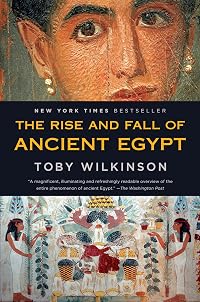
The Rise and Fall of Ancient Egypt
by Toby Wilkinson
On This Page
Description
In this magnificent history, Toby Wilkinson combines grand narrative sweep with detailed knowledge of hieroglyphs and the iconography of power, to reveal Ancient Egypt in all its complexity--from the brutality and repression that lay behind the appearance of its unchanging monarchy to its extraordinary architectural and cultural achievements.Tags
Recommendations













Member Reviews
Toby Wilkinson’s The Rise and Fall of Ancient Egypt examines the history of pharaonic Egypt from the earliest nomadic herdsmen and their eventual unification under King Narmer all the way down to Cleopatra roughly three thousand years later. He describes how the role of kingship and state religion became intertwined in ancient Egypt, creating a powerful elite who glorified themselves and thus maintained their power over one of the most prosperous empires of the ancient world, though they did so at the expense of workers and farmers. As Wilkinson writes, “in early Egypt, the kings were the gods. Monarchy was not just an integral part of religion; the two were synonymous” (p. 36). Kings used the symbol of the mace both to show more demonstrate subjugation of foreign adversaries and to command the respect of their own people. Popular art and literature, some of which survives from the Middle and New Kingdoms, directly link obedience to the pharaoh with Egyptian identity. The learned elite were the primary audience for works such as The Tale of Sinuhe, which cautioned them against betraying the power the pharaoh granted them in exchange for loyalty (p. 149).
In the New Kingdom, the cult of the pharaoh eventually broke down due to inept administration at all levels, leading to one of the first recorded strikes when laborers working on the royal tomb did not receive their food and pay (p. 335). Wilkinson demonstrates how this break down in pharaonic power under Ramses III foreshadowed the eventual end of native pharaonic rule, opening Egypt to rulers from Libya, Nubia, Persia, Greece, and Rome. The internecine fighting between various factions with foreign ties laying claim to the throne of Egypt. The last effort of an Egyptian sovereign to reclaim power only doomed the institution further. Wilkinson writes of Amenirdis (404 – 399 BCE), “By seizing power through cunning and brute force, he had stripped away any remaining mystique from the office of pharaoh, revealing the kingship for what it had become (or, behind the heavy veil of decorum and propaganda, had always been) – the preeminent political trophy” (p. 430). This set the stage for pharaonic Egypt’s last gasp under the Ptolemaic dynasty.
Wilkinson’s history boldly recounts over three thousand years of history using a variety of historical, archaeological, climatological, and other sources filtered through a Foucauldian lens of power relationships in order to challenge the traditional top-down history of Egypt often written by the pharaohs – or their inner circles – which took for granted the role of power in their society. Naturally, such a work condenses events, but Wilkinson successfully captures the drama of each pharaoh, pointing the way for future reading while providing an essential introduction for those looking to learn about pharaonic civilization as it continues to capture the modern imagination all these millennia later. show less
In the New Kingdom, the cult of the pharaoh eventually broke down due to inept administration at all levels, leading to one of the first recorded strikes when laborers working on the royal tomb did not receive their food and pay (p. 335). Wilkinson demonstrates how this break down in pharaonic power under Ramses III foreshadowed the eventual end of native pharaonic rule, opening Egypt to rulers from Libya, Nubia, Persia, Greece, and Rome. The internecine fighting between various factions with foreign ties laying claim to the throne of Egypt. The last effort of an Egyptian sovereign to reclaim power only doomed the institution further. Wilkinson writes of Amenirdis (404 – 399 BCE), “By seizing power through cunning and brute force, he had stripped away any remaining mystique from the office of pharaoh, revealing the kingship for what it had become (or, behind the heavy veil of decorum and propaganda, had always been) – the preeminent political trophy” (p. 430). This set the stage for pharaonic Egypt’s last gasp under the Ptolemaic dynasty.
Wilkinson’s history boldly recounts over three thousand years of history using a variety of historical, archaeological, climatological, and other sources filtered through a Foucauldian lens of power relationships in order to challenge the traditional top-down history of Egypt often written by the pharaohs – or their inner circles – which took for granted the role of power in their society. Naturally, such a work condenses events, but Wilkinson successfully captures the drama of each pharaoh, pointing the way for future reading while providing an essential introduction for those looking to learn about pharaonic civilization as it continues to capture the modern imagination all these millennia later. show less
“Throughout history, megalomaniacs and tyrants have used such epithets—“father of the nation,” “dear leader”—but the terms usually have a hollow ring. Modern experience suggests that the titles are more about brainwashing and subjugation than the expression of popular acclaim. And yet, when it comes to ancient Egypt, scholars still balk at such an interpretation.”
A thorough and well reasoned travelogue through ancient Egyptian history from the earliest settlements to the death of Cleopatra, focused primarily on the Archaic Period until the close of the New Kingdom.
Much of the work does focus on the "great men" since their records have been preserved, but the author will supplement with what can be known about the lives of "average" Egyptians throughout the period.
The author does well with high quality socio-political and cultural analysis of ancient Egyptian history. From beginning to end Egypt is understood both in its own terms and as part of its greater world: the ancient Near East, the Nubians/Kushites, and the Greeks, and their influences are explained. The author analyzes how the show more fundamental principles of the civilization developed in the predynastic, Archaic, and early Old Kingdom periods, and how that time was Egypt's most stable even if most autocratic. He explains the crisis that led to the collapse of the Old Kingdom well, and the disaster of the civil war known as the First Intermediate Period. He set forth how the Middle Kingdom established itself in response to these events, and how they succeeded and failed. Much more is made of the Hyksos than anything else in the Second Intermediate Period, and for good reason; the author is fair in regards to his assessment of them and what they attempted to do, and set forth how the descendants of Sequenra Taa proved more successful than he did and defeated both the Kushites and the Hyksos to establish the New Kingdom. Much is made of the New Kingdom, its empire, the building programs, the ideology, the foreign policy, and how it all collapsed under its own weight and emphasis on the army. The author then framed the Third Intermediate Period as first Libyan and then Kushite rule over Egypt; the humiliation of the Kushites by the Assyrians (perhaps being a bit too harsh on the Kushites); and considered the Twenty-Sixth dynasty to be outmatched by the situation in which they found themselves, considering the invasion and defeat at the hands of Cambyses all but inevitable. The last flowering of native rule and its love of animal mummies is described; the Ptolemies are given decent coverage, even though the conclusion with the priesthood of Ptah and the last Cleopatra is a little overdone. The author concludes with the long-term influence Egyptian civilization has provided over the West.
A magisterial and highly recommended history of ancient Egypt. show less
Much of the work does focus on the "great men" since their records have been preserved, but the author will supplement with what can be known about the lives of "average" Egyptians throughout the period.
The author does well with high quality socio-political and cultural analysis of ancient Egyptian history. From beginning to end Egypt is understood both in its own terms and as part of its greater world: the ancient Near East, the Nubians/Kushites, and the Greeks, and their influences are explained. The author analyzes how the show more fundamental principles of the civilization developed in the predynastic, Archaic, and early Old Kingdom periods, and how that time was Egypt's most stable even if most autocratic. He explains the crisis that led to the collapse of the Old Kingdom well, and the disaster of the civil war known as the First Intermediate Period. He set forth how the Middle Kingdom established itself in response to these events, and how they succeeded and failed. Much more is made of the Hyksos than anything else in the Second Intermediate Period, and for good reason; the author is fair in regards to his assessment of them and what they attempted to do, and set forth how the descendants of Sequenra Taa proved more successful than he did and defeated both the Kushites and the Hyksos to establish the New Kingdom. Much is made of the New Kingdom, its empire, the building programs, the ideology, the foreign policy, and how it all collapsed under its own weight and emphasis on the army. The author then framed the Third Intermediate Period as first Libyan and then Kushite rule over Egypt; the humiliation of the Kushites by the Assyrians (perhaps being a bit too harsh on the Kushites); and considered the Twenty-Sixth dynasty to be outmatched by the situation in which they found themselves, considering the invasion and defeat at the hands of Cambyses all but inevitable. The last flowering of native rule and its love of animal mummies is described; the Ptolemies are given decent coverage, even though the conclusion with the priesthood of Ptah and the last Cleopatra is a little overdone. The author concludes with the long-term influence Egyptian civilization has provided over the West.
A magisterial and highly recommended history of ancient Egypt. show less
I should have known. The title alone, that simplistic ‘The Rise and Fall’, did not bode well. Nevertheless, I was convinced by the rave reviews, also in renowned newspapers. Note: this is written with verve, and so it certainly appeals to those who want a short overview of ancient Egyptian history. But there's the rub: Wilkinson has systematically described all of Egyptian history in 20th-21st century terms, that is, in terms of an anti-statist conservative. Constantly, Wilkinson describes Ancient Egyptian society as dictatorial, authoritarian, and even totalitarian. My suspicion is that he had a current agenda with this book. I don't want to compromise his knowledge and skills, but with this simplistic and anachronistic approach he show more has done the historiography of ancient Egypt no favors at all. More in my History account on Goodreads: https://www.goodreads.com/review/show/5059998714. show less
Professor Wilkerson’s comprehensive and sweeping history of ancient Egypt is tied together by several strands that run through the book: the pull of separation between Upper and Lower Egypt, the opportunity and danger represented by Nubia, and the relationship between the pharaoh’s power and the gods. Although Wilkerson emphasizes the role of the Nile, he also insists on the importance of the desert trading routes both to the Red Sea and to the oases in the Sahara.
Accessible to the general reader, the book has enough footnotes and bibliography to enlighten and benefit a more specialist audience. The book would benefit from larger, more legible maps and from a time line. These would help the non-specialist appreciate the course of show more events and the sheer length of pharaonic culture.
Please note that the book gives a relatively short treatment to Ptolemaic Egypt, although it offers a concise summary. I would have liked to have learned more about the relationships between the native Egyptians and their Greek/Macedonian overlords. show less
Accessible to the general reader, the book has enough footnotes and bibliography to enlighten and benefit a more specialist audience. The book would benefit from larger, more legible maps and from a time line. These would help the non-specialist appreciate the course of show more events and the sheer length of pharaonic culture.
Please note that the book gives a relatively short treatment to Ptolemaic Egypt, although it offers a concise summary. I would have liked to have learned more about the relationships between the native Egyptians and their Greek/Macedonian overlords. show less
If you're looking for a one-volume overview of Egyptian history, look no further. All problems of interpretation and chronology are ironed out into a driving narrative that's told with real imagination. Wilkinson signposts some of the problems in the notes. There's also a massive bibliography. A nicely produced book with good illustrations and clear, simple maps. It's well written. Particularly good is the opening sequence with it's geographical overview of the country. Very useful for people who don't live in a long thin country.
As the title suggest, The Rise and Fall of Ancient Egypt covers over 3000 years of history and like the Nile river runs shallow and long. Be prepared for a pageant of royal names which all sound alike, or are exactly the same, followed by a small bit of their reign before moving onto the next exulted king. Like the names, events seem to repeat as well. It lacks some texture of the period being mostly a plain political history. I found the authors style to be a little grating at times, at the beginning he informs us Egypt is the history of 2-bit despots. Great. That may be true but his lack of enthusiasm for the subject wears off on the reader. It seems to try and be a counter-weight to popular culture romanticization. That's OK but show more c'mon, Egypt really was pretty fascinating and always will be. Anyway this book has slightly turned me off from Ancient Egypt but I'm not convinced there isn't more to be found of interest. show less
Members
- Recently Added By
Published Reviews
ThingScore 75
Toby Wilkinson's The Rise and Fall of Ancient Egypt stands in the great tradition of Breasted but incorporates much new archaeological information. With a literary flair and a sense for a story well told, Mr. Wilkinson offers a highly readable, factually up-to-date account of what we know about Egyptian political history. . . .
Mr. Wilkinson energetically chronicles the deeds of the great kings show more [and] . . . also brings us, intimately sometimes, into a world of everyday Egyptians, one revealed only in the last century by the work of scholars systemically studying Egyptian material culture. Documents give glimpses, all too occasionally but clearly, of labor camps, workers strikes and — at the end of the New Kingdom — even robbery of the royal tombs. . . .
Mr. Wilkinson puts too much emphasis on the importance of the dynasties. This is still the norm in Egyptian history, but it does not tell us much about the driving forces of historical change, which included climatic crises — manifested in wild Nile flooding — and exogenous shocks such as invasion. . . .
Elsewhere in The Rise and Fall of Ancient Egypt, Mr. Wilkinson rightly stresses the brutal nature of the Egyptian state. "Autocratic regimes," he says, "live and die by force, and ancient Egypt was no exception." "The most chilling example of this tendency," he suggests, "can be seen in the tombs of Egypt's early rulers . . . where dismembered bodies of several individuals had clearly been interred with the tomb owner." . . .
Mr. Wilkinson's account shares with Breasted's one unfortunate flaw — epitomized by this book's title. Mr. Wilkinson sees the first millennium as one of great decline, a "fall" from a supposed golden age. . . . But in fact this was a crucial period in the evolution of Egyptian civilization. . . . [It] saw the first Greek merchants and soldiers arrive in Egypt, the introduction of coinage and (as Herodotus tells us) the circumnavigation of Africa. A period of change, no doubt. But "change and decay," as Mr. Wilkinson has it? I demur. show less
Mr. Wilkinson energetically chronicles the deeds of the great kings show more [and] . . . also brings us, intimately sometimes, into a world of everyday Egyptians, one revealed only in the last century by the work of scholars systemically studying Egyptian material culture. Documents give glimpses, all too occasionally but clearly, of labor camps, workers strikes and — at the end of the New Kingdom — even robbery of the royal tombs. . . .
Mr. Wilkinson puts too much emphasis on the importance of the dynasties. This is still the norm in Egyptian history, but it does not tell us much about the driving forces of historical change, which included climatic crises — manifested in wild Nile flooding — and exogenous shocks such as invasion. . . .
Elsewhere in The Rise and Fall of Ancient Egypt, Mr. Wilkinson rightly stresses the brutal nature of the Egyptian state. "Autocratic regimes," he says, "live and die by force, and ancient Egypt was no exception." "The most chilling example of this tendency," he suggests, "can be seen in the tombs of Egypt's early rulers . . . where dismembered bodies of several individuals had clearly been interred with the tomb owner." . . .
Mr. Wilkinson's account shares with Breasted's one unfortunate flaw — epitomized by this book's title. Mr. Wilkinson sees the first millennium as one of great decline, a "fall" from a supposed golden age. . . . But in fact this was a crucial period in the evolution of Egyptian civilization. . . . [It] saw the first Greek merchants and soldiers arrive in Egypt, the introduction of coinage and (as Herodotus tells us) the circumnavigation of Africa. A period of change, no doubt. But "change and decay," as Mr. Wilkinson has it? I demur. show less
added by TomVeal
Lists

r/History Recommended Reading List
603 works; 12 members

r/AskHistorians' Recommended Books
1,068 works; 19 members

Kindle Non-Fiction
221 works; 1 member

Egypt
5 works; 1 member
Author Information

21+ Works 2,810 Members
Toby Wilkinson is the author of Tutankhamun's Trumpet (2022) and the-New York Times best-selling The Rise and Fall of Ancient Egypt, which won the Hessell-Tiltman Prize for History. He is a Bye-Fellow of Clare College, University of Cambridge, England.
Awards and Honors
Awards
Distinctions
Common Knowledge
- Original title
- The Rise and Fall of Ancient Egypt. The History of a Civilisation from 3000 BC to Cleopatra
- Original publication date
- 2010 (UK) (UK)
- Important places
- Egypt
- Epigraph
- "My name is Ozymandias, king of kings:
Look on my words, ye Mighty, and despair!"
Nothing beside remains. Round the decay
Of that colossal wreck, boundless and bare,
The lone and level sands stretch far away.
<... (show all)br>—Percy Bysshe Shelley, "Ozymandias" - Dedication
- For Ben and Ginny
- First words
- Two hours before sunset on November 26, 1922, the English Egyptologist Howard Carter and three companions entered a rock-cut corridor dug into the floor of the Valley of the Kings. (Introduction)
- Last words
- (Click to show. Warning: May contain spoilers.)The ancient Egyptians could not have wished for more.
- Original language
- English
Classifications
Statistics
- Members
- 1,268
- Popularity
- 19,323
- Reviews
- 25
- Rating
- (3.97)
- Languages
- 7 — Dutch, English, Estonian, German, Italian, Polish, Spanish
- Media
- Paper, Audiobook, Ebook
- ISBNs
- 21
- UPCs
- 1
- ASINs
- 9