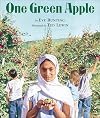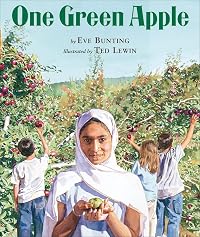
One Green Apple
by Eve Bunting
On This Page
Description
While on a school field trip to an orchard to make cider, a young immigrant named Farah gains self-confidence when the green apple she picks perfectly complements the other students' red apples.Tags
Recommendations




Member Recommendations
Member Reviews
Farah is a recent immigrant going on a field trip with her classmates. Given that she is new to the country and doesn't know the language yet, she is understandably shy. But she starts to come out of her shell when she notices that some things are the same everywhere -- friendship and laughter among them.
This is a lovely picture book designed to help young children learn about the immigrant experience. It gives native children an understanding of what might be going on in their new classmates' minds while providing an identifiable story for immigrant children. On a broader, universal level the book can also speak to any child (or person) who has felt out of place in a social situation. I loved the metaphor used in the book of Farah's show more green apple -- which looks different from the red apples her classmates picked -- being blended right into the apple cider they all make. What a lovely symbol of assimilation and how we may look different on the outside but inside we are the same.
The text is full of mostly simple sentences, so it can be easily accessible to young readers. The illustrations are a little too staid for my taste, but they do graphically depict the text appropriately. show less
This is a lovely picture book designed to help young children learn about the immigrant experience. It gives native children an understanding of what might be going on in their new classmates' minds while providing an identifiable story for immigrant children. On a broader, universal level the book can also speak to any child (or person) who has felt out of place in a social situation. I loved the metaphor used in the book of Farah's show more green apple -- which looks different from the red apples her classmates picked -- being blended right into the apple cider they all make. What a lovely symbol of assimilation and how we may look different on the outside but inside we are the same.
The text is full of mostly simple sentences, so it can be easily accessible to young readers. The illustrations are a little too staid for my taste, but they do graphically depict the text appropriately. show less
This was another surprisingly serious book by Eve Bunting, which is a pleasant surprise from all of the other silly picture books I have been reading for my other logs. I enjoyed reading this multicultural book for two reasons, with the first being the multicultural and relatable nature of the book. Farah moves from India to America and has little knowledge of English, so she is thrust into a society where she can barely understand what’s going on around her. A lot of children can relate to this feeling since many families have recently immigrated to America, forcing their children to become bilingual for educational purposes. I like that it shows how diversity is common and should be accepted in educational settings. The second show more reason I like this book is because of the symbolism of the green apple, both in the title and in the text. Farah is the only student who picks a green apple, and when it is squeezed to make juice, it doesn’t ruin the other apples, but it does add its own special taste. The green apple symbolizes Farah as a person: Although she is noticeably different and in a new place, she still blends in with the rest of her peers, but retains her unique Indian identity. The main idea of this story is that you are not as different as you think, and you can blend in and feel accepted while still staying true to who you are. show less
I greatly enjoyed this book. The author elected to tell the story through a powerful narrator: a young girl starting school in the United States without the knowledge of English to help her. Her thoughts in the book are incredibly articulate, and at one point she even thinks towards to teacher “I understand. It’s not that I am stupid. It is just that I am lost in this new place” (12). This statement serves as a reminder to any reader that just because someone is struggling with a language, they do not deserve to be talked down to or patronized. To further this idea, Farah, the main character, showcases her strength by helping her classmates press apples despite an initial hesitation. She is “not sure if I should be with the show more others” but her later success in helping shows that she does have a place, regardless of any differences between herself and the other characters.
The story offers a line of hope for any reader who may find themselves in Farah’s shoes: in a new place where they do not know the language. Farah notices that “Laughs sound the same as at home. Just the same. So do sneezes and belches and lots of things”. This was a great, hopeful way for the author to end the story, which I appreciated.
The message of this story is: there may be differences between language and culture, but there are always human similarities. show less
The story offers a line of hope for any reader who may find themselves in Farah’s shoes: in a new place where they do not know the language. Farah notices that “Laughs sound the same as at home. Just the same. So do sneezes and belches and lots of things”. This was a great, hopeful way for the author to end the story, which I appreciated.
The message of this story is: there may be differences between language and culture, but there are always human similarities. show less
I really like this book just because it is a great multicultural book. It is about a Muslim girl who goes on a field trip with her class to an apple orchard. I love the point of view on this book because it is a first person point of view from a young Muslim girl. Its an insiders glance into what a person from a different culture might think or feel. The author writes "It is my first word outside myself. There will be more." So the author is describing how the girl saying apple is the first English word she has said aloud since she got to the US. Going off of this, I think the character was very well developed. I think that her thoughts and actions were believable for a child who is new to America. The author writes "I hang back, not show more sure if I should be with the others." This I feel like is a common thought that children from other cultures have. I also enjoyed the illustrations. I like how the illustrator used water color to display texture. He also used layering to get deeper and richer colors. The big picture to this story is now matter how different two groups of people may seem, there is always a similarity. show less
I enjoyed reading this book. First, I liked the plot of the story because it captured the emotions of a young girl with a visibly different culture and how she felt moving to an American school. I think the first time experiencing a different culture is interesting for the minority as well as the majority. This moment reminded me of an experience I had in elementary school and how it was important to befriend the student. I liked the symbolism of the apples in the story. At the end all the students had red apples, while the new student had a green apple. When they mixed the apples together the students realized it all tasted the same. The message of this story was that we all have differences, yet we are also similar because we are all show more humans. show less
Farah is going to a new school, in a new country with a new language. She wears a dupatta on her head, or a traditional headscarf and she does not speak English. With simple and un-adorned language Bunting takes us into her nervousness and through the unfamiliarity, offering Farah's thoughts on a field trip with her new classmates, "I am tight inside myself."
She is unsure and looking for what she knows. Eventually Farah finds it, in a potential new friend bridging the distance to share names, in working for apple cider, and in the familiarity of sounds. She pushes through the wariness and the unease to pick and apple, the titular green apple, and put it into the cider. The class discover that all the apples together make a balanced show more cider, savoring the juice together, and riding back in the hay wagon with a new outlook.
This story is beautifully illustrated with moving watercolors and stunningly expressed emotions. On the way back Farah shares a daring attempt at a new word, Apple, with some other children, "it is my first outside-myself word." The message that one is different but that together it is balanced is a bit heavy-handed. Might be a bit too sweet of a resolution for older children, but the emotion apparent in taking linguistic first-steps, working in an unfamiliar language, and in pitching in are all very appealing. show less
She is unsure and looking for what she knows. Eventually Farah finds it, in a potential new friend bridging the distance to share names, in working for apple cider, and in the familiarity of sounds. She pushes through the wariness and the unease to pick and apple, the titular green apple, and put it into the cider. The class discover that all the apples together make a balanced show more cider, savoring the juice together, and riding back in the hay wagon with a new outlook.
This story is beautifully illustrated with moving watercolors and stunningly expressed emotions. On the way back Farah shares a daring attempt at a new word, Apple, with some other children, "it is my first outside-myself word." The message that one is different but that together it is balanced is a bit heavy-handed. Might be a bit too sweet of a resolution for older children, but the emotion apparent in taking linguistic first-steps, working in an unfamiliar language, and in pitching in are all very appealing. show less
“One Green Apple” is simple, yet so moving. I love a book that is understated, yet moving. Bunting is able to reach deeply into the emotions of a small, fragile girl who feels tiny inside herself and help the reader understand her pain. Just arriving to this country, Farah wants to come outside of herself and connect, but she has several barriers. One; her dupatta causes her to stand out from her peers, and two; her language barriers keep her apart except for her classmate Anna, who reaches into Farah's frightened and tiny self to welcome her. I enjoyed the illustrations of the book very much. The illustrations are very strong and the facial expressions are a wonderful mimic of human expression. And though the words are few, the show more feeling and the message is palpable and powerful. The big message of this book is to bring understanding to the plight of a young, immigrant, girl on the first day of school who just want to fit in. show less
Members
- Recently Added By
Lists

Scholastic 100 Best Read-Aloud Books
100 works; 8 members
Author Information

276+ Works 51,881 Members
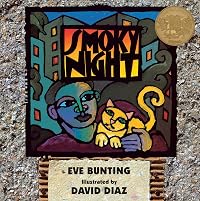
Eve Bunting was born in 1928 in Maghera, Ireland, as Anne Evelyn Bunting. She graduated from Northern Ireland's Methodist College in Belfast in 1945 and then studied at Belfast's Queen's College. She emigrated with her family in 1958 to California, and became a naturalized citizen in 1969. That same year, she began her writing career, and in 1972, show more her first book, "The Two Giants" was published. In 1976, "One More Flight" won the Golden Kite Medal, and in 1978, "Ghost of Summer" won the Southern California's Council on Literature for Children and Young People's Award for fiction. "Smokey Night" won the American Library Association's Randolph Caldecott Medal in 1995 and "Winter's Coming" was voted one of the 10 Best Books of 1977 by the New York Times. Bunting is involved in many writer's organizations such as P.E.N., The Authors Guild, the California Writer's Guild and the Society of Children's Book Writers. She has published stories in both Cricket, and Jack and Jill Magazines, and has written over 150 books in various genres such as children's books, contemporary, historic and realistic fiction, poetry, nonfiction and humor. (Bowker Author Biography) show less
All Editions
Awards and Honors
Awards
Classifications
Statistics
- Members
- 726
- Popularity
- 39,104
- Reviews
- 96
- Rating
- (4.27)
- Languages
- English
- Media
- Paper, Audiobook, Ebook
- ISBNs
- 13
- UPCs
- 1
- ASINs
- 6