On This Page
Tags
Recommendations

















Member Reviews
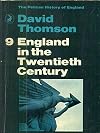
The final volume of the Pelican History of England was published in 1965, covering 1914 to 1963; I read that edition many years ago. In 1981, it was updated to cover through 1979, but since author David Thomson died in 1970, one of his former students, Geoffrey Warner, did the update. According to his preface, Warner didn't update Thomson's text very much; instead, he just added two chapters to the end to cover the last fifteen years. The result is somewhat odd, because it takes what was already one of the longest Pelican Histories and makes it even longer—even though it covers the shortest span of time!
I did think this book had more detail than earlier ones... which wasn't always warranted. Whereas previous volumes would not really show more go into detail about the movement of foreign wars, this one does. I think probably this is partially because it has the space to do, but also because its author lived through the events in question (Thomson would have been in his thirties during World War II), so they seemed important to him. Additionally, there's more blow-by-blow detail on the politicking and the parties; again, I suspect the dual reason of 1) available space, and 2) recency bias. To me, though, this made the book less effective; the best Pelican Histories (such as Thomson's own volume 8) have given a bird's-eye view of the era in question, but here I felt a bit bogged down in the identities of specific cabinet ministers. (The other consequence of recency is that he's more likely to assume readers already know what something is than other contributors to the series, which I guess is fair enough, but I would have appreciated an explanation of what the "coupon election" was!)
The other thing that makes this volume unusual is that it's the only one to be written by a repeat author. Thus, unsurprisingly, Thomson continues the emphasis of his previous volume, focusing on how the government became increasingly invested in the management of society through a variety of means. Though as I said above I did think we got a bit too much detail about specific ministries, Thomson does ably show how the two major political parties, and the succession of prime ministers, attempted to regulate the economy and elevate the welfare of the citizenry in ways that were sometimes surprisingly similar and sometimes very different. By the 1950s, "British society now presupposed full employment, economic growth, mass consumption, and therefore mass advertising" but "[u]like the Welfare State, it cared little about inequalities of wealth" (260).
For example, he points out that what used to be called "departments," "boards," and "offices" largely became "ministries" after the Great War: "The change implied a new theory of government, in which politicians and their 'departments' of expert administrators jointly shaped and pursued policies" (64). The world wars were also significant in that the pyramid-shaped power structures introduced during wartime became a guiding principle for the organization of government after (219). Of particular importance was the growth of education, which expanded significantly across successive generations in the first half of the century: "The national system of education kept pace with – though perhaps several paces behind – the development of modern Britain: its advance helped, in turn, to make possible the next phase of growth" (189).
Fun fact I learned from this book: H. G. Wells was supposedly the first person to ever use the term "leftism" in print (116). Unfortunately, Thomson gives a date for this (1927)... but not a citation! I think this may have been in his lecture Democracy under Revision, which was published that year by the Hogarth Press, but in a quick online search, it seems like the text isn't available online. Alas, a Google Books search for "leftism" with the date filter set to terminate at 1926 brings up a number of hits, mostly from communist periodicals, so it seems to be untrue. One gets the feeling that Thomson himself is a liberal if not a leftist, but often disappointed with the actual execution of leftist policies in practice. There is a funny bit where he cites a book read at the first meeting of the Left Book Club in 1936: "Describing future possibilities of artificial insemination, the author exclaimed: 'How many women, in an enlightened community devoid of superstitious taboos and of sex slavery, would be eager and proud to bear and rear a child of Lenin or of Darwin!' Fortunately some of its successors were more realistic" (163). I'll have to see if I can work that into my book chapter on left-wing use of Darwinism somewhere.
I was struck by how Thomson described prime ministers Ramsey MacDonald and Stanley Baldwin in the 1930s: "Like a sedate and leisurely firm of comfortable family solicitors, they conducted the business affairs of Great Britain and the Commonwealth with mild, unhurried manners, facing no issue until it was claimant, seeking no decision until it was overdue. [...] History may come, more and more, to see them as Tweedledum and Tweedledee – presiding jointly over British national life in one of its peculiarly unheroic periods" (141). I don't know enough about the reception of British prime ministers to know if this actually came about!
There is a little but not a lot of discussion of the changing social mores of the twentieth century, though I found what there was to be quite interestingly framed; I sort of sensed a young person sneering at how his elders saw as controversial things he had not seen as controversial at all: "one marvels at how restricted they were in their modernity, how lacking in robust dissipations. Even there wildness was brittle, their cult of self-indulgence as synthetic as the cocktails at their interminable parties, or the jazz played in the night-clubs. [...] It was not long before they got tired of themselves" (87). C'mon, David, just how boring were your parents, really?
We see a combination of Thomson's critique of the left and his issues with twentieth-century social mores when he claims that "[t]o all those who, before the war, had held the materialist view that crime was caused largely by slums, poverty, and bad economic conditions, it was disconcerting to discover that the Welfare State brought a steep rise in crime," especially among teenagers, whose incomes had risen the most! (276) "The conclusion seemed to be that crime is determined not by material conditions alone, but by the whole social environment, including such intangible factors as the ethical standards and values prevalent in society as a whole, the personal and collective anxieties to which men were subjected, and even the effectiveness of humanistic or religious teaching about human relationships" (276-7). If Thomson mentions him, I didn't catch it, but it seems very much not a coincidence that Thomson supports this point by citing statistics from 1959-61 and that Anthony Burgess wrote A Clockwork Orange in 1962.
In volume 8, Thomson discussed the monarchy a bit; surprisingly, there's less discussion of the abdication crisis than you might expect, but I found what Thomson said about Edward VIII's father, George VI, charming: "He had perhaps, as his successor remarked, waged 'a private war with the twentieth century', but his very old-fashionedness had been his strength" (151).
I wonder if I would have registered it if I hadn't been cued by the preface, but Geoffrey Warner's two chapters at the end are noticeably different, and I'm not just talking about the fact he breaks them up into fewer but longer sections than Thomson. While Warner maintains Thomson's focus on specific ministries and politicians and parties, he largely moves away from Thomson's focus on the "social state"; we get a lot more detail here about Britain's foreign policy during the era in question, especially issues surrounding decolonization and the Commonwealth. This is interesting but didn't really seem to be of a piece with the book I'd just read. show less
I did think this book had more detail than earlier ones... which wasn't always warranted. Whereas previous volumes would not really show more go into detail about the movement of foreign wars, this one does. I think probably this is partially because it has the space to do, but also because its author lived through the events in question (Thomson would have been in his thirties during World War II), so they seemed important to him. Additionally, there's more blow-by-blow detail on the politicking and the parties; again, I suspect the dual reason of 1) available space, and 2) recency bias. To me, though, this made the book less effective; the best Pelican Histories (such as Thomson's own volume 8) have given a bird's-eye view of the era in question, but here I felt a bit bogged down in the identities of specific cabinet ministers. (The other consequence of recency is that he's more likely to assume readers already know what something is than other contributors to the series, which I guess is fair enough, but I would have appreciated an explanation of what the "coupon election" was!)
The other thing that makes this volume unusual is that it's the only one to be written by a repeat author. Thus, unsurprisingly, Thomson continues the emphasis of his previous volume, focusing on how the government became increasingly invested in the management of society through a variety of means. Though as I said above I did think we got a bit too much detail about specific ministries, Thomson does ably show how the two major political parties, and the succession of prime ministers, attempted to regulate the economy and elevate the welfare of the citizenry in ways that were sometimes surprisingly similar and sometimes very different. By the 1950s, "British society now presupposed full employment, economic growth, mass consumption, and therefore mass advertising" but "[u]like the Welfare State, it cared little about inequalities of wealth" (260).
For example, he points out that what used to be called "departments," "boards," and "offices" largely became "ministries" after the Great War: "The change implied a new theory of government, in which politicians and their 'departments' of expert administrators jointly shaped and pursued policies" (64). The world wars were also significant in that the pyramid-shaped power structures introduced during wartime became a guiding principle for the organization of government after (219). Of particular importance was the growth of education, which expanded significantly across successive generations in the first half of the century: "The national system of education kept pace with – though perhaps several paces behind – the development of modern Britain: its advance helped, in turn, to make possible the next phase of growth" (189).
Fun fact I learned from this book: H. G. Wells was supposedly the first person to ever use the term "leftism" in print (116). Unfortunately, Thomson gives a date for this (1927)... but not a citation! I think this may have been in his lecture Democracy under Revision, which was published that year by the Hogarth Press, but in a quick online search, it seems like the text isn't available online. Alas, a Google Books search for "leftism" with the date filter set to terminate at 1926 brings up a number of hits, mostly from communist periodicals, so it seems to be untrue. One gets the feeling that Thomson himself is a liberal if not a leftist, but often disappointed with the actual execution of leftist policies in practice. There is a funny bit where he cites a book read at the first meeting of the Left Book Club in 1936: "Describing future possibilities of artificial insemination, the author exclaimed: 'How many women, in an enlightened community devoid of superstitious taboos and of sex slavery, would be eager and proud to bear and rear a child of Lenin or of Darwin!' Fortunately some of its successors were more realistic" (163). I'll have to see if I can work that into my book chapter on left-wing use of Darwinism somewhere.
I was struck by how Thomson described prime ministers Ramsey MacDonald and Stanley Baldwin in the 1930s: "Like a sedate and leisurely firm of comfortable family solicitors, they conducted the business affairs of Great Britain and the Commonwealth with mild, unhurried manners, facing no issue until it was claimant, seeking no decision until it was overdue. [...] History may come, more and more, to see them as Tweedledum and Tweedledee – presiding jointly over British national life in one of its peculiarly unheroic periods" (141). I don't know enough about the reception of British prime ministers to know if this actually came about!
There is a little but not a lot of discussion of the changing social mores of the twentieth century, though I found what there was to be quite interestingly framed; I sort of sensed a young person sneering at how his elders saw as controversial things he had not seen as controversial at all: "one marvels at how restricted they were in their modernity, how lacking in robust dissipations. Even there wildness was brittle, their cult of self-indulgence as synthetic as the cocktails at their interminable parties, or the jazz played in the night-clubs. [...] It was not long before they got tired of themselves" (87). C'mon, David, just how boring were your parents, really?
We see a combination of Thomson's critique of the left and his issues with twentieth-century social mores when he claims that "[t]o all those who, before the war, had held the materialist view that crime was caused largely by slums, poverty, and bad economic conditions, it was disconcerting to discover that the Welfare State brought a steep rise in crime," especially among teenagers, whose incomes had risen the most! (276) "The conclusion seemed to be that crime is determined not by material conditions alone, but by the whole social environment, including such intangible factors as the ethical standards and values prevalent in society as a whole, the personal and collective anxieties to which men were subjected, and even the effectiveness of humanistic or religious teaching about human relationships" (276-7). If Thomson mentions him, I didn't catch it, but it seems very much not a coincidence that Thomson supports this point by citing statistics from 1959-61 and that Anthony Burgess wrote A Clockwork Orange in 1962.
In volume 8, Thomson discussed the monarchy a bit; surprisingly, there's less discussion of the abdication crisis than you might expect, but I found what Thomson said about Edward VIII's father, George VI, charming: "He had perhaps, as his successor remarked, waged 'a private war with the twentieth century', but his very old-fashionedness had been his strength" (151).
I wonder if I would have registered it if I hadn't been cued by the preface, but Geoffrey Warner's two chapters at the end are noticeably different, and I'm not just talking about the fact he breaks them up into fewer but longer sections than Thomson. While Warner maintains Thomson's focus on specific ministries and politicians and parties, he largely moves away from Thomson's focus on the "social state"; we get a lot more detail here about Britain's foreign policy during the era in question, especially issues surrounding decolonization and the Commonwealth. This is interesting but didn't really seem to be of a piece with the book I'd just read. show less
This is a nice little history of fifty years in the early twentieth century. I was previously familiar with the broad strokes of this, especially the two World Wars, of course, but much of England's domestic affairs in the period between the wars was largely unknown to me. Thomson supposes some more familiarity with the covered politicians than I had, but I suppose that wasn't unreasonable in 1965. The big strikes and the formation of the Commonwealth of Nations were probably the part most interesting to me, as well as the details on the handling of the buildup to the Second World War, especially the the pacifistic sentiments of many in the 1920s and '30s. Not as essential as Thomson's nineteenth-century history, but he writes show more engagingly and informatively. show less
The Pelican History of England: 9
Ratings
Members
- Recently Added By
Author Information
20 Works 1,515 Members
Some Editions
Series

Common Knowledge
- Canonical title
- England in the Twentieth Century
- Original publication date
- 1965
- People/Characters
- Clement Attlee; Anthony Eden; Stanley Baldwin; Ernest Bevin; Neville Chamberlain; Winston Churchill (show all 11); George V, King of the United Kingdom; John Maynard Keynes; David Lloyd George; Ramsay MacDonald; Harold Macmillan
- Important places
- England, UK; British Empire
- Important events
- World War I; World War II
- Dedication
- To
MY SISTER WITH LOVE - First words
- Preface
This book differs from earlier volumes of the series in at least two respects.
CHAPTER ONE
Britain and the British Empire in 1914
OPTICAL ILLUSIONS
In 1919, looking back across the chasm of the Great War at the England of pre-war days, men tended to see it as a golden age of ... (show all)stability and prosperity, a civilization to be as far as possible recaptured and restored save for those few fatal flaws which, they believed, had led to the disaster of general war. - Original language
- English
Classifications
- Genres
- History, Nonfiction, General Nonfiction
- DDC/MDS
- 941.082 — History & geography History of Europe British Isles Historical periods of British Isles 1837- Period of Victoria and House of Windsor 1901-1999
- LCC
- DA30 .P4 — History of Europe, Asia, Africa and Oceania Great Britain History of Great Britain England History General
- BISAC
Statistics
- Members
- 262
- Popularity
- 124,134
- Reviews
- 4
- Rating
- (3.38)
- Languages
- Chinese, English
- Media
- Paper
- ISBNs
- 4
- ASINs
- 26