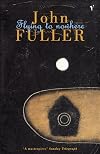
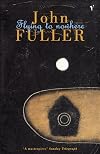
Flying to Nowhere
by John Fuller
On This Page
Description
"WINNER OF THE WHITBREAD PRIZE AND SHORTLISTED FOR THE BOOKER PRIZE John Fuller's first novel opens with the arrival of church agent Vane on a remote Welsh island where he is to investigate the disappearance of pilgrims visiting its sacred well. While Vane looks for clues and corpses the local Abbot seaches for the location of the soul. Magical and poetic, Flying to Nowhereawakens our secret hopes and fears and our need to believe in miracles."Tags
Recommendations


















Member Reviews
Rating: 4.5* of five
The Publisher Says: Flying to Nowhere is a modern Gothic novel with spiritual overtones that open out a set of classic novelistic quests. Set on a remote Welsh island during the Middle Ages, the tale is woven around two main characters&em;Vane, an emissary sent by the Bishop to investigate the disappearance of a number of pilgrims to the island's miraculous well; and the abbot, who dissects cadavers in a desperate attempt to find the human soul. In language that oscillates between graphic and lyrical extremes, John Fuller relates the intricate thematic parallels of their quests which remain unresolved even at the end. Flying to Nowhere, in which the existence of absolute truth is openly challenged, asks unanswerable show more questions, and encourages provocative speculation.
My Review: Fuller's modern Gothic novel(la, it's so short) is an incantation to Kalliope, a hymn to gods hanging on to existence and power just barely because of hymn-singers like this doing their blessed work.
I loved the idea of a book that juxtaposes ancient and modern journeys (sea and dissection). I felt, as each part of the book wavered into focus, the little shiver of anticipatory longing.
A beautiful word-bath. A pleasure to read. A toe-curling literary satisfaction. show less
The Publisher Says: Flying to Nowhere is a modern Gothic novel with spiritual overtones that open out a set of classic novelistic quests. Set on a remote Welsh island during the Middle Ages, the tale is woven around two main characters&em;Vane, an emissary sent by the Bishop to investigate the disappearance of a number of pilgrims to the island's miraculous well; and the abbot, who dissects cadavers in a desperate attempt to find the human soul. In language that oscillates between graphic and lyrical extremes, John Fuller relates the intricate thematic parallels of their quests which remain unresolved even at the end. Flying to Nowhere, in which the existence of absolute truth is openly challenged, asks unanswerable show more questions, and encourages provocative speculation.
My Review: Fuller's modern Gothic novel(la, it's so short) is an incantation to Kalliope, a hymn to gods hanging on to existence and power just barely because of hymn-singers like this doing their blessed work.
I loved the idea of a book that juxtaposes ancient and modern journeys (sea and dissection). I felt, as each part of the book wavered into focus, the little shiver of anticipatory longing.
A beautiful word-bath. A pleasure to read. A toe-curling literary satisfaction. show less
I generally eschew summaries in this pattern, but in this case I cannot avoid it: If Umberto Eco had written "Wicker Man", it would have been exactly like this.
Two separate societies, one all-male and theoretically Christian but with a leader preoccupied by the search for the physical seat of the soul and thus all floundering, one all- or almost-all-female and dedicated to agricultural pursuits, some dark relationship between them. A symbolic horse, a Gormenghastian building complex, an official church investigation into the efficacy (and therefore funding) of a holy well. An apprentice whose desires conflict and a master whose views are incisive, but more in the knife sense than the accuracy sense.
The words form powerful imagery and show more plausible flows of character thought, all without evident effort; the story flows with the retroactive inevitability natural to life-modeled fiction; the fixations of the middle-aged and the flirtations of the young are lovingly, if honestly, depicted; it's beautiful. Even the gruesome bits. (There are some.)
Just don't expect a tidy resolution of a mystery. As with "The Name of the Rose", which to some people is a historical capital-R Romance, to some an argument about literary genres, to some a serial killer mystery, to some a complex reflection on art and belief, this book also does not have a message and a resolution.
It has an indelible aftertaste. What that taste is, is subjective. show less
Two separate societies, one all-male and theoretically Christian but with a leader preoccupied by the search for the physical seat of the soul and thus all floundering, one all- or almost-all-female and dedicated to agricultural pursuits, some dark relationship between them. A symbolic horse, a Gormenghastian building complex, an official church investigation into the efficacy (and therefore funding) of a holy well. An apprentice whose desires conflict and a master whose views are incisive, but more in the knife sense than the accuracy sense.
The words form powerful imagery and show more plausible flows of character thought, all without evident effort; the story flows with the retroactive inevitability natural to life-modeled fiction; the fixations of the middle-aged and the flirtations of the young are lovingly, if honestly, depicted; it's beautiful. Even the gruesome bits. (There are some.)
Just don't expect a tidy resolution of a mystery. As with "The Name of the Rose", which to some people is a historical capital-R Romance, to some an argument about literary genres, to some a serial killer mystery, to some a complex reflection on art and belief, this book also does not have a message and a resolution.
It has an indelible aftertaste. What that taste is, is subjective. show less
A strange story. The book is a collection of pictures in prose, and shows how sometimes an author succeeds in merging form and content so perfectly that one cannot survive without the other. Whether it is the descriptions of the monks silhouetted against the craggy,scrubby rocks, their gowns etched to their bodies as they walk uphill into a head wind, or the stallion snorting in fear and frustration while trying to maintain his balance against all odds, the imagery that he conceives is so evocative that it stays in the mind long after you've finished the book.
The story itself is also very odd and can be understood at different levels.
I would recommend it particularly for readers who love language for the sake of language, and who show more derive pleasure out of the sensuality of certain words and phrases bunching together in a certain fashion. show less
The story itself is also very odd and can be understood at different levels.
I would recommend it particularly for readers who love language for the sake of language, and who show more derive pleasure out of the sensuality of certain words and phrases bunching together in a certain fashion. show less
Very odd; very peculiar. So dense with lyrical language it takes real effort to make it through the (fairly simple) plot, and while I appreciate the book's ruminations on life, death, and the separation of flesh and spirit I have trouble with any written work that sacrifices story for experimentation in how that story is told.
bewitching. In turn pathetic, sad, horrible.
Struggled through this, but not sure why.
Members
- Recently Added By
Lists

Booker Prize
491 works; 62 members

Man Booker Prize Longlist 1983
6 works; 1 member

Monastic life
31 works; 1 member

Booker Prize Shortlist: Titles Not Yet Read
161 works; 4 members

Jones & Newman: Best Horror Books Further Recommended Reading
577 works; 4 members
Author Information

58+ Works 1,012 Members
John Fuller is a fellow of Magdalen College, Oxford, where he teaches English. He is also a poet and novelist. His collection Stones and Fires won the 1996 Forward Prize
Some Editions
Awards and Honors
Awards
Common Knowledge
- Canonical title
- Flying to Nowhere
- Original title
- Flying to Nowhere
- Alternate titles
- De hemel tegemoet : een vertelling
- Original publication date
- 1983
- Epigraph*
- Animula vagula blandula hospes comesque corporis,
quae nunc abibis in loca pallidula rigida nudula,
nec ut soles dabis iocos!
P. AELIUS HADRIANUS - Blurbers
- Cunningham, Valentine; Mars-Jones, Adam
- Original language*
- Engels
*Some information comes from Common Knowledge in other languages. Click "Edit" for more information.
Classifications
Statistics
- Members
- 274
- Popularity
- 117,870
- Reviews
- 7
- Rating
- (3.41)
- Languages
- Dutch, English, French, Swedish
- Media
- Paper, Ebook
- ISBNs
- 10
- ASINs
- 6