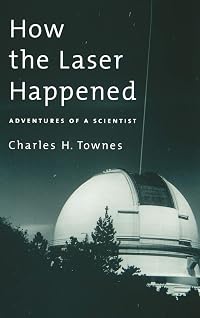
How the Laser Happened: Adventures of a Scientist
by Charles H. Townes
On This Page
Description
Charles Townes invented the maser and the laser, and was a pioneer in the use of spectroscopic techniques to determine the atomic composition of stars. This is the memoir of a life devoted to scientific research.Tags
Recommendations
















Member Reviews
https://www.academia.edu/30439880/Review_of_Townes_How_the_Laser_Happened_Advent...
review for Ambix 50 (2003), 328-9. How the Laser Happened: Adventures of a Scientist, Charles H. TownesPp: iii+200Illus.IndexOxford University Press2002 (pbk) (first published 1999 (hbk))Lb. 9.99 (pbk)ISBN: 0-19-515376-6
Charles Townes is best known as the co-winner with Nikolai Basov and Alexander Prokhorov of the1964 Nobel Prize for “fundamental work in quantum electronics which led to the production of oscillators and amplifiers according to the maser-laser principle”.Encouragingly, the Introduction begins with Townes’s assertion about the importance of “scientific sociology”. He defines this, though, in a much narrower sense than did Merton show more or even Kuhn some decades ago, as concerning “people, their interactions and mutual stimulation” (p. 1). The book portrays his own good science as the product of networking between the accidental acquaintances made at universities, committees and advisory boards. Indeed, Townes cites his personal experiences to argue that the production of new knowledge is unpredictable and uncertain until the importance and potential of a novel idea is recognised, after which “the sociology of science asserts its power”, when “symbiotic,mutually amplifying ideas get traded back and forth among people with a variety of backgrounds and points of view, insuring that the field will develop and grow” (p. 83).Despite telling his personal story of the maser and laser as an “unpredictable but perhaps natural path”(p. 15), Townes provides only the sketchiest of accounts of others’ contributions. Indeed, much of what he does write is to correct public misrepresentations of priority disputes. Thus he is careful to emphasise that Basov and Prokhorov did not build the first maser. He also gives a chronology of his interactions with Gordon Gould, who was later to claim precedence in a number of ideas concerning laser design –summarised by Townes as “a peculiar episode in the story of the laser” (p. 95). The laser, in fact, gets rather little mention in the book – scarcely two dozen pages hinting at the physics, design concepts and patent disputes. Rather more space is devoted to Townes’s contributions as scientific advisor to government and industry.These interestingly illustrate the contingency of decision-making regarding infrared technology, the space programme, ICBMs and other policy issues. Here, too, Townes attempts to right the historical record: he emphasises that military programmes often were encouraged as much by free-wheeling scientists as by military planners. Townes also stresses that he was misrepresented by students and some colleagues at Berkeley in the late 1960s and early 1970s as irresponsibly hawkish, and casts himself as a‘southern liberal’ who attempted to reduce American involvement in Vietnam and, much later, the Strategic Defence Initiative. In isolated passages the scientific enthusiasm comes across well (e.g. his description of the ammonia atom as a “nitrogen atom slung in a triangular trapeze formed by hydrogen atoms”, p. 40) but other sections (especially chapter 1) seem redrafted to appeal to a pop science readership.
Readers seeking a history of the laser will not find it here, but they will get an autobiographical account, written for Americans, of the career highlights of one influential scientist. show less
review for Ambix 50 (2003), 328-9. How the Laser Happened: Adventures of a Scientist, Charles H. TownesPp: iii+200Illus.IndexOxford University Press2002 (pbk) (first published 1999 (hbk))Lb. 9.99 (pbk)ISBN: 0-19-515376-6
Charles Townes is best known as the co-winner with Nikolai Basov and Alexander Prokhorov of the1964 Nobel Prize for “fundamental work in quantum electronics which led to the production of oscillators and amplifiers according to the maser-laser principle”.Encouragingly, the Introduction begins with Townes’s assertion about the importance of “scientific sociology”. He defines this, though, in a much narrower sense than did Merton show more or even Kuhn some decades ago, as concerning “people, their interactions and mutual stimulation” (p. 1). The book portrays his own good science as the product of networking between the accidental acquaintances made at universities, committees and advisory boards. Indeed, Townes cites his personal experiences to argue that the production of new knowledge is unpredictable and uncertain until the importance and potential of a novel idea is recognised, after which “the sociology of science asserts its power”, when “symbiotic,mutually amplifying ideas get traded back and forth among people with a variety of backgrounds and points of view, insuring that the field will develop and grow” (p. 83).Despite telling his personal story of the maser and laser as an “unpredictable but perhaps natural path”(p. 15), Townes provides only the sketchiest of accounts of others’ contributions. Indeed, much of what he does write is to correct public misrepresentations of priority disputes. Thus he is careful to emphasise that Basov and Prokhorov did not build the first maser. He also gives a chronology of his interactions with Gordon Gould, who was later to claim precedence in a number of ideas concerning laser design –summarised by Townes as “a peculiar episode in the story of the laser” (p. 95). The laser, in fact, gets rather little mention in the book – scarcely two dozen pages hinting at the physics, design concepts and patent disputes. Rather more space is devoted to Townes’s contributions as scientific advisor to government and industry.These interestingly illustrate the contingency of decision-making regarding infrared technology, the space programme, ICBMs and other policy issues. Here, too, Townes attempts to right the historical record: he emphasises that military programmes often were encouraged as much by free-wheeling scientists as by military planners. Townes also stresses that he was misrepresented by students and some colleagues at Berkeley in the late 1960s and early 1970s as irresponsibly hawkish, and casts himself as a‘southern liberal’ who attempted to reduce American involvement in Vietnam and, much later, the Strategic Defence Initiative. In isolated passages the scientific enthusiasm comes across well (e.g. his description of the ammonia atom as a “nitrogen atom slung in a triangular trapeze formed by hydrogen atoms”, p. 40) but other sections (especially chapter 1) seem redrafted to appeal to a pop science readership.
Readers seeking a history of the laser will not find it here, but they will get an autobiographical account, written for Americans, of the career highlights of one influential scientist. show less
Ratings
Members
- Recently Added By
Author Information

7+ Works 68 Members
Charles Townes was born in Greenville, South Carolina, and attended Furman University. After graduate study at Duke University and the California Institute of Technology, he spent the years from 1939 to 1947 at the Bell Telephone Laboratories designing radar-controlled bombing systems. Townes then joined the physics department of Columbia show more University. In 1951, while sitting on a park bench, the idea for the maser (microwave amplification by stimulated emission of radiation) occurred to him as a way to produce high-intensity microwaves. In 1953 the first maser became operational. In a maser, ammonia (NH3) molecules are raised to an excited vibrational state and then fed into a resonant cavity, where (as in a laser) they stimulated part of the spectrum. "Atomic clocks" of great accuracy are based on this concept, and solid-state maser amplifiers are used in radioastronomy. In 1964 Townes and two Soviet laser pioneers, Aleksander Prokhorov and Nikolai Basov, shared the Nobel Prize. Since 1966 Townes has been at the University of California, Berkeley. (Bowker Author Biography) show less
Awards and Honors
Awards
Classifications
Statistics
- Members
- 38
- Popularity
- 766,129
- Reviews
- 1
- Rating
- (3.50)
- Languages
- Chinese, English
- Media
- Paper, Ebook
- ISBNs
- 7