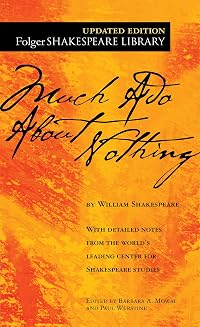
Much Ado About Nothing
by William Shakespeare
On This Page
Description
Shakespeare's comedy play Much Ado About Nothing pivots around the impediments to love for young betrothed Hero and Claudio when Hero is falsely accused of infidelity and the "lover's trap" set for the arrogant and assured Benedick who has sworn of marriage and his gentle adversary Beatrice. The merry war between Benedick and Beatrice with the promptings of their friends soon dissolves into farcical love, while Hero's supposed infidelity is shown to be little more than "much ado about nothing"..
Tags
Recommendations


Member Recommendations
Shuffy2 Beatrice and Benedick and Lizzie and Darcy- there are some similarties! This is my favorite of Shakespeare's comedies! Two characters who love to spar with words, 2 couples who love each other, and a bad guy! Perfect mix...
90
Member Reviews
Leonato, the governor of Messina, hosts Don Pedro and his troops on his estate after a successful battle. One of his men, Claudio and Leonato's daughter Hero immediately fall in love and plan to marry. But Don Pedro's jealous brother Don John plots to upset the happy scenario by framing Hero as an unfaithful woman. The plan to exonerate Hero involves cribbing from Romeo & Juliet with a fake death, but a happier outcome.
Much of this is overshadowed by the B-plot involving Leonato's niece Beatrice and Claudio's friend and fellow soldier Benedick. As the play begins, they display a deep loathing for one another exchanging barbed quips I can only imagine in the style of a 1940s screwball comedy. Don Pedro's men along with Hero and her show more attendant Ursual plot to convince Beatrice and Benedick that the other suffers from unrequited love for them. The ploy works hilariously to create the ur-text of enemies-to-lovers romance plots.
I think this may be to most laugh out loud funniest of Shakespeare's comedies in the chronology thus far (although The Comedy of Errors, Love's Labour's Lost, and A Midsummer's Night's Dream all have their moments) while also tying together two complementary plots in a successful whole. show less
Much of this is overshadowed by the B-plot involving Leonato's niece Beatrice and Claudio's friend and fellow soldier Benedick. As the play begins, they display a deep loathing for one another exchanging barbed quips I can only imagine in the style of a 1940s screwball comedy. Don Pedro's men along with Hero and her show more attendant Ursual plot to convince Beatrice and Benedick that the other suffers from unrequited love for them. The ploy works hilariously to create the ur-text of enemies-to-lovers romance plots.
I think this may be to most laugh out loud funniest of Shakespeare's comedies in the chronology thus far (although The Comedy of Errors, Love's Labour's Lost, and A Midsummer's Night's Dream all have their moments) while also tying together two complementary plots in a successful whole. show less
The title is so accurate it hurts. Consider the “villain” of this play for a minute-- he is just kind of sad for some reason and he thinks it would lift his spirits to make the other people around him miserable too. Luckily he has a pair of dedicated henchmen who are totally on board, so they just fabricate some juicy drama and away we go! Characters fall in and out of love based on whispers and hearsay, not because of any concrete actions. Though it might seem light and fluffy on the surface, there is something terrifying about how easy it is to emotionally uproot these character’s entire existences. How much are our feelings and opinions manipulated by people/society? Are the most genuine emotions we feel based upon lies? Can we show more even pretend to be in control of our lives?!? existential breakdown). So really everyone in this play is ridiculous, but if you can get caught up in the absurdity it makes for a pretty fun time. show less
I was dealt a sizeable blow by the Introduction to my Wordsworth edition of Much Ado About Nothing, and the play itself never really recovered me. You see, the Introduction went into the history of the play and pointed out that our surviving version of Much Ado is an early text, representing "a preliminary stage in the play's evolution: we lack a 'finished', enriched and polished version" (pg. 13). And it is true: the inconsistencies which you sometimes find in Shakespeare attack you like waves on breakers in Much Ado: convoluted plotlines, inert characters put into a scene without any lines or even a purpose, and underdeveloped or counter-intuitive motivations for key characters. Even the division of the play into Acts and scenes is a show more modern editorial decision. When you add to this the lack of eloquent soliloquies or memorable phrases, the lack of rhyme to end scenes, and bawdy jokes that don't land, then you have the sort of Shakespeare experience that enthusiasts try so desperately to dispel: a 'comedy' and a play that is too much like hard work. It is the near-equivalent of that modern habit of posthumously publishing a famous author's incomplete manuscript as a new work.
However, the same Introduction also points out Much Ado's saving grace: we sometimes forget, but Shakespeare was meant as drama, not literature. "Shakespeare wrote his plays as scripts for performance, and the main critical test is whether they succeed as performances" (pg. 16). The underlying concept of Much Ado is a good one: of lovers getting into misunderstandings and consequently into all sorts of inept schemes, before things work out and they all live happily ever after. It is the framework for most modern romantic comedies. Much Ado does this well: there are some good lines, and Benedick and Beatrice can be a delight; "they never meet but there's a skirmish of wit between them" (pg. 32). So whilst it may be a clunker in book form, there is enough here for directors and actors on both stage and screen to deliver a great interpretation – and many have. (One can only wonder at how Shakespeare's finished piece would look, had it survived into modern times.) But readers of Shakespeare should approach with more caution than I did: Much Ado About Nothing is one for the stage, not the page. show less
However, the same Introduction also points out Much Ado's saving grace: we sometimes forget, but Shakespeare was meant as drama, not literature. "Shakespeare wrote his plays as scripts for performance, and the main critical test is whether they succeed as performances" (pg. 16). The underlying concept of Much Ado is a good one: of lovers getting into misunderstandings and consequently into all sorts of inept schemes, before things work out and they all live happily ever after. It is the framework for most modern romantic comedies. Much Ado does this well: there are some good lines, and Benedick and Beatrice can be a delight; "they never meet but there's a skirmish of wit between them" (pg. 32). So whilst it may be a clunker in book form, there is enough here for directors and actors on both stage and screen to deliver a great interpretation – and many have. (One can only wonder at how Shakespeare's finished piece would look, had it survived into modern times.) But readers of Shakespeare should approach with more caution than I did: Much Ado About Nothing is one for the stage, not the page. show less
Shakespeare - Arden Edition of Much Ado About Nothing
Much Ado About Nothing is one of those Shakespeare plays which many people feel they know from Kenneth Branaugh's star studded movie of 1993.
Full of Mediterranean sunshine, tanned and physically striking celebrity actors in freshly starched linen exuding the dewy glow of youth and cavorting on the grounds of a gorgeously framed Italian villa whose own beauty did much to highlight the lighter side of the play. I certainly remember it this way, but there is a darker side. Many of Shakespeare's plays are open to interpretation when they are staged or filmed. The director is at liberty to choose which version he/she wants to show and Branaugh chose the lighter side even to the extent of show more cutting 180 lines from the dialogue between Benedick and Beatrice. When sitting down with the text in front of you the reader can make his own interpretation and in this instance I was surprised by just how dark or near tragic this play could be. I also watched the 1984 BBC television film which keeps close to the text and the Claudio-Hero semi tragedy takes central stage.
The story starts with an elite group of soldiers coming back from war Don Pedro: Prince of Aragon, Benedick Lord of Padua, young Claudio Lord of Florence and Don John illegitimate brother of Don Pedro. They arrive in Messina where the Governor Leonato bids them welcome and asks them to stay. There is history between Beatrice and Benedick who cannot resist in spa-ing with each other every time they meet, they have a love-hate relationship. Claudio who has been commended for his actions in the wars falls in love with Leonato's daughter Hero. At a masked ball Don Pedro says he will win the affections of Hero and hand her over to the more inexperienced Claudio. Leonato is happy to sanction the marriage of Claudio and Hero for the following week. The plain speaking villain (on his own admission) Don John hatches a plot to trick Claudio and Don Pedro to believe that Hero is not a virgin. Two friends of Don John, Borachio and Conrad arrange for Margaret (a lady in waiting) to to dress up in hero's clothes and be seen in Hero's bedroom with Borachio. Dogberry the master constable and the watch despite their comedy routine catch the two plotters, but not in time to prevent Claudio and Don Pedro denouncing Hero as a whore at the alter. Hero swoons and the friar smells a plot and suggests to the distraught Leonato that he takes and hides Hero while her friends pretend that she is dead. While this dark side of the plot is being played out, there is the love jousting continuing between Beatrice and Benedick aided and abetted by their friends who trick them both into believing that each one loves the other, but can'e admit it. There is much eaves dropping and skulking around in the undergrowth similar to Don Pedro and Claudio.
The two love matches are skilfully intertwined and Benedick and Beatrice find themselves caught up in the defence of Hero against Don Pedro and Claudio. Dogberry eventually reveals the plotters to Leonato and Don Pedro, who have worked themselves up into challenging each other to fight. A truce is called and Claudio agrees to marry another member of Leonato's household; sight unseen, but it is Hero, and there is a double wedding celebration as Benedick and Beatrice still jesting join the celebrations.
The play can be seen as a battle of the sexes between two couples, light hearted but pointed between Beatrice and Benedick, but semi tragic in the case of Claudio and Hero. There is the need for a bride to be a virgin, which although seems somewhat outdated in todays westernised culture was of supreme importance in some periods of our history and takes a central position in this story. This all points to the Claudio-Hero story as being the main plot, however the play can be easily subverted into a romantic comedy if the Benedick-Beatrice story is given equal billing. They both have the best lines which are genuinely funny and their love play jousting, sits well with the comedy interludes, provided by Dogberry and the Watch.
It is interesting that Shakespeare gives Beatrice and Benedick the best lines as they twist each other comments in a way that would have been familiar to some Elizabethan theatregoers. It is similar to the euphuistic language used by John Lyly in his books and plays, but whereas this was largely an exercise in style and could go on at inordinate length, in Shakespeares hands it is cutting and witty. When it is all said and done and we are at the celebratory end of the play it is the comic interplay between Beatrice and Benedick that stays in my memory.
It is interesting that The title of the Much Ado About Nothing indicates to the modern reader that is is an exercise in frivolity, but when you understand that 'Nothing' in Elizabethan times was another term for female genitalia then the dark side of the play rears its head again. I read the Arden Shakespeare edition of the play and thought that the introduction and editing by Claire McEachern was one of the best that I have read - 5 stars show less
Much Ado About Nothing is one of those Shakespeare plays which many people feel they know from Kenneth Branaugh's star studded movie of 1993.
Full of Mediterranean sunshine, tanned and physically striking celebrity actors in freshly starched linen exuding the dewy glow of youth and cavorting on the grounds of a gorgeously framed Italian villa whose own beauty did much to highlight the lighter side of the play. I certainly remember it this way, but there is a darker side. Many of Shakespeare's plays are open to interpretation when they are staged or filmed. The director is at liberty to choose which version he/she wants to show and Branaugh chose the lighter side even to the extent of show more cutting 180 lines from the dialogue between Benedick and Beatrice. When sitting down with the text in front of you the reader can make his own interpretation and in this instance I was surprised by just how dark or near tragic this play could be. I also watched the 1984 BBC television film which keeps close to the text and the Claudio-Hero semi tragedy takes central stage.
The story starts with an elite group of soldiers coming back from war Don Pedro: Prince of Aragon, Benedick Lord of Padua, young Claudio Lord of Florence and Don John illegitimate brother of Don Pedro. They arrive in Messina where the Governor Leonato bids them welcome and asks them to stay. There is history between Beatrice and Benedick who cannot resist in spa-ing with each other every time they meet, they have a love-hate relationship. Claudio who has been commended for his actions in the wars falls in love with Leonato's daughter Hero. At a masked ball Don Pedro says he will win the affections of Hero and hand her over to the more inexperienced Claudio. Leonato is happy to sanction the marriage of Claudio and Hero for the following week. The plain speaking villain (on his own admission) Don John hatches a plot to trick Claudio and Don Pedro to believe that Hero is not a virgin. Two friends of Don John, Borachio and Conrad arrange for Margaret (a lady in waiting) to to dress up in hero's clothes and be seen in Hero's bedroom with Borachio. Dogberry the master constable and the watch despite their comedy routine catch the two plotters, but not in time to prevent Claudio and Don Pedro denouncing Hero as a whore at the alter. Hero swoons and the friar smells a plot and suggests to the distraught Leonato that he takes and hides Hero while her friends pretend that she is dead. While this dark side of the plot is being played out, there is the love jousting continuing between Beatrice and Benedick aided and abetted by their friends who trick them both into believing that each one loves the other, but can'e admit it. There is much eaves dropping and skulking around in the undergrowth similar to Don Pedro and Claudio.
The two love matches are skilfully intertwined and Benedick and Beatrice find themselves caught up in the defence of Hero against Don Pedro and Claudio. Dogberry eventually reveals the plotters to Leonato and Don Pedro, who have worked themselves up into challenging each other to fight. A truce is called and Claudio agrees to marry another member of Leonato's household; sight unseen, but it is Hero, and there is a double wedding celebration as Benedick and Beatrice still jesting join the celebrations.
The play can be seen as a battle of the sexes between two couples, light hearted but pointed between Beatrice and Benedick, but semi tragic in the case of Claudio and Hero. There is the need for a bride to be a virgin, which although seems somewhat outdated in todays westernised culture was of supreme importance in some periods of our history and takes a central position in this story. This all points to the Claudio-Hero story as being the main plot, however the play can be easily subverted into a romantic comedy if the Benedick-Beatrice story is given equal billing. They both have the best lines which are genuinely funny and their love play jousting, sits well with the comedy interludes, provided by Dogberry and the Watch.
It is interesting that Shakespeare gives Beatrice and Benedick the best lines as they twist each other comments in a way that would have been familiar to some Elizabethan theatregoers. It is similar to the euphuistic language used by John Lyly in his books and plays, but whereas this was largely an exercise in style and could go on at inordinate length, in Shakespeares hands it is cutting and witty. When it is all said and done and we are at the celebratory end of the play it is the comic interplay between Beatrice and Benedick that stays in my memory.
It is interesting that The title of the Much Ado About Nothing indicates to the modern reader that is is an exercise in frivolity, but when you understand that 'Nothing' in Elizabethan times was another term for female genitalia then the dark side of the play rears its head again. I read the Arden Shakespeare edition of the play and thought that the introduction and editing by Claire McEachern was one of the best that I have read - 5 stars show less
CRITIQUE
Okay. I think I will have to start with the obvious problems – racism, anti-Semitism, and sexism. Some scholars of Shakespeare excuse him as being a product of his time. I am also a product of my time, so I can’t just let him off the hook for these flaws.
When Benedick says, “If I do not love her, I am a Jew.” It is a clear slur against Jews. Taking the content of his speech into consideration, he means something like, “If I do not love her, then I am a fool.” (Act 2 Scene 3)
When Claudio agrees to marry whoever Leonato asks him to, he is motivated to do so out of guilt – guilt for his role in Hero’s death. He is agreeing to do penance for his misdeeds. So when he says, “I’ll hold my mind, were she an show more Ethiope,” he is saying that he will marry her, even if she is black. As penance. Not cool. (Act 5 Scene 4)
And of course, there is the obvious sexism. Who cares if Hero is a virgin?
Claudio is a royal jerk. Even if he does think that Hero is disloyal, he could confront her in private and allow her to defend herself. And even if Hero has been disloyal, Claudio could simply break off his engagement and leave. But to publicly disgrace her? In the 16th century? That was close to a death sentence.
And Hero’s father? How could he possibly buy into the scandal? On his behalf, after Leonato recovers from his shock, he does defend Hero the next day. But still.
Benedick decides to defend Hero’s honor just minutes after it was tarnished. Even though he hardly knows her. So what’s Leonato’s excuse for not doing the same?
Another question that begs to be answered is: Why in the world would Hero take Claudio back after what he did? And why would Hero’s father support it? I guess it was either that or the nunnery…
It’s crass to think that even a virgin whose reputation has been tainted has no option other than a “religious life”. The Friar makes this clear:
“And if it sort not well, you may conceal her,
As best befits her wounded reputation,
In some reclusive and religious life,
Out of all eyes, tongues, minds, and injuries.”
(p. 163, Act 4 Scene 1)
PRAISE
I really love the bantering: between Beatrice and the messenger, between Beatrice and Benedick, between Benedick and Claudio. Even Don Pedro and Leonato join in on the bantering – and they’re supposed to be these high-society, proper noblemen. And these are not just light, polite topics about which they are joking around. Topics include how ugly and disdainful the other is, and who slept with the other man’s wife. It’s hilarious. With a little updated language, this could be a group of college students, joking around – intelligent, sharp-witted, and with an incredibly good sense of humor.
And for all the sexism that existed in the 16th century, and for all the weak female characters in Shakespearean plays, Beatrice is by far the strongest Shakespearean female character I have come across to date – and she can be considered a strong female character, displaying intelligence, wit, strength, and integrity, even when measured by today’s standards.
She is not the typical late 16th century European woman by any definition of the word. She suggests her cousin choose a husband that pleases her:
“Yes, faith; it is my cousin's duty to make curtsey and say, 'Father, as it please you'. But yet for all that, cousin, let him be a handsome fellow, or else make another curtsey and say, 'Father, as it please me'” (p. 39).
A young noblewoman (or any woman) doing what she pleases in 1598, especially in regards to whom she marries, is nothing short of revolutionary.
Yes, Beatrice is quite the rebel. Not only in gender issues. When she tells Benedick, "We must follow the leaders," referring to the dance, and he adds, "In every good thing," Beatrice continues, "Nay, if they lead to any ill, I will leave them at the next turning" (p. 47).
So apparently Beatrice is not willing to follow people blindly just because they are designated leaders. I like her spirit.
Benedick’s character is also admirable. Despite his outward display of “being a professed tyrant to their sex,” he sees Beatrice as his equal in wit and intelligence and admires her for it. He is a stand-up, principled man, which he proves when he stays to see if Hero is alright, in spite of her alleged disloyalty, even after his friends have left her for dead. He stays, not solely because of his feelings for Beatrice, but because that’s the kind of decent person he is. And when he challenges Claudio to a duel, he believes in the honor he is fighting for. He is in no way a puppet on Beatrice’s string, but is clearly his own man in taking these grave steps to right the wrongs done to “a sweet and innocent lady” (p. 199, Act 5 Scene 1).
It’s interesting that the Goodreads description of the play above doesn’t mention Benedick and Beatrice at all and suggests that the “play's central plot shows how Don John maliciously deceives Claudio into believing that Hero has taken a lover on the eve of her marriage, causing Claudio to repudiate her publicly, at the altar.”
I don’t think that that was the “play’s central plot” at all, but rather a background story for the essential story line featuring the hero and heroine, Benedick and Beatrice.
The end of Act 4 Scene 1 is my favorite part and, I would purport, the most powerful section of the play. Benedick and Beatrice profess their love for each other in the middle of the tragically unfolding drama, in which Beatrice’s cousin’s life is ruined and Benedick agrees to challenge his best friend to a duel. Powerful stuff. Elegantly written. Pure drama. (p. 165-173) show less
Okay. I think I will have to start with the obvious problems – racism, anti-Semitism, and sexism. Some scholars of Shakespeare excuse him as being a product of his time. I am also a product of my time, so I can’t just let him off the hook for these flaws.
When Benedick says, “If I do not love her, I am a Jew.” It is a clear slur against Jews. Taking the content of his speech into consideration, he means something like, “If I do not love her, then I am a fool.” (Act 2 Scene 3)
When Claudio agrees to marry whoever Leonato asks him to, he is motivated to do so out of guilt – guilt for his role in Hero’s death. He is agreeing to do penance for his misdeeds. So when he says, “I’ll hold my mind, were she an show more Ethiope,” he is saying that he will marry her, even if she is black. As penance. Not cool. (Act 5 Scene 4)
And of course, there is the obvious sexism. Who cares if Hero is a virgin?
Claudio is a royal jerk. Even if he does think that Hero is disloyal, he could confront her in private and allow her to defend herself. And even if Hero has been disloyal, Claudio could simply break off his engagement and leave. But to publicly disgrace her? In the 16th century? That was close to a death sentence.
And Hero’s father? How could he possibly buy into the scandal? On his behalf, after Leonato recovers from his shock, he does defend Hero the next day. But still.
Benedick decides to defend Hero’s honor just minutes after it was tarnished. Even though he hardly knows her. So what’s Leonato’s excuse for not doing the same?
Another question that begs to be answered is: Why in the world would Hero take Claudio back after what he did? And why would Hero’s father support it? I guess it was either that or the nunnery…
It’s crass to think that even a virgin whose reputation has been tainted has no option other than a “religious life”. The Friar makes this clear:
“And if it sort not well, you may conceal her,
As best befits her wounded reputation,
In some reclusive and religious life,
Out of all eyes, tongues, minds, and injuries.”
(p. 163, Act 4 Scene 1)
PRAISE
I really love the bantering: between Beatrice and the messenger, between Beatrice and Benedick, between Benedick and Claudio. Even Don Pedro and Leonato join in on the bantering – and they’re supposed to be these high-society, proper noblemen. And these are not just light, polite topics about which they are joking around. Topics include how ugly and disdainful the other is, and who slept with the other man’s wife. It’s hilarious. With a little updated language, this could be a group of college students, joking around – intelligent, sharp-witted, and with an incredibly good sense of humor.
And for all the sexism that existed in the 16th century, and for all the weak female characters in Shakespearean plays, Beatrice is by far the strongest Shakespearean female character I have come across to date – and she can be considered a strong female character, displaying intelligence, wit, strength, and integrity, even when measured by today’s standards.
She is not the typical late 16th century European woman by any definition of the word. She suggests her cousin choose a husband that pleases her:
“Yes, faith; it is my cousin's duty to make curtsey and say, 'Father, as it please you'. But yet for all that, cousin, let him be a handsome fellow, or else make another curtsey and say, 'Father, as it please me'” (p. 39).
A young noblewoman (or any woman) doing what she pleases in 1598, especially in regards to whom she marries, is nothing short of revolutionary.
Yes, Beatrice is quite the rebel. Not only in gender issues. When she tells Benedick, "We must follow the leaders," referring to the dance, and he adds, "In every good thing," Beatrice continues, "Nay, if they lead to any ill, I will leave them at the next turning" (p. 47).
So apparently Beatrice is not willing to follow people blindly just because they are designated leaders. I like her spirit.
Benedick’s character is also admirable. Despite his outward display of “being a professed tyrant to their sex,” he sees Beatrice as his equal in wit and intelligence and admires her for it. He is a stand-up, principled man, which he proves when he stays to see if Hero is alright, in spite of her alleged disloyalty, even after his friends have left her for dead. He stays, not solely because of his feelings for Beatrice, but because that’s the kind of decent person he is. And when he challenges Claudio to a duel, he believes in the honor he is fighting for. He is in no way a puppet on Beatrice’s string, but is clearly his own man in taking these grave steps to right the wrongs done to “a sweet and innocent lady” (p. 199, Act 5 Scene 1).
It’s interesting that the Goodreads description of the play above doesn’t mention Benedick and Beatrice at all and suggests that the “play's central plot shows how Don John maliciously deceives Claudio into believing that Hero has taken a lover on the eve of her marriage, causing Claudio to repudiate her publicly, at the altar.”
I don’t think that that was the “play’s central plot” at all, but rather a background story for the essential story line featuring the hero and heroine, Benedick and Beatrice.
The end of Act 4 Scene 1 is my favorite part and, I would purport, the most powerful section of the play. Benedick and Beatrice profess their love for each other in the middle of the tragically unfolding drama, in which Beatrice’s cousin’s life is ruined and Benedick agrees to challenge his best friend to a duel. Powerful stuff. Elegantly written. Pure drama. (p. 165-173) show less
Much Ado is, by far, my absolute favorite Shakespeare. The humor, the wit, the back and forth (especially between Benedick and Beatrice) just ticks all the boxes for greatness.
This particular copy I picked up from a local library sale just before I was supposed to teach Shakespeare to 10th graders as part of my student teaching. I chose Much Ado because it was the lightest of my three choices (the others being Othello and Julius Caesar), but also the play I knew best. As I told my students at the time, Much Ado is a prime example of an early form of the situational comedy, where all the misunderstandings could be easily avoided if only certain parties would talk to one another, but then there really would be Nothing going on.
And, always show more remember, Dogberry is an ass. show less
This particular copy I picked up from a local library sale just before I was supposed to teach Shakespeare to 10th graders as part of my student teaching. I chose Much Ado because it was the lightest of my three choices (the others being Othello and Julius Caesar), but also the play I knew best. As I told my students at the time, Much Ado is a prime example of an early form of the situational comedy, where all the misunderstandings could be easily avoided if only certain parties would talk to one another, but then there really would be Nothing going on.
And, always show more remember, Dogberry is an ass. show less
Read this around a campfire tonight at a Shakespeare Night organized by a wonderful friend who always plans the best things! She’s wonderful too because she cast me as Dogberry, and I had a blast reading his lines.
I’ve been enamored of this play for many years, but I’d never actually read it. I’ve watched the adaptation with Kenneth Branagh and Emma Thompson over and over, and I love the Joss Whedon version too. I remember seeing Whedon’s adaptation for the first time at the Wisconsin Film Festival and giggling my whole drive home, every time I thought of Nathan Fillion’s performance as Dogberry.
It’s a play full of ridiculous schemes, a romantic hero I want to punch, and the best enemies-to-lovers banter I’ve ever read. show more It’s fun to read and even more fun to see performed, so if you haven’t done either of those things, get on it, people! show less
I’ve been enamored of this play for many years, but I’d never actually read it. I’ve watched the adaptation with Kenneth Branagh and Emma Thompson over and over, and I love the Joss Whedon version too. I remember seeing Whedon’s adaptation for the first time at the Wisconsin Film Festival and giggling my whole drive home, every time I thought of Nathan Fillion’s performance as Dogberry.
It’s a play full of ridiculous schemes, a romantic hero I want to punch, and the best enemies-to-lovers banter I’ve ever read. show more It’s fun to read and even more fun to see performed, so if you haven’t done either of those things, get on it, people! show less
Members
- Recently Added By
Lists

Favourite Books
1,820 works; 316 members

Greatest Books, allegedly
484 works; 9 members

Mensa for Kids Excellence in Reading Award Program (Grades 9-12)
116 works; 3 members

Five star books
1,767 works; 110 members

Literature which inspired Pop songs
85 works; 9 members

Comedy of Manners
73 works; 1 member

Stage Plays/Screenplays/Dialogues/Anything Dialogue-Storytelling Related
81 works; 2 members
Books Mentioned in The Wedding Planner's Daughter series
107 works; 2 members
1:28 p.m.'s 350 Stage Plays Challenge
94 works; 3 members

Book Titles Mentioned In Newberry Medal And Honor Books
884 works; 3 members

Authors from England
147 works; 4 members

AP Lit
363 works; 6 members
Essential/Recognized Stage Plays
115 works; 4 members
Classical Conversations Challenge III Exposition
8 works; 1 member
Phi Beta Kappa reading list
260 works; 8 members

Books Read in 2023
5,638 works; 147 members
'Books You Can't Live Without: The Top 100', The Guardian, 2007
156 works; 7 members

Recommended Reading : 600 Classics Reviewed, Editors of Salem Press, 2015
634 works; 6 members
My Play Collection
769 works; 3 members
Mensa for Kids Excellence in Reading Award Program (Grades 9-12)
116 works; 5 members

Books Read in 2016
4,666 works; 197 members

Favorite Shakespeare plays?
37 works; 45 members
Favorite Literary Love Stories
182 works; 101 members
Plays I Like
230 works; 31 members

Recommend the 20 best books you've read in the last five years
2,168 works; 607 members

Read the book and saw the movie
1,170 works; 192 members

Great Books Favorites
71 works; 6 members

Books With Characters I'd Like to Date
18 works; 9 members

Books Read in 2013
1,630 works; 51 members

Ambleside Books
459 works; 18 members

100 Books to Read in a Lifetime (That Are Older Than 200 Years)
415 works; 176 members

Western World's Greatest Books - Project Gutenberg
295 works; 15 members
One Book, Many Authors
441 works; 39 members

University literature
145 works; 5 members
Best Book and Movie Combos
70 works; 11 members

Books mentioned in The Diary of a Provincial Lady
59 works; 4 members

Read
293 works; 4 members
Blue Pyramid 1,276 Best Books of All Time
1,248 works; 32 members
Love Triangles in Literature
108 works; 15 members
Early Modern (Shakesperean)
64 works; 2 members
School Made Us Read It
380 works; 196 members
Talk Discussions
Past Discussions
February Shakespeare CAT: Much Ado About Nothing - Romantic Comedy in 2022 Category Challenge (March 2022)
Author Information

6,154+ Works 444,062 Members
William Shakespeare, 1564 - 1616 Although there are many myths and mysteries surrounding William Shakespeare, a great deal is actually known about his life. He was born in Stratford-Upon-Avon, son of John Shakespeare, a prosperous merchant and local politician and Mary Arden, who had the wealth to send their oldest son to Stratford Grammar School. show more At 18, Shakespeare married Anne Hathaway, the 27-year-old daughter of a local farmer, and they had their first daughter six months later. He probably developed an interest in theatre by watching plays performed by traveling players in Stratford while still in his youth. Some time before 1592, he left his family to take up residence in London, where he began acting and writing plays and poetry. By 1594 Shakespeare had become a member and part owner of an acting company called The Lord Chamberlain's Men, where he soon became the company's principal playwright. His plays enjoyed great popularity and high critical acclaim in the newly built Globe Theatre. It was through his popularity that the troupe gained the attention of the new king, James I, who appointed them the King's Players in 1603. Before retiring to Stratford in 1613, after the Globe burned down, he wrote more than three dozen plays (that we are sure of) and more than 150 sonnets. He was celebrated by Ben Jonson, one of the leading playwrights of the day, as a writer who would be "not for an age, but for all time," a prediction that has proved to be true. Today, Shakespeare towers over all other English writers and has few rivals in any language. His genius and creativity continue to astound scholars, and his plays continue to delight audiences. Many have served as the basis for operas, ballets, musical compositions, and films. While Jonson and other writers labored over their plays, Shakespeare seems to have had the ability to turn out work of exceptionally high caliber at an amazing speed. At the height of his career, he wrote an average of two plays a year as well as dozens of poems, songs, and possibly even verses for tombstones and heraldic shields, all while he continued to act in the plays performed by the Lord Chamberlain's Men. This staggering output is even more impressive when one considers its variety. Except for the English history plays, he never wrote the same kind of play twice. He seems to have had a good deal of fun in trying his hand at every kind of play. Shakespeare wrote 154 sonnets, all published on 1609, most of which were dedicated to his patron Henry Wriothsley, The Earl of Southhampton. He also wrote 13 comedies, 13 histories, 6 tragedies, and 4 tragecomedies. He died at Stratford-upon-Avon April 23, 1616, and was buried two days later on the grounds of Holy Trinity Church in Stratford. His cause of death was unknown, but it is surmised that he knew he was dying. (Bowker Author Biography) show less
Some Editions
Awards and Honors
Series
Belongs to Publisher Series
Work Relationships
Is contained in
5 Plays: As You Like It; The Merry Wives of Windsor; A Midsummer Night's Dream; Much Ado About Nothing; Twelfth Night by William Shakespeare
Ein Sommernachtstraum / Der Kaufmann von Venedig / Viel Lärm um nichts / Wie es euch gefällt / Die lustigen Weiber von by William Shakespeare
The Annotated Shakespeare: The Comedies, Histories, Sonnets and Other Poems, Tragedies and Romances Complete by William Shakespeare (indirect)
Is retold in
Has the adaptation
Is abridged in
Inspired
Has as a study
Has as a supplement
RSC Music & Speeches : Much Ado About Nothing or Love's Labour's Won {sound recording} by Royal Shakespeare Company
Shakespeare : Much Ado About Nothing : Novello Theatre : 2006 {programme} by Royal Shakespeare Company
Has as a commentary on the text
Has as a student's study guide
Has as a teacher's guide
Common Knowledge
- Canonical title
- Much Ado About Nothing
- Original title
- Much Ado About Nothing
- Alternate titles
- Benedick and Betteris
- Original publication date
- 1598
- People/Characters
- Beatrice {Much Ado About Nothing); Benedick; Don Pedro; Don John; Claudio; Leonato (show all 17); Antonio; Balthasar; Borachio; Conrade; Innogen; Hero; Margaret; Ursula; Dogberry; Verges; Friar Francis
- Important places
- Messina, Sicily, Italy; Sicily, Italy; Italy
- Related movies
- Much Ado About Nothing (1993 | IMDb); Much Ado About Nothing (1973 | IMDb); Much Ado About Nothing (1984 | IMDb); Much Ado About Nothing (1940 | IMDb); Much Ado About Nothing (2012 | IMDb)
- First words
- I learn in this letter that Don Pedro of Aragon comes this night to Messina.
- Quotations
- He wears his faith but as the fashion of his hat.
Silence is the perfectest herald of joy: I were but little happy, if I could say how much.
I thank God I am as honest as any man living that is an old man and no honester than I.
What a deformed thief this fashion is.
Is it not strange that sheep's guts should hale souls out of men's bodies?
The world must be peopled. (show all 7)
I think this is your daughter.
Her mother hath many times told me so. - Last words
- (Click to show. Warning: May contain spoilers.)Strike up, pipers.
- Publisher's editor
- Hodge, Jessica [Thomson Learning]; Harrison, G. B. (Penguin Popular Classics); Foakes, R. A. (New Penguin Shakespeare); Gibson, Rex (Cambridge School Shakespeare)
- Original language*
- Inglese
- Disambiguation notice
- This work is for the complete Much Ado About Nothing only. Do not combine this work with abridgements, adaptations or simplifications (such as "Shakespeare Made Easy"), Cliffs Notes or similar study guides, or anything... (show all) else that does not contain the full text. Do not include any video recordings. Additionally, do not combine this with other plays.
*Some information comes from Common Knowledge in other languages. Click "Edit" for more information.
Classifications
Statistics
- Members
- 12,320
- Popularity
- 690
- Reviews
- 115
- Rating
- (4.07)
- Languages
- 20 — Catalan, Chinese, French-based Creoles and Pidgins, Czech, Dutch, English, Finnish, French, German, Greek, Hungarian, Italian, Korean, Norwegian (Bokmål), Polish, Russian, Spanish, Swedish, Turkish, Portuguese (Portugal)
- Media
- Paper, Audiobook, Ebook
- ISBNs
- 464
- UPCs
- 7
- ASINs
- 145