Energy Island: How one community harnessed the wind and changed their world
by Allan Drummond
On This Page
Description
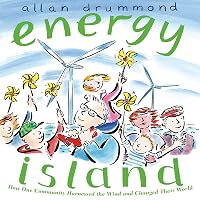
It's windy on the Danish island of Samsø. Meet the environmentally friendly folks who, in a few short years, worked together for energy independence, and who now proudly call their home Energy Island.Tags
Recommendations

Member Reviews
Summary: This children's informational text was about a community of people who lived on an island off of Denmark and their energy story. This community took it into their own hands to become energy independent in which they used natural resources to create their own energy instead of getting it from Denmark. The community worked together and achieved their goal. The island is now completely energy efficient and the book teaches about the types of energy and the resources.
Argument: There were many reasons I enjoyed this informational text. First, this book was not an average informational text. It wasn't covered page by page with information but instead it was told like a story. It talked about the community in a fun and exciting way show more with such emotion. The second reason I enjoyed this book was its differentiation between story and information. The story about the community is in the middle of the page and on some pages to the far right or left side there is a bar with information about types of energy or resources. I like how it gave facts with the story. The last reason I enjoyed this book was for its pictures and text formatting. The text was broken up in two to three sentences on different parts of each page. Each segment of text had its own small illustration so there could be up to eight separate illustrations on each page. It was very fun and engaging to read.
The main theme of this to teach about the different types of energy resources and how to become energy independent. It is a persuasion text that convinces others to go energy independent just like the community in the book. show less
Argument: There were many reasons I enjoyed this informational text. First, this book was not an average informational text. It wasn't covered page by page with information but instead it was told like a story. It talked about the community in a fun and exciting way show more with such emotion. The second reason I enjoyed this book was its differentiation between story and information. The story about the community is in the middle of the page and on some pages to the far right or left side there is a bar with information about types of energy or resources. I like how it gave facts with the story. The last reason I enjoyed this book was for its pictures and text formatting. The text was broken up in two to three sentences on different parts of each page. Each segment of text had its own small illustration so there could be up to eight separate illustrations on each page. It was very fun and engaging to read.
The main theme of this to teach about the different types of energy resources and how to become energy independent. It is a persuasion text that convinces others to go energy independent just like the community in the book. show less
This week, I'm looking at a book about environmental responsibility with plenty of practical advice and fascinating facts. This is the story of the Danish island of Samso.
Samso used to be an ordinary island. They had farms and a fishing fleet, a ferry and lots and lots of wind! Then the Danish Ministry of Environment and Energy chose Samso as the place to become independent of nonrenewable energy and a teacher named Soren Hermansen decided to help bring the project to life. Despite initial resistance, residents of the island gradually came to support the idea and offered their own suggestions and innovations. Wind turbines were built and after a storm knocked out most of the island's power, people came to see the advantages of show more independent power. Finally, the island became independent of nonrenewable energy sources - and even makes more energy than it can use!
Explanations of the various terms and concepts related to energy, including nonrenewable and renewable energy, climate change, etc. are included in sections set throughout the book. Drummond's illustrations swirl and explode throughout the book with life and energy and excitement. Ideas are spread throughout the story for ways to save and improve energy sources in big and small ways.
Verdict: This is an inspiring book for children and adults alike. An enjoyable read-aloud that easily incorporates an important message without being preachy or laden with doom. Recommended - would make a good nonfiction read-aloud for storytimes with older kids.
ISBN: 9780374321840; Published March 2011 by Farrar Straus Giroux; Borrowed from another library; Added to my library order wishlist. show less
Samso used to be an ordinary island. They had farms and a fishing fleet, a ferry and lots and lots of wind! Then the Danish Ministry of Environment and Energy chose Samso as the place to become independent of nonrenewable energy and a teacher named Soren Hermansen decided to help bring the project to life. Despite initial resistance, residents of the island gradually came to support the idea and offered their own suggestions and innovations. Wind turbines were built and after a storm knocked out most of the island's power, people came to see the advantages of show more independent power. Finally, the island became independent of nonrenewable energy sources - and even makes more energy than it can use!
Explanations of the various terms and concepts related to energy, including nonrenewable and renewable energy, climate change, etc. are included in sections set throughout the book. Drummond's illustrations swirl and explode throughout the book with life and energy and excitement. Ideas are spread throughout the story for ways to save and improve energy sources in big and small ways.
Verdict: This is an inspiring book for children and adults alike. An enjoyable read-aloud that easily incorporates an important message without being preachy or laden with doom. Recommended - would make a good nonfiction read-aloud for storytimes with older kids.
ISBN: 9780374321840; Published March 2011 by Farrar Straus Giroux; Borrowed from another library; Added to my library order wishlist. show less
This book is a great way for children to understand about energy in a way that catches their interest. The information given is real world relatable that gives insight in the workings of energy. I love the fact that it is based on an actual place that you can find on a map, which is a great way for kids to see how a community came together to make a change and inspire them to do something too.
At a time when most countries are producing ever-increasing amounts of greenhouse gasses, the rather ordinary citizens of Samsø have accomplished something extraordinary―in just ten years they have reduced their carbon emissions by 140% and become almost completely energy independent. A narrative tale and a science book in one, this inspiring true story proves that with a little hard work and a big idea, anyone can make a huge step toward energy conservation. The inspiring first book in the author’s acclaimed series about real-world communities going green.
This book would work well when talking about energy conservation with kids. I think that I could use this book after teaching about conservation because it could be a good way to be like "now what can we do to help?" It can be a good way to get into a discussion about how we can help conserve in our communities.
The book is a great read for all students. It motivates students to dream big and follow their dreams no matter what. It also shows how far one idea can go if you work hard on it.
Energy Island tells the story of how the Danish island, Samso, became energy independent by using their most important and prevalent natural resource, the wind. It is told in story book fashion and has interesting sidebars giving more detailed information at a higher reading level. They discuss different topics, such as, "Renewable Energy," "Global Warming," and "Wind Energy." I found the book very interesting and would certainly recommend for classrooms K - 4. The illustrations are bright and compliment the text. The endpages have similar illustrations as are in the book and are of people enjoying the wind and chasing their hats. The saying constant throughout the book is, "Hold onto your hats!"
Members
- Recently Added By
Lists

Beautiful Feet Books
304 works; 7 members
Author Information

44+ Works 1,143 Members
Awards and Honors
Awards
Notable Lists
Classifications
Statistics
- Members
- 386
- Popularity
- 81,178
- Reviews
- 39
- Rating
- (4.40)
- Languages
- English
- Media
- Paper
- ISBNs
- 4
- ASINs
- 1