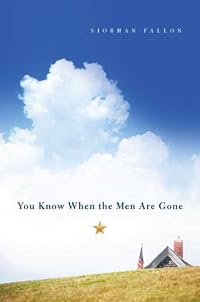
You Know When the Men Are Gone
by Siobhan Fallon 
On This Page
Description
A collection of interconnected stories relate the experiences of Fort Hood military wives who share a poignant vigil during which they raise children while waiting for their husbands to return.Tags
Recommendations
























Member Reviews
A dreamy half-lost gaze of a story collection - really, a novel broken into pieces. It dragged at me and pulled me under. I dreamt myself into that world -- it is our shared world, the world of soldiers gone from home and weapons and bombings -- but not my world, not my reality.
Some fragments were more solid than others. The interpreter. The man at the window. The injured foot. Meg. All of this happening simultaneously and still within its own time, as one holds memory; it is no surprise that this was drawn from the author's own life.
I disagree strongly with some other reviewers that they are repetitive. Or rather I agree, but the maddening repetition is the damn point. This is what happens. And it goes on and on and on in infinite show more variations on love and sorrow and patience and loss, and always always we are waiting for an uncertain end.
4 stars for this emotional draw; it's so rare that I dream into fiction! - 3 for writing - at first it bothered me (oh the run on sentences without logical pause) - and then that, too, melted. Form into function.
read via e-book. show less
Some fragments were more solid than others. The interpreter. The man at the window. The injured foot. Meg. All of this happening simultaneously and still within its own time, as one holds memory; it is no surprise that this was drawn from the author's own life.
I disagree strongly with some other reviewers that they are repetitive. Or rather I agree, but the maddening repetition is the damn point. This is what happens. And it goes on and on and on in infinite show more variations on love and sorrow and patience and loss, and always always we are waiting for an uncertain end.
4 stars for this emotional draw; it's so rare that I dream into fiction! - 3 for writing - at first it bothered me (oh the run on sentences without logical pause) - and then that, too, melted. Form into function.
read via e-book. show less
Probably the best book I've read about military spouses. High quality writing, laser insights, descriptions that feel like observations rather than imaginations. OK, well there is one story whose scenario I really hope is fundamentally imagined, but the relational truths are powerful.
I can admit to being unsure about this book. I didn't think I would be able to connect with any of the stories because I'm not the wife of anyone, much less the wife of a soldier. However, I was hooked after the first story. Beautifully written, with many voices and viewpoints. It provides a glimpse into the lives of our soldiers and their families and allows the reader to understand (even if just as an outsider) the sacrifices the soldiers AND their wives make to protect our country.
 This review was written for LibraryThing Early Reviewers.
As I closed the book after reading the last story in You Know When the Men Are Gone, I couldn't help thinking that you also know when an important new talent has emerged on the literary scene. Because Siobhan Fallon simply blew me away with these eight interrelated pieces which detail with a near surgical precision exactly what it is like - how it feels - to be part of the all-volunteer army that continues to fight our so-called "war on terror" thousands of miles away on the other side of our ever-shrinking planet.
Every story in this jewel-like collection contains at least one moment - and often more - which will bring the hot sting of unshed tears to your eyes, if indeed you succeed in containing those tears. Because Fallon has show more succeeded in showing you another side of the wars, the hidden costs on the home front, which test, stretch, and often destroy military families. And these are young families, obviously - men and women, many barely out of their teens, who should be enjoying each other and their young children and babies. Instead they are faced with long and lonely separations, followed by reunions ruined by the unexplainable depressions, black rages and abberant behavior that are the unmistakable markers of Post Traumatic Stress Disorder.
While reading Fallon's stories I kept trying to think of other books I might have read which deal with the wives' stories. All that came to mind was the currently-running TV series, Army Wives, which my wife and I watch every week. I know it is based on a book, but we have not read it. Then I thought of a book from another war, Tim Farrington's moving and beautiful 2005 novel, Lizzie's War, which utilized shifting viewpoints, moving back and forth between the marine combatant in the Vietnam jungle and his wife and children back home in the States. Fallon's book easily equals that accomplishment.
Elizabeth Strout's Olive Kitteridge also came to mind, mostly because that novel too is rendered as a group of interrelated stories with the title character as the unifying element. In Fallon's book what unites the stories is not a single character, but a much larger entity, the army. And also, of course, the war, with its continuing deployments and separations, which eat away at the foundations of all those still-new, young and vulnerable marriages and relationships. Strout's book won the Pulitzer Prize for fiction. I have a feeling that Fallon's book will also win its share of prizes.
Finally, I think You Know When the Men Are Gone should become required reading for the decision makers in Washington, from the President and Secretary of Defense all the way on down the chain of command, both civilian and military. It's probably naive of me to think this, but perhaps, having read these stories of heartbreak and misery, they would not be so quick to vote for war. It should also be read by every active duty soldier - in all branches of service. It would promote a better understanding of the lot of the women they leave behind every time they deploy. I guess I'm saying that the book deserves an extremely wide audience, because this slim volume of stories could - should - reverberate in our country for years to come. I give this book my unqualified and highest recommendation. show less
Every story in this jewel-like collection contains at least one moment - and often more - which will bring the hot sting of unshed tears to your eyes, if indeed you succeed in containing those tears. Because Fallon has show more succeeded in showing you another side of the wars, the hidden costs on the home front, which test, stretch, and often destroy military families. And these are young families, obviously - men and women, many barely out of their teens, who should be enjoying each other and their young children and babies. Instead they are faced with long and lonely separations, followed by reunions ruined by the unexplainable depressions, black rages and abberant behavior that are the unmistakable markers of Post Traumatic Stress Disorder.
While reading Fallon's stories I kept trying to think of other books I might have read which deal with the wives' stories. All that came to mind was the currently-running TV series, Army Wives, which my wife and I watch every week. I know it is based on a book, but we have not read it. Then I thought of a book from another war, Tim Farrington's moving and beautiful 2005 novel, Lizzie's War, which utilized shifting viewpoints, moving back and forth between the marine combatant in the Vietnam jungle and his wife and children back home in the States. Fallon's book easily equals that accomplishment.
Elizabeth Strout's Olive Kitteridge also came to mind, mostly because that novel too is rendered as a group of interrelated stories with the title character as the unifying element. In Fallon's book what unites the stories is not a single character, but a much larger entity, the army. And also, of course, the war, with its continuing deployments and separations, which eat away at the foundations of all those still-new, young and vulnerable marriages and relationships. Strout's book won the Pulitzer Prize for fiction. I have a feeling that Fallon's book will also win its share of prizes.
Finally, I think You Know When the Men Are Gone should become required reading for the decision makers in Washington, from the President and Secretary of Defense all the way on down the chain of command, both civilian and military. It's probably naive of me to think this, but perhaps, having read these stories of heartbreak and misery, they would not be so quick to vote for war. It should also be read by every active duty soldier - in all branches of service. It would promote a better understanding of the lot of the women they leave behind every time they deploy. I guess I'm saying that the book deserves an extremely wide audience, because this slim volume of stories could - should - reverberate in our country for years to come. I give this book my unqualified and highest recommendation. show less
You Know When the Men Are Gone by Siobhan Fallon is a collection of connected war stories. Fallon, an army wife herself, portrays vividly life on the base, from the first title story, which evokes the absence of the men through a lack of sound: “…without the men, there is a sense of muted silence, a sense of muted life.” These war stories don’t focus on the battlefield; instead, they show the effects of war on the soldiers’ families and are filled with realistic characters and situations. You Know When the Men Are Gone is a strong debut.
The strength of these stories lies in the characterizations. Fallon presents a variety of situations and characters – some happy marriages and some marriages that are disintegrating. But show more common problems exist. Wives get used to living without the husbands, and after returning from deployment, even the best relationships have adjustments to make. Domestic violence, drinking, and infidelity are all too common. Reading this collection of stories reminds us that even the families whose soldiers return pay a price. show less
The strength of these stories lies in the characterizations. Fallon presents a variety of situations and characters – some happy marriages and some marriages that are disintegrating. But show more common problems exist. Wives get used to living without the husbands, and after returning from deployment, even the best relationships have adjustments to make. Domestic violence, drinking, and infidelity are all too common. Reading this collection of stories reminds us that even the families whose soldiers return pay a price. show less
This review was written for LibraryThing Early Reviewers.Normally short stories are not high on my list of appealing things to read. A few authors have managed to break through my apathy for the form though and after reading this collection of linked short stories, I'm going to add Siobhan Fallon to the list. When we see news coverage of our troops, it generally focuses on the far away places in which they are fighting, the emotional toll it takes on the men and women in uniform, or on the tragedy of their loss. Rarely do we see even a human interest story on the lives of the people they've left behind, the husbands, wives, and children who wait patiently for them on military bases around the country. Fallon's stories offer glimpses into the lives of the families who live a military life even show more when the men (and women) are gone.
I picked this up one night and absolutely zipped through it. Beautiful and affecting, these tales of life on base after the soldiers are deployed and how they integrate back into their lives and those of their families after such extended absences are timely and well-written. The uniqueness of the army base setting and the challenges faced by our military and their families make this an unusual but important read. Tackling subjects as diverse as infidelity, loss of trust, loneliness, the ever present threat of death or disability, and the petty everyday minutia that takes on a greater significance in light of the dangers facing the husbands in these stories, the collection is unvarnished and honest.
Fallon's prose in unadorned and straightforward and the stories are sometimes stark and unforgiving. The lives of the wives are threaded through with tension and anticipation, sometimes pleasant and other times terrifying. Some of the stories are a little ragged and unfinished but that reflects reality of life on base. There are no real endings, not even when a wife hears the worst, that her husband has died, just the relentless march of life moving onward. A moving look at the enormous range of sacrifices made by our military and their loved ones, this collection is well worth savoring. show less
I picked this up one night and absolutely zipped through it. Beautiful and affecting, these tales of life on base after the soldiers are deployed and how they integrate back into their lives and those of their families after such extended absences are timely and well-written. The uniqueness of the army base setting and the challenges faced by our military and their families make this an unusual but important read. Tackling subjects as diverse as infidelity, loss of trust, loneliness, the ever present threat of death or disability, and the petty everyday minutia that takes on a greater significance in light of the dangers facing the husbands in these stories, the collection is unvarnished and honest.
Fallon's prose in unadorned and straightforward and the stories are sometimes stark and unforgiving. The lives of the wives are threaded through with tension and anticipation, sometimes pleasant and other times terrifying. Some of the stories are a little ragged and unfinished but that reflects reality of life on base. There are no real endings, not even when a wife hears the worst, that her husband has died, just the relentless march of life moving onward. A moving look at the enormous range of sacrifices made by our military and their loved ones, this collection is well worth savoring. show less
I tend to find anthologies or collections of short stories to be somewhat of a hit and miss grab bag. I tend to find some stories that I love, others I think are terrible, and still others, I'm just somewhat indifferent towards. I found this book to continue to fall into that pattern. The stories I did love tended to be the ones I could most identify with, and those I didn't like seemed to be the ones that stretched things the furthest. Also, one of the things I tend not to like about short stories is their lack of an ending or closure - they can often times feel incomplete to me. This was the case in this book. In some of the stories, not having an ending worked. It felt realistic to the "life goes on" aspect of life, the "this was a show more resolution for today, but who knows what will happen tomorrow" way things go. "Remission" and "You Survived the War, Now Survive the Homecoming" are both examples of that kind of story for me, and "Remission" was probably my favorite story of the book, and the one that drew the most emotion from me. In other stories, the lack of ending seemed almost a cop-out, like the author either didn't know how to end the story, or knew how it had to end, or would have ended in real life, but was afraid to put it into writing that way. The first story, "You Know When the Men Are Gone", and "Leave" were both disappointments for me in that respect.
One of the reasons I chose to read this book is that I, too, lived in Killeen, just off Fort Hood, during a major troop deployment. My brother, career military, was deployed to Iraq from Fort Hood, and so I ended up moving in with my sister-in-law in Killeen to help out, as she was just starting nursing school and had a just-turned-two-year-old. Although we did not live on post, we lived just off of it, and spent a great deal of time on post, at the homes of my sister-in-law's friends who did live on post, and running errands to the commissary, PX, etc. The vast majority of people I met were either in the military themselves, or were military spouses. While I did find some of the stories in this book to ring very true to my experiences, others seemed far more unrealistic. I don't necessarily doubt that they COULD have happened (weird things happen in the military, and unpopular as this statement may be, not ALL members of the military are honorable, trustworthy, or decent people). These stories just did not really mesh with my own observations and experience of life in Killeen and Fort Hood at that time.
One of the major issues in military life is, indeed, the marital strain that occurs, and I felt for the most part, the author captures this quite well. Adultery and cheating occur frequently on both sides and, as a result of its frequency, those who may not actively participate in it generally do have a fear or paranoia that their significant other will. Even if this fear is kept in check for the most part, the smallest thing can set it off, and jealousy, rage, & suspicion will bubble up to the surface. The general stress and strain of being separated for so long, and of having such an extended, intense experience that the other person can't share in, is also something that can tear a relationship apart and that the author captures well. The wall of things left unsaid between military couples is immense and can seem like insurmountable obstacles at times. And, even with all of the changes that have occurred over the last 10 years or so, the saying is still true: if the military wanted you to have a wife & family, they would issue you one. It is something I get frustrated with on a regular basis. If you enter the military, or you marry a military member, you MUST understand that this is the way it is going to be, with all of the costs and benefits that go along with it. It's pretty easy to tell those who get it and will be in it for the long haul, and those who don't and who will be separated or divorced before even one tour of duty is up.
The general ambience of the base is also something that the author captured well, although, I will say, the absence of men did not seem as pronounced to me during my time there, as the author represented it. Yes, there did seem to be a greater ratio of women to men then you might get in the civilian world, but there wasn't a complete absence of men felt, and even once the majority of the troops had returned, and I went back to visit, there didn't seem to be a sense of that many more men, just more that the scales had tipped back into balance between men and women again. The camaraderie that can develop between military spouses, combined with the distances that can still be maintained among those groups is very true to life as well. One of the things that did bother me about the book was an overall sense of helplessness or hopelessness. It was very much a downer to me, and few, if any of the stories had what I would consider a positive experience. And, as much as life, especially military life, can be negative and hard, there really are hope and happy endings to be found, and I just wish the author could have included a little bit more of that.
Overall, I am glad I read the book, I guess I had just hoped for more. And, while I might recommend it to someone who does not have a connection to the military, so they can get a better feel for what it is like to live on a military base, the only reason I would recommend it to my sister-in-law is to get her perspective on how true to life she feels it is. show less
One of the reasons I chose to read this book is that I, too, lived in Killeen, just off Fort Hood, during a major troop deployment. My brother, career military, was deployed to Iraq from Fort Hood, and so I ended up moving in with my sister-in-law in Killeen to help out, as she was just starting nursing school and had a just-turned-two-year-old. Although we did not live on post, we lived just off of it, and spent a great deal of time on post, at the homes of my sister-in-law's friends who did live on post, and running errands to the commissary, PX, etc. The vast majority of people I met were either in the military themselves, or were military spouses. While I did find some of the stories in this book to ring very true to my experiences, others seemed far more unrealistic. I don't necessarily doubt that they COULD have happened (weird things happen in the military, and unpopular as this statement may be, not ALL members of the military are honorable, trustworthy, or decent people). These stories just did not really mesh with my own observations and experience of life in Killeen and Fort Hood at that time.
One of the major issues in military life is, indeed, the marital strain that occurs, and I felt for the most part, the author captures this quite well. Adultery and cheating occur frequently on both sides and, as a result of its frequency, those who may not actively participate in it generally do have a fear or paranoia that their significant other will. Even if this fear is kept in check for the most part, the smallest thing can set it off, and jealousy, rage, & suspicion will bubble up to the surface. The general stress and strain of being separated for so long, and of having such an extended, intense experience that the other person can't share in, is also something that can tear a relationship apart and that the author captures well. The wall of things left unsaid between military couples is immense and can seem like insurmountable obstacles at times. And, even with all of the changes that have occurred over the last 10 years or so, the saying is still true: if the military wanted you to have a wife & family, they would issue you one. It is something I get frustrated with on a regular basis. If you enter the military, or you marry a military member, you MUST understand that this is the way it is going to be, with all of the costs and benefits that go along with it. It's pretty easy to tell those who get it and will be in it for the long haul, and those who don't and who will be separated or divorced before even one tour of duty is up.
The general ambience of the base is also something that the author captured well, although, I will say, the absence of men did not seem as pronounced to me during my time there, as the author represented it. Yes, there did seem to be a greater ratio of women to men then you might get in the civilian world, but there wasn't a complete absence of men felt, and even once the majority of the troops had returned, and I went back to visit, there didn't seem to be a sense of that many more men, just more that the scales had tipped back into balance between men and women again. The camaraderie that can develop between military spouses, combined with the distances that can still be maintained among those groups is very true to life as well. One of the things that did bother me about the book was an overall sense of helplessness or hopelessness. It was very much a downer to me, and few, if any of the stories had what I would consider a positive experience. And, as much as life, especially military life, can be negative and hard, there really are hope and happy endings to be found, and I just wish the author could have included a little bit more of that.
Overall, I am glad I read the book, I guess I had just hoped for more. And, while I might recommend it to someone who does not have a connection to the military, so they can get a better feel for what it is like to live on a military base, the only reason I would recommend it to my sister-in-law is to get her perspective on how true to life she feels it is. show less
Members
- Recently Added By
Published Reviews
ThingScore 100
"In an accomplished debut story collection, Fallon lays bare the lonely lives of military families when the men go to war. In these eight loosely connected tales, the families of Fort Hood, Texas, wait for their men to come home. That waiting, filled with anxiety, boredom and sometimes resentment, creates a Godot-like existence, in which real life begins only when a soldier’s deployment show more ends... Fallon reveals the mostly hidden world of life on base for military families, and offers a powerful, unsentimental portrait of America at war. A fresh look at the Iraq war as it plays out on the domestic front." show less
added by siobhanfallon
The crucial role of military wives becomes clear in Fallon's powerful, resonant debut collection, where the women are linked by absence and a pervading fear that they'll become war widows. In the title story, a war bride from Serbia finds she can't cope with the loneliness and her outsider status, and chooses her own way out. The wife in "Inside the Break" realizes that she can't confront her show more husband's probable infidelity with a female soldier in Iraq; as in other stories, there's a gap between what she can imagine and what she can bear to know. In "Remission," a cancer patient waiting on the results of a crucial test is devastated by the behavior of her teenage daughter, and while the trials of adolescence are universal, this story is particularized by the unique tensions between military parents and children. One of the strongest stories, "You Survived the War, Now Survive the Homecoming," attests to the chasm separating men who can't speak about the atrocities they've experienced and their wives, who've lived with their own terrible burdens. Fallon writes with both grit and grace: her depiction of military life is enlivened by telling details, from the early morning sound of boots stomping down the stairs to the large sign that tallies automobile fatalities of troops returned from Iraq. Significant both as war stories and love stories, this collection certifies Fallon as an indisputable talent. (Jan.) (STARRED REVIEW) show less
added by siobhanfallon
Lists

Best books read in 2011
200 works; 51 members
Author Information

3+ Works 728 Members
Siobhan Fallon is a LibraryThing Author, an author who lists their personal library on LibraryThing.
Some Editions
Awards and Honors
Awards
Distinctions
Common Knowledge
- Original publication date
- 2011-01-20
- Important places
- Fort Hood, Texas, USA; Iraq
- Important events
- Iraq War
- Dedication
- To K.C. : best friend, husband, father solider. You are always worth the wait.
- First words
- In Fort Hood housing, like all army housing, you get used to hearing through the walls.
- Publisher's editor
- Einhorn, Amy
- Blurbers
- Kwok, Jean; Percy, Benjamin; Shapiro, Dani; Ciment, Jill; Fick, Nathaniel; Biank, Tanya
Classifications
Statistics
- Members
- 490
- Popularity
- 61,233
- Reviews
- 71
- Rating
- (4.01)
- Languages
- English, Norwegian
- Media
- Paper, Audiobook, Ebook
- ISBNs
- 12
- ASINs
- 9