Visiting Day
by Jacqueline Woodson
On This Page
Description
A young girl and her grandmother visit the girl's father in prison.Tags
Recommendations








Member Reviews
This is a story inspired by routines that several families will be familiar with, a trip to prison. Prison visits, especially for children, can be a shameful experience. Woodson changes that. Once a month, a little girl and her grandma begin their day early cooking some good southern food. The food is for the long bus trip they need to make to get to the prison where her daddy is. The bus is full of other people making the same trip, so they all pass around the food in a type of celebration that it’s finally visiting day. During the visit, everyone is happy and telling stories. Then it’s over. Grandma points out that one day, daddy will be home and they won’t ever have to leave him again. Jacqueline never gives our characters show more names. This is no accident. With our characters lacking names, we as readers don’t see this as Sally’s story; we see this as the story of several little girls. Jacqueline’s overall message emphasizes remaining hopeful for their family members return.
Details: This book was written to interest children in grades K-3 and is on a 3.6 reading level. show less
Details: This book was written to interest children in grades K-3 and is on a 3.6 reading level. show less
Another great book by Jacqueline who doesn't hesitate to tackle the tough stuff as she writes about a dad in prison. In the beginning though you have very little clues to hint to her dad being in jail, Woodson keeps you guessing as you think military, pilot, anything but a prisoner. She really surprises you. She describes the pain of our main character perfectly, as the young protagonist doesn't know when daddy is going to come home. Very sweet book and not a topic a lot of people would write about.
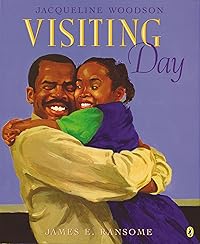
Before reading, I assumed that Visiting Day was about visiting day at a jail because that was the first thing that came to mind. Based on the picture on the cover, you can assume that it is a daughter visiting her dad on visiting day.
This book is about a young girl who eagerly awaits Visiting Day, a day that only rolls around once a month, so that she can go see her Daddy where he is "just doing some time." The child talks about their preparations and excitement on the morning of, and she talks about the wonderful yet brief period she spends with her dad while visiting. Her grandmother tells her, as they sadly ride the bus to return home, that this will not be forever, and they sit and laugh together, talking about all the big plans show more they have for when he returns.
This book hit a really soft spot for me, as I have worked very closely with younger children in this position through my city's Juvenile Court. It is so incredibly hard on a child, and a figure like this child's grandmother is not always present for the kids going through this. I like that Woodson never says they are going to a jail or a prison or talks about why he's there. A child does not care what their parent did to end up being taken away; they only care about when they'll be returning home. Woodson's selective word choice really drives in that point. The only thing the little girl in the story cares about is waiting to see her Daddy again. show less
This book is about a young girl who eagerly awaits Visiting Day, a day that only rolls around once a month, so that she can go see her Daddy where he is "just doing some time." The child talks about their preparations and excitement on the morning of, and she talks about the wonderful yet brief period she spends with her dad while visiting. Her grandmother tells her, as they sadly ride the bus to return home, that this will not be forever, and they sit and laugh together, talking about all the big plans show more they have for when he returns.
This book hit a really soft spot for me, as I have worked very closely with younger children in this position through my city's Juvenile Court. It is so incredibly hard on a child, and a figure like this child's grandmother is not always present for the kids going through this. I like that Woodson never says they are going to a jail or a prison or talks about why he's there. A child does not care what their parent did to end up being taken away; they only care about when they'll be returning home. Woodson's selective word choice really drives in that point. The only thing the little girl in the story cares about is waiting to see her Daddy again. show less
This book is so sensitive to the experience of a young girl visiting her father in prison. It describes her emotions, and the journey of seeing her father and how she must process missing him and understanding what is happening in their life. This book has the most beautiful painted illustrations and is empathetic and completely necessary in our modern society, for children who need help understanding about their parent being incarcerated.
I had mixed feelings about this book after reading it. I liked this book because it had so much emotion and love that showed the reader that the crime did not matter. However, I felt that some of text was a bit too intense for children to read. For example, when reading that Mrs. Tate is “shooting [her] a look that says, ‘You better not make a sound about Mrs. Tate not having enough money to take the bus up there to see her only son,’” I felt uncomfortable, because although it may be a true situation, I felt that it was a bit rude and passive aggressive to those who really don’t have enough money to visit family in jail. However, this book definitely represents a cold reality for some people and families and can help children show more understand these hard topics in an easier way; therefore, I think it is acceptable to overlook the intensity of this book, depending on the audience. In addition, I really enjoyed that some pages had no text on them at all. This allows for struggling readers to keep up with the story and helps develop inference skills by creating their own idea of what is happening on that page. Finally, the point of view from the little girl makes the story relatable to young children because of similar age and thoughts, which allow children to broaden their perspectives on the situation. show less
The narrator, a young girl, wakes up early once a month to her grandma fixing fried chicken and cornbread, smiling her “just-for-Grandma-and-Daddy smile.” It’s visiting day, and she is going to see her daddy. Her grandma tells her that Daddy is “doing a little time.” The visits are happy ones, with the narrator telling her dad all about the previous month while sitting on his lap. Lots of smiles, kisses, and hugs are exchanged, but then it is time to go. The narrator is sad, but she knows she will see her dad again the next month and looks forward to the day he’ll be home for good.
The illustrations by James E. Ransome are beautifully painted and show the emotions of the narrator and other characters clearly. The stark show more contrast between the blue sky and the watchtower, which peeks up from behind a tall wall with barbed wire, tells the reader why the girl and her grandma are having to visit. They also help the reader empathize with the narrator, her grandma, and her dad. When the narrator returns home, it is dark and the streets are deserted, showing the reader just how long the day was for only a short time to visit.
Inspired by her own visits with her uncle Robert in prison, this story shows that despite prison, the family’s love endures, and there is only a sense of hope that things will be better in the future when they can all be together again. show less
The illustrations by James E. Ransome are beautifully painted and show the emotions of the narrator and other characters clearly. The stark show more contrast between the blue sky and the watchtower, which peeks up from behind a tall wall with barbed wire, tells the reader why the girl and her grandma are having to visit. They also help the reader empathize with the narrator, her grandma, and her dad. When the narrator returns home, it is dark and the streets are deserted, showing the reader just how long the day was for only a short time to visit.
Inspired by her own visits with her uncle Robert in prison, this story shows that despite prison, the family’s love endures, and there is only a sense of hope that things will be better in the future when they can all be together again. show less
Visiting Day by Jacqueline Woodson was a wonderful book that touches on a difficult topic. Every month on visiting day, a little girl gets ready to visit her daddy in jail. Together, both Grandma and the little girl prepare themselves for the day ahead. Only on this day do they go on a long bus ride, eating fried chicken and cornbread, arms full of presents from Mrs. Tate for her son, excited about seeing Daddy again. Despite her sadness, the little girl is determined to look on the bright side and hope for the day when her Daddy will finally come home. Visiting Day is beautiful in its simplicity, and it does a fantastic job of illustrating a difficult reality for many children. This book is full of optimism and acceptance, perfect for show more children who have parents that may be incarcerated. show less
Members
- Recently Added By
Author Information

53+ Works 36,986 Members
Jacqueline Woodson was born in Columbus, Ohio on February 12, 1963. She received a B.A. in English from Adelphi University in 1985. Before becoming a full-time writer, she worked as a drama therapist for runaways and homeless children in New York City. Her books include The House You Pass on the Way, I Hadn't Meant to Tell You This, Lena, and The show more Day You Begin. She won the Coretta Scott King Award in 2001 for Miracle's Boys. After Tupac and D Foster, Feathers, and Show Way won Newbery Honors. Brown Girl Dreaming won the E. B. White Read-Aloud Award in 2015. Her other awards include the Margaret A. Edwards Award for lifetime achievement in writing for young adults, the Los Angeles Times Book Prize, and the 2018 Astrid Lindgren Memorial Award. She was also selected as the Young People's Poet Laureate in 2015 by the Poetry Foundation. (Bowker Author Biography) show less
Awards and Honors
Common Knowledge
- Original publication date
- 2002
Classifications
Statistics
- Members
- 574
- Popularity
- 51,652
- Reviews
- 174
- Rating
- (4.45)
- Languages
- English
- Media
- Paper, Ebook
- ISBNs
- 9
- ASINs
- 1