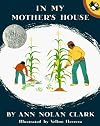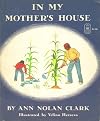
In My Mother's House
by Ann Nolan Clark
On This Page
Description
A young Tewa Indian describes the homes, customs, work, and strong communal spirit of his people.Tags
Recommendations





Member Reviews
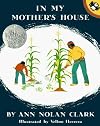
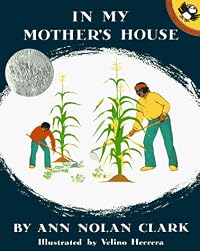
First published in 1941, and chosen as a Caldecott Honor Book in 1942 - other titles chosen that year include An American ABC, Paddle-to-the-Sea and Nothing At All - this collection of poems presents a group of Tewa children's view of life in the Tesuque Pueblo, outside of Santa Fe, and was created because its author, for many years a teacher of Native American children, had noticed the dearth of children's books told from the indigenous perspective. Beginning with the home, the poems (or poem, if you will, as they are all interconnected) address such issues as the plaza, or public space of the community, the field and irrigation ditches, and the hills and mountains around the pueblo. The book concludes back in the home, as the young show more narrator(s) describes all of these elements of Pueblo life as making a chain: "A strong chain, / To hold me close / To home, / Where I live / In my Mother's house."
Apparently collected from the Tewa students she taught, these simple poems reflect the teller(s)' direct relationship with the world around them, their affection for their families and community, and their strong ties to home. The book was originally hand-bound, decorated with artwork from the children themselves, and used as a geography in Clark's classroom at the Tesuque Pueblo. It was later published in book form, with illustrations by artist Velino Herrera (credited here as "Herrara," he was also known a Ma-Pe-Wi), who was from the Zia Pueblo. Although not destined to become a particular favorite of mine, I did enjoy In My Mother's House, and think that it could be a interesting title, when used in study-units on the native peoples of the Southwest. The artwork, which alternates between black and white and full color, is gorgeous! show less
Apparently collected from the Tewa students she taught, these simple poems reflect the teller(s)' direct relationship with the world around them, their affection for their families and community, and their strong ties to home. The book was originally hand-bound, decorated with artwork from the children themselves, and used as a geography in Clark's classroom at the Tesuque Pueblo. It was later published in book form, with illustrations by artist Velino Herrera (credited here as "Herrara," he was also known a Ma-Pe-Wi), who was from the Zia Pueblo. Although not destined to become a particular favorite of mine, I did enjoy In My Mother's House, and think that it could be a interesting title, when used in study-units on the native peoples of the Southwest. The artwork, which alternates between black and white and full color, is gorgeous! show less
The poetry deserves 5 stars, the illustrations were 3 stars, in my opinion.
I really love that this story is told through a Native American point of view and voice (I'd like to know the name(s) of the child(ren) that wrote the poems, since that seemed to be what was happening according to the author's note). The descriptions and poetry for each aspect of what goes on in their community was very sweet and provided an excellent view into the world as they see it at times.
As for the illustrations:
In some pictures, simple line art is used to give life to the orderly pueblos and puffy clouds; in others, color and shape give life to the people, plants, and horses spoken about in the poems. While I like these things, I believe the illustrator show more could've used more color in certain areas for emphasis, even just simple splashes here and there for a highlighting effect or to give the page a more interesting, lively look- especially when the poetry names colors! When the poem mentions the water or field specifically, color that part in and leave the rest of the line are black and white; when the poem focuses in on plants and their uses, color in the flowers or the parts of the plant the poem specifically mentions. As it is right now, the illustrations don't seem to have any rhyme or reason, or symbolism, as to what is colored and given attention and what isn't, which kind of bothers me. show less
I really love that this story is told through a Native American point of view and voice (I'd like to know the name(s) of the child(ren) that wrote the poems, since that seemed to be what was happening according to the author's note). The descriptions and poetry for each aspect of what goes on in their community was very sweet and provided an excellent view into the world as they see it at times.
As for the illustrations:
In some pictures, simple line art is used to give life to the orderly pueblos and puffy clouds; in others, color and shape give life to the people, plants, and horses spoken about in the poems. While I like these things, I believe the illustrator show more could've used more color in certain areas for emphasis, even just simple splashes here and there for a highlighting effect or to give the page a more interesting, lively look- especially when the poetry names colors! When the poem mentions the water or field specifically, color that part in and leave the rest of the line are black and white; when the poem focuses in on plants and their uses, color in the flowers or the parts of the plant the poem specifically mentions. As it is right now, the illustrations don't seem to have any rhyme or reason, or symbolism, as to what is colored and given attention and what isn't, which kind of bothers me. show less
This book could be classified as either realistic fiction or poetry. The story is told by a young child, who describes each aspect of his life in a Pueblo village. He describes the bricks that his house is made out of, the seeds that grow in the ground, and the horses that he loves to ride. This would be a great book to introduce students to the Latino culture that is still alive today in the south. This could also be used in reader's theatre since it is separated by sections, and written in verse.
According to my copy, the poems were written by the children themselves, making Clark more like an editor than an author. Apparently the illustrator is native, too. So, I guess this has value for historical accuracy.
Unfortunately, I found it dull. I hope we have better books by & for native children by now.
Unfortunately, I found it dull. I hope we have better books by & for native children by now.
This is wonderful book to use for children's study of Native American life and poetry. I really enjoyed reading it.
This book is a collection of Pueblo Indian poems. This shows the village and village life. The books talks about the customs, the houses, the community and the work that's to be done. It would be a good story to use when referencing how an adobe house is built.This book is from the 1940's, and the colors are faded with black lines.
Lovely illustrations, particularly of the horses!
Members
- Recently Added By
Lists

Caldecott Honor Books
296 works; 23 members

Romalda Spalding's Writing Road To Reading
213 works; 3 members

Newbery Adjacent
747 works; 3 members

Books Read in 2023
5,547 works; 145 members
Author Information

60+ Works 3,761 Members
All Editions
Awards and Honors
Awards
Distinctions
Notable Lists
Common Knowledge
- Canonical title
- In My Mother's House
- Original publication date
- 1941
- First words
- This is my Mother's house; my Father made it.
- Last words
- (Click to show. Warning: May contain spoilers.)They make a chain, a strong chain, to hold me close to home, where I live in my Mother's house.
Classifications
Statistics
- Members
- 584
- Popularity
- 50,103
- Reviews
- 8
- Rating
- (3.41)
- Languages
- English
- Media
- Paper
- ISBNs
- 7
- ASINs
- 12