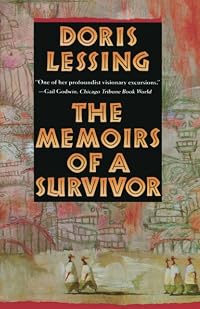
The Memoirs of a Survivor
by Doris Lessing
On This Page
Description
A compelling vision of a disorietating and barbaric future from Doris Lessing, winner of the Nobel Prize for Literature. Many years in the future, city life has broken down, communications have failed and food supplies are dwindling. From her window a middle-aged woman - our narrator - watches things fall apart and records what she witnesses: hordes of people migrating to the countryside, gangs of children roaming the streets. One day, a young girl, Emily, is brought to her house by a show more stranger and left in her care. A strange, precocious adolescent, drawn to the tribal streetlife and its barbaric rituals, she is unafraid of the harsh world outside, while our narrator retreats into her hidden world where reality fades and the past is revisited ... show lessTags
Recommendations





















Member Recommendations
Member Reviews
Great science fiction has a sense of wonder and this dystopian novel achieves a unique atmosphere which isn’t quite wonder but then again it isn’t really science fiction. On the face of it Lessing achieves a similar sense of a breakdown in civilisation that J G Ballard achieved in novels like “The Burning World” or the “Drowned World”, but Lessing gives us much more than that. It could be argued that Ballard kept on re-writing the same novel with “High Rise” and “Concrete Island” whereas Lessing adds mystery, madness and human suffering in a heady cocktail that left this reader wondering about just what he had read. From the very start Lessing confuses readers perceptions; yes society is breaking down, the unnamed show more Survivor is a first hand witness as she gazes out from her apartment window, but we never know quite what caused this unravelling of the civilised world, and who is Emily whose pet is a monstrous cross between a dog and a cat and far more insidious is the other world that the Survivor crosses over to behind her apartment wall.
The novel opens with:
“We all remember that time. It was no different for me than for others. Yet we do tell each other over and over again the particularities of the events we shared and the repetition, the listening, it is as if we are saying: It was like that for you too? Then that confirms it, yes, it was so it must have been. I wasn’t imagining things.”………
There lies the mystery: it is written in the first person as a memoir by the Survivor, but we are never sure just how much was imagined. The survivor describes herself as an older woman living alone at a time when essential services in her city are breaking down. The Government seems to be losing control of events which are shrouded in here-say. There are food shortages, industry has broken down, there are no new products, most manufacturing people are unemployed and the only people who are earning a living are government workers - the bureaucracy. People are living on the pavement opposite the apartment, they form themselves into groups centred round a leader preparing to move off into the countryside, when one group leaves another is soon forming, there are criminal violent gangs taking over districts and in the absence of hard news people are relying on each other for information; the information they need to survive. One evening there is a knock on the Survivor’s door and a stranger leaves Emily a young girl of 14 with her to look after. Emily brings Hugo with her; an ugly amalgam of cat and dog. They settle in and Emily soon morphs from a young girl to a young woman taking her place with the various groups living; for part of the time with them on the pavement. It is at this time that the Survivor sees the wall in her apartment dissolve, allowing her to enter another series of rooms. The rooms appear too have been disrupted and she works to put things straight. On another visit through the wall she sees Emily as a very young girl being tickled unmercifully by her guilty looking father.
Conditions get tougher, people forage for food, cottage industries spring up repairing and adapting goods and bartering takes precedence. A new leader (Gerald) emerges from the groupings on the street and Emily falls in love with him and together they take control, meanwhile the Survivor is left with the forsaken Hugo. Electricity supplies breakdown and the group are threatened by a gang of feral young children who live underground. The Survivor waits again for the wall in her apartment to dissolve as she watches Emily and Gerald’s relationship develop.
The Survivor acts like a teller of a story, she does not seem to be affected by the events around her: she is reporting what is happening both in the real world and her trips through the wall: she is a sort of cipher, perhaps not quite real. Doris Lessing in her novel “The Four Gated City” (that culminated her children of violence series) has a mentally ill woman as one of the central characters. This woman spends great chunks of her time examining the walls of her room, looking for a way through; a way out and it made me think that the Survivor in this current novel is suffering from a similar mental illness. How much is she imagining, perhaps everything although her descriptions and the telling of her story is very realistic. Hugo the strange monster, and Emily’s arrival all point to a world at the very least out of kilter and then again there is the world behind the wall where the Survivor looks for her salvation. There are layers in this book that remain mysterious perhaps just out of reach adding to that sense of wonder that Lessing achieves with her descriptions of the dystopia that is quickly gaining ground.
This is a brilliant work of fiction, told by the all seeing eyes of the Survivor. Lessing's view of the breakdown in civilisation has a ring of authenticity and this is juxtaposed with the strange events that appear so matter of fact to the story teller. There is no doubt that the world behind the wall is a parallel to the world outside the apartment, but just how much of this is in the head of the survivor whose technique of reporting seems so perfectly sane. Could she be a lonely elderly woman going quietly insane within the confines of her apartment? Does the real world outside the apartment as she sees it actually exist? Is the real breakdown wholly internal to the Survivor? Whether or not this is the case, it is Lessing’s convincing depiction of the breakdown of civilisation, with the descent of the city people first into self help groups, but then into hunter gatherers in danger of being overrun by barbarism, that makes the story seem so real. New leaders emerge from the coalescing groups, on the pavements, but in the cityscape it is the ferrel children that claim the streets. Gerald’s attempts to impose some order on the children are met with incomprehension and violence.
Fiction, fantasy, dystopia, political reality, mental breakdown add up to another of Lessing’s jaundiced view of the nature of the society in which we live. It all coalesces in this novel, but not quite enough to provide a central vision that would make this an outstanding work of art. It does however make a great novel and one that prays on my worst nightmares - feral children, or is that just children. A 4.5 star read. show less
The novel opens with:
“We all remember that time. It was no different for me than for others. Yet we do tell each other over and over again the particularities of the events we shared and the repetition, the listening, it is as if we are saying: It was like that for you too? Then that confirms it, yes, it was so it must have been. I wasn’t imagining things.”………
There lies the mystery: it is written in the first person as a memoir by the Survivor, but we are never sure just how much was imagined. The survivor describes herself as an older woman living alone at a time when essential services in her city are breaking down. The Government seems to be losing control of events which are shrouded in here-say. There are food shortages, industry has broken down, there are no new products, most manufacturing people are unemployed and the only people who are earning a living are government workers - the bureaucracy. People are living on the pavement opposite the apartment, they form themselves into groups centred round a leader preparing to move off into the countryside, when one group leaves another is soon forming, there are criminal violent gangs taking over districts and in the absence of hard news people are relying on each other for information; the information they need to survive. One evening there is a knock on the Survivor’s door and a stranger leaves Emily a young girl of 14 with her to look after. Emily brings Hugo with her; an ugly amalgam of cat and dog. They settle in and Emily soon morphs from a young girl to a young woman taking her place with the various groups living; for part of the time with them on the pavement. It is at this time that the Survivor sees the wall in her apartment dissolve, allowing her to enter another series of rooms. The rooms appear too have been disrupted and she works to put things straight. On another visit through the wall she sees Emily as a very young girl being tickled unmercifully by her guilty looking father.
Conditions get tougher, people forage for food, cottage industries spring up repairing and adapting goods and bartering takes precedence. A new leader (Gerald) emerges from the groupings on the street and Emily falls in love with him and together they take control, meanwhile the Survivor is left with the forsaken Hugo. Electricity supplies breakdown and the group are threatened by a gang of feral young children who live underground. The Survivor waits again for the wall in her apartment to dissolve as she watches Emily and Gerald’s relationship develop.
The Survivor acts like a teller of a story, she does not seem to be affected by the events around her: she is reporting what is happening both in the real world and her trips through the wall: she is a sort of cipher, perhaps not quite real. Doris Lessing in her novel “The Four Gated City” (that culminated her children of violence series) has a mentally ill woman as one of the central characters. This woman spends great chunks of her time examining the walls of her room, looking for a way through; a way out and it made me think that the Survivor in this current novel is suffering from a similar mental illness. How much is she imagining, perhaps everything although her descriptions and the telling of her story is very realistic. Hugo the strange monster, and Emily’s arrival all point to a world at the very least out of kilter and then again there is the world behind the wall where the Survivor looks for her salvation. There are layers in this book that remain mysterious perhaps just out of reach adding to that sense of wonder that Lessing achieves with her descriptions of the dystopia that is quickly gaining ground.
This is a brilliant work of fiction, told by the all seeing eyes of the Survivor. Lessing's view of the breakdown in civilisation has a ring of authenticity and this is juxtaposed with the strange events that appear so matter of fact to the story teller. There is no doubt that the world behind the wall is a parallel to the world outside the apartment, but just how much of this is in the head of the survivor whose technique of reporting seems so perfectly sane. Could she be a lonely elderly woman going quietly insane within the confines of her apartment? Does the real world outside the apartment as she sees it actually exist? Is the real breakdown wholly internal to the Survivor? Whether or not this is the case, it is Lessing’s convincing depiction of the breakdown of civilisation, with the descent of the city people first into self help groups, but then into hunter gatherers in danger of being overrun by barbarism, that makes the story seem so real. New leaders emerge from the coalescing groups, on the pavements, but in the cityscape it is the ferrel children that claim the streets. Gerald’s attempts to impose some order on the children are met with incomprehension and violence.
Fiction, fantasy, dystopia, political reality, mental breakdown add up to another of Lessing’s jaundiced view of the nature of the society in which we live. It all coalesces in this novel, but not quite enough to provide a central vision that would make this an outstanding work of art. It does however make a great novel and one that prays on my worst nightmares - feral children, or is that just children. A 4.5 star read. show less
[Memoirs of a Survivor] by Doris Lessing
Some books do not age well, none more than dystopias that play on their culture’s fears and play out an exaggerated nightmare. Whether it becomes fascinating, bemusing or worryingly naïve is going to be dependent on its characters and plot and sadly Lessing’s book is a dense, horrid, disturbing, surreal mess.
Near future Britain and family has broken down. Society is slowly dying, food is scarce and government is withdrawing into an elite circle. The young are on the move and starting to sweep the middle aged and the old up in their path. A practical uncaring path at that. Our unnamed narrator (of indeterminate old age) is randomly left with a teenager (Emily) to look after as everything show more decays. As the gangs of cannibalistic children take over she watches Emily try to make her way in the world with no future. On top of that, inbetween everything she falls into another world beyond this world and err.. experiances the Emily's youth.. err probably I have no real idea what is going on. She tidies up a lot. Also there's worshipping of giant egg.
The fear of youth and the breakdown of family is just too alien a fear that I just cannot understand nor relate to, especially in a world that practically speaking that makes no sense. Add a writing style that is a mess of babbling neurosis that corkscrews through your mind like nails scraping down a blackboard. Add the entwining of a nonsensical dreamlike autobiographic sequence which soon drifts into mind numbing banality as goes through “the wall” to describe empty run down rooms… page after page after page. This added, enforced surealness, squeezed in made me mad, I just couldn’t unlock it: a dog that looks like a cat! Deep! The characterisation quite frankly just made me want to cry.
I know I should have stopped (but group read) and because I didn't I had to read about the sexual abuse as paedophiles climbed out of the woodwork without nary comment from author or narrator. Yes it is normal for society to break down and a 25 year old man to keep a harem of 13 year olds, because men are like that and anyway your teenager is happy right? I feel dirty just thinking about it.
I happily admit that I may have missed salient facts and therefore the point of it all but I really don’t give a damn. I have to say that this is without a doubt one of the worse books I have ever read and why it is so lauded or Lessing was so proud will remain a mystery that I can’t be bothered to unravel.
Highly unrecommend, unless you really really need to give as a gift to someone you hate. show less
Some books do not age well, none more than dystopias that play on their culture’s fears and play out an exaggerated nightmare. Whether it becomes fascinating, bemusing or worryingly naïve is going to be dependent on its characters and plot and sadly Lessing’s book is a dense, horrid, disturbing, surreal mess.
Near future Britain and family has broken down. Society is slowly dying, food is scarce and government is withdrawing into an elite circle. The young are on the move and starting to sweep the middle aged and the old up in their path. A practical uncaring path at that. Our unnamed narrator (of indeterminate old age) is randomly left with a teenager (Emily) to look after as everything show more decays. As the gangs of cannibalistic children take over she watches Emily try to make her way in the world with no future. On top of that, inbetween everything she falls into another world beyond this world and err.. experiances the Emily's youth.. err probably I have no real idea what is going on. She tidies up a lot. Also there's worshipping of giant egg.
The fear of youth and the breakdown of family is just too alien a fear that I just cannot understand nor relate to, especially in a world that practically speaking that makes no sense. Add a writing style that is a mess of babbling neurosis that corkscrews through your mind like nails scraping down a blackboard. Add the entwining of a nonsensical dreamlike autobiographic sequence which soon drifts into mind numbing banality as goes through “the wall” to describe empty run down rooms… page after page after page. This added, enforced surealness, squeezed in made me mad, I just couldn’t unlock it: a dog that looks like a cat! Deep! The characterisation quite frankly just made me want to cry.
I know I should have stopped (but group read) and because I didn't I had to read about the sexual abuse as paedophiles climbed out of the woodwork without nary comment from author or narrator. Yes it is normal for society to break down and a 25 year old man to keep a harem of 13 year olds, because men are like that and anyway your teenager is happy right? I feel dirty just thinking about it.
I happily admit that I may have missed salient facts and therefore the point of it all but I really don’t give a damn. I have to say that this is without a doubt one of the worse books I have ever read and why it is so lauded or Lessing was so proud will remain a mystery that I can’t be bothered to unravel.
Highly unrecommend, unless you really really need to give as a gift to someone you hate. show less
this is a brilliant book, slow, introvert, and painfully clever and observant. the first twenty pages describe descent of a previously presumably highly functioning society into disorder. it vividly depicts quiet panic and waiting that people who find themselves in such situations often experience - the main character sits by her window and watches people who leave, while trying to preserve her everyday (soon to be lost forever) past routine. while wealthy neighbours secretly move out to the unknown and perhaps safer directions, she is left with a young girl and an unusual pet. a new world starts to inhabit the same streets, houses, apartments, and stores where she has lived for a long time. the book addresses a very important question show more of how does one try to stay sane, and to find some sort of sense in a place that has been changed forever.
the relationship between the woman and the girl addresses an issue of love, jealousy towards youth, meaning of maturity, and dispassionately describes what it's like when you live in the same house with someone who is supposed to be close to you, but whom you do not really know.
this is not an easy read. lessing is not kind and merciful towards the reader: since so much is put into this book, it demands a lot from you. show less
the relationship between the woman and the girl addresses an issue of love, jealousy towards youth, meaning of maturity, and dispassionately describes what it's like when you live in the same house with someone who is supposed to be close to you, but whom you do not really know.
this is not an easy read. lessing is not kind and merciful towards the reader: since so much is put into this book, it demands a lot from you. show less
This year I've read crappy books and I've read outstanding books, but this is the first one that bored me to sleep. Luckily, I read it on the Greyhound, so snoozing was pretty much the best thing I could have done. Thanks, Doris.
Maybe it's just different tastes. I feel like Lessing created a few flashes of a story I'd be interested in reading. Where were the gathering tribes going? What were all those people doing to scavenge the parts they sold in collected markets? What happened to folks picked up by the powers that be? What was the deal with the cat-dog? I wanted to know more about the amoral children living in the sewers and the sexual morals created in an end-times situation.
Instead I got a sort of dreamy, drifty, show more shoulder-shrugging, oblivious side view of the whole affair. A story about a girl's first experience with love and sex, but without any real passion applied to the tale telling. And something about an alternate reality that may or may not exist only in the narrator's mind.
final thought: Not my cup of tea, but there was enough happening around the borders that I wouldn't refuse to try another of her novels. show less
Maybe it's just different tastes. I feel like Lessing created a few flashes of a story I'd be interested in reading. Where were the gathering tribes going? What were all those people doing to scavenge the parts they sold in collected markets? What happened to folks picked up by the powers that be? What was the deal with the cat-dog? I wanted to know more about the amoral children living in the sewers and the sexual morals created in an end-times situation.
Instead I got a sort of dreamy, drifty, show more shoulder-shrugging, oblivious side view of the whole affair. A story about a girl's first experience with love and sex, but without any real passion applied to the tale telling. And something about an alternate reality that may or may not exist only in the narrator's mind.
final thought: Not my cup of tea, but there was enough happening around the borders that I wouldn't refuse to try another of her novels. show less
Society is breaking down, communications are almost gone and the government is so out of control it may as well not exist. Within this world the narrator, an unnamed woman, watches the world outside her window and keeps to herself. Until one day Emily, and her pet, are left in her care by a stranger.
Emily is a young teenager on the cusp of adulthood and beginning to attempt to find her way in a world that has no order. So she starts to integrate into the streetlife, the nomadic tribes and the people searching for a new meaning to their lives. And so the narrator is also drawn in whilst at the same time losing herself into a distant world entirely seperate from the harsh reality.
This is a dystopian fiction I really wanted to like, and show more parts of it I did. The tales of Emily and her experiences and the descriptions of 'real' life, I enjoyed thoroughly. However, I lost interest and patience with the other parts of this novel, as I felt myself being hit repeatedly over the head with ill-disguised meaning and tedious metaphors. The language was sometimes simple but too often flowery and longwinded and I felt my attention draining from the pages.
Thankfully this was short and so I was able to keep going in order to find out what happened in the real world, which was all I was interested in. I did try to immerse myself more fully into the book but I couldn't manage it.
Those who have read anything else by this author might have better success than me as I felt part of my problem was the writing style, which was just too convuluted for me. This all felt like trying far too hard to be deep and meaningful.
However, the underlying story is intriguing and well realised and one I've glad I've read. I just wish I hadn't had the slog of unnecessary words to experience it. show less
Emily is a young teenager on the cusp of adulthood and beginning to attempt to find her way in a world that has no order. So she starts to integrate into the streetlife, the nomadic tribes and the people searching for a new meaning to their lives. And so the narrator is also drawn in whilst at the same time losing herself into a distant world entirely seperate from the harsh reality.
This is a dystopian fiction I really wanted to like, and show more parts of it I did. The tales of Emily and her experiences and the descriptions of 'real' life, I enjoyed thoroughly. However, I lost interest and patience with the other parts of this novel, as I felt myself being hit repeatedly over the head with ill-disguised meaning and tedious metaphors. The language was sometimes simple but too often flowery and longwinded and I felt my attention draining from the pages.
Thankfully this was short and so I was able to keep going in order to find out what happened in the real world, which was all I was interested in. I did try to immerse myself more fully into the book but I couldn't manage it.
Those who have read anything else by this author might have better success than me as I felt part of my problem was the writing style, which was just too convuluted for me. This all felt like trying far too hard to be deep and meaningful.
However, the underlying story is intriguing and well realised and one I've glad I've read. I just wish I hadn't had the slog of unnecessary words to experience it. show less
Read many years ago and still remember being impressed. Probably started me off on my reading of post-apocalyptic novels.
I read this for a Brit Lit class at Ohio State, back in the 80s. I don't remember a lot about it except that I was impressed with Lessing's writing style.
Members
- Recently Added By
Published Reviews
ThingScore 75
added by rat_in_a_cage
Doris Lessing's new work, "The Memoirs of a Survivor," is a brilliant fable, quite unlike any of her previous novels yet dependent on them, a restatement of her major themes.
added by private library
Lists

The Guardian's 1000 Novels Everyone Must Read
1,005 works; 549 members

Best Dystopias
280 works; 272 members

Top Five Books of 2013
1,562 works; 715 members

An End of the World Reading List
63 works; 4 members
Author Information

264+ Works 37,221 Members
Doris Lessing was born in Kermanshah, Persia (later Iran) on October 22, 1919 and grew up in Rhodesia (the present-day Zimbabwe). During her two marriages, she submitted short fiction and poetry for publication. After moving to London in 1949, she published her first novel, The Grass Is Singing, in 1950. She is best known for her 1954 Somerset show more Maugham Award-winning experimental novel The Golden Notebook. Her other works include This Was the Old Chief's Country, the Children of Violence series, the Canopus in Argos - Archives series, and Alfred and Emily. She has received numerous awards for her work including the 2001 Prince of Asturias Prize in Literature, the David Cohen British Literature Prize, and the 2007 Nobel Prize for Literature. She died on November 17, 2013 at the age of 94. (Bowker Author Biography) show less
Some Editions
Awards and Honors
Series
Belongs to Publisher Series
Common Knowledge
- Canonical title*
- En overlevendes erindringer
- Original title
- The Memoirs of a Survivor
- Original publication date
- 1974
- People/Characters
- Emily Mary Cartright; June; Gerald
- Important places
- Africa
- Related movies
- Memoirs of a Survivor (1981 | IMDb)
- Dedication
- This book is for my son Peter.
- First words
- We all remember that time.
- Last words
- (Click to show. Warning: May contain spoilers.)And then, at the very last moment, they came, his children came running, clinging to his hands and his clothes, and they all followed quickly on after the others as the last walls dissolved.
*Some information comes from Common Knowledge in other languages. Click "Edit" for more information.
Classifications
Statistics
- Members
- 1,293
- Popularity
- 18,924
- Reviews
- 11
- Rating
- (3.49)
- Languages
- 20 — Arabic, Danish, Dutch, English, Estonian, Finnish, French, German, Greek, Italian, Japanese, Norwegian (Bokmål), Norwegian, Polish, Portuguese, Romanian, Russian, Spanish, Swedish, Turkish
- Media
- Paper, Ebook
- ISBNs
- 58
- ASINs
- 17