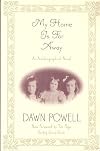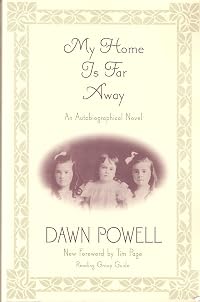
My Home Is Far Away: An Autobiographical Novel
by Dawn Powell
On This Page
Description
Fiction. Literature. HTML:My Home is Far Away is the most precisely autobiographical of Powell’s fifteen novels. In this family chronicle set in early twentieth century Ohio, young Marcia Willard’s family struggles to keep up with the rapidly changing times, and Marcia endures disillusionment, cruelty, and betrayal to forge a survivor’s sense of independence. John Updike has compared Powell with Theodore Dreiser, Willa Cather, Sherwood Anderson, “and those other Midwestern writers show more who felt something epic in the national shift from rural to urban, from provincial sequestration to metropolitan liberation.” By 1941, when Powell set to work on My Home Is Far Away, she was better known for the smart, boozy, bawdy, hilarious send-ups of Manhattan high and low life. She had begun to attain a reputation for high sophistication and nothing could be less “sophisticated” – in the glittering, all-knowing, furiously present-tense, big-city manner Powell had perfected – than My Home Is Far Away.This was the month of cherries and peaches, of green apples beyond the grape arbor, of little dandelion ghosts in the grass, of sour grass and four-leaf clovers, of still dry heat holding the smell of nasturtiums and dying lilacs. This was the best month of all and the best day. It was not birthday, Easter, Christmas, or picnic, but all these things and something else, something wonderful, something utterly unknown. The two little girls in embroidered white Sunday dresses knew no way to express their secret joy but by whirling each other dizzily over the lawn crying, “We’re moving, we’re moving! We’re moving to London Junction!”
My Home Is Far Away is one of the very few examples of a book written for adults, with an adult command of the language, that maintains the vantage point of a hungry, serious child throughout. It might be likened to a memoir that has been penned not with the usual tranquility of distance but rather with the sense that everything happening to the characters is happening right now, without any promise of eventual escape, without any assurance that childhood, too, shall pass away.
My Home is Far Away had been out of print for sixty years when Steerforth reissued it in 1995. It received immediate widespread acclaim, and was featured on the cover of the New York Times Book Review, where Terry Teachout called it “one of the permanent masterpieces of childhood, comparable with David Copperfield, What Maisie Knew and the early reminiscences of Colette,” and where he proclaimed Powell to be “one of this country’s least recognized great novelists.”. show less
Tags
Recommendations




















Member Recommendations
Lum by Libby Ware
by susanbooks
susanbooks Two families so far apart in culture and time but so alike in their callous neglect
Member Reviews
This is Dawn Powell's semiautobiographical novel. She was the middle of three sisters, born and raised in small Ohio towns, in the early part of the 20th century. Much of the mindcast of these people is familiar to me, born as I was in the Midwest in the middle of the 20th century. They are monochrome people, without culture, monolingual, and not open to change, much like Trumplodytes.
Their mother died of tuberculosis when they were young girls and their mujeriego, travelling salesman father refused to support them and take care of them, dumping them here and there, with relatives, in various hotels, until their welcome was worn out. Running around with various women like a slut, the father ultimately married a woman who treated the show more girls viciously, making sure they knew they were constantly punished, never allowed to have any possessions, never to have any clothes but rags. This story is heartbreaking, but her tragic childhood gave Dawn Powell a rich source of inspiration from which to create her works. show less
Their mother died of tuberculosis when they were young girls and their mujeriego, travelling salesman father refused to support them and take care of them, dumping them here and there, with relatives, in various hotels, until their welcome was worn out. Running around with various women like a slut, the father ultimately married a woman who treated the show more girls viciously, making sure they knew they were constantly punished, never allowed to have any possessions, never to have any clothes but rags. This story is heartbreaking, but her tragic childhood gave Dawn Powell a rich source of inspiration from which to create her works. show less
This was a good read, and sad. I didn't know very much about this author until a friend recommended this book; apparently she was much more well known for her humor/satire writing. This book is an autobiographical novel about her childhood in Ohio, early in the 20th century, which was primarily shaped by her deadbeat father and his antics.
It's a really neat snapshot of daily life during this time (for BT folks, she's almost an exact contemporary of MHL) and Powell creates great little character sketches of just about everyone, even the most minor people in the story. She can really create a scene out of almost nothing, it's impressive.
A lot of it is HARD to read, though -- some of the father's exploits are presented almost humorously, show more or at least sardonically, but knowing the book is a fairly close autobiography makes it hard to take too lightly. I got the feeling the author herself looked back at some of the episodes with more of a wry "eh, whata ya gonna do? attitude, but still, difficult to read in parts, even knowing that the protagonist grew up and had a generally successful independent life (from what little I know). show less
It's a really neat snapshot of daily life during this time (for BT folks, she's almost an exact contemporary of MHL) and Powell creates great little character sketches of just about everyone, even the most minor people in the story. She can really create a scene out of almost nothing, it's impressive.
A lot of it is HARD to read, though -- some of the father's exploits are presented almost humorously, show more or at least sardonically, but knowing the book is a fairly close autobiography makes it hard to take too lightly. I got the feeling the author herself looked back at some of the episodes with more of a wry "eh, whata ya gonna do? attitude, but still, difficult to read in parts, even knowing that the protagonist grew up and had a generally successful independent life (from what little I know). show less
This story begins with 3 happy little girls growing up in rural Ohio at the turn of the last century. Then their mother dies. There is no family near to care for them. Their father loves them & does the best he can, but he prefers the role of swinging salesman rather than that of father. They are sent to their grandmother who lives in a boarding house in Cleveland, She, too, prefers the swinging style of the new 20th century & the little girls are more or less on their own. When school authorities intervene, they are put on a train & sent back to their father. The father then does what countless men before him have done, saddled with the responsibility of 3 small children, he looks around for the first available woman & marries her.
The show more result is a disaster. Though the woman manages to assume an outward appearance of middle class respectability, she does not care for children & considers them as barriers to the wedded bliss she had looked forward to with their father. The father has finally become financially sucessful in his traveling salesman enterprises, but his children receive no benefits from their higher standard of living.
Dawn Powell, the author of "My home is far Away" has admitted that this is an autobiographical novel. At the time of its publication in 1944, Ms. Powell was famous for her witty, sophisticated
stories published in magazines like the
NEW YORKER>. Diana Trilling once said of her "Who really says the funny things for which Dorothy Parker gets credit?"
Though far from a sophisticated story, "My home is far away" contains a great deal of humor. It also made me cry. Yet when the children's situation seemed hopeless & there were no relatives able to help them, the older daughters were able, by their own inner strength to save themselves. it is this development of this inner strength that Dawn Powell reveals & that make the characters & their story so real. It is not a sentimental tale. It is told with a realism that while standard today was rare for 1944. Ms. Powell has changed the names of her characters, but the situations were real enough to be recognizable to readers of the book. After its publication, she returned to her more sophisticated style, which seemed to be what her readers (& also her agent & editor) preferred Most of her work is now out of print, but a revival of interest lead to the re-printing of "My Home is Far Away" in 1995 & also 2 of her other novels & a collection of short stories. Dawn Powell spent most of her life in New York City where she died in 1965. show less
The show more result is a disaster. Though the woman manages to assume an outward appearance of middle class respectability, she does not care for children & considers them as barriers to the wedded bliss she had looked forward to with their father. The father has finally become financially sucessful in his traveling salesman enterprises, but his children receive no benefits from their higher standard of living.
Dawn Powell, the author of "My home is far Away" has admitted that this is an autobiographical novel. At the time of its publication in 1944, Ms. Powell was famous for her witty, sophisticated
stories published in magazines like the
NEW YORKER>. Diana Trilling once said of her "Who really says the funny things for which Dorothy Parker gets credit?"
Though far from a sophisticated story, "My home is far away" contains a great deal of humor. It also made me cry. Yet when the children's situation seemed hopeless & there were no relatives able to help them, the older daughters were able, by their own inner strength to save themselves. it is this development of this inner strength that Dawn Powell reveals & that make the characters & their story so real. It is not a sentimental tale. It is told with a realism that while standard today was rare for 1944. Ms. Powell has changed the names of her characters, but the situations were real enough to be recognizable to readers of the book. After its publication, she returned to her more sophisticated style, which seemed to be what her readers (& also her agent & editor) preferred Most of her work is now out of print, but a revival of interest lead to the re-printing of "My Home is Far Away" in 1995 & also 2 of her other novels & a collection of short stories. Dawn Powell spent most of her life in New York City where she died in 1965. show less
Un romanzo bello e commovente ispirato alle vicende autobiografiche dell'autrice. E' un'opera che offre il genuino punto di vista di una bambina arrabbiata col mondo, col destino e con gli adulti che sacrificano il diritto dei figli a sognare, giocare, crescere, imparare. Ambientata in Ohio all'inizio del novecento, la vicenda della famiglia Villard è una storia di dissoluzione degli affetti ma soprattutto è la testimonianza di come sia complicato e doloroso scoprire il mondo degli adulti.
L'autrice è stata una delle più grandi scrittrici americane del Novecento, da poco fortunatamente riscoperta. La sua vita somiglia ad una fiaba: nata nel 1896 in una piccola cittadina dell'Ohio, era seconda di tre sorelle e a sette anni perde la show more madre, che muore ad un tentativo di aborto. La seconda moglie del padre, un commesso viaggiatore alcolizzato, è una donna disturbata psichicamente, che nutre astio per le tre ragazze. Dawn si rifugia nella lettura, preadolescente legge addirittura Schopenhauer, sogna e scrive. La matrigna trova i suoi primi scritti e li brucia, questo atto di crudeltà insieme alle tante altre vessazioni spinge Dawn a fuggire di casa e va a vivere a Shelby da una zia. Dopo anni di impegno e sofferte speranze ottiene una borsa di studio al Lake Erie College for Women. Da quel momento niente fermerà più la giovane che diventa un'affermata scrittrice. Gore Vidal l'ha definita “la nostra migliore scrittrice della seconda metà del secolo” . show less
L'autrice è stata una delle più grandi scrittrici americane del Novecento, da poco fortunatamente riscoperta. La sua vita somiglia ad una fiaba: nata nel 1896 in una piccola cittadina dell'Ohio, era seconda di tre sorelle e a sette anni perde la show more madre, che muore ad un tentativo di aborto. La seconda moglie del padre, un commesso viaggiatore alcolizzato, è una donna disturbata psichicamente, che nutre astio per le tre ragazze. Dawn si rifugia nella lettura, preadolescente legge addirittura Schopenhauer, sogna e scrive. La matrigna trova i suoi primi scritti e li brucia, questo atto di crudeltà insieme alle tante altre vessazioni spinge Dawn a fuggire di casa e va a vivere a Shelby da una zia. Dopo anni di impegno e sofferte speranze ottiene una borsa di studio al Lake Erie College for Women. Da quel momento niente fermerà più la giovane che diventa un'affermata scrittrice. Gore Vidal l'ha definita “la nostra migliore scrittrice della seconda metà del secolo” . show less
Mar 24, 2017Italian
Ratings
Members
- Recently Added By
Author Information

30+ Works 3,156 Members
Work Relationships
Is contained in
Common Knowledge
- Canonical title*
- La mia casa è lontana
- People/Characters
- Marcia Willard; Lena Willard; Harry Willard; Daisy Reed Willard; Idah Hawkins Turner Willard
- Dedication
- For my cousin, Sergeant Jack F. Sherman
- First words
- This was the month of cherries and peaches, of green apples beyond the grape arbor, of little dandelion ghosts in the grass, of sour grass and four-leaf clovers, of still dry heat holding the smell of nasturiums and dying lil... (show all)acs.
- Canonical DDC/MDS
- 813.54
- Canonical LCC
- PS3531.O936
- Disambiguation notice
- Caution: ISBN 3890291066 is used at /work/13215713 and /work/84290
Or, in other words: Don't combine this... (show all) work with Soul Kiss.
*Some information comes from Common Knowledge in other languages. Click "Edit" for more information.
Classifications
Statistics
- Members
- 167
- Popularity
- 196,499
- Reviews
- 4
- Rating
- (4.19)
- Languages
- English, German, Italian
- Media
- Paper, Ebook
- ISBNs
- 5
- ASINs
- 3