On This Page
Description
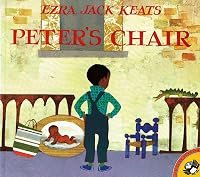
When Peter discovers his blue furniture is being painted pink for a new baby sister, he rescues the last unpainted item, a chair, and runs away.Tags
Recommendations






Member Reviews
Pete has a new baby sister . . . her name is Susie. And Pete is not sure he is happy about it. His parents painted his cradle, his high chair, and his crib pink for Susie. Now they’re going to paint his chair. So Pete grabs it and runs to his room.
Then Pete and his dog, Willie, run away.
What will happen when Pete’s parents discover that both Pete and Willie are gone?
Colorful illustrations highlight this gentle tale, a story many young readers will relate to and will readily empathize with Pete’s frustrations. It’s a perfect platform for a discussion between parent and child, reminding them that a new baby does not take the place of the older child.
The targeted audience, young readers ages three through seven [preschool through show more second grade], are sure to relate to Pete’s feelings. Ostensibly, the story is about Pete's sibling rivalry, but, in truth, it speaks more to Pete’s feelings about change and his baby sister than it does to any sense of rivalry. Some readers may cringe at what many consider the gender stereotype of Pete’s furniture being blue and then painted pink for Susie, but young readers are likely to be accepting of this as the norm in their world. This charming story is a sweet tale of love and accommodation and family.
Young readers will chuckle at Pete’s solution to his problem and the ending is perfect for the telling of this tale.
Highly recommended. show less
Then Pete and his dog, Willie, run away.
What will happen when Pete’s parents discover that both Pete and Willie are gone?
Colorful illustrations highlight this gentle tale, a story many young readers will relate to and will readily empathize with Pete’s frustrations. It’s a perfect platform for a discussion between parent and child, reminding them that a new baby does not take the place of the older child.
The targeted audience, young readers ages three through seven [preschool through show more second grade], are sure to relate to Pete’s feelings. Ostensibly, the story is about Pete's sibling rivalry, but, in truth, it speaks more to Pete’s feelings about change and his baby sister than it does to any sense of rivalry. Some readers may cringe at what many consider the gender stereotype of Pete’s furniture being blue and then painted pink for Susie, but young readers are likely to be accepting of this as the norm in their world. This charming story is a sweet tale of love and accommodation and family.
Young readers will chuckle at Pete’s solution to his problem and the ending is perfect for the telling of this tale.
Highly recommended. show less
PETER'S CHAIR is one of seven other children's books by Ezra Jack Keats that features a little boy named Peter. In this particular story, Peter is struggling with the adjustment of having a new baby sister. He sees that everything that was once his when he was a baby - the cradle, the crib, and the highchair - have all been painted pink for the baby. As Peter becomes very frustrated by this, he notices that his little chair has yet to be painted and he decides to run off with it. While outside his house, hiding the chair from his parents, Peter tries to sit in his chair but realizes that he is too big for it now. In this moment, Peter learns that he doesn't need to keep this little chair because he can no longer use it and in the end he show more offers to help his father paint it pink. Like many of Keats' other books, the illustrations are made from collages, and very colorful and detailed. I like all of the different poses Peter is depicted in; they really help to convey his emotions and thoughts. I think this story can be very relatable to children who have younger, or even older, siblings because sharing is a huge part of life with siblings. This would be a nice story to read out loud in the classroom and then have students depict an object they have difficulty sharing with siblings or friends (if they are an only child). They could draw and color a picture or create a collage picture of the object, mirroring Keats' illustrations. show less
Not sure how I missed this, when I was working through Keats' book for university. I like how Peter is loved, but not coddled; his parents don't make a great big fuss of 'now you're the big brother.' So thanks to Little Free Libraries for passing on these treasures!
---
Reread. I love that Keats is subtle. It takes the reader a bit of time to realize why Peter takes the picture of himself as a baby with him when he runs away. And a bit to understand the game he plays when he goes back home. And of course I love the art. The only thing now is that painting all of Suzie's furniture pink is probably not a great idea. I certainly wouldn't have done it. My babies were raised with yellow & green furnishings, with clothing as gender neutral as I show more could find. (Born in 1985, 88, 96.) show less
---
Reread. I love that Keats is subtle. It takes the reader a bit of time to realize why Peter takes the picture of himself as a baby with him when he runs away. And a bit to understand the game he plays when he goes back home. And of course I love the art. The only thing now is that painting all of Suzie's furniture pink is probably not a great idea. I certainly wouldn't have done it. My babies were raised with yellow & green furnishings, with clothing as gender neutral as I show more could find. (Born in 1985, 88, 96.) show less
I gave this book 5 stars for the story that the book tells. At some pint in every child's life they have to share something that they don't want to. This book reminds me of a time when I had to share my brand new toys with my moms friends kids. I think this book could be used to talk with children about having a sibling come into the family. You could also use this to talk about sharing in the classroom.
This book is about a little boy with a new sibling, and the ways in which the boy copes with his feelings and figures out how to be an older sibling by saying goodbye to his old chair. The illustrations are fantastic with great colors and great patterns and texture. The only thing that bothers me about this story is the fact that all of the boys blue things get painted pink for his new sister, illustrating a strong viewpoint of color and gender representation. However, the overall storyline is relateable, and Ezra Jack Keats was one of the first authors to depict black children as main characters in children’s literature. His stories are great representations of familiar experiences to young children.
This book is so touching. It's easy to sympathize with Peter, I felt his sorrow at seeing all the dear objects of his early childhood transform, as they were given a new purpose, and it makes his change of heart at the end all the more endearing. This book may not have the silent magic of [b:The Snowy Day|310258|The Snowy Day|Ezra Jack Keats|https://d202m5krfqbpi5.cloudfront.net/books/1347624377s/310258.jpg|51286], but it's heartfelt.
A young boy named Peter is adjusting to his parents having a new baby sister. Things become too much for him when he realizes all of his parents attention is focused on the new baby and painting his old furniture pink. They try to include him in preparing the furniture but he doesn't want to because those were HIS things. He takes his chair (which is not yet painted) and runs away. At one point he realizes that he is too big for his chair. When he comes inside for dinner he realizes that he has outgrown some of his old things and that he is growing up. He then offers to help his parents get ready for the baby. I think this is a good concept to touch on with children especially for those who are about to become older siblings, however I show more do think that parents today are for the most part very careful in how they include their first born in preparing for a new baby. I am not sure that this story is "needed" today. show less
Members
- Recently Added By
Published Reviews
ThingScore 100
A more charming or contemporary child than Peter is hard to bring to mind.
added by ArrowStead
Lists

Best children's picture books
377 works; 84 members

Honey For a Child's Heart
1,152 works; 25 members

African American
99 works; 3 members

Children's picture books with kids of color
129 works; 15 members

Reading Rainbow
193 works; 10 members

Children's Books About Babies & Toddlers
69 works; 3 members

Early Picture Books
467 works; 9 members

Recommended Reading List
219 works; 1 member

Written and Illustrated By
805 works; 1 member
Author Information

52+ Works 46,233 Members
Ezra Jack Keats was born Jacob Ezra Katz in Brooklyn, New York on March 11, 1916. He was a mural painter for the Works Progress Administration (WPA) for three years before taking a job as a comic book illustrator. During World War II, he joined the United States Air Corp and was a camouflage pattern designer. After the war, he changed his name to show more make his Jewish heritage less noticeable. He wrote and/or illustrated more than 85 children's books. The first book he illustrated was Jubilant for Sure by Elizabeth Hubbard Lansing, which was published in 1954. The first book he wrote was My Dog is Lost, which was published in 1960. His other works include Pet Show and The Snowy Day, which won a Caldecott Medal in 1963. He was also awarded the University of Southern Mississippi Medallion for outstanding contributions in the field of children's literature in 1980. He died of a heart attack on May 6, 1983. (Bowker Author Biography) show less
Awards and Honors
Series

Work Relationships
Is contained in
Common Knowledge
- Canonical title
- Peter's Chair
- Original publication date
- 1967
- People/Characters
- Peter [Ezra Jack Keats]
- Dedication
- For Joan Roseman
- First words
- Peter stretched as high as he could.
- Last words
- (Click to show. Warning: May contain spoilers.)And they did.
- Original language
- English
- Canonical DDC/MDS
- 813.54
Classifications
Statistics
- Members
- 5,239
- Popularity
- 2,606
- Reviews
- 341
- Rating
- (4.13)
- Languages
- 5 — Chinese, English, French, Spanish, Thai
- Media
- Paper, Audiobook, Ebook
- ISBNs
- 57
- ASINs
- 10