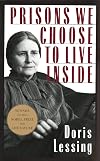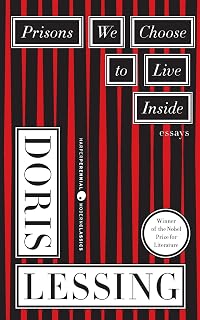
Prisons We Choose to Live Inside
by Doris Lessing
On This Page
Description
"One of the most important writers of the past hundred years." - The Times (London) In this perceptive collection of essays, Doris Lessing addresses directly the prime questions before us all: how to think for ourselves, how to understand what we know, how to pick a path in a world deluged with opinions and information, and how to look at our society and ourselves with fresh eyes.Tags
Recommendations

























Member Reviews
Doris Lessing was born in Persia but raised in Southern Rhodesia, present day Zimbabwe. Her living and witnessing the brutal racism by the white colonialists in Zimbabwe against the black population awakened her activism against colonialism and oppressive structures which in turn influenced her writing. In this series of essays Doris Lessing examines how and why societies revert back to cruelties and authoritarianism after years of progress.
There's a particular description of Margaret Thatcher's campaign that was so shocking to me.
"When Mrs. Thatcher was elected for her second term of office, she employed
Saatchi & Saatchi, a big advertising firm, to handle her campaign. These people
used every trick in the book, from turns of phrase show more calculated to arouse easy
emotions, to the colours of her dresses and the curtains she stood in front of, to
calculated entrances and exits and the use of the media."
Seems eerily familiar? The use of a firm to manipulate the public for political purposes? It was so odd reading these essays and recognising what Lessing had observed and written about in the 80s replicate itself in such a similar manner. Doris Lessing explores "group pressure" and how dangerous it is for a society, the importance of social sciences and history and literature in learning about ourselves and how history repeats itself while guarding ourselves against institutions, governments and groups that may use all this information for ill motives.
A small book but a mind opening read. show less
There's a particular description of Margaret Thatcher's campaign that was so shocking to me.
"When Mrs. Thatcher was elected for her second term of office, she employed
Saatchi & Saatchi, a big advertising firm, to handle her campaign. These people
used every trick in the book, from turns of phrase show more calculated to arouse easy
emotions, to the colours of her dresses and the curtains she stood in front of, to
calculated entrances and exits and the use of the media."
Seems eerily familiar? The use of a firm to manipulate the public for political purposes? It was so odd reading these essays and recognising what Lessing had observed and written about in the 80s replicate itself in such a similar manner. Doris Lessing explores "group pressure" and how dangerous it is for a society, the importance of social sciences and history and literature in learning about ourselves and how history repeats itself while guarding ourselves against institutions, governments and groups that may use all this information for ill motives.
A small book but a mind opening read. show less
A clear-sighted, well-argued plea for individuality of thought in an age of mass emotions and social conditioning.
Doris Lessing has faith in the power of writers to stay detached from these mass emotions and "enable us to see ourselves as others see us." I like the image she gives of writers as a collective organism, constantly evolving but always providing this same crucial function of detached examination of the human condition.
There are some fascinating passages on the way mass emotions are constructed by governments and leaders, for example pointing out how often "blood" is invoked when calling people to war or revolution - this, she says, is a harking back to our long ancestral history of ritual sacrifice, cleansing through blood. show more Also the constant projection of an Enemy to rally people together.
It's refreshing to hear Lessing's account of how often majority opinion has been completely wrong, and the most seemingly unchangeable opinions have changed completely - for example the white minority in the Rhodesia of her childhood thought that their racist regime would last forever, but it didn't. Also in World War Two, Britons revered friendly, pipe-smoking Uncle Joe Stalin, their ally against Hitler, but then a couple of years later he was their worst enemy (I remember my grandmother talking about this as well).
There are lots of fascinating psychological experiments showing how much we will do to agree with authority or with the group - only a small minority (she puts it at 10%) is usually prepared to go against the group opinion, often at great individual cost. She says that all of us are, to some degree, brainwashed by the society we live in, and that "There is nothing much we can do about this except to remember that it is so."
She goes on: "It seems to me that we are being governed by waves of mass emotion, and while they last it is not possible to ask cool, serious questions. One simply has to shut up and wait, everything passes." This reminds me of living in New York through 9/11 and the hugely irrational responses to it. In that time, there were certain things you simply couldn't say.
Lessing gives several examples of this group thinking, from classic psychological experiments (such as the one where people are divided into prisoners and warders, and the warders quickly become sadistic and authoritarian) to the world of literature, where certain writers are praised by everyone, then suddenly fall out of fashion (Lessing herself wrote a couple of novels under a pseudonym to see if they got the same reaction as her other work, and of course they were rejected by her two regular publishers and ignored by the critics).
This book was written in 1987, before the arrival of technologies like the internet. The methods of control and manipulation are surely stronger now than in 1987, but so are the possibilities for resistance. It's easier now to find the information that undercuts official propaganda, or to publish your own individual views, or to connect with other people who dissent from the majority opinion. Not following the herd is a challenge at any time, but, as Lessing says, it's vital:
"Of course, there are original minds, people who do take their own line, who do not fall victim to the need to say, or do, what everyone else does. But they are few. Very few. On them depends the health, the vitality of all our institutions." show less
Doris Lessing has faith in the power of writers to stay detached from these mass emotions and "enable us to see ourselves as others see us." I like the image she gives of writers as a collective organism, constantly evolving but always providing this same crucial function of detached examination of the human condition.
There are some fascinating passages on the way mass emotions are constructed by governments and leaders, for example pointing out how often "blood" is invoked when calling people to war or revolution - this, she says, is a harking back to our long ancestral history of ritual sacrifice, cleansing through blood. show more Also the constant projection of an Enemy to rally people together.
It's refreshing to hear Lessing's account of how often majority opinion has been completely wrong, and the most seemingly unchangeable opinions have changed completely - for example the white minority in the Rhodesia of her childhood thought that their racist regime would last forever, but it didn't. Also in World War Two, Britons revered friendly, pipe-smoking Uncle Joe Stalin, their ally against Hitler, but then a couple of years later he was their worst enemy (I remember my grandmother talking about this as well).
There are lots of fascinating psychological experiments showing how much we will do to agree with authority or with the group - only a small minority (she puts it at 10%) is usually prepared to go against the group opinion, often at great individual cost. She says that all of us are, to some degree, brainwashed by the society we live in, and that "There is nothing much we can do about this except to remember that it is so."
She goes on: "It seems to me that we are being governed by waves of mass emotion, and while they last it is not possible to ask cool, serious questions. One simply has to shut up and wait, everything passes." This reminds me of living in New York through 9/11 and the hugely irrational responses to it. In that time, there were certain things you simply couldn't say.
Lessing gives several examples of this group thinking, from classic psychological experiments (such as the one where people are divided into prisoners and warders, and the warders quickly become sadistic and authoritarian) to the world of literature, where certain writers are praised by everyone, then suddenly fall out of fashion (Lessing herself wrote a couple of novels under a pseudonym to see if they got the same reaction as her other work, and of course they were rejected by her two regular publishers and ignored by the critics).
This book was written in 1987, before the arrival of technologies like the internet. The methods of control and manipulation are surely stronger now than in 1987, but so are the possibilities for resistance. It's easier now to find the information that undercuts official propaganda, or to publish your own individual views, or to connect with other people who dissent from the majority opinion. Not following the herd is a challenge at any time, but, as Lessing says, it's vital:
"Of course, there are original minds, people who do take their own line, who do not fall victim to the need to say, or do, what everyone else does. But they are few. Very few. On them depends the health, the vitality of all our institutions." show less
Nobel Laureate Doris Lessing makes an argument for the importance of individualism in modern society. Her argument that the need for everyone to think critically, to question received knowledge and always be suspicious of peer pressure, unquestioning conformity and internal censorship is as true today as it was in 1986. These were lessons she knows should have been learnt by her own time, but were not and have still not become the norm now. This far I am in agreement and it is all too easy to see examples today. And yet the were several issues that I found very problematic.
It is very much a product of its time and a preoccupation with Cold War politics and communist regimes, while dated, is completely understandable. My issues were show more with other elements. Lessing's idea that her society was "reverting" to a more brutal state relies on a progressive idea of history that jars while at the same time setting up the idea that a better age existed, a fact white she does ruefully admit. As extreme repressive regimes continue to fall away only to repeat in slightly altered form it is difficult to support the idea that such developments are really a reversion to a previous "primitive" state. The very use of such adjectives now causes a wince.
There are also several references to objective observation during her discussion of the role of literature and the social sciences that assume that this is possible when even the "hard"sciences today suggest that all observation not only suffers from bias but even causes it.
Most significantly of all was a balance between the individual and the group that I don't agree with. Groups do have a tendancy towards mass thought, to ready acceptance of the received view and there is always the danger of the "mob" in action and in thought but while new ideas might originate with brave individuals (Akhenaten is a questionable example and her interpretation of his place in Egyptian history troubled me) it is only with support of a group, however small this may be at the start, that these can have real impact.
Lessing had, of course, seen plenty of horrific examples of the dark side of dogmatic groups, the false patriotism of the First World War, the colonialism of the British Empire, fascist and communist dictatorships from the 1930s onwards and I would in no denigrate her argument with regards to these examples. But one of the results of her personal experience is an overly monolithic and primarily negative view of all mass movements that carries with it it's own problems. Yes, we need to think, we need to question, we need to be aware of ourselves as individuals and we will always need the few who are brave and tireless and unwavering but they in turn will always need the cooperation and support of wider sections of society. show less
It is very much a product of its time and a preoccupation with Cold War politics and communist regimes, while dated, is completely understandable. My issues were show more with other elements. Lessing's idea that her society was "reverting" to a more brutal state relies on a progressive idea of history that jars while at the same time setting up the idea that a better age existed, a fact white she does ruefully admit. As extreme repressive regimes continue to fall away only to repeat in slightly altered form it is difficult to support the idea that such developments are really a reversion to a previous "primitive" state. The very use of such adjectives now causes a wince.
There are also several references to objective observation during her discussion of the role of literature and the social sciences that assume that this is possible when even the "hard"sciences today suggest that all observation not only suffers from bias but even causes it.
Most significantly of all was a balance between the individual and the group that I don't agree with. Groups do have a tendancy towards mass thought, to ready acceptance of the received view and there is always the danger of the "mob" in action and in thought but while new ideas might originate with brave individuals (Akhenaten is a questionable example and her interpretation of his place in Egyptian history troubled me) it is only with support of a group, however small this may be at the start, that these can have real impact.
Lessing had, of course, seen plenty of horrific examples of the dark side of dogmatic groups, the false patriotism of the First World War, the colonialism of the British Empire, fascist and communist dictatorships from the 1930s onwards and I would in no denigrate her argument with regards to these examples. But one of the results of her personal experience is an overly monolithic and primarily negative view of all mass movements that carries with it it's own problems. Yes, we need to think, we need to question, we need to be aware of ourselves as individuals and we will always need the few who are brave and tireless and unwavering but they in turn will always need the cooperation and support of wider sections of society. show less
Prisons We Choose To Live Inside by Doris Lessing 1986
These essays are taken from a series of five lectures given by Doris Lessing under the auspices of the Canadian Broadcasting Company in 1985. The overriding themes of of these lectures are that we do not learn from history, we as a civilization keep repeating the same mistakes, despite being better informed and we fail to take notice of the developing sciences of psychology and anthropology. Lessing makes her case persuasively and asks the questions that continue to baffle some people. Why do we continue to go to war, why do we elect leaders that we know or at least suspect are telling us lies.
“ I think it is sentimental to discuss the subject of war or peace, without acknowledging show more that a great many people enjoy war - not only the idea of it but the fighting itself……… people who have lived through a war know that as it approaches, an at first secret, unacknowledged, elation begins, as if an almost invisible drum is beating……….an awful, illicit, violent excitement is abroad….. everyone is possessed by it.”
“ We have now reached the stage where a political leader not only uses, skilfully, time-honoured rabble rousing tricks - see Shakespeare's Julius Caesar - but employ experts to make it even more effective. But the antidote is that, in an open society, we may also examine these tricks being used on us. If, that is, we choose to examine them”
My favourite of the five short essays (they are all good) is her one on Group Minds: nothing scientific here and nothing particularly new but she gets across her points as to how difficult it is to stand apart from the majority, whether it is a social group, an income level group, or even a protest movement. How easy it is to be carried along by emotions instead of examining the evidence at hand in the light of reason.
The Wind Blows Away our Words by Doris Lessing 1987
This is reportage and stories following Lessing’s trip to Peshawar and Chitral in Pakistan in 1986. She had for some time been involved in the Resistance to the Russian invasion of Afghanistan through the aid organisation Afghan Relief. Peshawar in Northern Pakistan is as near as many people could get to the front line resistance in Afghanistan and was at that time the home to a huge number of refugees. She got to interview some of the leaders of the Muhjahadin, but her primary focus in this extended essay is the plight of the refugees, particularly the women, who having fled the bombing found themselves imprisoned in camps where their freedom was curtailed by the rising power of the Mullahs
She bemoans the fact that the Russian invasion of Afghanistan and the plight of the refugees received little coverage in the Western press; famine in Africa was much higher in the list of priorities, in spite of the fact that there were an estimated five million Afghan refugees and over a million civilians killed by the Russians.
There is no doubt that Lessing had points to make from her own perspective, but I see them as particularly valid. I had stayed in Peshawar and Chitral ten years earlier and had spent a little time in Afghanistan as well staying in the same hotels that Lessing was reporting from and so her descriptions of the towns and villages brought them back vividly to life. I have no reason to doubt that her descriptions of the border regions on the edge of conflict are no less accurate.
Both of these collections of essays are well worth reading, 4 stars. show less
These essays are taken from a series of five lectures given by Doris Lessing under the auspices of the Canadian Broadcasting Company in 1985. The overriding themes of of these lectures are that we do not learn from history, we as a civilization keep repeating the same mistakes, despite being better informed and we fail to take notice of the developing sciences of psychology and anthropology. Lessing makes her case persuasively and asks the questions that continue to baffle some people. Why do we continue to go to war, why do we elect leaders that we know or at least suspect are telling us lies.
“ I think it is sentimental to discuss the subject of war or peace, without acknowledging show more that a great many people enjoy war - not only the idea of it but the fighting itself……… people who have lived through a war know that as it approaches, an at first secret, unacknowledged, elation begins, as if an almost invisible drum is beating……….an awful, illicit, violent excitement is abroad….. everyone is possessed by it.”
“ We have now reached the stage where a political leader not only uses, skilfully, time-honoured rabble rousing tricks - see Shakespeare's Julius Caesar - but employ experts to make it even more effective. But the antidote is that, in an open society, we may also examine these tricks being used on us. If, that is, we choose to examine them”
My favourite of the five short essays (they are all good) is her one on Group Minds: nothing scientific here and nothing particularly new but she gets across her points as to how difficult it is to stand apart from the majority, whether it is a social group, an income level group, or even a protest movement. How easy it is to be carried along by emotions instead of examining the evidence at hand in the light of reason.
The Wind Blows Away our Words by Doris Lessing 1987
This is reportage and stories following Lessing’s trip to Peshawar and Chitral in Pakistan in 1986. She had for some time been involved in the Resistance to the Russian invasion of Afghanistan through the aid organisation Afghan Relief. Peshawar in Northern Pakistan is as near as many people could get to the front line resistance in Afghanistan and was at that time the home to a huge number of refugees. She got to interview some of the leaders of the Muhjahadin, but her primary focus in this extended essay is the plight of the refugees, particularly the women, who having fled the bombing found themselves imprisoned in camps where their freedom was curtailed by the rising power of the Mullahs
She bemoans the fact that the Russian invasion of Afghanistan and the plight of the refugees received little coverage in the Western press; famine in Africa was much higher in the list of priorities, in spite of the fact that there were an estimated five million Afghan refugees and over a million civilians killed by the Russians.
There is no doubt that Lessing had points to make from her own perspective, but I see them as particularly valid. I had stayed in Peshawar and Chitral ten years earlier and had spent a little time in Afghanistan as well staying in the same hotels that Lessing was reporting from and so her descriptions of the towns and villages brought them back vividly to life. I have no reason to doubt that her descriptions of the border regions on the edge of conflict are no less accurate.
Both of these collections of essays are well worth reading, 4 stars. show less
Great rationale to question personal and social belief systems and the tension between the primitive and social being.
A collection of five lectures given in 1985. Drawing from politics, literature, social thought, religion and history, Doris Lessing draws a portrait of the extraordinary contradictions of modern society.
Some favorite quotes:
Against these enormously powerful primitive instincts, we have this: the ability to observe ourselves from other viewpoints. (4)
I think novelists perform many useful tasks for their fellow citizens, but one of the most valuable is this: to enable us to see ourselves as others see us. (7)
Novels should be on the same shelf with anthropology, says one friend of mine, an anthropologist. Writers comment on the human condition, talk about it continually. It is our subject. Literature is one of the most useful ways we have of achieving this “other eye,” this detached manner of seeing ourselves; history is another. Yet literature and history increasingly are not seen like this by the young, as indispensable tools for show more living . . . but I’ll come back to this later. (8)
… The sentimentalities with which we all shield ourselves from the horrors of which we are capable… (9)
I think it is sentimental to discuss the subject of war, or peace, without acknowledging that a great many people enjoy war –not only the idea of it, but the fighting itself. (9)
It was evident that the actual combatants on both sides, both blacks and whites, had thoroughly enjoyed the war. It was a fighting that demanded great skill, individual bravery, initiative, resourcefulness –the skills of a guerrilla, talents that through a long peace-time life may never have been called in to use. Yet people may suspect they have them, and secretly long for an opportunity to show them. This is not the least of the reasons, I believe, that wars happen.
These people, black and white, men and women, had been living in that extreme of tension, alertness, danger, with all their capacities in full use. I heard people say that nothing could ever come up to that experience. (11)
It is by now of course a cliché that political movements and religious movements behave alike. (25)
… It is not possible for the Church –as was the case till only yesterday, historically speaking –to dominate a whole society as the sole arbiter of conduct and thought. But for two thousand years Europe was under a tyrant –the Christian church –which allowed no other way of thinking, cut off all influences from outside, did not hesitate to kill, extirpate, persecute, burn and torture in the name of God. To remember this history is not for the sake of keeping alive the memories of old tyrannies, but to recognize present tyranny, for these patterns are in a still. It would be strange if they were not.
It is these patterns that I believe we should study, become conscious of, and recognize as they emerge in us and in the societies we live in. (25-26)
It is the heritage of the structure of Christian thought in us that we should study. (26)
Every one of us is part of the great comforting illusions, and part illusions, which every society uses to keep up its confidence in itself. These are hard to examine, and the best we can hope for is that a kindly friend from another culture will enable us to look at our culture with dispassionate eyes. (33)
Of course, if you are a member of a group that by its own definition is right, good and true, with all the complacent attitudes that go with this –such as that one’s opponents are evil –then of course it is hard to stand aside, hard to take that necessary step upwards on the ladder into objectivity. (39)
We are group animals still, and there is nothing wrong with that. But what is dangerous is not the belonging to a group, or groups, but not understanding the social laws that govern groups and govern us. (48)
This “inner censorship” is what the psychologists call “internalizing” an exterior pressure –such as a parent –and what happens is that a previously resisted and disliked attitude becomes your own. (56)
… When war starts, countries cannot afford disinterested examination of their behaviour. When a war starts, nations go mad - and have to go mad, in order to survive. (61)
… All types of society produced privileged elites…
Elites, privileged classes, groups better educated than others… This seems to be the stage at which the world is now, or at least, nothing else seems to be visible anywhere. (67)
Suppose we redefine the word “elite,” for our present purposes, too mean any group of people who for any reason are in the possession of ideas that put them ahead of the majority? (68)
To my mind the whole push and thrust and development of the world is towards the more complex, the flexible, the open-minded, the ability to entertain many ideas, sometimes contradictory ones, in one’s mind at the same time. (71-72) show less
Against these enormously powerful primitive instincts, we have this: the ability to observe ourselves from other viewpoints. (4)
I think novelists perform many useful tasks for their fellow citizens, but one of the most valuable is this: to enable us to see ourselves as others see us. (7)
Novels should be on the same shelf with anthropology, says one friend of mine, an anthropologist. Writers comment on the human condition, talk about it continually. It is our subject. Literature is one of the most useful ways we have of achieving this “other eye,” this detached manner of seeing ourselves; history is another. Yet literature and history increasingly are not seen like this by the young, as indispensable tools for show more living . . . but I’ll come back to this later. (8)
… The sentimentalities with which we all shield ourselves from the horrors of which we are capable… (9)
I think it is sentimental to discuss the subject of war, or peace, without acknowledging that a great many people enjoy war –not only the idea of it, but the fighting itself. (9)
It was evident that the actual combatants on both sides, both blacks and whites, had thoroughly enjoyed the war. It was a fighting that demanded great skill, individual bravery, initiative, resourcefulness –the skills of a guerrilla, talents that through a long peace-time life may never have been called in to use. Yet people may suspect they have them, and secretly long for an opportunity to show them. This is not the least of the reasons, I believe, that wars happen.
These people, black and white, men and women, had been living in that extreme of tension, alertness, danger, with all their capacities in full use. I heard people say that nothing could ever come up to that experience. (11)
It is by now of course a cliché that political movements and religious movements behave alike. (25)
… It is not possible for the Church –as was the case till only yesterday, historically speaking –to dominate a whole society as the sole arbiter of conduct and thought. But for two thousand years Europe was under a tyrant –the Christian church –which allowed no other way of thinking, cut off all influences from outside, did not hesitate to kill, extirpate, persecute, burn and torture in the name of God. To remember this history is not for the sake of keeping alive the memories of old tyrannies, but to recognize present tyranny, for these patterns are in a still. It would be strange if they were not.
It is these patterns that I believe we should study, become conscious of, and recognize as they emerge in us and in the societies we live in. (25-26)
It is the heritage of the structure of Christian thought in us that we should study. (26)
Every one of us is part of the great comforting illusions, and part illusions, which every society uses to keep up its confidence in itself. These are hard to examine, and the best we can hope for is that a kindly friend from another culture will enable us to look at our culture with dispassionate eyes. (33)
Of course, if you are a member of a group that by its own definition is right, good and true, with all the complacent attitudes that go with this –such as that one’s opponents are evil –then of course it is hard to stand aside, hard to take that necessary step upwards on the ladder into objectivity. (39)
We are group animals still, and there is nothing wrong with that. But what is dangerous is not the belonging to a group, or groups, but not understanding the social laws that govern groups and govern us. (48)
This “inner censorship” is what the psychologists call “internalizing” an exterior pressure –such as a parent –and what happens is that a previously resisted and disliked attitude becomes your own. (56)
… When war starts, countries cannot afford disinterested examination of their behaviour. When a war starts, nations go mad - and have to go mad, in order to survive. (61)
… All types of society produced privileged elites…
Elites, privileged classes, groups better educated than others… This seems to be the stage at which the world is now, or at least, nothing else seems to be visible anywhere. (67)
Suppose we redefine the word “elite,” for our present purposes, too mean any group of people who for any reason are in the possession of ideas that put them ahead of the majority? (68)
To my mind the whole push and thrust and development of the world is towards the more complex, the flexible, the open-minded, the ability to entertain many ideas, sometimes contradictory ones, in one’s mind at the same time. (71-72) show less
Members
- Recently Added By
Lists

Recommended Election Year Reads
9 works; 1 member

Books Read in 2016
4,666 works; 199 members

Shaykh Hamza's Book Recommendations
439 works; 3 members
Author Information

262+ Works 37,139 Members
Doris Lessing was born in Kermanshah, Persia (later Iran) on October 22, 1919 and grew up in Rhodesia (the present-day Zimbabwe). During her two marriages, she submitted short fiction and poetry for publication. After moving to London in 1949, she published her first novel, The Grass Is Singing, in 1950. She is best known for her 1954 Somerset show more Maugham Award-winning experimental novel The Golden Notebook. Her other works include This Was the Old Chief's Country, the Children of Violence series, the Canopus in Argos - Archives series, and Alfred and Emily. She has received numerous awards for her work including the 2001 Prince of Asturias Prize in Literature, the David Cohen British Literature Prize, and the 2007 Nobel Prize for Literature. She died on November 17, 2013 at the age of 94. (Bowker Author Biography) show less
Series
Belongs to Publisher Series
Common Knowledge
- Canonical title*
- Le prigioni che abbiamo dentro: cinque lezioni sulla libertà
- Original title
- Prisons we choose to live inside
- Original publication date
- 1987
*Some information comes from Common Knowledge in other languages. Click "Edit" for more information.
Classifications
Statistics
- Members
- 488
- Popularity
- 62,053
- Reviews
- 9
- Rating
- (3.62)
- Languages
- 8 — Catalan, Dutch, English, Estonian, French, Italian, Portuguese, Spanish
- Media
- Paper, Audiobook, Ebook
- ISBNs
- 22
- ASINs
- 4