On This Page
Description
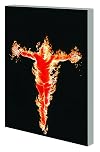
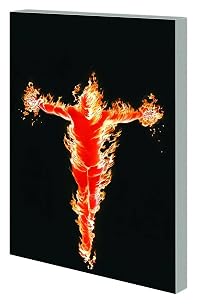
The Torch is dead--buried with full military honors. But what does death mean for an artificial man? The Mad Thinker is determined to find out, with the reluctant help of the Torch's best and oldest friend--Tom (Toro) Raymond. COLLECTING: The Torch #1-8Tags
Recommendations
Member Recommendations


Member Reviews
Although the book does play heavily off the themes of Avengers/Invaders, and relies on the reader having a fairly good grasp of the characters and relationships involved (knowing Toro's history is a major plus), it is still a fairly self-contained story and a great read.
The Human Torch doesn't feature terribly often, so it was a pleasant surprise to find out that the character would be getting his own miniseries. It was an even bigger surprise that the story was well-done and genuinely entertaining. (The Torch had always been a character that writers could never agree on a purpose for.) For a Golden Age fan, seeing the Torch and Toro together again would be enjoyment enough, but then to use the series as a way to tie up so many of the show more loose ends that the characters had left over the years was certainly welcome. The series has its weak points, of course -- the Torch finding his humanity again was less a gradual slope than a sheer drop off, and Toro's mother's involvement in Horten's work was touched on but not fully explored... Indeed, the Torch's about-face is so sudden that even Toro comments on it: "Last time we met up, you wouldn't even use my NAME. Now you say you want to HELP me. How does that work?" Still, the good points of the story outweigh the bad. It's a wonderful look at the Torch and Toro's history and relationship, and at the idea of free will and conscience.
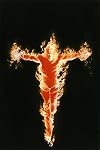
The art is exceedingly well-done, though the style-- specifically the choice to color directly over the pencils --may be off-putting to some. The book, as a whole, feels less rigid than a traditionally-inked book, giving a slightly organic quality to the art -- fitting, in a story about a machine finding his humanity. Berkenkotter keeps all of the characters on-model through a wide variety of scenes and does an excellent job of following Ross' designs and sketches while still expressing his own flare. The Torches are easily distinguishable from one another; a welcome skill when Toro, Jim, and Johnny Storm share panels together. And the battle scenes are easy to follow while not lacking excitement. A bonus to buying the trade over the loose single issues are the full-page covers that sit before each "chapter." Ross' renditions of the Torches are always spectacular, and they are even more enjoyable when not hidden behind a title and corner box. In addition, the trade has a few pages of Ross' sketches at the end, including some very nice studies of Toro.
All in all, very much worth the cover price, and a great way to reintroduce two characters that have been somewhat forgotten; the Torch due to misuse, and Toro as simply a Golden Age byline. Hopefully this will be a catalyst for both to firmly set roots in the current MU. show less
The Human Torch doesn't feature terribly often, so it was a pleasant surprise to find out that the character would be getting his own miniseries. It was an even bigger surprise that the story was well-done and genuinely entertaining. (The Torch had always been a character that writers could never agree on a purpose for.) For a Golden Age fan, seeing the Torch and Toro together again would be enjoyment enough, but then to use the series as a way to tie up so many of the show more loose ends that the characters had left over the years was certainly welcome. The series has its weak points, of course -- the Torch finding his humanity again was less a gradual slope than a sheer drop off, and Toro's mother's involvement in Horten's work was touched on but not fully explored... Indeed, the Torch's about-face is so sudden that even Toro comments on it: "Last time we met up, you wouldn't even use my NAME. Now you say you want to HELP me. How does that work?" Still, the good points of the story outweigh the bad. It's a wonderful look at the Torch and Toro's history and relationship, and at the idea of free will and conscience.
The art is exceedingly well-done, though the style-- specifically the choice to color directly over the pencils --may be off-putting to some. The book, as a whole, feels less rigid than a traditionally-inked book, giving a slightly organic quality to the art -- fitting, in a story about a machine finding his humanity. Berkenkotter keeps all of the characters on-model through a wide variety of scenes and does an excellent job of following Ross' designs and sketches while still expressing his own flare. The Torches are easily distinguishable from one another; a welcome skill when Toro, Jim, and Johnny Storm share panels together. And the battle scenes are easy to follow while not lacking excitement. A bonus to buying the trade over the loose single issues are the full-page covers that sit before each "chapter." Ross' renditions of the Torches are always spectacular, and they are even more enjoyable when not hidden behind a title and corner box. In addition, the trade has a few pages of Ross' sketches at the end, including some very nice studies of Toro.
All in all, very much worth the cover price, and a great way to reintroduce two characters that have been somewhat forgotten; the Torch due to misuse, and Toro as simply a Golden Age byline. Hopefully this will be a catalyst for both to firmly set roots in the current MU. show less
The Torch is dead - buried with full military honors. But what does death mean for an artificial man? The Mad Thinker is determined to find out, with the reluctant help of the Torch's best and oldest friend - Tom 'Toro' Raymond.
Picked up in my local comic book store as a retelling of one of the original superheroes. Jimmy Storm from the Fantastic Four (the Human Torch that people are more familiar with) named himself after this character who is an android with the ability to set himself on fire. He's been resurrected by The Mad Thinker, who is trying to dominate the world - naturally - and his best friend Tom has been resurrected along side him.
Both have to confront the modern world, whilst confronting The Torch's demise (The Mad show more Thinker is destroying his cell structure) and deal with the grand children of the original Nazis who have set up a New Berlin in South America stocked with androids.
It's not the most deep or complex of stories - the Mad Thinker and his associates seem to be able to double cross each other with regularity and ease, and the Torch's struggles with human thinking and emotion makes him like Data/Spock but much less engaging.
The graphics are good, Toro looks remarkably like Clark Kent, and situations have to be resolved by using brains as well as brawn. The contacts with the Resistance seem to accept remaining in New Berlin rather easily but.....mid level story for a lazy afternoon read show less
Picked up in my local comic book store as a retelling of one of the original superheroes. Jimmy Storm from the Fantastic Four (the Human Torch that people are more familiar with) named himself after this character who is an android with the ability to set himself on fire. He's been resurrected by The Mad Thinker, who is trying to dominate the world - naturally - and his best friend Tom has been resurrected along side him.
Both have to confront the modern world, whilst confronting The Torch's demise (The Mad show more Thinker is destroying his cell structure) and deal with the grand children of the original Nazis who have set up a New Berlin in South America stocked with androids.
It's not the most deep or complex of stories - the Mad Thinker and his associates seem to be able to double cross each other with regularity and ease, and the Torch's struggles with human thinking and emotion makes him like Data/Spock but much less engaging.
The graphics are good, Toro looks remarkably like Clark Kent, and situations have to be resolved by using brains as well as brawn. The contacts with the Resistance seem to accept remaining in New Berlin rather easily but.....mid level story for a lazy afternoon read show less
Ratings
Members
- Recently Added By
Author Information

231+ Works 9,480 Members
Alex Ross was born in 1968. He attended St. Alban's School in Washington, D.C. and graduated from Harvard University in 1990. It was there that he studied under composer Peter Lieberson and was a D.J. on the classical and underground rock departments of the college radio station. He earned a Harvard A.B. in English summa cum laude for a thesis on show more James Joyce. From the years, 1992-1996, Alex Ross was a music critic at the New York Times. He also wrote for the New Republic, Slate, and The London Review of Books. In 1993 he started contributing to The New Yorker and became a staff writer in 1996. In 2007 his released his first book in the U.S. entitled The Rest is Noise: Listening to the Twentieth Century, a cultural history of music since 1900. This book received widespread crritical praise in the U.S. and earned a National Book Critics Circle Award, a spot on New York Times list of the ten best books of 2007, and a finalist citation for the Pulitzer Prize in general non-fiction. His second book - Listen to This- was published in September 2010. Alex Ross has also received a Holtzbrink fellowship at the American Academy in Berlin. (Bowker Author Biography) show less

683+ Works 38,490 Members
Series


Common Knowledge
- Original publication date
- 2010
- People/Characters
- Toro (Tom Raymond); Human Torch (Jim Hammond | android); Sub-Mariner (Namor McKenzie); Mad Thinker; Reed Richards; Susan Storm Richards (show all 11); Johnny Storm; Benjamin J. Grimm; Betty Brant; Vision (Aarkus); Inhuman Torch
- Important places
- New York, New York, USA; Bolivia
- First words
- On my thirteenth birthday, May 6th, 1939, the German airship Hindenburg caught fire as it tried to dock at Lakehurst, New Jersey.
- Quotations
- Hey, this is great. We kinda had a shortage of people who could catch fire. Now I think we're all good.
- Last words
- (Click to show. Warning: May contain spoilers.)When it works at all.
Classifications
- Genres
- Graphic Novels & Comics, Tween
- DDC/MDS
- 741.5941 — Arts & recreation Drawing & decorative arts Drawing Comic books, graphic novels, fotonovelas, cartoons, caricatures, comic strips History, geographic treatment, biography European British Isles
- LCC
- PN6728 .H84 .T6 — Language and Literature Literature (General) Literature (General) Collections of general literature Comic books, strips, etc.
- BISAC
Statistics
- Members
- 16
- Popularity
- 1,521,348
- Reviews
- 2
- Rating
- (3.90)
- Languages
- English
- Media
- Paper
- ISBNs
- 2