Stein and Hemingway: The Story of a Turbulent Friendship
by Lyle Larsen
On This Page
Description
"This text explores Gertrude Stein's and Ernest Hemingway's friendship, one of the most fascinating and instructive literary associations of the twentieth century. They moved from a mentor/student relationship to a rivalry between artistic peers. Despite fluctuations--of love, jealousy, resentment and name-calling--their association endured due to Stein's weakness for Hemingway and his need for her"--Provided by publisher.Tags
Recommendations











Member Recommendations
Member Reviews
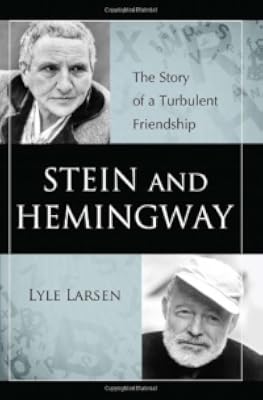
First off, who selected the photos for the cover art for this book? Seriously, it sets the mood immediately: Gertrude Stein looking mean and shrill and Ernest Hemingway with an amiable Dos Equis half-smile, his cap at a jaunty angle. Would I have perceived the book differently had she looked a bit more congenial?
In any case, this is a fascinating read full of gossip and name-dropping of just about every major literary figure in the US and UK in the early 20th century. The book covers more than just the friendship between Stein and Hemingway, as Eliot, Pound, Fitzgerald and others (Picasso!) are interspersed in the stories. Somehow it surprises me to see just how catty and vindictive many of these authors and poets were, especially that show more they seemed to focus a great deal on revealing the faults of each other rather than promoting the writing art.
Stein seems to have all the great lines. In one case, the book explores the numerous times writers came to visit Stein at 27 rue de Fleurus. One night, Ezra Pound stopped by. "Gertrude Stein liked him but did not find him amusing. She said he was a village explainer, excellent if you were a village, but if you were not, not." Ouch! Another night T.S. Eliot shows up: "Eliot and Gertrude Stein had a solemn conversation, mostly about split infinitives and other grammatical solecisms". Stimulating! But when Hemingway came to see her, their conversations and subsequent friendship became a random mixture of mutual admiration and dismissive gestures, mind games and begrudged respect.
Stein's opinion of Hemingway thereafter, and her part in his success is revealed in a conversation she had with Sherwood Anderson. As Larsen writes, "Hemingway had been formed by the two of them, and they were both a little proud and a little ashamed of the work of their minds."
William Carlos Williams got a knock in when he remarked on her endless piles of manuscripts, asking her "are you sure that writing is your metier?....things that children write have seemed to me so Gertrude Steinish in their repetitions." Score WCW. Naturally, she refused to see him again.
Hemingway, once matured and successful on his own, looked at Stein as lazy and disagreeable. He felt that she theorized more than she actually created. He was harsh and overly worked up about a new way she wore her hair, closely cropped, "like a Roman emperor". That her haircut was tied into her sexuality was obvious to Hemingway, and it could that he didn't like this "unambiguous statement of her sexual alignment." In any case, their friendship was pretty much over. As he explains, "But I could never make friends again truly, neither in my heart nor in my head. When you cannot make friends any more in your head is the worst."
Another character in this real-life soap opera is Alice Toklas, Stein's companion and to all accounts, a troublemaker eager to separate Stein from her literary peers. Larsen offers insight into why she may have been so controlling.
It occurred to me that much of the friendship between this pair (as well as the other authors and artists mentioned) was dependent so much on face to face interaction...they made efforts to seek out each other's company, often staying for long periods of time in each other's homes. Alternatively, they'd write extensive letters documenting their thoughts. Given our technological excesses, it makes me wonder if modern authors would even interact in such ways today. Maybe firing off a Facebook post or a Tweet in response to another's work, but does the same 'peer-review' sense of conversation about artistic works still occur? Has globalization made it easier to come together, so much so that everyone takes it for granted and remains distant? show less
In any case, this is a fascinating read full of gossip and name-dropping of just about every major literary figure in the US and UK in the early 20th century. The book covers more than just the friendship between Stein and Hemingway, as Eliot, Pound, Fitzgerald and others (Picasso!) are interspersed in the stories. Somehow it surprises me to see just how catty and vindictive many of these authors and poets were, especially that show more they seemed to focus a great deal on revealing the faults of each other rather than promoting the writing art.
Stein seems to have all the great lines. In one case, the book explores the numerous times writers came to visit Stein at 27 rue de Fleurus. One night, Ezra Pound stopped by. "Gertrude Stein liked him but did not find him amusing. She said he was a village explainer, excellent if you were a village, but if you were not, not." Ouch! Another night T.S. Eliot shows up: "Eliot and Gertrude Stein had a solemn conversation, mostly about split infinitives and other grammatical solecisms". Stimulating! But when Hemingway came to see her, their conversations and subsequent friendship became a random mixture of mutual admiration and dismissive gestures, mind games and begrudged respect.
Stein's opinion of Hemingway thereafter, and her part in his success is revealed in a conversation she had with Sherwood Anderson. As Larsen writes, "Hemingway had been formed by the two of them, and they were both a little proud and a little ashamed of the work of their minds."
William Carlos Williams got a knock in when he remarked on her endless piles of manuscripts, asking her "are you sure that writing is your metier?....things that children write have seemed to me so Gertrude Steinish in their repetitions." Score WCW. Naturally, she refused to see him again.
Hemingway, once matured and successful on his own, looked at Stein as lazy and disagreeable. He felt that she theorized more than she actually created. He was harsh and overly worked up about a new way she wore her hair, closely cropped, "like a Roman emperor". That her haircut was tied into her sexuality was obvious to Hemingway, and it could that he didn't like this "unambiguous statement of her sexual alignment." In any case, their friendship was pretty much over. As he explains, "But I could never make friends again truly, neither in my heart nor in my head. When you cannot make friends any more in your head is the worst."
Another character in this real-life soap opera is Alice Toklas, Stein's companion and to all accounts, a troublemaker eager to separate Stein from her literary peers. Larsen offers insight into why she may have been so controlling.
It occurred to me that much of the friendship between this pair (as well as the other authors and artists mentioned) was dependent so much on face to face interaction...they made efforts to seek out each other's company, often staying for long periods of time in each other's homes. Alternatively, they'd write extensive letters documenting their thoughts. Given our technological excesses, it makes me wonder if modern authors would even interact in such ways today. Maybe firing off a Facebook post or a Tweet in response to another's work, but does the same 'peer-review' sense of conversation about artistic works still occur? Has globalization made it easier to come together, so much so that everyone takes it for granted and remains distant? show less
 This review was written for LibraryThing Early Reviewers.
This is a strangely interesting book, but, of course, Gertrude was at least strange, if not flat-out eccentric. Her word experiments (shades of Ulysses) did for prose what Cubism did for representational art. A sort of ”Do It Yourself” kit for readers, to reassemble into a personal understanding – particularly as she famously claimed she never cared what her “simple and lazy” readers thought of her works – they were, apparently, written only for the enjoyment of “the genius”, herself.
A friendship with Hemingway seems a challenge to comprehension – the original ”macho" man clashing with one of the notorious “pretentious faking bastards”, as he called them, raging, physically fighting and alienating all his show more friends (including Scott Fitzgerald, Archibald MacLeish, Ford Maddox Ford, Pound, Joyce …) while perhaps secretly struggling with his needs to indulge in his fetishisms and ‘feminine side’ as eventually revealed in his Garden of Eden. Once, in discussing her own sexuality Stein claimed she had always thought Hemingway was a “secret homosexual”, and she accused him of being ‘yellow’ in his denial of his softer, more gentle side.
Yet it seems, from Larsen’s deep research, they had a need for each other that lasted from his first meeting with his ‘muse’ in Paris in 1921 (with a letter of introduction from Sherwood Anderson) through many turbulent eruptions to a final attempt at reconciliation in 1944 as “Hem” was liberating Paris with his usual uproarious courage.
Gertrude’s own courage, Larsen explains, was in full evidence as she faced the threat of her Jewishness in Nazi occupied Paris and in her eventual battle with the cancer that killed her. “Do something”, Larsen records her saying to the cancer surgeon” I was not meant to suffer!” Larsen muses that in Hemingway’s suicide there might be seen that type of cowardice of which Stein had accused him. Either and both deaths must grieve readers, who are left wondering what else was to come from these two turbulent friends, but as Hemingway’s autobiographer, A. E. Hotchner records, Ernest thought it was time.
“Hotch, if I cannot live on my own terms then existence is impossible”.
Both Stein and Hemingway certainly lived that way. show less
A friendship with Hemingway seems a challenge to comprehension – the original ”macho" man clashing with one of the notorious “pretentious faking bastards”, as he called them, raging, physically fighting and alienating all his show more friends (including Scott Fitzgerald, Archibald MacLeish, Ford Maddox Ford, Pound, Joyce …) while perhaps secretly struggling with his needs to indulge in his fetishisms and ‘feminine side’ as eventually revealed in his Garden of Eden. Once, in discussing her own sexuality Stein claimed she had always thought Hemingway was a “secret homosexual”, and she accused him of being ‘yellow’ in his denial of his softer, more gentle side.
Yet it seems, from Larsen’s deep research, they had a need for each other that lasted from his first meeting with his ‘muse’ in Paris in 1921 (with a letter of introduction from Sherwood Anderson) through many turbulent eruptions to a final attempt at reconciliation in 1944 as “Hem” was liberating Paris with his usual uproarious courage.
Gertrude’s own courage, Larsen explains, was in full evidence as she faced the threat of her Jewishness in Nazi occupied Paris and in her eventual battle with the cancer that killed her. “Do something”, Larsen records her saying to the cancer surgeon” I was not meant to suffer!” Larsen muses that in Hemingway’s suicide there might be seen that type of cowardice of which Stein had accused him. Either and both deaths must grieve readers, who are left wondering what else was to come from these two turbulent friends, but as Hemingway’s autobiographer, A. E. Hotchner records, Ernest thought it was time.
“Hotch, if I cannot live on my own terms then existence is impossible”.
Both Stein and Hemingway certainly lived that way. show less
This review was written for LibraryThing Early Reviewers.Lyle Larsen’s “Stein and Hemingway: The Story of a Turbulent Friendship” provides an overview of each author’s background before tracing their up and (largely) down relationship. There is an extensive and interesting bibliography and the 186 page work is well sourced. In all, an interesting addition to the large corpus of work on Hemingway, the Lost Generation, and early 20th century culture and literature.
Gertrude Stein, sadly, is less well known to present day readers. As Larsen makes clear, she was convinced utterly of her own genius. To focus merely upon her “A rose is a rose is a rose” is to underestimate her influence and pioneering spirit. Many wouldn’t know but, in addition to her novels and poems, she also wrote show more opera libretti, ballets and children’s books. She was an early collector of Pablo Picasso – among others -- and his portrait of her is rightly famous. Much like her favored modernist artists, she left ‘representational’ writing behind, focusing not on meaning and plot, but on word play (sound, evocations of present sensation.) These theories influenced writers, poets, musicians and artists alike. Those who dislike her work, probably also dislike abstract expressionism or John Cage. Admittedly, her work is difficult to read. I do find her work far more effective when spoken. I recommend searching out recordings of Stein reading her own works on the internet. Stein herself said “You are accustomed to see with your eyes differently to the way you hear with your ears, and perhaps that is what makes it hard to read my works for some people.” As Larsen notes, her contemporaries spoke repeatedly and admiringly about her speaking ability. This is not to say that Stein could not effectively write in more conventional terms. Her “Autobiography of Alice B. Toklas” was, and is, both a critical and commercial success. As noted by Larsen, it was serialized in the Atlantic Monthly and landed on the cover of Time magazine.
Stein herself is seeing a resurgence. As of this writing, an exhibit of her (and the Stein family’s) art has just left San Francisco’s Museum of Modern Art for Paris before finishing at New York’s Metropolitan Museum of Art. Also, “Seeing Gertrude Stein: Five Stories” is presently on view at the Smithsonian Museum, Washington DC.
Of course, Ernest Hemingway is the more well known of the two. Larsen, an English professor and a founding member of the Hemingway Society, knows his stuff. We follow Hemingway through his early years alternately brash, eager and insecure. We follow his rise and mounting success, multiple marriages, endless feuds and slow sad decline. From Larsen’s view, young Hemingway was quite happy to sit at the feet of Stein, participating in her salon and absorbing all she had to share. Conversely, she equally enjoyed her pedantic role shepherding the younger writer. Once Hemingway had a bit of early success, he chafed at the dynamic, leading to the inevitable rupture. There remained a lifetime of sniping and criticism from one to the other. Admittedly, this rupture wasn’t new to either. Stein was known to drop friends, purportedly at Alice Toklas’ instigation. Hemingway, hoping to prove himself when younger, aiming to maintain supremacy when older, lit out on a string of public betrayals and brawls with just about anyone who ever assisted him or advanced his cause.
According to Larsen, Hemingway’s grandiosity was entrenched in insecurity, Stein’s in enormous self-confidence. If criticized, Stein was uncaring – the critics merely misunderstood. Larsen notes that Hemingway cherished grace under pressure, but exhibited little grace under criticism. He bristled under even the most benign of comments and carried grudges due to perceived slights to years’ long extents. His typical reaction to men was to punch their lights out --the pen being mightier than the sword only going so far. Smarting from Stein’s denigration of his later work and questioning his courage, fisticuffs were not an option. He was left to stew and snarl. His snide attack of Stein’s having changed due to “the menopause” was a continual theme. Larsen makes note that other intellectually equal women in his life – his mother and third wife, Martha Gellhorn – get similar treatment.
“Stein and Hemingway’s” back cover heralds Larsen’s use of unpublished material from the Hemingway Collection at the John F. Kennedy Library as shining “new light on this famous friendship.” Larsen does not highlight the new material in his text -- one is left to searching in the footnotes. This is unfortunate. The new material doesn’t break new ground, but is well worth noting. I particularly like the reference to Hemingway’s spoof “The Autobiography of Alice B. Hemingway.”
Both Stein and Hemingway seem to have mellowed as years passed. I like to imagine them both ensconced in some literary Valhalla, laughing, arguing and denigrating this latest crop of authors. Isn’t it pretty to think so? show less
Gertrude Stein, sadly, is less well known to present day readers. As Larsen makes clear, she was convinced utterly of her own genius. To focus merely upon her “A rose is a rose is a rose” is to underestimate her influence and pioneering spirit. Many wouldn’t know but, in addition to her novels and poems, she also wrote show more opera libretti, ballets and children’s books. She was an early collector of Pablo Picasso – among others -- and his portrait of her is rightly famous. Much like her favored modernist artists, she left ‘representational’ writing behind, focusing not on meaning and plot, but on word play (sound, evocations of present sensation.) These theories influenced writers, poets, musicians and artists alike. Those who dislike her work, probably also dislike abstract expressionism or John Cage. Admittedly, her work is difficult to read. I do find her work far more effective when spoken. I recommend searching out recordings of Stein reading her own works on the internet. Stein herself said “You are accustomed to see with your eyes differently to the way you hear with your ears, and perhaps that is what makes it hard to read my works for some people.” As Larsen notes, her contemporaries spoke repeatedly and admiringly about her speaking ability. This is not to say that Stein could not effectively write in more conventional terms. Her “Autobiography of Alice B. Toklas” was, and is, both a critical and commercial success. As noted by Larsen, it was serialized in the Atlantic Monthly and landed on the cover of Time magazine.
Stein herself is seeing a resurgence. As of this writing, an exhibit of her (and the Stein family’s) art has just left San Francisco’s Museum of Modern Art for Paris before finishing at New York’s Metropolitan Museum of Art. Also, “Seeing Gertrude Stein: Five Stories” is presently on view at the Smithsonian Museum, Washington DC.
Of course, Ernest Hemingway is the more well known of the two. Larsen, an English professor and a founding member of the Hemingway Society, knows his stuff. We follow Hemingway through his early years alternately brash, eager and insecure. We follow his rise and mounting success, multiple marriages, endless feuds and slow sad decline. From Larsen’s view, young Hemingway was quite happy to sit at the feet of Stein, participating in her salon and absorbing all she had to share. Conversely, she equally enjoyed her pedantic role shepherding the younger writer. Once Hemingway had a bit of early success, he chafed at the dynamic, leading to the inevitable rupture. There remained a lifetime of sniping and criticism from one to the other. Admittedly, this rupture wasn’t new to either. Stein was known to drop friends, purportedly at Alice Toklas’ instigation. Hemingway, hoping to prove himself when younger, aiming to maintain supremacy when older, lit out on a string of public betrayals and brawls with just about anyone who ever assisted him or advanced his cause.
According to Larsen, Hemingway’s grandiosity was entrenched in insecurity, Stein’s in enormous self-confidence. If criticized, Stein was uncaring – the critics merely misunderstood. Larsen notes that Hemingway cherished grace under pressure, but exhibited little grace under criticism. He bristled under even the most benign of comments and carried grudges due to perceived slights to years’ long extents. His typical reaction to men was to punch their lights out --the pen being mightier than the sword only going so far. Smarting from Stein’s denigration of his later work and questioning his courage, fisticuffs were not an option. He was left to stew and snarl. His snide attack of Stein’s having changed due to “the menopause” was a continual theme. Larsen makes note that other intellectually equal women in his life – his mother and third wife, Martha Gellhorn – get similar treatment.
“Stein and Hemingway’s” back cover heralds Larsen’s use of unpublished material from the Hemingway Collection at the John F. Kennedy Library as shining “new light on this famous friendship.” Larsen does not highlight the new material in his text -- one is left to searching in the footnotes. This is unfortunate. The new material doesn’t break new ground, but is well worth noting. I particularly like the reference to Hemingway’s spoof “The Autobiography of Alice B. Hemingway.”
Both Stein and Hemingway seem to have mellowed as years passed. I like to imagine them both ensconced in some literary Valhalla, laughing, arguing and denigrating this latest crop of authors. Isn’t it pretty to think so? show less
This review was written for LibraryThing Early Reviewers.I have always been interested in Hemingway as a major literary phenomenon of the 20th Century. Indeed his influence has now rolled over into this, the 21st Century. I cannot make the same claim about Gertrude Stein, quite another kind of "phenomenon," a personage who apparently became famous largely due to the strength of her personality. About all I knew of her was the much quoted "a rose is a rose is a rose." Lyle Larsen, in his STEIN AND HEMINGWAY, concentrates on the ups and downs of the "turbulent friendship" between these two people over a span of more than twenty years. An unexpected bonus of this book is the overview he provides of the complete careers and lives of both writers, including Hemingway's four marriages and Stein's show more long-time partner Alice B. Toklas.
What I learned, finally, about Gertrude Stein was not very flattering. Early on in the book she is described as "a megalomaniac ... apparently interested only in people who sit before her and listen." Initially, the young Ernest Hemingway was one of those disciples, a member of that much analyzed "lost generation." Stein is reported to have put her own literary skills on a par with Shakespeare and above Henry James. And yet here is a sample of her writing -
"If a magpie in the sky on the sky can not cry if the pigeon on the grass alas can alas and to pass the pigeon on the grass alas and the magpie in the sky on the sky and to try and to try alas on the grass alas the pigeon on the grass the pigeon on the grass and alas."
I mean, 'HUH?'
Bennet Cerf, whose Random House would become Stein's American publisher, "claimed not to understand a word Stein wrote." Not too surprising, actually. Perhaps a comment made by a young Eric Sevaried about Stein best explained the hold she had over the large coterie of artists and writers that flocked to her feet. He said, "She had the best flow of talk he had ever heard."
Larsen also reveals, by means of a thorough study of Hemingway's papers and other sources, that Hemingway was early on plagued by thoughts of suicide as evidenced in a letter to F. Scott Fitzgerald when he was briefly between marriages -
"He could write Fitzgerald that he was watching his diet and getting plenty of sleep so he could use his head again. He was through with the suicide stuff. 'Have refrained from any half turnings on of the gas or slitting the wrists ...'"
The Hemingway parts were, of course, much more interesting than the Stein sections, at least to me, but Larsen constructed his narrative in a way that their stories continued to arc back together periodically, from their first meeting after WWI to their last, shortly after WWII.
If Stein comes across as pompously deluded about her own writing talents, not to mention slightly ridiculous, Hemingway comes across as blustering, tortured, immature, driven and, finally, just plain sad. After his initial successes, which earned him a Pulitzer and a Nobel, his later works were savaged by the critics. And Hemingway was always very sensitive to criticism. In the end, it may have actually contributed to his tragic death, along with a deepening mental illness and the end of his creative powers.
While concentrating his focus on the relationship between these vastly different personalities, Larsen also manages to give us a thumbnail sketch of Paris in the 20's, 30's and 40's. His research was formidable, as evidenced by the extensive endnotes and bibliography. I have never been able to get all the way through Hemingway's posthumous work on his Paris years, A MOVEABLE FEAST. Larsen's work serves an important function in illuminating those years, and probably not just for me, but for any Hemingway - or Stein - enthusiast. And, just incidentally, in perusing the bibliography I found another nearly forgotten narrative of Paris in the 20's which I plan to read soon - Morley Callaghan's 1963 memoir, THAT SUMMER IN PARIS.
I tried years ago to read other books about Hemingway - Carlos Baker's and A.E. Hotchner's - but never managed to finish them. Lyle Larsen's slim volume, STEIN AND HEMINGWAY, will perhaps be a welcome alternative to those and other overly-long Hemingway biographies. In any case, it will help cement the reputation of Ernest Hemingway, dead now for over fifty years, but still being read and written about. Rest well, Ernie. People will still be reading your books and arguing your merits for another hundred years. I'm not so sure about Gertrude Stein though. show less
What I learned, finally, about Gertrude Stein was not very flattering. Early on in the book she is described as "a megalomaniac ... apparently interested only in people who sit before her and listen." Initially, the young Ernest Hemingway was one of those disciples, a member of that much analyzed "lost generation." Stein is reported to have put her own literary skills on a par with Shakespeare and above Henry James. And yet here is a sample of her writing -
"If a magpie in the sky on the sky can not cry if the pigeon on the grass alas can alas and to pass the pigeon on the grass alas and the magpie in the sky on the sky and to try and to try alas on the grass alas the pigeon on the grass the pigeon on the grass and alas."
I mean, 'HUH?'
Bennet Cerf, whose Random House would become Stein's American publisher, "claimed not to understand a word Stein wrote." Not too surprising, actually. Perhaps a comment made by a young Eric Sevaried about Stein best explained the hold she had over the large coterie of artists and writers that flocked to her feet. He said, "She had the best flow of talk he had ever heard."
Larsen also reveals, by means of a thorough study of Hemingway's papers and other sources, that Hemingway was early on plagued by thoughts of suicide as evidenced in a letter to F. Scott Fitzgerald when he was briefly between marriages -
"He could write Fitzgerald that he was watching his diet and getting plenty of sleep so he could use his head again. He was through with the suicide stuff. 'Have refrained from any half turnings on of the gas or slitting the wrists ...'"
The Hemingway parts were, of course, much more interesting than the Stein sections, at least to me, but Larsen constructed his narrative in a way that their stories continued to arc back together periodically, from their first meeting after WWI to their last, shortly after WWII.
If Stein comes across as pompously deluded about her own writing talents, not to mention slightly ridiculous, Hemingway comes across as blustering, tortured, immature, driven and, finally, just plain sad. After his initial successes, which earned him a Pulitzer and a Nobel, his later works were savaged by the critics. And Hemingway was always very sensitive to criticism. In the end, it may have actually contributed to his tragic death, along with a deepening mental illness and the end of his creative powers.
While concentrating his focus on the relationship between these vastly different personalities, Larsen also manages to give us a thumbnail sketch of Paris in the 20's, 30's and 40's. His research was formidable, as evidenced by the extensive endnotes and bibliography. I have never been able to get all the way through Hemingway's posthumous work on his Paris years, A MOVEABLE FEAST. Larsen's work serves an important function in illuminating those years, and probably not just for me, but for any Hemingway - or Stein - enthusiast. And, just incidentally, in perusing the bibliography I found another nearly forgotten narrative of Paris in the 20's which I plan to read soon - Morley Callaghan's 1963 memoir, THAT SUMMER IN PARIS.
I tried years ago to read other books about Hemingway - Carlos Baker's and A.E. Hotchner's - but never managed to finish them. Lyle Larsen's slim volume, STEIN AND HEMINGWAY, will perhaps be a welcome alternative to those and other overly-long Hemingway biographies. In any case, it will help cement the reputation of Ernest Hemingway, dead now for over fifty years, but still being read and written about. Rest well, Ernie. People will still be reading your books and arguing your merits for another hundred years. I'm not so sure about Gertrude Stein though. show less
This review was written for LibraryThing Early Reviewers.I liked this book, actually more than I thought I would. So much has been written about both Gertrude Stein and Earnest Hemingway that you wonder -- what else could be added. However, I don't know that much about either and in a relatively short book, (186 pages before the end matter), the device of using the context of their friendship provided a lot of insight into both personalities and I ended up learning a lot. For example, I finally figured out where "a rose is a rose is a rose" came from and why it was written that way -- which in itself paid for the book. Another element of surprise was that fundamentally neither Stein nor Hemingway were likable people -- very interesting, but surprisingly distasteful -- an element of the ego show more and vanity that each had (Stein to an amazing degree) and seemed to bring out in each other. I was also amused by how very poor a writer Stein was -- delusional about her own work. For a short work, this was highly informative, did not require any pre-knowledge, full of curiosities, and easy to read. Plus I was encouraged to dig deeper and learn more about Paris of that time, Hemingway, and some of the peripheral characters (learned enough about Stein, however). Well worth a look. show less
This review was written for LibraryThing Early Reviewers.I received a copy of this book from Library Thing as an Early Reviewer in exchange for a review.
Before I read this book, I read Sister Brother: Gertrude & Leo Stein by Brenda Wineapple, The Moveable Feast by Ernest Hemingway and The Paris Wife by Paula McLain and I watched Woody Allen’s Midnight in Paris movie which depicted both these personalities.
Lyle Larsen is an author who brings to life the relationship between two very strong individuals. Because he is an English professor from Santa Monica College and a founding member of the Hemingway Society, we have the pleasure of reading many details about Stein and Hemingway through the 20’s, 30’s, and 40’s that may not have been shared before this book. This concise narrative show more outlines the ups and downs of a very volatile association that moves from mentor-student…to friendship…and then to competitors and adversaries.
In their own way, both supported each other in their writings as well as the publishing of their works. You can sometimes wonder if either would have succeeded, if they didn’t have each other.
Larsen style of writing is easy to read as he chronically a time when American artists were learning their craft in Paris and the years following. He looks at them stretching their wings and understanding how to soar. Larsen looks for reasons why both reached unbelievable heights in different ways and analyzed what each predicted for one another and what turned out to be true. Stein and Hemingway maybe have understood each other better than anyone else did.
Read this book and learn more about the turbulent relationship of two American authors who are still remembered and respected today. show less
Before I read this book, I read Sister Brother: Gertrude & Leo Stein by Brenda Wineapple, The Moveable Feast by Ernest Hemingway and The Paris Wife by Paula McLain and I watched Woody Allen’s Midnight in Paris movie which depicted both these personalities.
Lyle Larsen is an author who brings to life the relationship between two very strong individuals. Because he is an English professor from Santa Monica College and a founding member of the Hemingway Society, we have the pleasure of reading many details about Stein and Hemingway through the 20’s, 30’s, and 40’s that may not have been shared before this book. This concise narrative show more outlines the ups and downs of a very volatile association that moves from mentor-student…to friendship…and then to competitors and adversaries.
In their own way, both supported each other in their writings as well as the publishing of their works. You can sometimes wonder if either would have succeeded, if they didn’t have each other.
Larsen style of writing is easy to read as he chronically a time when American artists were learning their craft in Paris and the years following. He looks at them stretching their wings and understanding how to soar. Larsen looks for reasons why both reached unbelievable heights in different ways and analyzed what each predicted for one another and what turned out to be true. Stein and Hemingway maybe have understood each other better than anyone else did.
Read this book and learn more about the turbulent relationship of two American authors who are still remembered and respected today. show less
This review was written for LibraryThing Early Reviewers.This is very readable account of the friendship of Gertrude Stein and Earnest Hemingway. In the process of chronicling that friendship it provides a good portrait of them both along with a glimpse of the many others who touched their lives. For me, who had read previous biographies of both, I was particularly pleased by the picture of Gertrude which explained her writing objectives, her megalomania, her combative nature, and her appeal. An excellent book.
This review was written for LibraryThing Early Reviewers.Members
- Recently Added By
Author Information
5 Works 32 Members
Lyle Larsen is a professor of English at Santa Monica College and a founding member of the Hemingway Society. He is the author of numerous books and articles.
Common Knowledge
- People/Characters
- Ernest Hemingway; Gertrude Stein
Classifications
- Genres
- Literature Studies and Criticism, Biography & Memoir, Fiction and Literature, Nonfiction
- DDC/MDS
- 818.5 — Literature & rhetoric American literature in English American miscellaneous writings in English 20th Century
- LCC
- PS3537 .T323 .Z694 — Language and Literature American literature American literature Individual authors 1900-1960
- BISAC
Statistics
- Members
- 23
- Popularity
- 1,145,194
- Reviews
- 11
- Rating
- (4.05)
- Languages
- English
- Media
- Paper, Ebook
- ISBNs
- 2