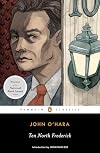
Ten North Frederick
by John O'Hara
On This Page
Description
"The National Book Award-winning novel by the writer whom Fran Lebowitz called "the real F. Scott Fitzgerald". Joe Chapin led a storybook life. A successful small-town lawyer with a beautiful wife, two over-achieving children, and aspirations to be president, he seemed to have it all. But as his daughter looks back on his life, a different man emerges: one in conflict with his ambitious and shrewish wife, terrified that the misdeeds of his children will dash his political dreams, and in love show more with a model half his age. With black wit and penetrating insight, Ten North Frederick stands with Richard Yates' Revolutionary Road, Evan S. Connell's Mr. Bridge and Mrs. Bridge, the stories of John Cheever, and Mad Men as a brilliant portrait of the personal and political hypocrisy of mid-century America"-- show lessTags
Recommendations





















Member Reviews
This turned out to be an absorbing novel that lead me to believe I was reading an author who really knew his stuff. There's the authentic rendition of dialogue to start with; not to mention a convincing familiarity with the workings of the American political machine that bring this novel alive.
The inevitable disappointments that accompany the ambitions for power and status are the meat and bones of this story. The quest for worldly success is always at the mercy of our human failings; and so it goes with this account of one family, that of Edith and Joe Chapin and their two offspring. The story of Joe's best efforts to attain the status he so desires, and Edith's need to exercise some form of control over the enterprise, is O'Hara's show more take on the unseemly side of Twentieth Century well-to-do American society. When it came to social class, furtive sex, alcohol and political manoevering John O'Hara was well placed and informed enough to write about it with some authority. show less
The inevitable disappointments that accompany the ambitions for power and status are the meat and bones of this story. The quest for worldly success is always at the mercy of our human failings; and so it goes with this account of one family, that of Edith and Joe Chapin and their two offspring. The story of Joe's best efforts to attain the status he so desires, and Edith's need to exercise some form of control over the enterprise, is O'Hara's show more take on the unseemly side of Twentieth Century well-to-do American society. When it came to social class, furtive sex, alcohol and political manoevering John O'Hara was well placed and informed enough to write about it with some authority. show less
I came to this novel having seen the 1957 film version and being intrigued with the film and wondering how faithful it was to the novel. I was surprised to find that the core of the film was not the main body of the novel, but only covered the final thirty pages or so. Yet this was no disappointment. I'd not read O'Hara before, but I will read more. This is a rather wonderful novel encompassing decades in the life of the central figure, Joe Chapin, a well-to-do Pennsylvania lawyer. The novel, told in one 390-page chapter and one 18-page one, skips around chronologically, but always fluidly, organically, as if the characters and time periods were taking turns with the story. It is filled with rich characters, some spectacular writing, show more and sometimes that writing reaches the level of magnificence. It is filled with insights into the wealthy of a middling-sized city in the first half of the twentieth century, and some of O'Hara's descriptions of political thought could have been written today. In the end, it made me care deeply about the sort of man one might not particularly care for. It is a real work of art, expressed with a wry poetry and an unblinking eye. show less
Another novel that is a strong mix of what I liked and didn't like. Thus. we end in the middle with three stars. The writing style felt old, out-dated. It reminded me a bit of Booth Tarkington's work, especially The Magnificent Ambersons. It is hard to believe that John O'Hara was a contemporary of Hemingway, Faulkner and Steinbeck. And then there is the subject matter. A white man from a wealthy family who had all of the advantages struggles to achieve his life's dreams. Not very inspiring or appealing.
And yet. Published in 1955, this novel addresses honestly and transparently many of the cultural blemishes and warts of the time: pre-marital sex, the resulting pregnancies and abortions, extramarital affairs by men and women, female as show more compared to male satisfaction from sex, class relations, alcoholism, the advantages of being born into the right family, etc. Politics and business relationships are integral to the story and described intelligently and in detail. It is all here. The writing is quite good, and the dialogue is excellent.
A good read and a great commentary on a part of American society, but stylistically tired and tedious. show less
And yet. Published in 1955, this novel addresses honestly and transparently many of the cultural blemishes and warts of the time: pre-marital sex, the resulting pregnancies and abortions, extramarital affairs by men and women, female as show more compared to male satisfaction from sex, class relations, alcoholism, the advantages of being born into the right family, etc. Politics and business relationships are integral to the story and described intelligently and in detail. It is all here. The writing is quite good, and the dialogue is excellent.
A good read and a great commentary on a part of American society, but stylistically tired and tedious. show less
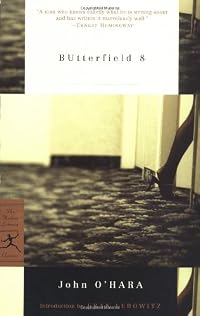
Pretty good book. I always enjoy O'Hara and his Pennsylvania connections and his very accurate portrayal of automobiles of the period about which he is writing. I also liked the opening of the book setting an odd tone for a family's response to a major death in the family and then, the remainder of the book clearing up how such came to be. I also have finally read enough O'Hara to notice that he peppers his books with tiny references to previous books of his, for example, phoning his daughter in NYC at "Butterfield 8" & expostulating on the main character's 'rage to live.' I now have a near complete set of O'Hara's works on my shelves and i look forward to continuing on with them.
The ending really smaltzed it up. It was laughable.
507. Ten North Frederick, by John O'Hara (read 13 Apr 1957) (National Book Award fiction prize for 1956) Not too good.
האיש שרצה להיות נשיא
Mar 21, 2012Hebrew
Members
- Recently Added By
Published Reviews
ThingScore 100
[T]his is the first John O’Hara novel I have read, and I can’t wait to read more, and I can’t wait to get ahold of his short stories and take them slowly, one-by-one, as my friend... has been haranguing for years. Ten North Frederick is, without a doubt, a brilliant book.
added by Shortride
Lists

Publisher's Weekly Bestsellers - Part II - 1940 - 1979
355 works; 5 members

National Book Award - Fiction
78 works; 10 members
Author Information

132+ Works 6,769 Members
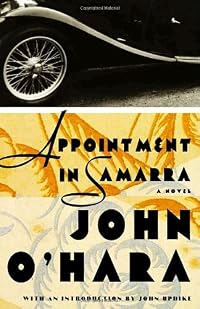
John Henry O'Hara was born in Pottsville, Pennsylvania on January 31, 1905. Many of his novels and short stories were set in fictionally named Pennsylvania towns with the main themes centering on class conflict and status. He began writing for the New Yorker in 1928; and during his life, sold 225 stories to the magazine. His first collection, The show more Doctor's Son and Other Stories (1935) was followed by twelve more. Pal Joey (1940) was made into a Broadway musical by Richard Rodgers and Lorenz Hart and later was adapted into a film starring Frank Sinatra and Rita Hayworth. Some of his published novels include Appointment in Samarra (1934), A Rage to Live (1949), The Lockwood Concern (1965), and The Good Samaritan and Other Stories (published posthumously in 1974). Ten North Frederick (1955) won the National Book Award and Butterfield 8 (1935) and From the Terrace (1958) were adapted into movies in 1960. He died from cardiovascular disease on April 11, 1970. (Bowker Author Biography) show less
Some Editions
Awards and Honors
Awards
Distinctions
Series
Belongs to Publisher Series
Common Knowledge
- Canonical title
- Ten North Frederick
- Original title
- Ten North Frederick
- Original publication date
- 1955
- People/Characters
- Abe Cohen
- Important places
- Gibbsville, Pennsylvania, USA
- Related movies
- Ten North Frederick (1958 | IMDb)
- First words
- Edith Chapin was alone in her sewing room on the third floor of the house at Number 10 in Frederick Street.
- Last words
- (Click to show. Warning: May contain spoilers.)Ingram hesitated. "I'd advise you to send for your son and daughter. You've always been known as a woman of great courage, and that's why I felt free to speak frankly to you."
Classifications
Statistics
- Members
- 331
- Popularity
- 95,628
- Reviews
- 7
- Rating
- (3.73)
- Languages
- English, German, Spanish
- Media
- Paper, Audiobook, Ebook
- ISBNs
- 13
- ASINs
- 23