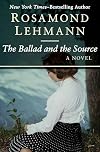
On This Page
Description
A young girl befriends an elderly woman during the First World War in this remarkable novel by one of Britain's best-loved authors Sibyl Jardine, the former best friend of Rebecca Landon's grandmother, has recently returned to the Priory, her home at the top of a hill. Rebecca is instantly drawn in by Sibyl's magnetic personality and blunt, shocking manner. Decades earlier, Sibyl had left her husband Charles for another man and, as a result, lost her daughter Ianthe. Now she is finally about show more to meet her three grandchildren, who will become an integral part of Rebecca's life as she journeys into adolescence. At the heart of this extraordinary novel is the enigma that is Sibyl Jardine: Is she a saint or a sinner? Is she a duplicitous lover or a woman who has been unjustly punished? Played out in a series of conversations between Rebecca, Sibyl Jardine, Jardine's granddaughter Maisie, and a Cockney maid named Tilly, The Ballad and the Source is a tale of perception and memory, passion and betrayal, and the fearsome power of a mother's love. show lessTags
Recommendations











Member Recommendations

KayCliff Characters from The Ballad and the Source reappear in The Sea-Grape Tree.
Member Reviews
"Curious novel" wrote another LT reviewer, the exact words I planned to use. While there is a continuous present for the child/adolescent narrator, Rebecca Landon, what she becomes enthralled by is the life story of her neighbor Mrs. Jardine. We learn who Rebecca is (a future writer, hungry for stories) through the way she listens and what she chooses to focus on and tell us. The setting is pre-ww1 rural England. The Ballad is, of course, Mrs. Jardine's tale of woe (and woeful it is) and the Source is the mysterious personal energy that some people have, magnetism, charisma, whatever you want to call it, that seems to draw both the best and worst out of people. Rebecca's grandmother had a connection with Sibyl Jardine, but it was show more ruptured long ago. When Mrs. Jardine turns up at the neighboring manor house, she wishes her grandchildren to meet Rebecca and her sister and be friends. Rebecca is instantly caught in Mrs. Jardine's web - and an odd web it is - she left her first husband and tiny child, regretted it, and subsequently spent her life trying to get her daughter back. There are, throughout, odd echoes of other writers - Eliot, James, Dickens and a hint of the gothic. Thematically there is a quiet feminist emphasis of the trouble that bored and intelligent but thwarted women used to get themselves into due to lack of choice and opportunity. Also a light-handed look at the spectrum of madness and inheritance and circumstances - clearly Mrs. Jardine has the potential to be mad, but she isn't - and possibly it it is that very madness that is part of what makes her so magnetic. The plot is sufficiently complex that I will leave it be - it's surprising and very deftly done. What makes the novel curious is that Rebecca witnesses almost none of the action, she is the recipient of confidences, from Mrs. Jardine, from her grandmother's retired lady's maid, Tilly, and from Maisie, Mrs. Jardine's grand-daughter and she puts the pieces together bit by bit of the saga. There is a hint of how unseemly it is for a girl of her pleasant and sane background to be so intrigued by such melodrama - but that is the hunger some of us (sometimes especially those of us who do lead 'boring' lives) have for 'stories'. However, the method Lehmann chose doesn't always work - the narrating does, from time to time become a little tedious - Tilly is cockney and I tired of her narration (she reminded me of the tiny woman who made the dolls in Our Mutual Friend...) and I can't think if I've ever read another novel that was entirely narrated in this manner. Nick Carraway narrates a story but he witnessed it all himself. Maisie's narration at the end felt the most gripping and entirely truthful. In this case we are at two removes, having not only to trust Rebecca's rendering but also to figure out what her confidants are telling her and what they are not telling her. The novel is an accomplished and complex piece of writing - and a ripping good yarn at the same time, quite an achievement. **** show less
This is a masterly piece of writing. The Ballad and the Source is the fourth of Rosamond Lehmann’s novels I have read, and I am enormously impressed with it. The story of Sibyl Jardine is told mainly in three long conversations, between Rebecca – who is ten at the start of the novel, and Tilly a sewing maid, Sibyl herself and later Maisie, Sibyl’s grandaughter. Sibyl, both saint and sinner is a fascinating figure. An unhappy marriage leads her to leave her home, and become cut off from her child. The consequences of this are far reaching and tragic. The young Rebecca is drawn to Mrs Jardine, and determined to find out the story of her life. This story takes some years to unfold fully, and as it does Rebecca’s perceptions of Mrs show more Jardine and her story are challenged. The writng is powerful and hugely accomplished. This is in some ways a complex novel, but Rosamond Lehmann’s brilliant writing brings it all together, the story, so much of which is told through dialogue never gets lost among the speech. I found this an enthralling novel, beautifully written. show less
I forgot I had read this before, and even after I realised that, I didn't really remember anything about it. The focus is on Rebecca's fascination with their neighbour Mrs Jardine, who was a friend of her grandmother. What stood out for me most on this reading was the telling of stories of your life to maintain your sense of self. That's what Sybil Jardine does to Rebecca, but it's also there in the stories Rebecca hears from Sybil's granddaughter Maisie.
This a rather odd book. It's the tale of an English gentlewoman, Sybil Jardine, who left her husband and lost her daughter, Ianthe. She goes on to become rather notorious, not only because of her behavior, but also because of semi-autobiographical novels she wrote. The story is told to a young girl, Rebecca Landon, by three narrators: Tilly, an old nursemaid/retainer, and Sybil herself, when Rebecca is ten-years old, and four years later by Rebecca's friend and Sybil's granddaughter, Maisie.
Basically, it's a character study of a woman who lived by the strength of her own lights, regardless of how her behavior affected others. Set in the years prior to WWI, Sibyl cared little for the moral strictures that bound the lives of women. In show more some aspects of Sibyl's life the novel reminded me of the biography, Becoming Modern: The Life of Mina Loy although Sibyl was a generation earlier. I found the book both fascinating and fervid. show less
Basically, it's a character study of a woman who lived by the strength of her own lights, regardless of how her behavior affected others. Set in the years prior to WWI, Sibyl cared little for the moral strictures that bound the lives of women. In show more some aspects of Sibyl's life the novel reminded me of the biography, Becoming Modern: The Life of Mina Loy although Sibyl was a generation earlier. I found the book both fascinating and fervid. show less
The narrator is a woman who is recounting events from her childhood--specifically from the age of ten until approximately fourteen years old. While the story line was interesting, and the writing was good, I could not accept the premise that the woman narrator could have had the conversations that she relates as having happened at the age of ten. I don't accept that the ten-year-old child could have understood and processed the conversations with an elderly woman who shares her most intimate thoughts and experiences with a ten-year-old girl. In portions of the beginning of the novel, the narrator makes clear that she really was a normal child, with childish ideas and perceptions. Then suddenly she carries on adults conversations. It's show more just not plausible. I even went back and reread the first few chapters to make sure that years had not passed.
Compare this to "What Maisie Knew" by Henry James. The point of that excellent novel is that the adults are having mysterious conversations which are at many times incomprehensible to the child Maisie, exactly as the adults want, since they are keeping secrets from her.
I'm not saying that a ten-year-old girl could never have held these conversations, but it so very unlikely that it kept me from accepting the story.
The novel drags in the middle, and then once the children are older teenagers and young adults, there is a long passage where a friend of the narrator tells a compelling story that is worth reading the book in order to reach.
All in all, I'm glad I read the novel. show less
Compare this to "What Maisie Knew" by Henry James. The point of that excellent novel is that the adults are having mysterious conversations which are at many times incomprehensible to the child Maisie, exactly as the adults want, since they are keeping secrets from her.
I'm not saying that a ten-year-old girl could never have held these conversations, but it so very unlikely that it kept me from accepting the story.
The novel drags in the middle, and then once the children are older teenagers and young adults, there is a long passage where a friend of the narrator tells a compelling story that is worth reading the book in order to reach.
All in all, I'm glad I read the novel. show less
Rebecca is fascinated by Mrs Jardine who comes to live in the nearby house with her quiet husband Harry and who had been a friend of her grandmother's until something happened. She gradually finds out more as Mrs Jardine, her grand-daughter Maisie and Tilly who had been a maid of Rebecca's grandmother tell their sides of the stories over the years.
I enjoyed this book.
I enjoyed this book.
This is the only book by Rosamond Lehmann that I haven't been able to get into, the style is too reliant on dialogue - very tedious.
Members
- Recently Added By
Author Information

24+ Works 3,104 Members
Some Editions
Awards and Honors
Distinctions
Series

Belongs to Publisher Series
Common Knowledge
- Canonical title
- The Ballad and the Source
- Original publication date
- 1944
- People/Characters
- Sybil Jardine; Rebecca Landon; Jessica Landon; Major Henry Jardine; Ianthe Herbert; Maisie Thomson (show all 9); Malcolm Thomson; Charity Thomson ("Cherry"); Flora Mackenzie ("Auntie Mack")
- First words
- One day my mother told me that Mrs. Jardine had asked us to pick primroses on her hill.
In 1944, the year that this book was first published, a friend reported to Rosamund Lehmann the reaction she saw it inspire in her fellow-lodger. (Introduction) - Quotations
- [Mrs Jardine says,] `She was a blue stocking, and like all the breed, wished to drive home that desolatingly boring fact'. [The young Narrator comments,] `I dared not interrupt to ask the meaning of this fantastic word'.
- Last words
- (Click to show. Warning: May contain spoilers.)Sybil Jardine returns to share with her another dream, and to take from her a different leave. (Introduction)
(Click to show. Warning: May contain spoilers.)Then someone cried: "Look!" and I looked in terror over my shoulder, and saw under the dark trees a figure folded in a blue cape, faceless, motionless, watching me. - Blurbers
- Mortimer, Raymond
- Original language
- English, UK
Classifications
Statistics
- Members
- 318
- Popularity
- 99,866
- Reviews
- 10
- Rating
- (3.82)
- Languages
- English, French
- Media
- Paper, Ebook
- ISBNs
- 10
- ASINs
- 21