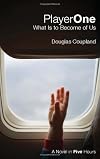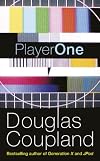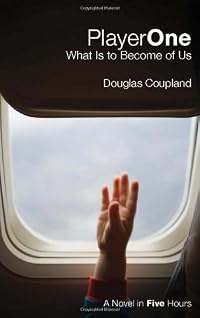
Player One: What Is to Become of Us
by Douglas Coupland
On This Page
Description
Now available in a new edition with a cover designed by the author, Douglas Coupland's CBC Massey Lectures is an innovative exploration of the modern crises of our time.Five disparate people are trapped inside an airport cocktail lounge during a global disaster: Karen, a single mother waiting for her online date; Rick, a down-on-his-luck bartender; Luke, a pastor on the run; Rachel, a cool Hitchcockian blonde incapable of true human contact; and finally a mysterious voice known as Player show more One. Slowly, over the course of the five-hour story, each reveals the truth about themselves while the world as they know it comes to an end.
Acclaimed novelist and visual artist Douglas Coupland probes human identity, society, religion, macroeconomics, and the afterlife in the inventive 2010 CBC Massey Lectures. Asking as many questions as it answers, Player One will leave readers with no doubt that we are in a new phase of existence as a species — and that there is no turning back.
. show less
Tags
Recommendations










Member Recommendations

freetrader Style very similar. Palahniuk more hilaric (not in Snuf, but in Choke e.g.), Coupland more philosophic. While reading it i was sometimes under the impression that i was reading Palahniuk. Are they the same, have they merged into one media event latley ?
02
Member Reviews
For the first part of the book I found myself thinking that this was one of the best Coupland books I had read in a very long time, hearkening back to when he first started publishing. Characters in interesting situations expressing amusing, nuanced, unique, passionate points-of-view about life, relationships, the nature of existence, and society. Eventually in this book the interpersonal dramas shift to terrifying thriller dramas but where actually almost nothing happens. The book is structured where each chapter cycles through the story being told by each of the characters in turn, but Coupland can't really write in different voices very well, so it starts to blend together, and by the end I found myself thinking this is one of the show more worst Coupland books I had ever read, as it becomes basically an essay (theoretically in the voice of one character) that goes on and on with a lot of Big Ideas jammed together. But they aren't interesting ideas or presented compellingly and also hey wait a minute weren't we in a story a minute go so why are we getting this thrown at us. show less
Shortly before I read this book, a co-worker of mine sat down with me in the break room and broke into a pretty heavy conversation. She knows I'm travelling home shortly and considering moving to Victoria in September (I might, I might not, but people like having answers so I tell them stuff like it's certain just to make them stop asking me). It was just me and her and she said, "Okay, I have to talk with you. You are going to Victoria in September. Remember that you probably won't come back." I thought she was going to talk about the allures of island life and West-Coast-best-coast sort of stuff. Instead she started talking about the upcoming food shortages and how I'd fare in Victoria, about oil and how planes will soon no longer be show more an option, how I will be in Victoria for the foreseeable future because travel will become impossible. She told me that she advised another coworker who had recently departed for Australia to get married there as quickly as she could so that she would not have to become politically/financially compromised once returning to Canada became impossible. This was also the day that the Holocene Extinction started trending on Facebook, like it was news and like it was immediate.
And that night I picked up this book. (Once more, the ghost in someone's house. This book was the top of the stack in the spare bedroom and I decided it was waiting for me. I've seen Douglas Coupland's art in Vancouver and always feel like I should read more Canadian authors and I couldn't resist the kind of thievery it feels like when I read a book that isn't mine without asking permission first.)
I can't say I found the book particularly striking. It was okay. I didn't get attached to anybody and I find the set up a little gimmicky ("this hour has 44 pages" until the pattern broke, which was more upsetting), and I had no interest in reading the glossary in the back. But thanks to the conversation with my co-worker, a conversation I knew was totally absurd in a Beckett-ly way, and the themes of this book, there were times I actually forgot the current state of the world and believed in this one instead. I had a moment of thinking, "man, it sucks that I won't be able to fly again after September." (September because that's when I intend to travel on, not because of any other particular event.) I caught myself strategizing how well I'd grow food on my own, what my skills would be in a post-oil society, and how long it would take me to cross the country on horseback if I wanted to return to my home town and family in a time of crisis. (Would Victoria disappear thanks to rising water levels? Or would climate change slow enough that it wouldn't be a concern? Victoria is lush and fertile but I don't know much about agriculture on the island. My home is lush and fertile too, my family are farmers and would provide for each other, but would the land still be arable and productive in this new world?)
As a literature student, I think it would be interesting a hundred years from now to discuss us like we discuss the Victorians. I think of how people would talk about how our literature and film from this time is obsessed with environmental dystopias and population overload. Even right now I want to talk about Interstellar and Kingsman and how at the polar ends of drama and comedy we have the same paranoia about what will become of the earth, and this is another blip in that genre of environmental-- I almost want to say "fear-mongering" but it isn't raising up that fear for a political purpose, it's merely expressing a fear that is persistent and powerful. And then I think, what a luxury, if 100 years from now people are still sitting around in classrooms discussing books from times past. Wouldn't it be great if we got it all wrong? show less
And that night I picked up this book. (Once more, the ghost in someone's house. This book was the top of the stack in the spare bedroom and I decided it was waiting for me. I've seen Douglas Coupland's art in Vancouver and always feel like I should read more Canadian authors and I couldn't resist the kind of thievery it feels like when I read a book that isn't mine without asking permission first.)
I can't say I found the book particularly striking. It was okay. I didn't get attached to anybody and I find the set up a little gimmicky ("this hour has 44 pages" until the pattern broke, which was more upsetting), and I had no interest in reading the glossary in the back. But thanks to the conversation with my co-worker, a conversation I knew was totally absurd in a Beckett-ly way, and the themes of this book, there were times I actually forgot the current state of the world and believed in this one instead. I had a moment of thinking, "man, it sucks that I won't be able to fly again after September." (September because that's when I intend to travel on, not because of any other particular event.) I caught myself strategizing how well I'd grow food on my own, what my skills would be in a post-oil society, and how long it would take me to cross the country on horseback if I wanted to return to my home town and family in a time of crisis. (Would Victoria disappear thanks to rising water levels? Or would climate change slow enough that it wouldn't be a concern? Victoria is lush and fertile but I don't know much about agriculture on the island. My home is lush and fertile too, my family are farmers and would provide for each other, but would the land still be arable and productive in this new world?)
As a literature student, I think it would be interesting a hundred years from now to discuss us like we discuss the Victorians. I think of how people would talk about how our literature and film from this time is obsessed with environmental dystopias and population overload. Even right now I want to talk about Interstellar and Kingsman and how at the polar ends of drama and comedy we have the same paranoia about what will become of the earth, and this is another blip in that genre of environmental-- I almost want to say "fear-mongering" but it isn't raising up that fear for a political purpose, it's merely expressing a fear that is persistent and powerful. And then I think, what a luxury, if 100 years from now people are still sitting around in classrooms discussing books from times past. Wouldn't it be great if we got it all wrong? show less
I really like Coupland's zeitgeist novels. 'Player One' is ostensibly about four people who end up trapped in the bar of an airport-adjacent hotel. In fact, it's about anomie, modernity, normality, and belief. Or rather, it touches upon all those things as each character is allowed their point of view. 'Player One' seems to emphasise that, although in the 21st century we are all expected to be individual and unique, below our surface differences our emotions, experiences, and struggles are curiously similar. It's also a very entertaining drama.
The setting is very astutely chosen. Coupland communicates very effectively the particular depersonalising weirdness of airports and their surroundings. This reminded me of Rem Koolhaas, the most show more entertaining writer on planning that I've ever come across. Koolhaas talks about a 'Generic City' which is essentially just a gigantic airport in design, atmosphere, and function. Quotes: 'The Generic City is the city liberated from the captivity of centre, from the straitjacket of identity [...] The Generic City is what is left after large sections of urban life crossed over into cyberspace [...] The dominant sensation of the Generic City is an eerie calm.'
'Player One' ends with an ironically-toned glossary of terms, only some of which were used in the novel. I liked this feature a lot, although it's hard tell which of the terms Coupland invented and which already existed. (Not that this matters.) I was particularly pleased by these three:
'Capillarigenerative Memory', the tendency of history to remember people who invent new hairstyles such as Caesar and Einstein.
'Dimanchopholia, a fear of unstructured time free of obligations. (Although this is not something I've ever experienced, I know at least two people with chronic cases.)
'Time Snack', the annoying moments of pseudo-leisure created when your computer stops responding.
This glossary is an effective mockery of the 21st century tendency to put a specific term, perhaps to pathologise, every facet of human behaviour and everything about our world. Drowning as we are in instantly accessible information, we've perhaps forgotten how to deal with uncertainty, unknowability, and infinity. If we had such coping mechanisms, that is. Anyhow, this is a good novel and I'm glad I read it. show less
The setting is very astutely chosen. Coupland communicates very effectively the particular depersonalising weirdness of airports and their surroundings. This reminded me of Rem Koolhaas, the most show more entertaining writer on planning that I've ever come across. Koolhaas talks about a 'Generic City' which is essentially just a gigantic airport in design, atmosphere, and function. Quotes: 'The Generic City is the city liberated from the captivity of centre, from the straitjacket of identity [...] The Generic City is what is left after large sections of urban life crossed over into cyberspace [...] The dominant sensation of the Generic City is an eerie calm.'
'Player One' ends with an ironically-toned glossary of terms, only some of which were used in the novel. I liked this feature a lot, although it's hard tell which of the terms Coupland invented and which already existed. (Not that this matters.) I was particularly pleased by these three:
'Capillarigenerative Memory', the tendency of history to remember people who invent new hairstyles such as Caesar and Einstein.
'Dimanchopholia, a fear of unstructured time free of obligations. (Although this is not something I've ever experienced, I know at least two people with chronic cases.)
'Time Snack', the annoying moments of pseudo-leisure created when your computer stops responding.
This glossary is an effective mockery of the 21st century tendency to put a specific term, perhaps to pathologise, every facet of human behaviour and everything about our world. Drowning as we are in instantly accessible information, we've perhaps forgotten how to deal with uncertainty, unknowability, and infinity. If we had such coping mechanisms, that is. Anyhow, this is a good novel and I'm glad I read it. show less
Player One is Douglas Coupland's contribution to the CBC Massey Lectures, in which contributors give a series of five lectures on a specific theme or topic of their choosing. Coupland decided to structure his five lectures as "a novel in five hours" -- the total length of the Massey Lectures -- with the story being told in essentially real time.
The cast of characters is brought together in an airport cocktail lounge. Karen, a recently divorced receptionist, has arrived for a hookup with a man she met on the Internet. Rick, the bartender, is disillusioned with his life and wants to meet noted motivational speaker Leslie Freemont. Luke is a former pastor who lost his faith and that same day absconded with the proceeds of his church's show more building fund. Rachel is a breeder of white mice and has also been diagnosed with high-functioning autism; her reason for coming to the lounge is to meet a man and have a child so that her father will finally consider her an actual human being. And then there's the mysterious Player One. The fates of these characters (and others) are eventually thrown together by an apocalyptic event that forces them to evaluate their lives and their place in the world and the universe.
This book explores some of Coupland's usual themes: modern consumerist society, the implications of technological advances and the state of humanity, the fate of humans as a species (especially in terms of self-inflicted disasters), and the individual versus the collective. Since this was intended to be consumed in a lecture format, it's more about the ideas behind the story than the actual story, but the first four hours at least are quite fascinating. The interlude of Player One at the very end was a bit heavy going for me, but the ideas themselves would warrant a reread.
Within Coupland's oeuvre I would probably compare this to Life After God, in that the story is more of an obvious vehicle for ideas than perhaps some of his other work -- or at least that's how I remember Life After God. It is also similar to Generation X with the "Future Legend", an appendix where Coupland lists terms of his own invention that describe sensations, events and perspectives of modern society. One of my favourite terms was "Fictive Rest", where people can't go to sleep without reading a tiny bit of fiction. "But don't finish your book before going to sleep," the book counsels, otherwise it will keep you awake for hours afterward.
I would recommend this to established fans of Coupland. The audio of the Massey Lectures would be worth listening to as well -- as I recall, Coupland read the main story while someone else would chip in periodically with terms from the "Future Legend" as they appeared in the story. show less
The cast of characters is brought together in an airport cocktail lounge. Karen, a recently divorced receptionist, has arrived for a hookup with a man she met on the Internet. Rick, the bartender, is disillusioned with his life and wants to meet noted motivational speaker Leslie Freemont. Luke is a former pastor who lost his faith and that same day absconded with the proceeds of his church's show more building fund. Rachel is a breeder of white mice and has also been diagnosed with high-functioning autism; her reason for coming to the lounge is to meet a man and have a child so that her father will finally consider her an actual human being. And then there's the mysterious Player One. The fates of these characters (and others) are eventually thrown together by an apocalyptic event that forces them to evaluate their lives and their place in the world and the universe.
This book explores some of Coupland's usual themes: modern consumerist society, the implications of technological advances and the state of humanity, the fate of humans as a species (especially in terms of self-inflicted disasters), and the individual versus the collective. Since this was intended to be consumed in a lecture format, it's more about the ideas behind the story than the actual story, but the first four hours at least are quite fascinating. The interlude of Player One at the very end was a bit heavy going for me, but the ideas themselves would warrant a reread.
Within Coupland's oeuvre I would probably compare this to Life After God, in that the story is more of an obvious vehicle for ideas than perhaps some of his other work -- or at least that's how I remember Life After God. It is also similar to Generation X with the "Future Legend", an appendix where Coupland lists terms of his own invention that describe sensations, events and perspectives of modern society. One of my favourite terms was "Fictive Rest", where people can't go to sleep without reading a tiny bit of fiction. "But don't finish your book before going to sleep," the book counsels, otherwise it will keep you awake for hours afterward.
I would recommend this to established fans of Coupland. The audio of the Massey Lectures would be worth listening to as well -- as I recall, Coupland read the main story while someone else would chip in periodically with terms from the "Future Legend" as they appeared in the story. show less
(Reprinted from the Chicago Center for Literature and Photography [cclapcenter.com]. I am the original author of this essay, as well as the owner of CCLaP; it is not being reprinted illegally.)
As I've been learning over the years now, as I become a greater and greater completist of his work (this is now the tenth book of his I've read, of the fourteen major titles he's now published), Douglas Coupland at his weirdest is usually Douglas Coupland at his best; and there's not much better an example of this than with his latest, the badly titled but hugely compelling Player One: What Is to Become of Us, a Novel in Five Hours, which actually started life literally as a five-hour radio play commissioned by the Canadian Broadcasting show more Corporation and the University of Toronto, part of an annual project known as "The Massey Lectures" which in the past has snagged fellow intellectuals like Margaret Atwood and Noam Chomsky. In this case, it's the story of a series of characters who have all gathered at an airport hotel bar on a random weekday for varying purposes, all of which we discover through the chapters written from various perspectives; so then about halfway through, when a sudden oil panic in the Middle East triggers a massive breakdown in law and order in the US, we then watch these characters react in differing ways to the chaos and bloodshed going on around them, with Coupland using the occasion to very slyly play with various philosophical questions regarding the fundamental nature of humanity.
As you can guess by recent novels like The Gum Thief and Generation A, Coupland doesn't have rosy conclusions to come to in Player One, essentially arguing by the end that humanity brought all of this upon itself and therefore deserves to go through it all (and indeed, will likely come out changed for the better by the end, not despite the mass decimation of the human race but literally because of it); but it's the way he comes to these conclusions that is the fascinating part, delivering what for him is an unusually stripped-down and focused manuscript, the constraints of its radio-performance specs obviously having a good influence on him, forcing him to cut so many of the endless digressions that have marked so many of his recent books. It's a dark story for sure, legitimately disturbing at times in a non-ironic post-apocalyptic-thriller kind of way; but it could be argued that it's also the best thing Coupland has written in at least a decade, depending on what kind of Coupland fan you are and which of his books you gravitate to the most. (If you're a fan of more thoughtful titles like Life After God and Generation X, you'll love this, while if you primarily like his more plot-oriented titles like Microserfs and All Families Are Psychotic, maybe not so much.) In any case, it comes highly recommended today, a quick read that will leave you with all kinds of troubling questions regarding the true nature of the human condition.
Out of 10: 9.7 show less
As I've been learning over the years now, as I become a greater and greater completist of his work (this is now the tenth book of his I've read, of the fourteen major titles he's now published), Douglas Coupland at his weirdest is usually Douglas Coupland at his best; and there's not much better an example of this than with his latest, the badly titled but hugely compelling Player One: What Is to Become of Us, a Novel in Five Hours, which actually started life literally as a five-hour radio play commissioned by the Canadian Broadcasting show more Corporation and the University of Toronto, part of an annual project known as "The Massey Lectures" which in the past has snagged fellow intellectuals like Margaret Atwood and Noam Chomsky. In this case, it's the story of a series of characters who have all gathered at an airport hotel bar on a random weekday for varying purposes, all of which we discover through the chapters written from various perspectives; so then about halfway through, when a sudden oil panic in the Middle East triggers a massive breakdown in law and order in the US, we then watch these characters react in differing ways to the chaos and bloodshed going on around them, with Coupland using the occasion to very slyly play with various philosophical questions regarding the fundamental nature of humanity.
As you can guess by recent novels like The Gum Thief and Generation A, Coupland doesn't have rosy conclusions to come to in Player One, essentially arguing by the end that humanity brought all of this upon itself and therefore deserves to go through it all (and indeed, will likely come out changed for the better by the end, not despite the mass decimation of the human race but literally because of it); but it's the way he comes to these conclusions that is the fascinating part, delivering what for him is an unusually stripped-down and focused manuscript, the constraints of its radio-performance specs obviously having a good influence on him, forcing him to cut so many of the endless digressions that have marked so many of his recent books. It's a dark story for sure, legitimately disturbing at times in a non-ironic post-apocalyptic-thriller kind of way; but it could be argued that it's also the best thing Coupland has written in at least a decade, depending on what kind of Coupland fan you are and which of his books you gravitate to the most. (If you're a fan of more thoughtful titles like Life After God and Generation X, you'll love this, while if you primarily like his more plot-oriented titles like Microserfs and All Families Are Psychotic, maybe not so much.) In any case, it comes highly recommended today, a quick read that will leave you with all kinds of troubling questions regarding the true nature of the human condition.
Out of 10: 9.7 show less
I'm not sure I understood this book, in all honesty. Coupland is asking questions about humanity and society here, delving into themes like the meaninglessness of human existence, the inevitability of death, and what exactly it means to be human. I didn't feel that this was as much a story as it was a framework for him to discuss his ideas. The characters are more like sock puppets with Coupland speaking through them; their conversations easily and frequently turn to philosophical themes and the storyline itself is pretty absurd. My first Coupland book, and most definitely will not be my last!
I haven’t read all of Douglas Coupland’s books, but I’m a fan. I reread Microserfs every few years. I like his work because he doesn’t shy away from the ridiculous in pursuit of the profound. He’s known for capturing (or attempting to capture) the zeitgeist and pushing limits with book design. I suppose I am the target market for his books: I’m a member of the cohort he’s famous for chronicling in his first novel, Generation X.
Not that Coupland sets out to comfort. He definitely doesn’t. His characters are rarely comfortable, and this is usually the point. (This time around, we see them all in a rundown airport cocktail lounge and it’s the end of the world as we know it.) His characters, I suspect, are an excuse to show more hear himself think. Apparently we embrace it because we need the mental break:
"People listening to songs are like people reading novels: for a few minutes, for a few hours, someone else gets to come in and hijack that part of your brain that’s always thinking. A good book or song kidnaps your interior voice and does all the driving. With the artist in charge, you’re free for a little while to leave your body and be someone else."
Yep, same old obsessions, stories and time.
More on blog at http://12frogs.com/reading/reviews/2010/10/player-one/ show less
Not that Coupland sets out to comfort. He definitely doesn’t. His characters are rarely comfortable, and this is usually the point. (This time around, we see them all in a rundown airport cocktail lounge and it’s the end of the world as we know it.) His characters, I suspect, are an excuse to show more hear himself think. Apparently we embrace it because we need the mental break:
"People listening to songs are like people reading novels: for a few minutes, for a few hours, someone else gets to come in and hijack that part of your brain that’s always thinking. A good book or song kidnaps your interior voice and does all the driving. With the artist in charge, you’re free for a little while to leave your body and be someone else."
Yep, same old obsessions, stories and time.
More on blog at http://12frogs.com/reading/reviews/2010/10/player-one/ show less
Members
- Recently Added By
Published Reviews
ThingScore 50
The way Coupland moulds his fiction from the throwaway debris of North American popular culture is quite brilliant; but after 12 novels it can seem a little familiar. His characters are still wondering what would happen to someone who is technically immortal but killed in an explosion: how would all the pieces come back together? And if you could take a pill to make you normal, would you do show more it? If there is a God, does he like people or not? show less
added by souloftherose
Lists

The Best of Canadian Literature
235 works; 32 members

Best 21st Century Books (So Far)
670 works; 86 members

Books With Numbers in the Title
308 works; 13 members

Five star books
1,755 works; 108 members

Books Read in 2013
1,629 works; 51 members

Massey Lectures
6 works; 1 member

2010s
241 works; 3 members

Books Read in 2011
684 works; 20 members
Author Information

44+ Works 38,660 Members
Douglas Coupland was born December 30, 1961 on a Canadian military base in Baden-Soellingen, Germany. He graduated from Sentinel Secondary School in West Vancouver in 1979 and went on to McGill University. He was unhappy there and went on to Emily Carr College of Art and Design. He has said that these were the best four years of his life. He show more graduated in 1984 with a focus on sculpture and moved on to study at the European Design Institute in Milan. He also completed a two-year course in Japanese business science in Hawaii in 1986.He soon began writing for magazines as a means of paying the bills. He soon started work on his first novel Generation X: Tales for an Accelerated Culture which was published in 1991. His second novel Shampoo Planet focused on the generation after Generation X and was published in 1992. This generation was termed "Global Teens". His career has consisted of writing, sculpting, and editing and he also hosted The Search for Generation X, a PBS documentary, 1991. Douglas Coupland has also worked on a magazine called Wired . He wrote a short story about the life of the employees of Mocrosoft Corporation. This short story provided inspiration for his novel Microserfs. (Bowker Author Biography) show less
Awards and Honors
Awards
Series
Belongs to Publisher Series
CBC Massey Lectures (2010)
Common Knowledge
- Canonical title
- Player One: What Is to Become of Us
- Alternate titles
- Player One: What Is to Become of Us: A Novel in Five Hours
- Original publication date
- 2010
- People/Characters*
- Player One; Rachel; Rick; Luke; Karen
- Important places*
- Toronto, Ontario, Canada
- Epigraph*
- You can have information or you can have life, but you can't have both.
Doug's Law - First words*
- Karen likes crossword puzzles because they make time pass quickly.
- Quotations
- Rosenwald's theorem: The belief that all the wrong people have self-esteem.
Karaokeal Amnesia: Most people don't know the complete lyrics of almost any song, particularly the ones they hold most dear. - Last words*
- (Click to show. Warning: May contain spoilers.)Good night and goodbye to you all.
- Publisher's editor*
- House of Anansi Press Inc.
*Some information comes from Common Knowledge in other languages. Click "Edit" for more information.
Classifications
Statistics
- Members
- 700
- Popularity
- 40,504
- Reviews
- 30
- Rating
- (3.40)
- Languages
- 5 — Dutch, English, French, German, Italian
- Media
- Paper, Ebook
- ISBNs
- 19
- ASINs
- 14