
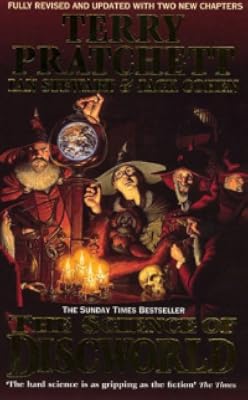
The Science of Discworld
by Terry Pratchett, Jack Cohen, Ian Stewart
The Science of Discworld (book 1), Discworld (Science of Discworld — Science I)
On This Page
Description
Not just another science book and not just another Discworld novella, The Science of Discworld is a creative, mind-bending mash-up of fiction and fact, that offers a wizard’s-eye view of our world that will forever change how you look at the universe.Can Unseen University’s eccentric wizards and orangutan Librarian possibly shed any useful light on hard, rational Earthly science?
In the course of an exciting experiment, the wizards of Discworld have accidentally created a new show more universe. Within this universe is a planet that they name Roundworld. Roundworld is, of course, Earth, and the universe is our own. As the wizards watch their creation grow, Terry Pratchett and acclaimed science writers Ian Stewart and Jack Cohen use Discworld to examine science from the outside. Interwoven with the Pratchett’s original story are entertaining, enlightening chapters which explain key scientific principles such as the Big Bang theory and the evolution of life on earth, as well as great moments in the history of science.
. show less
Tags
Recommendations



Member Reviews
This is an interesting hybrid of fiction and non-fiction. The fiction part is a story set in Terry Pratchett's Discworld universe, in which wizards accidentally create an entire non-magical universe, one that looks quite familiar to us, but entirely bizarre to them: there are just all these big round balls, and no discs on the backs of turtles anywhere. The non-fiction parts look at the evolution of this real universe, of one familiar planet in that universe, and the life on that (or, as the case may be, this) planet.
And while the fiction part is typically delightful Pratchett, I have somewhat mixed feelings about the non-fiction. There's a lot of good and interesting scientific information, cosmic perspective, and discussion of the show more philosophy of science, delivered in a readable and fairly entertaining fashion. But there's also a lot of speculation and opinion from the co-authors (a biologist and a mathematician), some of which I'm more on board with than others. And it's also really dated. This was originally published in 1999, with an updated edition in 2002, which might not seem that old, but science has definitely marched on since then. Especially as the authors are trying to be very cutting-edge, and some of the potentially interesting ideas they mention have completely failed to pan out.
Rating: It's very hard to know how to rate this. It's a fun read if you're a Discworld fan, and a lot of the science stuff is good and thought-provoking. But I don't think I can really recommend it if you're reading it for the science, just because it is so dated. Based on that, I'm going to give it a 3.5/5, but I feel a little bad about it. show less
And while the fiction part is typically delightful Pratchett, I have somewhat mixed feelings about the non-fiction. There's a lot of good and interesting scientific information, cosmic perspective, and discussion of the show more philosophy of science, delivered in a readable and fairly entertaining fashion. But there's also a lot of speculation and opinion from the co-authors (a biologist and a mathematician), some of which I'm more on board with than others. And it's also really dated. This was originally published in 1999, with an updated edition in 2002, which might not seem that old, but science has definitely marched on since then. Especially as the authors are trying to be very cutting-edge, and some of the potentially interesting ideas they mention have completely failed to pan out.
Rating: It's very hard to know how to rate this. It's a fun read if you're a Discworld fan, and a lot of the science stuff is good and thought-provoking. But I don't think I can really recommend it if you're reading it for the science, just because it is so dated. Based on that, I'm going to give it a 3.5/5, but I feel a little bad about it. show less
I went into this audiobook not really expecting to like it. But it features my favorite wizard, Ponder Stibbons, up to no good, or at least up to things he doesn't quite know how to control once the other wizards get involved. At least, that's the plot of the story. The story is told in alternating chapters with some Real Roundworld Science, which was quite informative. Lots of it was that pop science, "mind blowing" facts about the universe and our place in it, but we all need a reminder of how cool the world is if you let science take a look.
The Science of Discworld is an odd sort of Discworld book. Based on the name, I had thought it was going to delve into more detail about the fictional workings of the Discworld. Like, say, how the giant turtle and the elephants stay alive outside of an atmosphere or how water on the Discworld gets replenished when it keeps falling off the disc… If that last sentence makes it sound like I’ve gone off the deep end, then you clearly haven’t tried reading Discworld.
The science in this book is actually more about the real science of our own world, with a very thin Discworld story interspersed between the science bits. The Discworld part of the story takes place in the Unseen University, where the wizards end up creating a simulation of show more the birth of a universe remarkably like ours, followed by many million years’ worth of evolution on “roundworld”, a planet that is also remarkably like ours. Each short Discworld-based chapter is then followed up with a science chapter discussing topics related to what’s going on in the Discworld story.
For the first 25% of this book, I wasn’t sure I was going to make it through to the end. The science parts were boring me to tears because they mostly covered either terribly basic concepts or entirely theoretical topics that I wasn’t very interested in reading about. As it went on, it got more interesting, although there were still scattered bits of boredom here and there. If this had been a book about computer science, I probably would have enjoyed the theoretical parts equally as well as the practical parts. Actually, even though it wasn’t at all the focus of the story, computer science did get a few mentions here and there, and I particularly enjoyed those parts. When it comes to the natural sciences, however, my interest isn’t strong enough to sustain me through theory. I enjoyed it when the authors discussed what we do know and why we think we know it, whereas the various speculations about things we have no way of knowing for sure were more frustrating to me than interesting.
The Discworld part of the story was very short, but amusing. It served as a nice way to break up the science bits and provide some humor. However, the story had a major logical flaw that annoyed me to no end.It’s supposed to be physically impossible for anybody to get into the Roundworld experiment, but Hex is able to use suits to let people enter Roundworld virtually. Rincewind is the first person made to try this, and the luggage shows up physically in Roundworld, supposedly following Rincewind there. But Rincewind’s actual, physical body is still in Unseen University. There’s no logical reason that the luggage should have ended up inside the experiment. It was only done as cheap story trick to allow the wizards to get materials to and from Roundworld by having them transported via the luggage.
So… will I read the second science book? Yes, I think so, once I get to that point in the publication order. Whether or not I read the last two will probably depend on my reaction to the second one. show less
The science in this book is actually more about the real science of our own world, with a very thin Discworld story interspersed between the science bits. The Discworld part of the story takes place in the Unseen University, where the wizards end up creating a simulation of show more the birth of a universe remarkably like ours, followed by many million years’ worth of evolution on “roundworld”, a planet that is also remarkably like ours. Each short Discworld-based chapter is then followed up with a science chapter discussing topics related to what’s going on in the Discworld story.
For the first 25% of this book, I wasn’t sure I was going to make it through to the end. The science parts were boring me to tears because they mostly covered either terribly basic concepts or entirely theoretical topics that I wasn’t very interested in reading about. As it went on, it got more interesting, although there were still scattered bits of boredom here and there. If this had been a book about computer science, I probably would have enjoyed the theoretical parts equally as well as the practical parts. Actually, even though it wasn’t at all the focus of the story, computer science did get a few mentions here and there, and I particularly enjoyed those parts. When it comes to the natural sciences, however, my interest isn’t strong enough to sustain me through theory. I enjoyed it when the authors discussed what we do know and why we think we know it, whereas the various speculations about things we have no way of knowing for sure were more frustrating to me than interesting.
The Discworld part of the story was very short, but amusing. It served as a nice way to break up the science bits and provide some humor. However, the story had a major logical flaw that annoyed me to no end.
So… will I read the second science book? Yes, I think so, once I get to that point in the publication order. Whether or not I read the last two will probably depend on my reaction to the second one. show less
Amusing in its way. This kind of additional material can extend the pleasure or kill it completely, like explaining a joke. Pratchett's construction is strong enough to stand this effort.
An interesting project from our late, lamented friend Terry Pratchett and a few scientists to combine a Disc World story with the science behind our world. With Rincewind stuck in a world made by the wizards, trying to survive meteors ramming into the earth at a geologically speaking rapid clip, and the wizards trying to get him out, our scientists cover a history of the earth, including the possibility that dinosaurs built a civilisation before being wiped out by yet another meteor.
The ending is food for thought as it turned out the "Science of Discworld" was one of my favorite Terry Pratchett books.
The ending is food for thought as it turned out the "Science of Discworld" was one of my favorite Terry Pratchett books.
I just reread this. I had forgotten how good it was. It is mainly a book of science for general audiences that covers the birth of the universe and the evolution of life on Earth. - Alternating short chapters, however, tell the story of how our universe was 'actually' created by a magical experiment at Unseen University. :-)
This book. I'm shaking my head over this book.
It boils down to three things:
The Discworld portion of the book, involving the Unseen University, is excellent; 4 stars. Pratchett's writing is always good, even when it's average for him, and the UU storyline doesn't disappoint. I loved the verbal interplay between the Archchancellor and the Dean. The librarian and Rincewind also kept me going when I was at risk of wandering away during the science-y chapters.
The Science part of the book was also, if distilled down to its essence, good. Solid. Accurate, if dated (even the revised edition is over 10 years old now). The explanation of some difficult concepts sometimes even reaches inspired in its clarity.
The rest of the science writing show more is... well. Hmph. The authors of the science sections decided to weave commentary throughout their chapters; I don't know if they were going for a whole Statler and Waldorf vibe, or really are the supremely condescending and arrogant gits they sound like, but either way - I didn't like them. At all. Which really in the grand scheme of things matters not a wit, except that I'll avoid anything else either of these two puts their name on, and that amounts to a raindrop in an ocean.
They started off with this whole ridiculous premise they call lies-to-children, which, if you've read any of my status updates so far, you'll be fed up to your eyeballs hearing about, so suffice it to say they don't understand the meaning of the word lie and leave it at that. Even though they don't, and proceed to condescend to the reader throughout the book, telling them they've been believing these lies-to-children all along; everything the reader thinks they know is wrong and then proceeds to explain the concepts using simplified terms in easy to understand ways. You know, lies-to-children.
The thing is, most of the time I did understand the concept just fine before they started in, and wasn't at all wrong about what I, in fact, knew thankyouverymuch. And maybe I'm not the target audience for this book; that's fair. But the hypocrisy of condescending to the reader out of one side of their mouths by telling them what they believe to know is wrong, while simultaneously condescending to them out of the other side of their mouths by re-explaining the concept in terms just as simplified is simply too rich.
I was worried about giving concrete examples of this hypocrisy because I'm crap at taking notes (as in: I don't.) while I read and figured I'd never find those examples again. But it just now occurred to me to check the index, and, sure enough, there's an index entry for lies-to-children. Excellent!
In chapter 26, Stewart and Cohan take exception to the term genetic code, conflating the term with genetic blueprint. To be fair, most people do and they're right, DNA is not a genetic blueprint. But it is genetic coding - something they later refer to and claim as being the only part of the DNA we do, at this time, understand. So... thanks for clearing that up.
In chapter 36 - on dinosaurs - they mention a bunch of fiction including the cartoon Fantasia, quote a psychologist named Helen Haste who claims that we all think of dinosaurs as icons of sex and power (you might, I sure as hell don't; they're just really cool, freaky-looking reptiles), and infer that these are the basis of our knowledge concerning dinosaurs. Really? Is this true? All I remember from Fantasia is Mickey doing his Sorcerer's Apprentice bit, and maybe something about hippos in tutus? And I've never read Wells or The Lost World, so I'm pretty sure the bulk of my knowledge about dinosaurs came from Discover Magazine as a kid and later, NewScientist.
There are other examples, I'm sure, and don't even get me started on the whole idea that they know what happens when life on earth ends. They are wrong by sheer dint that nobody knows what happens. You can feel certain within yourself that you know what will happen to you, but that is not empirical certainty and to believe otherwise is a...lie-to-children!
So - did not like the commentary. 2 stars for that. 3 star average. Won't be reading anymore of their stuff, although I'm with Pratchett until the wheels fall off.
Book themes for Newtonmas: Any science book. show less
It boils down to three things:
The Discworld portion of the book, involving the Unseen University, is excellent; 4 stars. Pratchett's writing is always good, even when it's average for him, and the UU storyline doesn't disappoint. I loved the verbal interplay between the Archchancellor and the Dean. The librarian and Rincewind also kept me going when I was at risk of wandering away during the science-y chapters.
The Science part of the book was also, if distilled down to its essence, good. Solid. Accurate, if dated (even the revised edition is over 10 years old now). The explanation of some difficult concepts sometimes even reaches inspired in its clarity.
The rest of the science writing show more is... well. Hmph. The authors of the science sections decided to weave commentary throughout their chapters; I don't know if they were going for a whole Statler and Waldorf vibe, or really are the supremely condescending and arrogant gits they sound like, but either way - I didn't like them. At all. Which really in the grand scheme of things matters not a wit, except that I'll avoid anything else either of these two puts their name on, and that amounts to a raindrop in an ocean.
They started off with this whole ridiculous premise they call lies-to-children, which, if you've read any of my status updates so far, you'll be fed up to your eyeballs hearing about, so suffice it to say they don't understand the meaning of the word lie and leave it at that. Even though they don't, and proceed to condescend to the reader throughout the book, telling them they've been believing these lies-to-children all along; everything the reader thinks they know is wrong and then proceeds to explain the concepts using simplified terms in easy to understand ways. You know, lies-to-children.
The thing is, most of the time I did understand the concept just fine before they started in, and wasn't at all wrong about what I, in fact, knew thankyouverymuch. And maybe I'm not the target audience for this book; that's fair. But the hypocrisy of condescending to the reader out of one side of their mouths by telling them what they believe to know is wrong, while simultaneously condescending to them out of the other side of their mouths by re-explaining the concept in terms just as simplified is simply too rich.
I was worried about giving concrete examples of this hypocrisy because I'm crap at taking notes (as in: I don't.) while I read and figured I'd never find those examples again. But it just now occurred to me to check the index, and, sure enough, there's an index entry for lies-to-children. Excellent!
In chapter 26, Stewart and Cohan take exception to the term genetic code, conflating the term with genetic blueprint. To be fair, most people do and they're right, DNA is not a genetic blueprint. But it is genetic coding - something they later refer to and claim as being the only part of the DNA we do, at this time, understand. So... thanks for clearing that up.
In chapter 36 - on dinosaurs - they mention a bunch of fiction including the cartoon Fantasia, quote a psychologist named Helen Haste who claims that we all think of dinosaurs as icons of sex and power (you might, I sure as hell don't; they're just really cool, freaky-looking reptiles), and infer that these are the basis of our knowledge concerning dinosaurs. Really? Is this true? All I remember from Fantasia is Mickey doing his Sorcerer's Apprentice bit, and maybe something about hippos in tutus? And I've never read Wells or The Lost World, so I'm pretty sure the bulk of my knowledge about dinosaurs came from Discover Magazine as a kid and later, NewScientist.
There are other examples, I'm sure, and don't even get me started on the whole idea that they know what happens when life on earth ends. They are wrong by sheer dint that nobody knows what happens. You can feel certain within yourself that you know what will happen to you, but that is not empirical certainty and to believe otherwise is a...lie-to-children!
So - did not like the commentary. 2 stars for that. 3 star average. Won't be reading anymore of their stuff, although I'm with Pratchett until the wheels fall off.
Book themes for Newtonmas: Any science book. show less
Members
- Recently Added By
Lists

Books Read in 2023
5,547 works; 145 members

Sunny Summer Reads!
13 works; 1 member

Books Read in 2017
4,249 works; 130 members

Books Read in 2020
4,379 works; 124 members

Books Read in 2015
3,299 works; 126 members

Books Read in 2026
1,882 works; 66 members
Author Information

424+ Works 579,809 Members
Terry Pratchett was on born April 28, 1948 in Beaconsfield, United Kingdom. He left school at the age of 17 to work on his local paper, the Bucks Free Press. While with the Press, he took the National Council for the Training of Journalists proficiency class. He also worked for the Western Daily Press and the Bath Chronicle. He produced a series show more of cartoons for the monthly journal, Psychic Researcher, describing the goings-on at the government's fictional paranormal research establishment, Warlock Hall. In 1980, he was appointed publicity officer for the Central Electricity Generating Board with responsibility for three nuclear power stations. His first novel, The Carpet People, was published in 1971. His first Discworld novel, The Colour of Magic, was published in 1983. He became a full-time author in 1987. He wrote more than 70 books during his lifetime including The Dark Side of the Sun, Strata, The Light Fantastic, Equal Rites, Mort, Sourcery, Truckers, Diggers, Wings, Dodger, Raising Steam, Dragons at Crumbling Castle: And Other Tales, and The Shephard's Crown. He was diagnosis with early onset Alzheimer's disease in 2007. He was knighted for services to literature in 2009 and received the World Fantasy award for life achievement in 2010. He died on March 12, 2015 at the age of 66. (Bowker Author Biography) show less

13+ Works 8,751 Members

89+ Works 20,241 Members
Ian Stewart is a professor emeritus of mathematics at the University of Warwick. The author of numerous books on math, he has written for New Scientist, Discover, and Scientific American, among other publications in the United Kingdom and the United States. He lives in Coventry, England.
Some Editions
Awards and Honors
Awards
Series


Belongs to Publisher Series
Work Relationships
Is contained in
Common Knowledge
- Canonical title*
- Die Gelehrten der Scheibenwelt
- Original title
- The Science of Discworld
- Original publication date
- 1999; 2002 (revised) (revised)
- People/Characters
- Hex (Unseen University's thinking engine); Mustrum Ridcully (Archchancellor); Rincewind
- Important places
- Ankh-Morpork, Discworld; Unseen University, Ankh-Morpork, Discworld
- Epigraph
- 'Any sufficiently advanced technology is indistinguishable from magic'
ARTHUR C. CLARKE
'Any technology distinguishable from magic is insufficiently advanced'
GREGORY BENFORD
'The reason why truth is so much stranger than fiction is that there is no requirement for it to be consistent.'
MARK TWAIN
'There are no turtles anywhere'
PONDER STIBBONS - First words
- Once upon a time, there was Discworld. There is still an adequate supply.
- Quotations
- Science certainly does not claim to get things right, but it has a good record of ruling out ways to get things wrong.
- Last words
- (Click to show. Warning: May contain spoilers.)As above, so below.
- Original language
- English
*Some information comes from Common Knowledge in other languages. Click "Edit" for more information.
Classifications
Statistics
- Members
- 2,955
- Popularity
- 6,041
- Reviews
- 29
- Rating
- (3.86)
- Languages
- 7 — Czech, English, French, German, Italian, Polish, Russian
- Media
- Paper, Audiobook, Ebook
- ISBNs
- 27
- ASINs
- 13