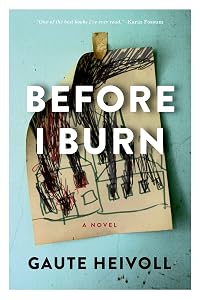
Before I Burn
by Gaute Heivoll
On This Page
Description
In the late 1970s, a pyromaniac runs amok in a close-knit community in rural Norway. Homes are burnt to a cinder, and panic spreads, as neighbours wonder who amongst them could be wreaking such fear and anguish. And slowly, almost imperceptibly, a mother comes to realise that her son is lighting the fires. Born into this time of chaos, Gaute Heivoll is indelibly linked to the arsonist intent on such destruction. By juxtaposing the pyromaniac's story with his own, Heivoll explores memory, show more loss and the agonising separation of child from parent that it is a rite of passage fo show lessTags
Recommendations
























Member Reviews
A house is burning at night. It is the first few minutes, before people have been alerted. All around there is silence. There is only the fire. The house stands there alone and no one can save it. It has been left to its fate, to its destruction. The flames and the smoke are being sucked up into the sky, or so it seems; there are creaks and groans, like distant responses. It is frightening, it is terrible and it is beyond comprehension. And it is almost beautiful.
The narrator of Before I Burn is an author who has decided to write a book about a series of fires which took place when he was a small baby - ten in the space of a month. He goes back to his family's home and starts to talk to the people who still remember those days; but what show more emerges is not a portrait of the arsonist but of the community which he came from, close-knit, taciturn, and with all emotions buried far below the surface.
We see all the arsonist's actions, but only his actions - we aren't told why he did what he did. There are things for us to interpret - all external facts, such as the fact that he was the fire chief's son, that he refuses to talk about his time in the army, or that when everyone was speculating about why the fires were happening he described the perpetrator as "a madman".
But the only emotions we are told about are those of the narrator as he is growing up, and as a result we almost borrow these emotions to understand the arsonist - perhaps, like the narrator, he never felt that he fitted in, he believed he had let his parents down. Perhaps, though, another person with another life would have drawn different conclusions about why he started to set fires. As the narrator says, "Who do we see when we see ourselves?" show less
The narrator of Before I Burn is an author who has decided to write a book about a series of fires which took place when he was a small baby - ten in the space of a month. He goes back to his family's home and starts to talk to the people who still remember those days; but what show more emerges is not a portrait of the arsonist but of the community which he came from, close-knit, taciturn, and with all emotions buried far below the surface.
We see all the arsonist's actions, but only his actions - we aren't told why he did what he did. There are things for us to interpret - all external facts, such as the fact that he was the fire chief's son, that he refuses to talk about his time in the army, or that when everyone was speculating about why the fires were happening he described the perpetrator as "a madman".
But the only emotions we are told about are those of the narrator as he is growing up, and as a result we almost borrow these emotions to understand the arsonist - perhaps, like the narrator, he never felt that he fitted in, he believed he had let his parents down. Perhaps, though, another person with another life would have drawn different conclusions about why he started to set fires. As the narrator says, "Who do we see when we see ourselves?" show less
Gaute Heivoll’s enormously satisfying novel/memoir, Before I Burn, recounts a period from the spring of 1978, when the people of Finsland, a remote, sparsely populated region in southern Norway, were terrorized by a series of deliberately set fires that destroyed homes and ruined lives. Heivoll’s cast of characters is made up of the people who were resident there at the time, a list that includes his own parents and, eventually, himself since he is born in the midst of the crisis. The book is billed as a crime novel, and though crimes are committed in its pages and police arrive to investigate, the prose has an undeniable literary polish and the story’s unconventional structure constantly chafes against the restraints of the show more genre. The action follows three distinct threads. In Finsland in 1978 fires are being set and no one can figure out who is responsible. At the centre of this is Dag, a smart, talented and deeply troubled young man and son of the local fire chief. In 1998 the twenty-year-old Gaute Heivoll, watching his father slowly succumb to cancer and profoundly dissatisfied with the routine path his life seems to be following, deliberately sabotages his law exams. And in the contemporary thread, Gaute, now a writer in his thirties, has returned home to Finsland with the intention of conducting first-hand research into the circumstances surrounding the fires while some of the people who experienced the fear and panic of those weeks in 1978 are still alive. Psychologically penetrating and chillingly evocative of what it must be like to feel threatened and helpless in your own home and suffer emotional turmoil at the hands of a force that is unpredictable and lacks both a face and a shape, Before I Burn grips the reader from the first scene and doesn’t let go until the unsettling epilogue. show less
In this wonderful novel, Gaute Heivoll tells the tale of a series of arsons that took place in Norway in 1978 while also reminiscing about his own evolution as a writer growing up in the same locale. Apart from the locale, the two stories have other appealing synchronicities. Heivoll was born at the time of the arsons; both Heivoll and the arsonist—Dag—have close relationships to their fathers; both fathers are gravely ill; and both young men deal with the illnesses in antisocial ways. Dag commits atrocious acts of arson in his small community and Heivoll abandons his law career and drinks to excess.
The novel simultaneously explores the origins and consequences of their actions. Dag fails in some mysterious way at his military show more service and thus does not live up to his father’s expectations. He returns and joins his father as a fireman in his village. This quiet village does not give him many opportunities to redeem himself and therefore, Dag begins to set fires to demonstrate his competence as a fireman to his father. The impact of these fires on his community are devastating, but this seems to be lost on Dag, who compartmentalizes his behavior by adopting three different personalities: Dag—the fireman, lad—the son, and I—himself. Dag writes letters to his victims and others from the mental hospital where he spends five years after confessing, but never seems to come to terms with his guilt and is never forgiven by his community.
Heivoll drops out of law school after his father gets cancer. He is unable to tell his father what he has done because of a strong sense of failure. He begins to drink and act out. On a mindless jaunt to Denmark, Gaute begins to realize that he was meant to be a writer and thus—unlike Dag—redeems his life. He returns to his village to research the fires in preparation to writing about them.
The two young men are well realized in the novel and despite alternating settings approximately a decade apart from each other, the plot develops coherently, building tension to two different thrilling climaxes—one on the final night of arson and the other on the ferry to Denmark. Heivoll further enhances the mood of the novel by introducing several other characters, including the victims and neighbors. show less
The novel simultaneously explores the origins and consequences of their actions. Dag fails in some mysterious way at his military show more service and thus does not live up to his father’s expectations. He returns and joins his father as a fireman in his village. This quiet village does not give him many opportunities to redeem himself and therefore, Dag begins to set fires to demonstrate his competence as a fireman to his father. The impact of these fires on his community are devastating, but this seems to be lost on Dag, who compartmentalizes his behavior by adopting three different personalities: Dag—the fireman, lad—the son, and I—himself. Dag writes letters to his victims and others from the mental hospital where he spends five years after confessing, but never seems to come to terms with his guilt and is never forgiven by his community.
Heivoll drops out of law school after his father gets cancer. He is unable to tell his father what he has done because of a strong sense of failure. He begins to drink and act out. On a mindless jaunt to Denmark, Gaute begins to realize that he was meant to be a writer and thus—unlike Dag—redeems his life. He returns to his village to research the fires in preparation to writing about them.
The two young men are well realized in the novel and despite alternating settings approximately a decade apart from each other, the plot develops coherently, building tension to two different thrilling climaxes—one on the final night of arson and the other on the ferry to Denmark. Heivoll further enhances the mood of the novel by introducing several other characters, including the victims and neighbors. show less
http://msarki.tumblr.com/post/75720788082/before-i-burn-a-novel-by-gaute-heivoll
Really, the music today in this Starbucks makes me want to destroy something. I am sort of stuck here as my Subaru is being worked on over at the Big O, a couple blocks away. Big job. New shocks, tire rotation, wheel alignment, oil change. You know, almost regular maintenance for an automobile with nearly 150,000 miles on it. Anyway, I ordered a mocha grande, gave them a name to call out when it was ready, and finally, fifteen minutes later, I go up to check on what could possibly be taking so long and there on the counter it sat. At least I thought it was mine. The person behind the counter said it was a mocha for somebody with my first name. I mentioned show more that it would have been nice if someone had informed me. The person remarked that a yell was made, but perhaps I didn't hear it. I have been back sitting here at my little square barstool table after another fifteen minutes have gone by and have yet to hear a yell out of anybody, least of all a barista, and there have been plenty of customers since me, so I think the rather grumpy employee was lying to me. Just like Gaute Heivoll may have been lying to me as well. But it doesn't matter to me if Gaute was telling me a tale because this book was supposed to be a work of fiction anyway. I am not at all positive that these related burns actually happened and do not really care. Gaute made them real enough for me.
The book is actually heart-wrenching with his personal memoir content regarding his dying dad and his own struggle over what to do with his life. The narrator has the same name as Gaute Heivoll so I suppose we can imagine this is a true story with some made-up shit in it. There is plenty of pain to go around the bowl and get it going with a very good spin. We get to know all the neighbors and their personal crosses they bear. And somehow we are getting to at least the surface personality of the criminal who is never revealed until late in the book, but you know all along who it is and I think this is also on purpose. I am of the opinion that Gaute Hovill knows exactly what he is doing, as in his being a supremely gifted writer with a masterly plan.
Something tells me this novel is a parallel bit about being an only child and how the pressures to make something of oneself might ignite a burn that can become unmanageable. It may be that a mental illness or dis-ease develops and exacerbates an already difficult situation. The reader is kept from knowing what exactly happened to the most tragic character of all the many collected in this book. It is never made clear what happened to this once kind and considerate person that fueled his eventual becoming a dangerous pyromaniac. Parents can sometimes cause more harm than good, and the damage is usually done in the spirit of love and adoration. I know firsthand what it is like to love someone too much and to care even a bit too exorbitantly for their happiness. It is quite hard to let go. To live and let live. But one must, or else perhaps have to live with possibly unseemly consequences.
In the end I realized this was a book of memory, about a certain time spent in the history of a small town called Finsland. A story about a boy who lost even himself, who hung onto a memory of his own perfection, a boy who even his parents no longer knew, and the journey some of us must make between a past time remembered and a life lost in its clouding over. It is obvious to me that Gaute Hovill is a born poet as there are enough beautiful sentences to prove his gift for stringing along words. But it is one of the saddest books I have ever read, and it is simply because of this: There is little in its completion that might redeem the lives that seem to still be lost grappling out in its frontier. But isn't that the truth. show less
Really, the music today in this Starbucks makes me want to destroy something. I am sort of stuck here as my Subaru is being worked on over at the Big O, a couple blocks away. Big job. New shocks, tire rotation, wheel alignment, oil change. You know, almost regular maintenance for an automobile with nearly 150,000 miles on it. Anyway, I ordered a mocha grande, gave them a name to call out when it was ready, and finally, fifteen minutes later, I go up to check on what could possibly be taking so long and there on the counter it sat. At least I thought it was mine. The person behind the counter said it was a mocha for somebody with my first name. I mentioned show more that it would have been nice if someone had informed me. The person remarked that a yell was made, but perhaps I didn't hear it. I have been back sitting here at my little square barstool table after another fifteen minutes have gone by and have yet to hear a yell out of anybody, least of all a barista, and there have been plenty of customers since me, so I think the rather grumpy employee was lying to me. Just like Gaute Heivoll may have been lying to me as well. But it doesn't matter to me if Gaute was telling me a tale because this book was supposed to be a work of fiction anyway. I am not at all positive that these related burns actually happened and do not really care. Gaute made them real enough for me.
The book is actually heart-wrenching with his personal memoir content regarding his dying dad and his own struggle over what to do with his life. The narrator has the same name as Gaute Heivoll so I suppose we can imagine this is a true story with some made-up shit in it. There is plenty of pain to go around the bowl and get it going with a very good spin. We get to know all the neighbors and their personal crosses they bear. And somehow we are getting to at least the surface personality of the criminal who is never revealed until late in the book, but you know all along who it is and I think this is also on purpose. I am of the opinion that Gaute Hovill knows exactly what he is doing, as in his being a supremely gifted writer with a masterly plan.
Something tells me this novel is a parallel bit about being an only child and how the pressures to make something of oneself might ignite a burn that can become unmanageable. It may be that a mental illness or dis-ease develops and exacerbates an already difficult situation. The reader is kept from knowing what exactly happened to the most tragic character of all the many collected in this book. It is never made clear what happened to this once kind and considerate person that fueled his eventual becoming a dangerous pyromaniac. Parents can sometimes cause more harm than good, and the damage is usually done in the spirit of love and adoration. I know firsthand what it is like to love someone too much and to care even a bit too exorbitantly for their happiness. It is quite hard to let go. To live and let live. But one must, or else perhaps have to live with possibly unseemly consequences.
In the end I realized this was a book of memory, about a certain time spent in the history of a small town called Finsland. A story about a boy who lost even himself, who hung onto a memory of his own perfection, a boy who even his parents no longer knew, and the journey some of us must make between a past time remembered and a life lost in its clouding over. It is obvious to me that Gaute Hovill is a born poet as there are enough beautiful sentences to prove his gift for stringing along words. But it is one of the saddest books I have ever read, and it is simply because of this: There is little in its completion that might redeem the lives that seem to still be lost grappling out in its frontier. But isn't that the truth. show less
Wave after wave of Scandinavian crime fiction has descended upon America and it still shows no sign of stopping. It’s an impressively lucrative business for a cultural landscape known to shy away from works in translation. As of 2012, The Economist noted that “only 3% of the books published annually in America and Britain are translated from another language; fiction’s slice is less than 1%”. What The Economist didn’t say is that considering the sheer size of the American publishing industry, that is still a heck of a lot of material. There’s obviously plenty of room for improvement but at least those crime writers can’t complain…
Gaute Heivoll’s Before I Burn is one of the most recent works in the field, a standalone show more novel based on Norway’s most dramatic arsonry case and centered around a man named Gaute Heivoll who, an infant at the time, narrates the story in the present day. So it reads like true crime but is in fact a novel; it looks like metafictional trickery but is in fact solidly down-to-earth. Gaute pieces together what happened, making liberal use of his empathetic imagination to enter the minds of the victims as, one by one, buildings are set ablaze.
Before I Burn hit the scene in 2010 and has been making the rounds at a fast pace. As a bestseller, it’s been published in twenty countries. Don Bartlett did the English translation in 2013 and now it’s made it to the American market through independent publisher Graywolf Press. Bartlett is a prolific freelance translator of Norwegian novels, and though he doesn’t make you forget that you’re reading a translation, his work is thoroughly professional and he captures the required tone with ease.
For the reader to most enjoy Before I Burn, it is important to understand what it’s not. It is not a thriller or a whodunnit. The identity of the pyromaniac is given almost right away. It’s not even a whydunnit. It is a character study of a small stoic town in the 70s, where everyone knows everyone else. Heivoll gives the crime novel back to the victims, putting the focus not on the criminal or the investigators but on the ordinary and the faceless: the well-trained cantor who finds himself guarding his home with a rifle; the old couple who lose everything up to their dentures in the fire; the neighbours who carry the burden of disbelief and dread as the number of conflagrations increase. It is as anti-Hollywood as it gets.
One of the novel’s primary attractions is its crossover appeal from crime fiction to literature. It shares the clipped precision and unabated gloom of Henning Mankell’s Faceless Killers, (which I admit is the only other book of this type I’ve read), yet sports a more elegant writing style, with less obvious exposition. Perhaps it tries a little too hard to elevate itself to a more “serious” level, featuring some tired examples of portentous phrasing and an incident with an ash-collecting mental patient that is too thematically pat to excuse. That said, Heivoll’s tone is hushed and respectful, forming a perfect complement to both sides of the narrative and bringing out the most hair-raising details of the arson case.
"It was then that the fire engine returned. … Out jumped a young man, though more a boy. They recognised him at once: it was the son of the fire chief, Ingemann at Skinnsnes. Inside the cabin he had a carrier bag full of food. …
‘Who wants a hot dog?!’ the boy yelled.
He had to step into the trees to find a suitable stick. Then he poked it through a sausage from the bag and lurched into the ruins, more or less where the living room had been. In his white shirt he wasn’t warmly dressed, and he held out his arms as if he were walking on glass. He walked along the foundation wall for some of the way, but then turned and came back. There were no flames left, just ash and the thin, grey smoke. He cursed aloud. He had driven all the way to Kaddeberg’s to buy sausages and now there weren’t any flames or embers to cook them over! What the hell was going on? No one spoke. He started laughing. The firemen watched him, turned away and pretended there was work to be done. Helga wrapped her jacket tighter around her.
‘Then we’ll have to eat them cold,’ the boy continued, clearly miffed. ‘What do you say? Cold sausages!’ He jumped down from the wall, went from one fireman to the next offering cold, slippery sausages straight from the packet."
Unquestionably, the novel is at its best in dealing with Dag, the troubled kid who turns into a pyromaniac. It doesn’t try to get into his head, defining him through the tension he creates in his parents Ingemann and Alma—their desperate concern, fear and heartbreak. His interactions with Ingemann and Alma are at the core of the novel, a motif of parental loss that plays out in other generations, in other ways.
Before I Burn juggles one very tense storyline with another less impactful one—the coming-of-age of Gaute—and this is where the novel falters. It shares almost equal time with the conflagrations and it feels like the Gaute-becomes-a-writer plot took up so many pages because it was important to Heivoll, not because it always added to the underlying story. I expected the strands to weave together by the end and transform each other’s meaning but it never really happened.
What did result was an excellent sketch of the community and its reactions, both short and long-term, to the fires of 1978. Little effort is made to distinguish the multitude of people in the small town, emphasising their bond rather than sowing confusion for the reader. Gaute’s research into the past becomes an investigation into the private life and small moments which define a person. “We chatted for ages. Not only about the fires; other stories also came up, interwoven into previous ones, and in this way the conversation extended into a picture that grew bigger and bigger, and in the end it was unstoppable”.
Before I Burn is not the sort of book you should take on vacation. It is grim and will have you calling your house at all hours to check it’s still there. Yet it’s also graceful and strangely captivating, hypnotic in its attention to detail and in its evocations of life’s great pains and small joys. That’s a tough sell for some, but if you like Nordic noir it’ll be right up your street.
http://pseudointellectualreviews.wordpress.com/2014/03/05/before-i-burn-gaute-he... show less
Gaute Heivoll’s Before I Burn is one of the most recent works in the field, a standalone show more novel based on Norway’s most dramatic arsonry case and centered around a man named Gaute Heivoll who, an infant at the time, narrates the story in the present day. So it reads like true crime but is in fact a novel; it looks like metafictional trickery but is in fact solidly down-to-earth. Gaute pieces together what happened, making liberal use of his empathetic imagination to enter the minds of the victims as, one by one, buildings are set ablaze.
Before I Burn hit the scene in 2010 and has been making the rounds at a fast pace. As a bestseller, it’s been published in twenty countries. Don Bartlett did the English translation in 2013 and now it’s made it to the American market through independent publisher Graywolf Press. Bartlett is a prolific freelance translator of Norwegian novels, and though he doesn’t make you forget that you’re reading a translation, his work is thoroughly professional and he captures the required tone with ease.
For the reader to most enjoy Before I Burn, it is important to understand what it’s not. It is not a thriller or a whodunnit. The identity of the pyromaniac is given almost right away. It’s not even a whydunnit. It is a character study of a small stoic town in the 70s, where everyone knows everyone else. Heivoll gives the crime novel back to the victims, putting the focus not on the criminal or the investigators but on the ordinary and the faceless: the well-trained cantor who finds himself guarding his home with a rifle; the old couple who lose everything up to their dentures in the fire; the neighbours who carry the burden of disbelief and dread as the number of conflagrations increase. It is as anti-Hollywood as it gets.
One of the novel’s primary attractions is its crossover appeal from crime fiction to literature. It shares the clipped precision and unabated gloom of Henning Mankell’s Faceless Killers, (which I admit is the only other book of this type I’ve read), yet sports a more elegant writing style, with less obvious exposition. Perhaps it tries a little too hard to elevate itself to a more “serious” level, featuring some tired examples of portentous phrasing and an incident with an ash-collecting mental patient that is too thematically pat to excuse. That said, Heivoll’s tone is hushed and respectful, forming a perfect complement to both sides of the narrative and bringing out the most hair-raising details of the arson case.
"It was then that the fire engine returned. … Out jumped a young man, though more a boy. They recognised him at once: it was the son of the fire chief, Ingemann at Skinnsnes. Inside the cabin he had a carrier bag full of food. …
‘Who wants a hot dog?!’ the boy yelled.
He had to step into the trees to find a suitable stick. Then he poked it through a sausage from the bag and lurched into the ruins, more or less where the living room had been. In his white shirt he wasn’t warmly dressed, and he held out his arms as if he were walking on glass. He walked along the foundation wall for some of the way, but then turned and came back. There were no flames left, just ash and the thin, grey smoke. He cursed aloud. He had driven all the way to Kaddeberg’s to buy sausages and now there weren’t any flames or embers to cook them over! What the hell was going on? No one spoke. He started laughing. The firemen watched him, turned away and pretended there was work to be done. Helga wrapped her jacket tighter around her.
‘Then we’ll have to eat them cold,’ the boy continued, clearly miffed. ‘What do you say? Cold sausages!’ He jumped down from the wall, went from one fireman to the next offering cold, slippery sausages straight from the packet."
Unquestionably, the novel is at its best in dealing with Dag, the troubled kid who turns into a pyromaniac. It doesn’t try to get into his head, defining him through the tension he creates in his parents Ingemann and Alma—their desperate concern, fear and heartbreak. His interactions with Ingemann and Alma are at the core of the novel, a motif of parental loss that plays out in other generations, in other ways.
Before I Burn juggles one very tense storyline with another less impactful one—the coming-of-age of Gaute—and this is where the novel falters. It shares almost equal time with the conflagrations and it feels like the Gaute-becomes-a-writer plot took up so many pages because it was important to Heivoll, not because it always added to the underlying story. I expected the strands to weave together by the end and transform each other’s meaning but it never really happened.
What did result was an excellent sketch of the community and its reactions, both short and long-term, to the fires of 1978. Little effort is made to distinguish the multitude of people in the small town, emphasising their bond rather than sowing confusion for the reader. Gaute’s research into the past becomes an investigation into the private life and small moments which define a person. “We chatted for ages. Not only about the fires; other stories also came up, interwoven into previous ones, and in this way the conversation extended into a picture that grew bigger and bigger, and in the end it was unstoppable”.
Before I Burn is not the sort of book you should take on vacation. It is grim and will have you calling your house at all hours to check it’s still there. Yet it’s also graceful and strangely captivating, hypnotic in its attention to detail and in its evocations of life’s great pains and small joys. That’s a tough sell for some, but if you like Nordic noir it’ll be right up your street.
http://pseudointellectualreviews.wordpress.com/2014/03/05/before-i-burn-gaute-he... show less
A strange, sad, compelling book. Wonderfully scaled and paced. Avoids all the bloat and bagginess of so many novels. The author does a beautiful job of leaving big, nagging, provocative silences in all the right places.
This is a Norwegian bestseller in which the narrator ruminates about an arsonist who terrorized his community at the time of his birth. He also thinks extensively about his relationship with his father and his father's death. This book definitely has that Scandinavian feel - it is written a bit flat and matter-of-factly - it's not as dramatic as the subject of an arsonist on the loose sounds like it would be.
I liked it, but I found myself losing interest periodically and in the end I don't think it will be very memorable for me.
I liked it, but I found myself losing interest periodically and in the end I don't think it will be very memorable for me.
Members
- Recently Added By
Published Reviews
ThingScore 100
In the case of Before I Burn by Gaute Heivoll, the mashup is suspense meets memoir. It sounds a little gimmicky, but I promise it's absolutely not. Instead we have a semi-autobiographical novel that's poetic, gripping and at times even profound.
added by ozzer
Lists

Books Read in 2016
4,666 works; 199 members
Author Information

20+ Works 382 Members
Some Editions
Awards and Honors
Series
Belongs to Publisher Series
Common Knowledge
- Canonical title
- Before I Burn
- Original title
- Før jeg brenner ned
- Original publication date
- 2010
- People/Characters*
- Gaute Heivoll; Dag; Ingemann; Alma
- Important places*
- Finsland, Norja
- Related movies
- Pyromanen (2016 | IMDb)
- Original language
- Norwegian
*Some information comes from Common Knowledge in other languages. Click "Edit" for more information.
Classifications
- Genres
- Fiction and Literature, General Fiction
- DDC/MDS
- 839.82 — Literature & rhetoric German & related literatures Other Germanic literatures Danish and Norwegian literatures Norwegian literature
- LCC
- PT8952.18 .E38 .F6713 — Language and Literature German, Dutch and Scandinavian literatures Norwegian literature Individual authors or works 2001-
- BISAC
Statistics
- Members
- 230
- Popularity
- 141,907
- Reviews
- 20
- Rating
- (3.70)
- Languages
- 13 — Danish, Dutch, English, Finnish, French, German, Italian, Norwegian (Bokmål), Norwegian, Portuguese, Russian, Swedish, Turkish
- Media
- Paper, Ebook
- ISBNs
- 24
- ASINs
- 4