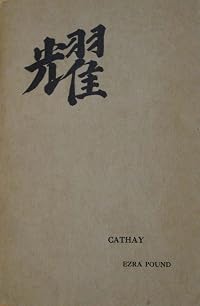
Cathay
by Ezra Pound 
On This Page
Description
Finalist, Pegasus Award for Poetry CriticismEzra Pound’s Cathay (1915) is a masterpiece both of modernism and of world literature. The muscular precision of images that mark Pound’s translations helped establish a modern style for American literature, at the same time creating a thirst for classical Chinese poetry in English. Pound’s dynamic free-verse translations in a modern idiom formed the basis for T.S. Eliot’s famous claim that Pound was the “inventor of Chinese poetry for show more our time.” Yet Pound achieved this feat without knowing any Chinese, relying instead on word-for-word “cribs” left by the Orientalist Ernest Fenollosa, whose notebooks reveal a remarkable story of sustained cultural exchange.This fully annotated critical edition focuses on Pound’s astonishing translations without forgetting that the original Chinese poems are masterpieces in their own right. On the one hand, the presentation of all that went into the final Cathay makes it possible for the first time to appreciate the magnitude and the nuances of Pound’s poetic art. At the same time, by bringing the final text together with the Chinese and Old English poems it claims to translate, as well as the manuscript traces of Pound's Japanese and American interlocutors, the volume also recovers practices of poetic circulation, resituating a Modernist classic as a work of world literature.The Pound text and its intertexts are presented with care, clarity, and visual elegance. By providing the first accurate and unabridged transcriptions of Fenollosa’s notebooks, along with carefully edited Chinese texts, the volume makes it possible to trace the movements of poetic ideas and poetic expression as they veer toward and away from Pound’s creations. In supplying the full Fenollosa texts, the volume overturns decades of scholarship that has mystified Pound’s translation process as a kind of “clairvoyance,” displaying instead the impressive amount of sinological learning preserved in Fenollosa’s hard-to-read notebooks and by detailing every deviation from the probable sense of the originals. The edition also supplies exhaustive historical, critical, and textual notes, clarifying points that have sometimes lent obscurity to Pound’s poems and making the process of translation visible even for readers with no knowledge of Chinese. Cathay: A Critical Edition includes the original fourteen Chinese translations as well as Pound’s unique version of “The Seafarer,” which is fully annotated alongside its Anglo-Saxon source. Also included are Pound’s fifteen additional Chinese translations from Lustra and other contemporary publications, his essay “Chinese Poetry” (1919), a substantial textual Introduction, and original essays by Christopher Bush and Haun Saussy on international modernism, the mediation of Japan, and translation.The meticulous treatment and analysis of the texts for this landmark edition will forever change how readers view Pound’s “Chinese” poems. In addition to discoveries that permanently alter the scholarly record and force us to revise a number of critical commonplaces, the critical apparatus allows readers to make fresh discoveries by making available the specific networks through which poetic expression moved among hands, languages, and media. Ultimately, this edition not only enables us more fully to appreciate a canonical work of Modernism but also resituates the art of Pound’s translations by recovering the historical circulations that went into the making of a multiply authored and intrinsically hybrid masterpiece. show lessTags
Recommendations















Member Reviews
five stars but for the forward by mary de rachewiltz, which had more to do with glorifying her father than with examining his translations.
>
da 'einaudi.it'
>
da 'amnesiavivace.it'
da 'einaudi.it'
>
da 'amnesiavivace.it'
Dec 7, 2014Italian
Ratings
Members
- Recently Added By
Lists

Books Read in 2013
1,630 works; 51 members

First published in 1915
87 works; 11 members
Author Information

390+ Works 10,766 Members
Ezra Pound, 1885-1972 Ezra Weston Loomis Pound ("Ezra Pound"), along with T. S. Eliot, was one of the two main influences on British and U.S. poetry between the two world wars. Pound was born in a small, two-storey house in Hailey, Idaho Territory on October 30, 1885. Between 1897 and 1900 Pound attended Cheltenham Military Academy, sometimes as a show more boarder, where he specialized in Latin. Pound graduated from the University of Pennsylvania and went abroad to live in 1908. The collection of his Letters, 1907--1941 revealed the great erudition of this most controversial expatriate poet. His first book, A Lume Spento, a small collection of poems, was published in Venice in 1908. With the publication of Personae in London in 1909, he became the leader of the imagists abroad. Pound's writings have been subject to many foreign influences. First he imitated the troubadours; then he came under the influence of the Chinese and Japanese poets. The Cantos (1925--60), his major work, to which he added for many years, is a mixture of modern colloquial language and classical quotation. The Pisan Cantos (1948), written during his imprisonment in Italy, is more autobiographical. Pound's prose, as well as his poetry, has been extremely influential. The Spirit of Romance (1910) is a revision of his studies of little-known romance writers. ABC of Reading (1934) is an exposition of his critical method. His critical writings include Literary Essays of Ezra Pound (1954), Instigations (1920), and Guide to Kulchur (1938). Pound was a linguist, whom Eliot called "the inventor of Chinese poetry for our time." His greatest translating achievements from Japanese, Chinese, Anglo-Saxon, Italian, Provencal, and French are collected in The Translations of Ezra Pound (1933). Among his other writings are Make It New: Essays; Jefferson and/or Mussolini, a discussion of American democracy and capitalism and fascism; and The Classic Noh Theatre of Japan, with Ernest Fenollosa. Living in Italy, Pound felt that some of the practices of Mussolini were in accord with the doctrines of social credit, in which he had become interested in the 1920s and 1930s. He espoused some of the general applications of fascism and also was a strong advocate of anti-Semitism. During World War II, he broadcast a pro-Fascist series of programs addressed to the Allied troops on Italian radio. Indicted for treason and brought to the United States to stand trial in 1946, he was judged mentally incompetent to prepare a defense and was committed to St. Elizabeth's Hospital in Washington, D.C. for over 12 years. After a concerted appeal to the federal government by American poets, led by Robert Frost, Pound was at last released in 1958 and returned to Italy. Pound died on November 1, 1972. (Bowker Author Biography) show less
Ezra Pound has a Legacy Library. Legacy libraries are the personal libraries of famous readers, entered by LibraryThing members from the Legacy Libraries group.
Series
Belongs to Publisher Series
New Directions Paperbook (1317)
Work Relationships
Is contained in
Common Knowledge
- Original title
- Cathay
- Original publication date
- 1915
Classifications
Statistics
- Members
- 118
- Popularity
- 276,222
- Reviews
- 2
- Rating
- (4.08)
- Languages
- 6 — Chinese, English, Italian, Portuguese, Spanish, Turkish
- Media
- Paper, Ebook
- ISBNs
- 14
- ASINs
- 1