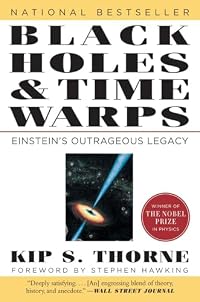
Black Holes and Time Warps : Einstein's Outrageous Legacy
by Kip S. Thorne
On This Page
Description
"Ever since Albert Einstein's general theory of relativity burst upon the world in 1915 some of the most brilliant minds of our century have sought to decipher the mysteries bequeathed by that theory, a legacy so unthinkable in some respects that even Einstein himself rejected them." "Which of these bizarre phenomena, if any, can really exist in our universe? Black holes, down which anything can fall but from which nothing can return; wormholes, short spacewarps connecting regions of the show more cosmos; singularities, where space and time are so violently warped that time ceases to exist and space becomes a kind of foam; gravitational waves, which carry symphonic accounts of collisions of black holes billions of years ago; and time machines, for traveling backward and forward in time." "Kip Thorne, along with fellow theorists Stephen Hawking and Roger Penrose, a cadre of Russians, and earlier scientists such as Oppenheimer, Wheeler and Chandrasekhar, has been in the thick of the quest to secure answers. In this masterfully written and brilliantly informed work of scientific history and explanation, Dr. Thorne, the Feynman Professor of Theoretical Physics at Caltech, leads his readers through an elegant, always human, tapestry of interlocking themes, coming finally to a uniquely informed answer to the great question: what principles control our universe and why do physicists think they know the things they think they know?" "Stephen Hawking's A Brief History of Time has been one of the greatest best-sellers in publishing history. Anyone who struggled with that book will find here a more slowly paced but equally mind-stretching experience, with the added fascination of a rich historical and human component."--Jacket. show lessTags
Recommendations

Member Reviews
The central argument of this book is undoubtedly true. We have lost our sense of wonder, especially in the last 20-30 years.
I watched the first images of that black hole in 2019 (*) in awe wondering how many cosmic phenomena are there yet to discover, but then I grew up in the shadow of the moon landing when the assumption was we would be living on Mars and in space stations by now. I don’t want to over romanticise that period because it was overshadowed by the Cold War and Nuclear War. Many seem to forget that we still live in the shadow of Nuclear War but, unlike the 70s, we no longer live under the occasional sunbeam of hope that we might overcome our problems that formed the narrative of Star Trek and even Star Wars to a lesser show more degree. Today we are only encouraged to see that Britain has Got Talent rather than the Universe contains wonders. Don’t get me wrong Britain has got Talent is a good watch but does any of it really matter as much of it seems like an attempt to escape from the boredom of everyday life in fleeting pleasures, whereas greater understanding of the cosmos can give yet greater pleasure: purpose, imagining that we too, or our ancestors, may progress to a point where we overcome our problems and will be unable to travel to that black hole much as our ancestors looked up and wondered about the moon. I sometimes feel like many politicians and entrepreneurs don’t want us to look to the sky above but keep our eyes firmly fixed on them as if they can stand comparison with the sheer majesty of this black hole. A sense of awe and curiosity is, in my opinion, one of things that made us even capable of seeing this black hole ( consider the existence of the black hole was ‘discovered’ by someone working with paper and pencil; refined by someone considering those theories; then worked on by a team over a century later to film its existence). If we don’t see the majesty and possibilities this picture shows us; if we fail to learn the lessons of Einstein’s work i.e. we mustn’t stop imagining, pondering beyond the observable but basing our theories on the observable. There is an irony that this vision of what until now may be considered one of the deadliest phenomena in the universe also is a confirmation of possibilities of the continued life of our species as it reflects our greatest qualities: our ability to dream; to work hard on our dreams as a team; and then our ability to start all over again when new possibilities appear.
Give me an unassuming Einstein who, for all his many human failings, strove through hard work he didn’t need to advertise every day, to raise all our understanding so we could all get something out of it and not just feel small and stupid next to him.
NB: I can't speak for anyone else's sense of wonder in relation to Sagittarius A*'s image, but I found it fascinating. I know there is something in the middle, and I have a fairly good grasp of what it is. That's a pretty bloody astonishing thing. To see an actual image of it, with the light cutting off at the event horizon, and that fucking whopping monster of a thing being flat out invisible in the middle of that firestorm. If you aren't amazed by it, you probably haven't got a clue what it represents. Although it is pretty “crappy” image quality (this image is a result of using data from eight radio telescopes sited on Earth and the black hole is 55m light years away from Earth, so we cannot really complain about “crappy” images). It'd look a lot more impressive from one light year away. If you could survive, which you probably couldn't. show less
I watched the first images of that black hole in 2019 (*) in awe wondering how many cosmic phenomena are there yet to discover, but then I grew up in the shadow of the moon landing when the assumption was we would be living on Mars and in space stations by now. I don’t want to over romanticise that period because it was overshadowed by the Cold War and Nuclear War. Many seem to forget that we still live in the shadow of Nuclear War but, unlike the 70s, we no longer live under the occasional sunbeam of hope that we might overcome our problems that formed the narrative of Star Trek and even Star Wars to a lesser show more degree. Today we are only encouraged to see that Britain has Got Talent rather than the Universe contains wonders. Don’t get me wrong Britain has got Talent is a good watch but does any of it really matter as much of it seems like an attempt to escape from the boredom of everyday life in fleeting pleasures, whereas greater understanding of the cosmos can give yet greater pleasure: purpose, imagining that we too, or our ancestors, may progress to a point where we overcome our problems and will be unable to travel to that black hole much as our ancestors looked up and wondered about the moon. I sometimes feel like many politicians and entrepreneurs don’t want us to look to the sky above but keep our eyes firmly fixed on them as if they can stand comparison with the sheer majesty of this black hole. A sense of awe and curiosity is, in my opinion, one of things that made us even capable of seeing this black hole ( consider the existence of the black hole was ‘discovered’ by someone working with paper and pencil; refined by someone considering those theories; then worked on by a team over a century later to film its existence). If we don’t see the majesty and possibilities this picture shows us; if we fail to learn the lessons of Einstein’s work i.e. we mustn’t stop imagining, pondering beyond the observable but basing our theories on the observable. There is an irony that this vision of what until now may be considered one of the deadliest phenomena in the universe also is a confirmation of possibilities of the continued life of our species as it reflects our greatest qualities: our ability to dream; to work hard on our dreams as a team; and then our ability to start all over again when new possibilities appear.
Give me an unassuming Einstein who, for all his many human failings, strove through hard work he didn’t need to advertise every day, to raise all our understanding so we could all get something out of it and not just feel small and stupid next to him.
NB: I can't speak for anyone else's sense of wonder in relation to Sagittarius A*'s image, but I found it fascinating. I know there is something in the middle, and I have a fairly good grasp of what it is. That's a pretty bloody astonishing thing. To see an actual image of it, with the light cutting off at the event horizon, and that fucking whopping monster of a thing being flat out invisible in the middle of that firestorm. If you aren't amazed by it, you probably haven't got a clue what it represents. Although it is pretty “crappy” image quality (this image is a result of using data from eight radio telescopes sited on Earth and the black hole is 55m light years away from Earth, so we cannot really complain about “crappy” images). It'd look a lot more impressive from one light year away. If you could survive, which you probably couldn't. show less
This book had a profound impact on me when I first read it back in 1998, so much so that I feel it is worth reposting a review I wrote on Amazon.com around the time of reading. I was so happy to hear Professor Thorne was one of the recipients of the 2017 Nobel Prize for Physics.
Once a reader embarks on the journey of discovery through this book, it is hard to turn back. Thorne manages to keep one interested, with each topic and chapter logically following from the last. He uses numerous diagrams, photographs and simple language to enlighten the reader. For example his illustration of how stars of various mass 'die' gives a masterful introductory explanation into white dwarfs, neutron stars and black holes in one diagram!
This book not show more only describes complex cosmological phenomena, but gives concise accounts of the people involved and their political and social influences. It is essential reading for anyone interested in the mysteries of space and leaves the reader contented that he now has at least some comprehension of phenomena that everyone seems to have heard about (quasers, pulsars, neutron stars, black holes) but few understand. show less
Once a reader embarks on the journey of discovery through this book, it is hard to turn back. Thorne manages to keep one interested, with each topic and chapter logically following from the last. He uses numerous diagrams, photographs and simple language to enlighten the reader. For example his illustration of how stars of various mass 'die' gives a masterful introductory explanation into white dwarfs, neutron stars and black holes in one diagram!
This book not show more only describes complex cosmological phenomena, but gives concise accounts of the people involved and their political and social influences. It is essential reading for anyone interested in the mysteries of space and leaves the reader contented that he now has at least some comprehension of phenomena that everyone seems to have heard about (quasers, pulsars, neutron stars, black holes) but few understand. show less
Kip Thorne’s name is practically synonymous with the modern era of gravitational physics. A former graduate student of living legend John Wheeler, Thorne and his research group have been leading participants in the renaissance of general relativity which began during the early 1960s and continues to this day. The hugely influential 1973 text book "Gravitation", co-authored with Charles Misner and Wheeler, introduced the modern view of general relativity to an entire generation of physicists. And Wheeler spent time during his early years working in Copenhagen with Niels Bohr. The lineage is long and distinguished.
Black Holes and Time Warps is more technical than Clifford Will's "Was Einstein Right?", and more personal. Thorne does not show more shy away from presenting fairly solid physics, and some readers may struggle with concepts such as Finkelstein’s reference frame for a star collapsing to a black hole, in which observers near the star are in free fall. But even those who skim over such details cannot help but come away with a greater understanding of black hole dynamics, and readers who have some grounding in physics will find their understanding consolidated and enhanced. Thorne has devoted much of the latter part of his career to experimental techniques for detecting gravitational waves, and the theoretical possibility of wormholes and time machines, and gives a good introduction to both topics. Even if – like me – you find it a little hard to swallow the idea of holding a wormhole open by stringing together just the right amount of exotic matter with a negative energy density, this line of research is invaluable for probing the limits of just what does happen when spacetime curvature becomes extreme.
Many readers will enjoy the personal glimpses Thorne offers of his own research efforts, and of colleagues such as Wheeler (to whom the book is dedicated), Chandrasekhar, Hawking, Penrose, and their Russian counterparts such as Vladimir Braginsky, Lev Landau, Igor Novikov, and Yakov Zel’dovich. Thorne describes his own stunned reaction on first hearing Novikov lecture at a 1965 conference, and realising the breadth and power of what was happening in Cold War Russia. He subsequently developed strong collaborative links with Novikov and other Soviet physicists, and draws some interesting contrasts between the US and USSR during this period. show less
Black Holes and Time Warps is more technical than Clifford Will's "Was Einstein Right?", and more personal. Thorne does not show more shy away from presenting fairly solid physics, and some readers may struggle with concepts such as Finkelstein’s reference frame for a star collapsing to a black hole, in which observers near the star are in free fall. But even those who skim over such details cannot help but come away with a greater understanding of black hole dynamics, and readers who have some grounding in physics will find their understanding consolidated and enhanced. Thorne has devoted much of the latter part of his career to experimental techniques for detecting gravitational waves, and the theoretical possibility of wormholes and time machines, and gives a good introduction to both topics. Even if – like me – you find it a little hard to swallow the idea of holding a wormhole open by stringing together just the right amount of exotic matter with a negative energy density, this line of research is invaluable for probing the limits of just what does happen when spacetime curvature becomes extreme.
Many readers will enjoy the personal glimpses Thorne offers of his own research efforts, and of colleagues such as Wheeler (to whom the book is dedicated), Chandrasekhar, Hawking, Penrose, and their Russian counterparts such as Vladimir Braginsky, Lev Landau, Igor Novikov, and Yakov Zel’dovich. Thorne describes his own stunned reaction on first hearing Novikov lecture at a 1965 conference, and realising the breadth and power of what was happening in Cold War Russia. He subsequently developed strong collaborative links with Novikov and other Soviet physicists, and draws some interesting contrasts between the US and USSR during this period. show less
Although a bit dated now, this book is a fascinating explanation of the history of black holes. It is very accessible to readers not trained in advanced physics. The author's writing style is engaging throughout and the book is full of anecdotes about the physicists who contributed to our understanding of black holes. The author explains relativity, warped space-time, gravitation, singularities, how black holes are formed, and how they may evaporate. The final chapter is a diversion about the possibility of wormholes and time machines, with a interesting connection to Carl Sagan's book Contact (which was made into a wonderful movie by the same name).
An extremely profitable read. The history of modern GR was interesting, but even better was that it forced me to really sort out in my mind a number of GR concepts.
Having said all this, I was disappointed by a lot of the book and remain extremely unconvinced by the final chapters.
Like every pop GR book I have ever read, this one embeds spacetime in hyperspace, IMHO an extremely misleading move. Beyond that, it talks about non-simply connected spacetimes (wormholes) in a way that strikes me as unjustified. My view is that a responsible discussion of this topic would point out that (as far as I know)
* GR in no way requires this assumption of spacetime
* GR in no way generates solutions with this property
* The simplest assumption is that show more it doesn't exist and finally
* If it did exist, the observational properties would be blah blah blah. show less
Having said all this, I was disappointed by a lot of the book and remain extremely unconvinced by the final chapters.
Like every pop GR book I have ever read, this one embeds spacetime in hyperspace, IMHO an extremely misleading move. Beyond that, it talks about non-simply connected spacetimes (wormholes) in a way that strikes me as unjustified. My view is that a responsible discussion of this topic would point out that (as far as I know)
* GR in no way requires this assumption of spacetime
* GR in no way generates solutions with this property
* The simplest assumption is that show more it doesn't exist and finally
* If it did exist, the observational properties would be blah blah blah. show less
An insider view of high energy physics by a hippie. This will explain black holes and quantum gravity. Don't let the publication date fool you. Unless you can do the math (which this book blessedly leaves out) this will bring you up to (nearly) date. And it gives you a look at the people involved.
What I liked best about this book is that it was very readable for the non-scientist/mathematician without over explaining things any intelligent, educated person might know. The topic is fascinating. Though some details are now outdated, it is an invaluable history of the scientific path from Einstein's theories to black holes. It left me wanting to read more.
Members
- Recently Added By
Lists

al.vick-wishlist-science and nature
83 works; 1 member

Isaac Arthur’s Book Recommendations
98 works; 3 members

The Great Courses: Introduction to Astrophysics
16 works; 1 member

In Our Time books
4,934 works; 2 members
Author Information

15+ Works 3,062 Members
Kip S. Thorne is the Feynman Professor of Theoretical Physics at the California Institute of Technology and the author of three other books, including (with John Wheeler and Charles Misner) Gravitation. He is the 1994 recipient of the American Institute of Physics Science Writing Award.
All Editions
Some Editions
Awards and Honors
Awards
Notable Lists
Series
Belongs to Publisher Series
Common Knowledge
- Canonical title
- Black Holes and Time Warps : Einstein's Outrageous Legacy
- Original title
- Black Holes and Time Warps: Einstein's Outrageous Legacy
- Original publication date
- 1994
- People/Characters
- Subrahmanyan Chandrasekhar; Albert Einstein; Jane Hawking; Stephen Hawking; Roger Penrose; Dennis Schiama (show all 8); Kip Thorne; John Archibald Wheeler
- Dedication
- I dedicate this book to John Archibald Wheeler, my mentor and friend.
- First words
- Of all the conceptions of the human mind, from unicorns to gargoyles to the hydrogen bomb, the most fantastic , perhaps, is the black hole: a hole in space with a definite edge into which anything can fall and out of which no... (show all)thing can escape; a hole with a gravitational force so strong that even light is caught and held in its grip; a hole that curves space and warps time.
- Last words
- (Click to show. Warning: May contain spoilers.)Every time machine is likely to self destruct (by means of circulating vacuum fluctuations) at the moment one tries to activate it. However, we cannot know for sure until physicists have fathomed in depth the laws of quantum gravity.
- Blurbers
- Browne, Malcom W.; Bartusiak, Marcia; Sagan, Carl; Lightman, Alan; Hawking, Stephen; Sagan, Carl (show all 8); Penrose, Roger; Wheeler, John Archibald
- Original language
- English
Classifications
Statistics
- Members
- 1,461
- Popularity
- 15,913
- Reviews
- 17
- Rating
- (4.23)
- Languages
- 9 — Czech, English, French, German, Greek, Italian, Japanese, Spanish, Thai
- Media
- Paper, Ebook
- ISBNs
- 25
- ASINs
- 8