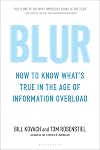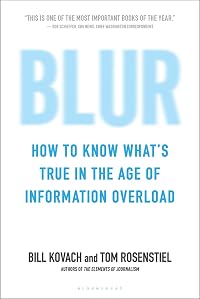
Blur: How to Know What's True in the Age of Information Overload
by Bill Kovach, Tom Rosenstiel
On This Page
Description
Like the authors' classic book The Elements of Journalism, Blur is a unique and readable discourse on how the information culture is changing. Just as important, it provides a road map for all citizens to navigate that culture by revealing the tradecraft great journalists have used to sift rumor from fact and access the truth. In an age when the line between citizen and journalist is becoming increasingly blurred, Blur is an indispensable guide.Tags
Recommendations



Member Reviews
Everybody complains about the quality of the media, but nobody does anything about it . . . in part because few of us know what to do about it. Happily, thanks to Bill Kovach, Tom Rosenstiel, and Blur, I now know a whole lot more about what to do about it than I did before. Blur is the textbook for the "Print Journalism" segment of the "Media Literacy 101" course that we all should have had in school but virtually none of us did. It explains what good journalism is, how to recognize it, and (just as important) where journalists can go wrong . . . and how to recognize that. The biggest problem with journalism today, Kovach and Rosenstiel argue, isn't political bias as such, but laziness. Reporters transcribe official statements without show more investigating them, interviewers fail to do the necessary background research, and publications that should no better fail to corroborate statements with two independent sources before publishing them. The result is a sea of information . . . some of it based on solid, careful research, but much of it misleading or completely erroneous.
Blur is, in the space of 200 pages, a (very) brief sketch of how we got here -- specifically of the ways in which information technology shapes the way we receive information -- a guide to how to deal with things as they are, a call for journalists to do better, and an examination of what the "next journalism," now emerging, might look like. Along the way it touches on subjects such as why (and how) people get news, and what good journalism looks like -- the latter illustrated with examples that are enough to make me want to change careers and become a reporter (not because they make it look easy -- far from it-- but because they make it look like an extraordinary challenge, in which the rewards come from making the world a better place. Blur is, in short, an extremely rich and wide-ranging book. That it's never confusing or dull (though it is serious) is a testament to how skillful the authors are at their trade.
The majority of readers will see the chapters on how to be an informed consumer of news as the heart of this book, and its most valuable feature. They'd be right, but the last 30 pages of the book -- two chapters on the "next journalism" -- also deserve notice. Its analysis of one potential road that the fusion of print journalism and the internet could take is lucid, innovative, and surprisingly compelling. There's a great deal of writing out there about the fact that jouralism is changing radically . . . not so much about where those changes might lead. Here's one very plausible-sounding possibility, embedded in one very thoughtful book. Highly recommended. show less
Blur is, in the space of 200 pages, a (very) brief sketch of how we got here -- specifically of the ways in which information technology shapes the way we receive information -- a guide to how to deal with things as they are, a call for journalists to do better, and an examination of what the "next journalism," now emerging, might look like. Along the way it touches on subjects such as why (and how) people get news, and what good journalism looks like -- the latter illustrated with examples that are enough to make me want to change careers and become a reporter (not because they make it look easy -- far from it-- but because they make it look like an extraordinary challenge, in which the rewards come from making the world a better place. Blur is, in short, an extremely rich and wide-ranging book. That it's never confusing or dull (though it is serious) is a testament to how skillful the authors are at their trade.
The majority of readers will see the chapters on how to be an informed consumer of news as the heart of this book, and its most valuable feature. They'd be right, but the last 30 pages of the book -- two chapters on the "next journalism" -- also deserve notice. Its analysis of one potential road that the fusion of print journalism and the internet could take is lucid, innovative, and surprisingly compelling. There's a great deal of writing out there about the fact that jouralism is changing radically . . . not so much about where those changes might lead. Here's one very plausible-sounding possibility, embedded in one very thoughtful book. Highly recommended. show less
 This review was written for LibraryThing Early Reviewers.
A powerful indictment of the channels through which we now receive our information. The authors identify four models of content: journalism of verification (the traditional mode, in which journalists serve as thoughtful gatekeepers, and provide accuracy and context), a journalism of assertion that emerged with 24-hour cable access, offering a passive conduit for speakers with little challenge or editing, the journalism of affirmation that caters to like-minded consumers tending to cherry-pick information to confirm preexisting convictions; and interest-group journalism that includes targeted websites funded by special interest organizations. The existence of this growing variety, the authors argue, places greater responsibility on the show more consumer to be aware of the nature of the information being received and to find for themselves the now-scattered bits of information they need to make valid decisions. The majority of the book is designed to equip the reader to make these distinctions.
One can readily concede the characterization of the largely disintegrating (in both senses, as concerns quality and progression from a prior unity of professional objective) state of news media, while not accepting the authors' optimism about the ability of the population at large to be either motivated or equipped to take the necessary steps to obtain anything better. This is, after all, the same public that has fueled the growth of the journalism of affirmation embodied in Fox news and even, although less successfully, some few offerings on the opposite end of the political spectrum. The appetite and energy to individually acquire the skills upon which we used to expect from the traditional media seem in short supply. That should be of small surprise, given the critical comments about the negative impact of internet use and a general lack of intellectual depth that becomes more common (e.g., Maggie Jackson's Distracted, and Nicholas Carr's The Shallows).
If it is true that a thriving democracy depends upon an educated and informed citizenry, and if it is also true that the plethora of information has decreased the amount of actual knowledge, and further that the burden of bridging the gap falls on each person where before we could rely on a skilled profession to do most of the heavy lifting, then perhaps we are in for a bleak future. Although the authors no doubt intend this solid work to offer encouraging instruction to the reader, the outcome is as likely to be a sobering pessimism arising from consumers' lack of critical curiosity. show less
One can readily concede the characterization of the largely disintegrating (in both senses, as concerns quality and progression from a prior unity of professional objective) state of news media, while not accepting the authors' optimism about the ability of the population at large to be either motivated or equipped to take the necessary steps to obtain anything better. This is, after all, the same public that has fueled the growth of the journalism of affirmation embodied in Fox news and even, although less successfully, some few offerings on the opposite end of the political spectrum. The appetite and energy to individually acquire the skills upon which we used to expect from the traditional media seem in short supply. That should be of small surprise, given the critical comments about the negative impact of internet use and a general lack of intellectual depth that becomes more common (e.g., Maggie Jackson's Distracted, and Nicholas Carr's The Shallows).
If it is true that a thriving democracy depends upon an educated and informed citizenry, and if it is also true that the plethora of information has decreased the amount of actual knowledge, and further that the burden of bridging the gap falls on each person where before we could rely on a skilled profession to do most of the heavy lifting, then perhaps we are in for a bleak future. Although the authors no doubt intend this solid work to offer encouraging instruction to the reader, the outcome is as likely to be a sobering pessimism arising from consumers' lack of critical curiosity. show less
This review was written for LibraryThing Early Reviewers.The most common criticism of late-20th and early 21st century journalism seems to be that it's not "real journalism" anymore. Kovach and Rosenstiel offer a model which considers that the thing we call "journalism" might not be a monolith. They find historical precedents for 4 different models - a "journalism of verification" which matches that "real journalism" category, a "journalism of assertion" which values immediacy over analysis, a "journalism of affirmation" which presents news in a way most likely to reinforce the beliefs of its audience, and an "interest-group journalism" in which special interests create content which looks like news to an uninformed viewer. They also recognize a "journalism of aggregation", in which show more organizations and individuals curate the "news feed" that is interesting to them.
While the bulk of the book talks about the first 3 models, and how to recognize and analyze them, the real theme of the book might be the last category. Individuals have increasingly accepted more of the responsibility for collecting their own varied sources of news, and the broad journalism industry has responded in logical ways to stay in business. If we are all becoming "aggregators" in one sense or another, we need to understand the different kinds of journalism, and know how to evaluate them (as what they are, not what we wish they were).
I didn't find the last section, on the future of news, as satisfying as the rest of the book. As good journalists, Kovach and Rosenstiel are measured in their language and conservative in their predictions. Unfortunately, that style which works so well for the rest of the book doesn't match the job of forecasting. (This is also the section where I felt too many sentences began or ended with "as we discuss in our other book...")
This book should be taught in high school, as part of preparation for informed citizenship. (Sadly, it probably will mostly be taught in college journalism classes.) show less
While the bulk of the book talks about the first 3 models, and how to recognize and analyze them, the real theme of the book might be the last category. Individuals have increasingly accepted more of the responsibility for collecting their own varied sources of news, and the broad journalism industry has responded in logical ways to stay in business. If we are all becoming "aggregators" in one sense or another, we need to understand the different kinds of journalism, and know how to evaluate them (as what they are, not what we wish they were).
I didn't find the last section, on the future of news, as satisfying as the rest of the book. As good journalists, Kovach and Rosenstiel are measured in their language and conservative in their predictions. Unfortunately, that style which works so well for the rest of the book doesn't match the job of forecasting. (This is also the section where I felt too many sentences began or ended with "as we discuss in our other book...")
This book should be taught in high school, as part of preparation for informed citizenship. (Sadly, it probably will mostly be taught in college journalism classes.) show less
This review was written for LibraryThing Early Reviewers.Blur is a dense look at how journalism is changing and how consumers can utilize journalistic skills to understand the news and information around them. Bill Kovach and Tom Rosenstiel discuss the challenges facing anyone who is trying to determine the truth of what they are reading online, the different types of journalism that you are likely to encounter, and how to identify not just the reliable sources but, on any given news-related Web site, the types of content that require more or less additional skepticism.
Although this book is placed under the journalism subject heading, it is perfect for just about anyone who spends time reading news and opinion content online. Kovach and Rosenstiel write engagingly, and any jargon is clearly show more explained both in general terms but also by providing context through examples. This makes the text accessible and they further break down the process - using the clever term, tradecraft of verification - to enable any information consumer to create the habits necessary to look at online information with the appropriate level of skepticism.
I read Blur during a week when the Pew Research Center for the People & Press report on news media was released (66% of Americans say news stories are often inaccurate, overall performance grows more negative) and the satirical news Web site, the Onion, was dealing with a Twitter post that had caused strong negative opinion because some people had been unable to identify it as fake news. The lessons to be learned from Blur make these sorts of stories more relevant and underscore the need for more people to be increasingly curious about their information sources and what those sources say.
The authors are not saying that everyone can be a journalist, or that everyone is. Instead, they highlight techniques that journalists use and explain how the average reader can use the same methods to identify the fact and fiction of what they read online.
The paperback edition has an afterword and has clearly been updated to incorporate examples from 2010, making the book feel very timely. But the underlying tips and guidance that the authors provide are timeless in an age where trust in the news and news organizations is lower and when nearly anyone can publish information online.
Excellent read. I would especially recommend this for anyone who deals with information - lawyers and other professions, librarians, business leaders - and who may need these sorts of tools when they research outside their own content area. show less
Although this book is placed under the journalism subject heading, it is perfect for just about anyone who spends time reading news and opinion content online. Kovach and Rosenstiel write engagingly, and any jargon is clearly show more explained both in general terms but also by providing context through examples. This makes the text accessible and they further break down the process - using the clever term, tradecraft of verification - to enable any information consumer to create the habits necessary to look at online information with the appropriate level of skepticism.
I read Blur during a week when the Pew Research Center for the People & Press report on news media was released (66% of Americans say news stories are often inaccurate, overall performance grows more negative) and the satirical news Web site, the Onion, was dealing with a Twitter post that had caused strong negative opinion because some people had been unable to identify it as fake news. The lessons to be learned from Blur make these sorts of stories more relevant and underscore the need for more people to be increasingly curious about their information sources and what those sources say.
The authors are not saying that everyone can be a journalist, or that everyone is. Instead, they highlight techniques that journalists use and explain how the average reader can use the same methods to identify the fact and fiction of what they read online.
The paperback edition has an afterword and has clearly been updated to incorporate examples from 2010, making the book feel very timely. But the underlying tips and guidance that the authors provide are timeless in an age where trust in the news and news organizations is lower and when nearly anyone can publish information online.
Excellent read. I would especially recommend this for anyone who deals with information - lawyers and other professions, librarians, business leaders - and who may need these sorts of tools when they research outside their own content area. show less
This review was written for LibraryThing Early Reviewers.Kovac and Rosenteil are journalists turned critics/educators, founders of The Committee of Concerned Journalists and authors of the textbook The Elements of Journalism. They carry a little weight.
Their goal in this short (200 pages or so) book is to provide a way to evaluate the credibility of news reports. The main tool is a set of questions we are urged to ask ourselves about the news reports we encounter, the answers to which will determine to what extent we can trust the information.
For the time-challenged, here are the questions:
1. What kind of content am I encountering?
2. Is the information complete; and if not, what is missing?
3. Who or what are the sources, and why should I believe them?
4. What evidence is presented, and how show more was it tested or vetted?
5. What might be an alternative explanation or understanding?
6. Am I learning what I need to?
The authors cite Walton's Informal Logic at one point, and I was already comparing the two works. Both deliver important information as first-rate content. They are well-organized, carefully thought out, clearly written, concise and well-documented. But in both cases, I found myself wishing for some small gift -- a clever phrase, a telling metaphor -- but it never showed up. Superb clarity. No grace whatever.
Don't get me wrong, this is a good book and you should get a copy and read it. You'll be a better person and better prepared to face the daily onslaught of news. But it is dry. Have a beverage nearby. show less
Their goal in this short (200 pages or so) book is to provide a way to evaluate the credibility of news reports. The main tool is a set of questions we are urged to ask ourselves about the news reports we encounter, the answers to which will determine to what extent we can trust the information.
For the time-challenged, here are the questions:
1. What kind of content am I encountering?
2. Is the information complete; and if not, what is missing?
3. Who or what are the sources, and why should I believe them?
4. What evidence is presented, and how show more was it tested or vetted?
5. What might be an alternative explanation or understanding?
6. Am I learning what I need to?
The authors cite Walton's Informal Logic at one point, and I was already comparing the two works. Both deliver important information as first-rate content. They are well-organized, carefully thought out, clearly written, concise and well-documented. But in both cases, I found myself wishing for some small gift -- a clever phrase, a telling metaphor -- but it never showed up. Superb clarity. No grace whatever.
Don't get me wrong, this is a good book and you should get a copy and read it. You'll be a better person and better prepared to face the daily onslaught of news. But it is dry. Have a beverage nearby. show less
This review was written for LibraryThing Early Reviewers.As a librarian, I find my profession facing many similar challenges to those faced by traditional journalists. People today are less inclined to get their information through trusted intermediaries that vet and edit content for their consumption. There are both positives and negatives to this but as former information middle-men, librarians and journalists are both in positions in which they have to both justify the value work they do and think about changes to that work to make it more relevant to consumers again.
Blur is a great little book that lays out these challenges by trying to help individual consumers to parse the news for themselves. By providing a sort of toolkit to digest the increasing amounts of information with which we show more are bombarded daily, the authors make a case for journalists more as teachers and assistants to an information-savvy public and less as the gatekeepers with total control over the framing of news stories.
This is a great little book that I'll be referring to often as I try to consider how my own profession must adapt to the same challenges. show less
Blur is a great little book that lays out these challenges by trying to help individual consumers to parse the news for themselves. By providing a sort of toolkit to digest the increasing amounts of information with which we show more are bombarded daily, the authors make a case for journalists more as teachers and assistants to an information-savvy public and less as the gatekeepers with total control over the framing of news stories.
This is a great little book that I'll be referring to often as I try to consider how my own profession must adapt to the same challenges. show less
This review was written for LibraryThing Early Reviewers.This is a well written book that reinforces the basics of good journalism. The difficulty that I have with the book is that the title seems to imply that the discussion would focus on critical thinking and fact-finding in the Internet era. Although the Internet is mentioned, most of the focus is on tried and true techniques illustrated by examples that are quite dated. Watergate, for example, is an excellent example of investigative journalism, but what would that investigation look like in the context of today's technology? The message seems to be 'let a couple of old-timers tell you about the fundamentals of journalism - they never change'. Well, I suspect journalism has changed significantly but you won't find anything specific in show more Blur. For example, say you were receiving messages on Twitter or Facebook from an journalist in, say, Egypt. Are there any tools or methods that could be used to verify this source? This book will not tell you about that kind of thing, it will just tell you that if you want to be a good journalist you should get your feet on the ground like journalists did in Viet Nam.
So I was educated by this book, but disappointed. show less
So I was educated by this book, but disappointed. show less
This review was written for LibraryThing Early Reviewers.Members
- Recently Added By
Lists

Books for the 2020 Campaign Season
16 works; 4 members

Research/Inquiry - resources for teacher-librarians
8 works; 3 members

Non-Fiction Worth Reading
1,016 works; 256 members

Best Books Won from LibraryThing Early Reviewers
11 works; 3 members

Books for Educators
164 works; 6 members

Best 21st Century Books (So Far)
679 works; 86 members

Books With Time Words in the Title
160 works; 4 members
Books That Changed Our Perspective
423 works; 168 members

Books We Discovered On LibraryThing
530 works; 130 members
Author Information

11 Works 1,312 Members
Bill Kovach is the chairman of the Committee of Concerned Journalists.

10 Works 882 Members
Some Editions
Common Knowledge
- Canonical title
- Blur: How to Know What's True in the Age of Information Overload
- Alternate titles
- Blur
- Original publication date
- 2010-11-09
- Dedication
- For Lynne-BK
For my mother and father, again and forever-TR - First words
- Melanie Moyer first senses something is wrong when she arrives to pick up her father at the hospital.
- Last words
- (Click to show. Warning: May contain spoilers.)The time for education has arrived.
- Blurbers
- Baquet, Dean; Lemann, Nicholas; Schieffer, Bob; Shribman, David M.
Classifications
- Genres
- Nonfiction, Technology, General Nonfiction, History
- DDC/MDS
- 070.9 — Computer science, information & general works News media, journalism & publishing Documentary media, educational media, news media; journalism; publishing Biography And History
- LCC
- PN4815.2 .K68 — Language and Literature Literature (General) Literature (General) Journalism. The periodical press, etc.
- BISAC
Statistics
- Members
- 168
- Popularity
- 195,316
- Reviews
- 14
- Rating
- (3.86)
- Languages
- English
- Media
- Paper, Audiobook, Ebook
- ISBNs
- 4
- ASINs
- 2