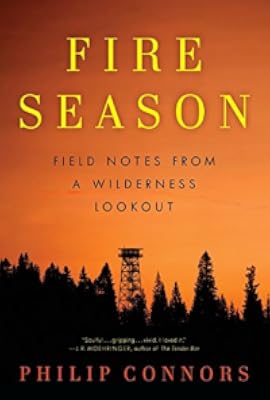
On This Page
Description
The author discusses his time spent ten thousand feet above ground as a fire lookout in a remote part of New Mexico, a job where he witnessed some of the most amazing phenomena nature has to offer.Tags
Recommendations













Member Recommendations
Member Reviews
A book that compels the reader to read it at a leisurely pace, Philip Connors' Walden-like memoir Fire Season sees its author remove himself from the urban rat-race of 21st-century American society to spend four months of each year as a fire-watcher in one of the last few remaining wilderness landscapes in the United States. In the Gila wilderness, atop a lookout tower on a mountain peak, with little more technology than a radio, he lives a solitary existence as he looks out on impressive natural vistas where there is not another human dwelling for a hundred miles (pg. 22).
It is to Fire Season's great credit that it avoids the clichés and pitfalls that this scenario immediately evokes. Connors does not rail against the modern life, show more only recognises its inferiority – indeed, he acknowledges that it is the life he lives outside of these four or five months of the year. While he writes eloquently about the natural world he finds himself immersed in, he does not rhapsodize, and in fact even recognises that – thanks to the conservation efforts of the last eighty years or so – this 'natural', 'preserved' world he retreats to is in some ways as planned and artificial as the world he has fled from. And while the book is necessarily a slow-paced, introspective narrative, there is nothing so trite in these pages as "finding oneself".
With these traps and clichés carefully avoided, Fire Season becomes a sincere and erudite account of a modern man who wrestles to balance his soul: the logical self-assessment that one must work, pay tax and take part in society, combined with that other noble and atavistic yearning we all possess to one extent or another; "that part of ourselves that relishes a campfire under a sky berserk with stars… completely reliant on our own dexterity" (pg. 91). Connors reaches no hugely profound revelation on this divide in every human heart, but he does document the experience well.
While Connors has much to say on the natural beauty of the region he inhabits, the solitude it offers and the thoughts that result, much of his book is transfixed by fire; that phenomenon which it is his job, as a fire-watcher, to look out for. Not only does Connors do the reader a service in fleshing out our understanding of the intricacies of this job, but also leads the reader to a more nuanced appreciation of forest fires, which are necessary for the bio-diversity of the land and are sometimes deliberately left unfought.
It is in stepping outside his firewatch tower that Connors begins to stretch himself, in ways that perhaps warp the effects of Fire Season on the reader. Sometimes, his reaches work well, as in the final chapter when he deftly links his experiences of fire in the Gila forests to his experience of fire in the urban jungle of New York, where he was present on 9/11 and walked the streets covered in ash. Elsewhere, the reaches fail to grasp: much of the book diverts itself with impersonal, journalistic accounts of the history of the Forest Service or conservation efforts in the United States. On one hand, it is good to see these highlighted by an astute commentator, particularly as contemporary narratives in American society seem to be so toxically negative, and the success of such historical endeavours show what can be done in the country if one looks to it.
That said, as worthy as such discussions are, they make a thoughtful and already-slow book almost static. It's something I see a lot of in modern travel memoirs: editor-induced padding and filler to make a slight book – and what's wrong with a book being slight, when the writing is fine? – more substantial. Connors does it better than most, due to his skills as a writer, but an affecting story of his encounter with a beleaguered fawn late on in the book (pp217-22) shows that it is the personal stories Connors relates which retain the most power. For all his in-depth discussion of the history of American conservation or forest-fire theory, it is a passing mention of sitting in his isolated tower on the Fourth of July, watching fireworks "blooming like tiny flowers" in the distance (pg. 192), that will have more staying power with the reader.
A good writer and a reasonably independent thinker, Connors might be a little too analytical at times for Fire Season to emerge as truly special, failing to allow himself to be taken away by the magic and majesty of his surroundings. But that still puts him in the first-rank, considering the dearth of truly deep writers and artists in our time. Connors draws heavily on Aldo Leopold for his nature writing, and on Norman Maclean for his discussions of forest-fire, and in such storied company he is not found wanting. In Fire Season, he proves himself a worthy successor, seated in crisp mountaintop isolation, naming emergent fires the way American wanderers once named creeks and canyons and land. Even if, at such a height, he remains in the shadows of Leopold and Maclean, they are at least cool shadows to be in. show less
It is to Fire Season's great credit that it avoids the clichés and pitfalls that this scenario immediately evokes. Connors does not rail against the modern life, show more only recognises its inferiority – indeed, he acknowledges that it is the life he lives outside of these four or five months of the year. While he writes eloquently about the natural world he finds himself immersed in, he does not rhapsodize, and in fact even recognises that – thanks to the conservation efforts of the last eighty years or so – this 'natural', 'preserved' world he retreats to is in some ways as planned and artificial as the world he has fled from. And while the book is necessarily a slow-paced, introspective narrative, there is nothing so trite in these pages as "finding oneself".
With these traps and clichés carefully avoided, Fire Season becomes a sincere and erudite account of a modern man who wrestles to balance his soul: the logical self-assessment that one must work, pay tax and take part in society, combined with that other noble and atavistic yearning we all possess to one extent or another; "that part of ourselves that relishes a campfire under a sky berserk with stars… completely reliant on our own dexterity" (pg. 91). Connors reaches no hugely profound revelation on this divide in every human heart, but he does document the experience well.
While Connors has much to say on the natural beauty of the region he inhabits, the solitude it offers and the thoughts that result, much of his book is transfixed by fire; that phenomenon which it is his job, as a fire-watcher, to look out for. Not only does Connors do the reader a service in fleshing out our understanding of the intricacies of this job, but also leads the reader to a more nuanced appreciation of forest fires, which are necessary for the bio-diversity of the land and are sometimes deliberately left unfought.
It is in stepping outside his firewatch tower that Connors begins to stretch himself, in ways that perhaps warp the effects of Fire Season on the reader. Sometimes, his reaches work well, as in the final chapter when he deftly links his experiences of fire in the Gila forests to his experience of fire in the urban jungle of New York, where he was present on 9/11 and walked the streets covered in ash. Elsewhere, the reaches fail to grasp: much of the book diverts itself with impersonal, journalistic accounts of the history of the Forest Service or conservation efforts in the United States. On one hand, it is good to see these highlighted by an astute commentator, particularly as contemporary narratives in American society seem to be so toxically negative, and the success of such historical endeavours show what can be done in the country if one looks to it.
That said, as worthy as such discussions are, they make a thoughtful and already-slow book almost static. It's something I see a lot of in modern travel memoirs: editor-induced padding and filler to make a slight book – and what's wrong with a book being slight, when the writing is fine? – more substantial. Connors does it better than most, due to his skills as a writer, but an affecting story of his encounter with a beleaguered fawn late on in the book (pp217-22) shows that it is the personal stories Connors relates which retain the most power. For all his in-depth discussion of the history of American conservation or forest-fire theory, it is a passing mention of sitting in his isolated tower on the Fourth of July, watching fireworks "blooming like tiny flowers" in the distance (pg. 192), that will have more staying power with the reader.
A good writer and a reasonably independent thinker, Connors might be a little too analytical at times for Fire Season to emerge as truly special, failing to allow himself to be taken away by the magic and majesty of his surroundings. But that still puts him in the first-rank, considering the dearth of truly deep writers and artists in our time. Connors draws heavily on Aldo Leopold for his nature writing, and on Norman Maclean for his discussions of forest-fire, and in such storied company he is not found wanting. In Fire Season, he proves himself a worthy successor, seated in crisp mountaintop isolation, naming emergent fires the way American wanderers once named creeks and canyons and land. Even if, at such a height, he remains in the shadows of Leopold and Maclean, they are at least cool shadows to be in. show less
I really enjoyed Fire Season for a number of reasons. First it's well written. Connors is likable, a gritty Everyman from Montanan sensitive to the environment who drinks whiskey while waxing philosophical about mans place in the world, holding court with the ghosts of Jack Kerouac, Edward Abbey and Norman Maclean. Secondly I am a big fan of books about social recluses who go into the wilderness, intentionally or on the run, living alone in nature; this book is clearly in the tradition of Walden. Finally I learned about what it's like manning a fire watch tower, managing a large national forest, and forest fires in general. How the history of no burn at any cost has created a huge store of tinder that causes giant forest fires that will show more take a century or more to undo the damage. This is a great book for a lot of reasons and I highly recommend it for the nature writing, western lifestyle, history, information about forest fires, and hanging out with a new voice in American nature writing. show less
Connors’ casually eloquent journal documents one summer of eight spent watching for puffs of smoke from a tower in the isolated Gila National Forest of New Mexico. Fire Season is an effortless blend of fire lookout anecdotes, history of preservation and prescribed burning in the United States, and Connors’ reflections on his own seasons spent in solitude in the tower. Relating as a writer to his forebears, Edward Abbey, Gary Snyder, and Jack Kerouac, among others, Connors creates a charmingly humble and honest literary masterpiece and a love letter to the hard earned wildernesses.
(NB: Quotes from the book are in italics)
In the early 2000s, Philip Conors spent eight summers serving as a fire lookout for the U.S. Forest Service, stationed in the Gila National Forest in southwestern New Mexico. This book, superficially arranged as a "diary" of one season, is divided into the months he spends on duty, isolated from most human contact from April to August. There are lots of great details about the nuts and bolts of how a fire spotter does his job, what the living conditions are like (he doesn't sleep in his lookout tower, though some do; his only companion is his dog, Alice), and his encounters throughout the summer with various wildlife of both the two- and four-legged variety.
When Connors was writing about the job, the setting, and the wildlife, and musing about why such a solitary existence appeals so much to him (when he has a wife back in town!), I enjoyed this book a lot. He has a gift for expressing his keen observations that made me appreciate a life that other than the solitude sounds pretty terrible to this non-camper. The personal observations are intermingled with some background about the Forest Service, its changing policies toward fighting wildfires (or not), much of which I already knew from reading other books, particularly Timothy Egan's [The Big Burn] but most readers will appreciate the context those sections provide.
Less successful were his railings against who he sees as the "villains" who threaten the beauty of our unspoiled lands. Ranchers, and their cattle come in for some particularly harsh treatment, as do commercial entities primarily interested in extracting lumber and minerals, and the governmental agencies that facilitate such commercial uses. Which isn't to say that I disagree with much of what he says, but his harsh tone in these sections is so at odds with the gentle descriptions elsewhere that they come off as jarring. They harsh the mellow, you might say.
If you need an active plot to keep you reading, this probably isn't the book for you. Not much happens here: Some "smokes" get spotted, some fish get caught, some tents get pitched, some bears get spotted, some weather happens. It's all very tranquil and soothing, for the most part, which also meant that I found it hard to read long stretches at a time. I was enjoying what I was reading, but it was just a tad slow-moving. I never quite reached this nirvana that Connors describes for himself:
In the early 2000s, Philip Conors spent eight summers serving as a fire lookout for the U.S. Forest Service, stationed in the Gila National Forest in southwestern New Mexico. This book, superficially arranged as a "diary" of one season, is divided into the months he spends on duty, isolated from most human contact from April to August. There are lots of great details about the nuts and bolts of how a fire spotter does his job, what the living conditions are like (he doesn't sleep in his lookout tower, though some do; his only companion is his dog, Alice), and his encounters throughout the summer with various wildlife of both the two- and four-legged variety.
It's no wonder our Forest Serviceshow more
brethren think of us lookouts as the freaks on the peaks. We have, in the words of our forebear Edward Abbey, "an indolent, melancholy nature." Our walk home is always uphill. We live alone on the roof of the world, clinging to the rock like condors, fiercely territorial. We ply our trade inside a steel-and-glass room immaculately designed to attract lightning. Our purpose and our pleasure is to watch: study the horizon, ride out the storms, an eagle eye peeled for evidence of flame.
When Connors was writing about the job, the setting, and the wildlife, and musing about why such a solitary existence appeals so much to him (when he has a wife back in town!), I enjoyed this book a lot. He has a gift for expressing his keen observations that made me appreciate a life that other than the solitude sounds pretty terrible to this non-camper. The personal observations are intermingled with some background about the Forest Service, its changing policies toward fighting wildfires (or not), much of which I already knew from reading other books, particularly Timothy Egan's [The Big Burn] but most readers will appreciate the context those sections provide.
Sweet, expansive days of birdsong and sunshine string together, one after another. Through the open tower windows I hear the call of the hermit thrush, one of the most gorgeous sounds in all of nature, a mellifluous warble beginning on a long, clear note. Dark-eyed juncos hop along the ground, searching for seeds among the grass and pine litter. All is quiet on the radio. Not a single fire burns in southwest New Mexico. I swim languidly in the waters of solitude, unwilling to rouse myself to anything but the most basic of labors. Brush teeth. Piss in the meadow. Boil water for coffee. Observe clouds. Note greening of Gambel oak. Read old notebooks for what this date has offered in other seasons.
Less successful were his railings against who he sees as the "villains" who threaten the beauty of our unspoiled lands. Ranchers, and their cattle come in for some particularly harsh treatment, as do commercial entities primarily interested in extracting lumber and minerals, and the governmental agencies that facilitate such commercial uses. Which isn't to say that I disagree with much of what he says, but his harsh tone in these sections is so at odds with the gentle descriptions elsewhere that they come off as jarring. They harsh the mellow, you might say.
Soon I come upon evidence that several cattle have been munching on the grass, their piles of dung still wet. They've strayed several miles out of their owner's allotment on the forest to the west, probably through a broken fence. These four-legged locusts, with their shit-smeared rumps and moon-eyed stares, flies orbiting each of their orifices, have done more than anything else to inflict widespread damage on the public lands of the American West. Yet given the power and persistence of the cattlemen's lobby, they continue to graze on the public domain, trampling riparian areas, hastening erosion, pulverizing wildlife habitat, disturbing the fire regime, and generally wreaking havoc on the land wherever they roam.
If you need an active plot to keep you reading, this probably isn't the book for you. Not much happens here: Some "smokes" get spotted, some fish get caught, some tents get pitched, some bears get spotted, some weather happens. It's all very tranquil and soothing, for the most part, which also meant that I found it hard to read long stretches at a time. I was enjoying what I was reading, but it was just a tad slow-moving. I never quite reached this nirvana that Connors describes for himself:
That thing some people call boredom, in the correct if elusive dosage, can be a form of inoculation against itself. Once you struggle through that swamp of monotony, where time bogs down in excruciating ticks of equilibrium, to reach a kind of waiting and watching that verges on what I can only call the holy.I never quite achieved that holy epiphany while reading this book, but I'm still glad I took this walk on the wild side. And one final quote before I leave you:
show less
Afternoons the turkey vultures circle, indolent and bloody-headed, sniffing out the presence of death. Their arrogant flight reminds me that my time here—on this mountain, on this orb—is short. If I were to slip and fall of the lookout tower, it wouldn't be long before I passed into a new link of the food chain. A not unpleasant fate, perhaps: beats the stuffy prison of the graveyard tomb. So many dreary neighbors. So little sunlight. We're all carrion eventually, whether for birds or for worms. I'd rather my remnants soar over mountains than slither beneath sod.
In this beautifully written memoir the author recounts one of the 5 month seasons he has spent as a Fire Lookout, sitting above the trees in a tower in the Gila National Forest in southern New Mexico. Connors tells us not only how he spends his days, but shares his thoughts on a variety of subjects. Among them, he talks about the history of the Forest Service, the evolving policies on fire management, and the philosophical changes, from an agency who brokered natural resources, into one whose primary focus is the protection of wilderness, for its own intrinsic value. The author describes watching for that telltale wisp of smoke, countless hours on end, the books he reads, the evening hikes with his dog, the radio coordination with show more others in other towers, scattered over this vast area.
But most of all the author tells of the ways he has come to value solitude, telling of the countless days when he has no human contact, and how he has learned to balance that with his need also to spend time with others, especially with his wife, who he sees periodically throughout his long stays on the mountain. At the time of this writing, Connors was ending his eighth season as a Lookout, and knew that as much as he loved this life, it might soon have to end.
Connors is a gifted writer, giving us his messages sometimes in informative language, sometimes in lyrical and flowing expression. show less
But most of all the author tells of the ways he has come to value solitude, telling of the countless days when he has no human contact, and how he has learned to balance that with his need also to spend time with others, especially with his wife, who he sees periodically throughout his long stays on the mountain. At the time of this writing, Connors was ending his eighth season as a Lookout, and knew that as much as he loved this life, it might soon have to end.
Connors is a gifted writer, giving us his messages sometimes in informative language, sometimes in lyrical and flowing expression. show less
Sublime musings from a fire look out.
'I've seen lunar eclipses and desert sandstorms and lightning that made my hair stand on end. I've watched deer and elk frolic in the meadow below me, and pine trees explode in a blue ball of smoke. If there's a better job anywhere on the planet, I'd like to know what it is.’
Philip Conor is fire lookout in USA's Gila National Forest, 5 months of the year he spends his days, miles from civilisation looking for wisps of smoke. It’s a stunning piece of nature writing; blending an engaging memoir, fascinating histories, wry musings on solitude, evocative descriptions of the wild and passionate pleas of conservation. His enthusiasm and literary flights are always grounded in irony, humour and robust show more facts.
'For most people I know, this little room would be a prison cell or a catafalque. My movements, admittedly, are limited. I can lie on the cot, sit on the stool, pace five paces before I must turn on my heel and retrace my steps. I can, if I choose, read, type, stretch, or sleep. I can study once again the contours of the mountains, the sensuous shapes of the mesas’ edges, the intricate drainages fingering out of the hills.'
A beautiful, bittersweet eulogy to a life he loves. Perhaps not for those who dislike a gentle pace, intolerant of a tiny amount of repetition (how bad fire repression is) and the odd, uneasy digression. It is on the whole is almost perfect. Highly Recommended. show less
'I've seen lunar eclipses and desert sandstorms and lightning that made my hair stand on end. I've watched deer and elk frolic in the meadow below me, and pine trees explode in a blue ball of smoke. If there's a better job anywhere on the planet, I'd like to know what it is.’
Philip Conor is fire lookout in USA's Gila National Forest, 5 months of the year he spends his days, miles from civilisation looking for wisps of smoke. It’s a stunning piece of nature writing; blending an engaging memoir, fascinating histories, wry musings on solitude, evocative descriptions of the wild and passionate pleas of conservation. His enthusiasm and literary flights are always grounded in irony, humour and robust show more facts.
'For most people I know, this little room would be a prison cell or a catafalque. My movements, admittedly, are limited. I can lie on the cot, sit on the stool, pace five paces before I must turn on my heel and retrace my steps. I can, if I choose, read, type, stretch, or sleep. I can study once again the contours of the mountains, the sensuous shapes of the mesas’ edges, the intricate drainages fingering out of the hills.'
A beautiful, bittersweet eulogy to a life he loves. Perhaps not for those who dislike a gentle pace, intolerant of a tiny amount of repetition (how bad fire repression is) and the odd, uneasy digression. It is on the whole is almost perfect. Highly Recommended. show less
Five miles from the nearest road, sitting on top of what is essentially a lightning rod with a roof – that's not something most of us could tolerate, much less crave. Something Mr. Connors chose to do for several summers in his job as a fire lookout. (Something that I, being a bit of a loner, would probably like. Except for the lightning. And the snakes. And the dead mice stuck to the floor when the cabin is first opened for the season.)
Despite all the vitriol we've directed at it, despite all the technology we've deployed to fight it, wildfire still erupts in the union of earth and sky, in the form of a lightning strike to a tree, and there is nothing we can do to preempt it. The best we can do, in a place like Gila, is have a human show more stationed in a high place to cry out the news. If this gets to sounding borderline mystical, as if I've joined the cult of the pyromaniacal, all I can say is: guilty as charged.
What makes this book even better is that Alice, a rescued dog, gets to spend her summers there too. Initially, Mr. Connors doesn't want to get a dog.
Experience with the dogs of family and friends indicated they were odoriferous, overbearing beasts, dedicated to immediate gratification of whatever urge bubbled up in their tiny little brains, their owners perversely in need of unconditional love and mindless diversion.
Adopt they do nevertheless, as a compromise for a wife who will tolerate his solitary job away from her all summer.
Now that Alice has been in our lives for three years, I see her for what she truly is: an odoriferous, overbearing beast, dedicated to immediate gratification of whatever urge bubbles up in her tiny little brain, and a reliable and even comforting source of unconditional love and mindless diversion.
Also, she's pretty cute.
This is more than just a memoir about sitting on top of a lookout tower. It is also about the history and changing view toward wildfire management. It is about ecology, and how we have encouraged nature to get so out of balance. It is about cattle grazing on public land, their ranchers paying a pittance while the cattle destroy the natural habitat. I say this all as a complete hypocrite, living in a forested area with lots of lightning and careless people, due for a natural fire and wanting it to be stopped immediately if (when) it comes.
Two stories about specific animals were deeply troubling – one that the author related, about a wolf and her pups. The other about a fawn that the author, in his ignorance while trying to do the right thing, caused.
And I even learned a new word: azimuth. Always a plus for me. The book was entertaining and informative, and I think the time I spent reading it was well spent.
The quotes may have changed in the published edition. Thank you to ECCO for giving me an uncorrected proof for review. show less
Despite all the vitriol we've directed at it, despite all the technology we've deployed to fight it, wildfire still erupts in the union of earth and sky, in the form of a lightning strike to a tree, and there is nothing we can do to preempt it. The best we can do, in a place like Gila, is have a human show more stationed in a high place to cry out the news. If this gets to sounding borderline mystical, as if I've joined the cult of the pyromaniacal, all I can say is: guilty as charged.
What makes this book even better is that Alice, a rescued dog, gets to spend her summers there too. Initially, Mr. Connors doesn't want to get a dog.
Experience with the dogs of family and friends indicated they were odoriferous, overbearing beasts, dedicated to immediate gratification of whatever urge bubbled up in their tiny little brains, their owners perversely in need of unconditional love and mindless diversion.
Adopt they do nevertheless, as a compromise for a wife who will tolerate his solitary job away from her all summer.
Now that Alice has been in our lives for three years, I see her for what she truly is: an odoriferous, overbearing beast, dedicated to immediate gratification of whatever urge bubbles up in her tiny little brain, and a reliable and even comforting source of unconditional love and mindless diversion.
Also, she's pretty cute.
This is more than just a memoir about sitting on top of a lookout tower. It is also about the history and changing view toward wildfire management. It is about ecology, and how we have encouraged nature to get so out of balance. It is about cattle grazing on public land, their ranchers paying a pittance while the cattle destroy the natural habitat. I say this all as a complete hypocrite, living in a forested area with lots of lightning and careless people, due for a natural fire and wanting it to be stopped immediately if (when) it comes.
Two stories about specific animals were deeply troubling – one that the author related, about a wolf and her pups. The other about a fawn that the author, in his ignorance while trying to do the right thing, caused.
And I even learned a new word: azimuth. Always a plus for me. The book was entertaining and informative, and I think the time I spent reading it was well spent.
The quotes may have changed in the published edition. Thank you to ECCO for giving me an uncorrected proof for review. show less
Members
- Recently Added By
Lists

Firewatch reading list
14 works; 1 member

Books Read in 2014
2,343 works; 86 members

Books Read in 2015
3,299 works; 127 members
Books Read in 2016
4,666 works; 199 members
Author Information

6+ Works 671 Members
Awards and Honors
Awards
Series

Common Knowledge
- Canonical title
- Fire Season: Field Notes From a Wilderness Lookout
- Original publication date
- 2011-03-10
- People/Characters
- Philip Connors; Martha Connors
- Important places
- Gila National Forest, New Mexico, USA; New York, New York, USA
- Important events
- World Trade Center Attacks (2001-09-11)
- Epigraph
- Oil the saws, sharpen axes,
Learn the names of all the peaks you see and which is highest- there are hundreds-
Learn by heart the drainages between
Go find a shallow pool of snowmelt on a good day, bathe in the lukew... (show all)arm water.
-Gary Snyder, "Things to Do Around a Lookout" - Dedication
- For Martha
- First words
- Until about fifteen years ago I thought fire lookouts had gone the way of itinerant cowboys, small-time gold prospectors, and other icons of an older, wilder West.
- Last words
- (Click to show. Warning: May contain spoilers.)This is my poem.
- Blurbers
- Philip Gourevitch
Classifications
Statistics
- Members
- 542
- Popularity
- 54,830
- Reviews
- 37
- Rating
- (3.88)
- Languages
- English
- Media
- Paper, Audiobook, Ebook
- ISBNs
- 16
- ASINs
- 7